
Key takeaway
Europe can give Americans stronger work-life balance, walkable cities, affordable healthcare, easy travel, and a slower daily rhythm, but the experience depends heavily on which country you choose, how you earn, your visa route, your family situation, and how willing you are to adapt. There is no single right answer. The best move is the one matched to your real life, not the postcard version of it.
An American lands in Lisbon or Amsterdam expecting the hard part to be the language. Six months in, the language is fine. What actually stings is smaller: the apartment is half the size, the salary is lower, the bank appointment takes three weeks, and the friendly neighbors are warm but somehow never quite become close friends. The obvious differences were easy. It is the quiet ones, the shrinking paycheck, the growing distance from aging parents, the loneliness that survives a full social calendar, that catch people off guard.
This guide covers where different types of Americans tend to fit best in Europe, how daily life actually differs from the United States, the legal routes in, the realities of careers and healthcare, and the emotional adjustment that begins only after the boxes are unpacked. If you are weighing Europe against destinations elsewhere, our guide to the best countries for expats in 2026 gives the wider global picture; here we stay focused on the American-to-Europe move specifically.
Quick Answer: Is Europe a Good Place for American Expats?
Europe is an excellent destination for Americans who want work-life balance, accessible healthcare, walkable cities, cultural variety, and easy international travel. The common trade-offs are lower local salaries, more bureaucracy, language barriers, smaller homes, higher visible taxes, and social integration that tends to happen more slowly than Americans expect.
| Priority | What to weigh | What the reader must evaluate |
|---|---|---|
| Remote work and lifestyle | Spain, Portugal, and the low-tax or nomad-visa routes | Visa income bar, housing, taxes, internet, community |
| International careers | Netherlands, Ireland, Germany | Salary, employer sponsorship, working language |
| Families | Spain, Netherlands, Ireland | Schools, healthcare, housing, partner adjustment |
| Retirement | Portugal, Spain, Italy | Residency route, healthcare, costs, community |
| Social life and belonging | Spain, Portugal, Ireland | Language friction, local friendships, expat networks |
Here is the catch that reshapes everything: the "best" European country changes dramatically depending on whether you arrive with a remote American salary, depend on a local European job, move with children, or follow a partner. The same city can feel comfortable on one and financially tight on another.
What Are the Best Places for American Expats to Live in Europe?
There is no universal best country for American expats in Europe. The right destination depends on your profile: a remote worker, a local-salary professional, a family, and a retiree each thrive in different places. Rather than a generic top-ten, match the country to how you will actually live and earn.
| Country | Best suited to | Main advantage | Main trade-off |
|---|---|---|---|
| Spain | Remote workers, retirees, families | Lifestyle, healthcare, English gets you far in cities | Lower local salaries, bureaucracy |
| Portugal | Remote workers, retirees | Safe, welcoming, established expat community | Housing costs rising in Lisbon and Porto |
| Netherlands | Career professionals, entrepreneurs | Strong job market, very high English fluency | Expensive, competitive housing |
| Ireland | Career professionals, ancestry movers | English-speaking, strong employers | High cost of living, tight housing |
| Germany | Career professionals | Stable economy, strong salaries in tech | Bureaucracy, language needed to integrate |
| Italy | Retirees, ancestry movers | Lifestyle, ancestry citizenship route | Slower job market, administrative friction |
Spain. Spain appeals to Americans for its climate, universal public healthcare that is free at the point of service for residents, and a cost of living meaningfully lower than much of Western Europe. Its Digital Nomad Visa and Non-Lucrative Visa cover most remote workers and self-funded movers. The trade-off Americans underestimate is the local job market: wages are lower and career progression slower, so Spain works best when your income comes from outside Spain.
Portugal. Portugal is one of the easiest emotional landings in Europe, with a long history of welcoming foreigners, high safety, and a large expat community that makes arriving less lonely. The D8 remote-work visa is well established. The trade-off is housing: competition and prices in Lisbon and Porto have climbed sharply, and the old NHR tax perk was scrapped in 2024, so the numbers are less generous than a few years ago.
Netherlands. The Netherlands suits career-driven Americans and entrepreneurs, with a strong international job market and some of the highest English fluency in Europe, so you can build a working life before you speak Dutch. The trade-off is cost and housing: the rental market is fierce and expensive, especially in and around Amsterdam.
Ireland. Ireland is the natural choice for Americans who want to work in English and for those with Irish ancestry pursuing an EU passport. Major employers and a familiar business culture ease the transition. The trade-off is a high cost of living and a genuinely tight housing market, particularly in Dublin.
Germany. Germany offers economic stability and strong salaries, especially in engineering and tech, plus solid public services. The trade-off Americans underestimate is integration: bureaucracy is heavy, digital services lag, and truly belonging socially usually requires learning German, which many find harder and slower than expected.
Italy. Italy is a lifestyle and retirement favorite, and a strong option for Americans claiming citizenship through ancestry. The trade-off is practical friction: a slower job market and administrative processes that test your patience, so it rewards those with foreign income or a passive-income route.
What Is Living in Europe Like for an American?
Americans usually experience Europe as more walkable, slower-paced, more regulated, and far less work-centered than the United States, but also more bureaucratic, more linguistically demanding, and, in some countries, more socially reserved. The lifestyle upgrade is real; so is the adjustment tax that comes with it.

| Area | What Americans may notice in Europe |
|---|---|
| Work | More leave, stronger boundaries, often lower salaries |
| Healthcare | Wider public access, different waiting and referral systems |
| Housing | Smaller homes, older buildings, competitive rentals |
| Transport | Much less dependence on cars in most cities |
| Taxes | Higher visible taxes, more publicly funded services |
| Shopping and services | Shorter hours, less round-the-clock convenience |
| Social life | Close friendships tend to form more slowly |
| Communication | More direct or more formal, depending on the country |
Work and salary. The work-life balance is the headline win: more paid leave, protected time off, and a cultural expectation that you actually disconnect. The counterweight is compensation. Take-home salaries are often lower than in the US, and career ceilings can feel closer, which is why so many Americans do best bringing income with them.
Healthcare. Most Americans are relieved by the cost. Universal or heavily subsidized systems remove the financial terror that surrounds American medicine. The adjustment is structural: more referrals, more waiting for non-urgent care, and learning an unfamiliar system in a second language, which feels stressful precisely when you are already unwell.
Housing and transport. Expect smaller homes, older buildings, and competitive rental markets in desirable cities. In exchange, you often lose the car entirely. Reliable trains, trams, and bikes reshape daily life, and many Americans find they walk more, spend less on transport, and feel healthier for it.
Social norms and personal space. Communication styles vary widely, from Dutch directness to more formal reserve elsewhere. In many countries, people keep tight, long-established social circles, so acquaintances come quickly but close friends slowly. It is not coldness; it is a different pace of trust.
What Americans miss. The convenience. Late-night shopping, fast everything, endless product variety, easy customer service, and the casual friendliness of strangers. None of it is catastrophic, but the accumulation of small absences is a real part of the adjustment.
How Can an American Move to Europe Legally?
Americans generally need a country-specific residence route for any stay beyond the short tourist limit. The most common paths are employer-sponsored work, remote-work or digital nomad visas, study, family reunification, ancestry or citizenship, and retirement or financially independent residence. Each country sets its own rules.
| Route | Best suited to | Main requirement to investigate |
|---|---|---|
| Employer-sponsored work | Skilled professionals | A job offer and employer sponsorship |
| Digital nomad or remote work | Foreign-income earners | Minimum income and foreign-employer rules |
| Study | Students and career changers | Admission and proof of financial means |
| Family or partner | Couples and families | Relationship and dependency rules |
| Ancestry or citizenship | People with European heritage | Documentary proof of lineage |
| Retirement or passive income | Retirees and self-funded movers | Income, savings, and health insurance |
"Moving to Europe" is not one legal process. Income thresholds, work permissions, family rights, tax consequences, and renewal conditions differ in every country, and they change often. For example, Spain's Digital Nomad Visa requires roughly €2,849 per month in 2026 while Portugal's D8 sits near €3,040 per month, and both figures move with local minimum wages. Always confirm the current requirements directly with the official government or consular source before you build a plan around them.
What Challenges Do American Expats Face in Europe?
The biggest challenges Americans face in Europe are bureaucracy, language barriers, lower salaries, distance from family, and the difficulty of forming close friendships. Underneath those sits a subtler one: the feeling of becoming suddenly less competent at ordinary daily life, from paying a bill to booking a doctor.
Bureaucracy and loss of control. Registering your address, opening a bank account, enrolling in healthcare, and signing a lease can each involve unfamiliar systems, in-person appointments, and paperwork in another language. Tasks that took minutes in the US can take weeks, and that loss of everyday competence is quietly demoralizing.
Language barriers. There is a wide gap between functioning in English and belonging in the local language. You can work, shop, and socialize in English in many European cities, but bureaucracy, deeper friendships, and a real sense of home usually live in the local language. Not learning it keeps you slightly outside the glass.
Homesickness and distance from family. Time zones turn casual calls into scheduled events, and you start missing the small things: birthdays, Sunday dinners, being there when someone is sick. This is one of the most underestimated parts of the move, and our guide to expat homesickness and how to cope abroad walks through why it hits and what genuinely helps.
Loneliness even after meeting people. Colleagues and acquaintances are not the same as close friends, and a busy social calendar can still feel empty. Many Americans are surprised that connection abroad takes longer and needs more deliberate effort, which is exactly why loneliness abroad can continue even after making friends.
Anxiety and constant uncertainty. Visa renewals, currency and tax complexity, housing insecurity, and navigating unfamiliar systems create a low hum of decision fatigue. It is a lot of small unknowns stacked on top of each other, and it wears on you. Here is what research shows about anxiety while living abroad and when it is worth taking seriously.
What Do Americans Underestimate Before Moving to Europe?
Americans most often underestimate how much lower local salaries are, how tight housing can be, how complex the taxes get, how slowly close friendships form, the toll a move takes on an accompanying partner, and how quickly a comfortable life can wobble if the job disappears. The excitement hides the fragility.
The accompanying partner. When one person moves for a job and the other follows, the follower often absorbs the hidden cost: a paused or abandoned career, financial dependency, the loss of a daily routine, and social isolation while the working partner has a built-in office network. Left unspoken, that imbalance breeds resentment. This is real enough that we wrote a full guide to the hidden cost of moving abroad for a partner's career.
Job loss abroad. In the US, losing a job is painful. Abroad, it can threaten your income, identity, visa status, housing, and healthcare all at once, since residency is often tied to employment. That compounding pressure is uniquely destabilizing, and understanding the mental-health impact of losing a job abroad before it happens helps you plan a safety net.
Family distance. Missed milestones, aging parents, time-zone friction, and a persistent low-grade guilt about being far away are part of the deal, and they tend to intensify rather than fade over the years.
Moving abroad does not remove your old life. It asks you to carry it from much farther away.
Which European Country Fits Your Type of Move?
Start with the structure of your move, not with lifestyle content. Your income source, legal route, and family situation should drive the country choice, because the same destination can feel affordable or unaffordable depending entirely on how you fund your life there.
| American expat profile | What matters most | Countries to compare |
|---|---|---|
| Remote worker | Visa income bar, taxes, housing, community | Spain, Portugal |
| Local-career professional | Salary, sponsorship, working language | Netherlands, Ireland, Germany |
| Family with children | Schools, healthcare, partner integration | Spain, Netherlands, Ireland |
| Retiree | Residency, healthcare, cost, social life | Portugal, Spain, Italy |
| Student | Tuition, work rights, housing, pathways | Germany, Netherlands, Ireland |
| Accompanying partner | Work rights, network, independence | Netherlands, Ireland, Spain |
The single most important variable is income source. A city like Lisbon or Valencia can feel genuinely affordable on an American remote salary and financially tight on a local wage. Decide how you will earn before you fall in love with a place.
What Should Americans Do During Their First 90 Days in Europe?
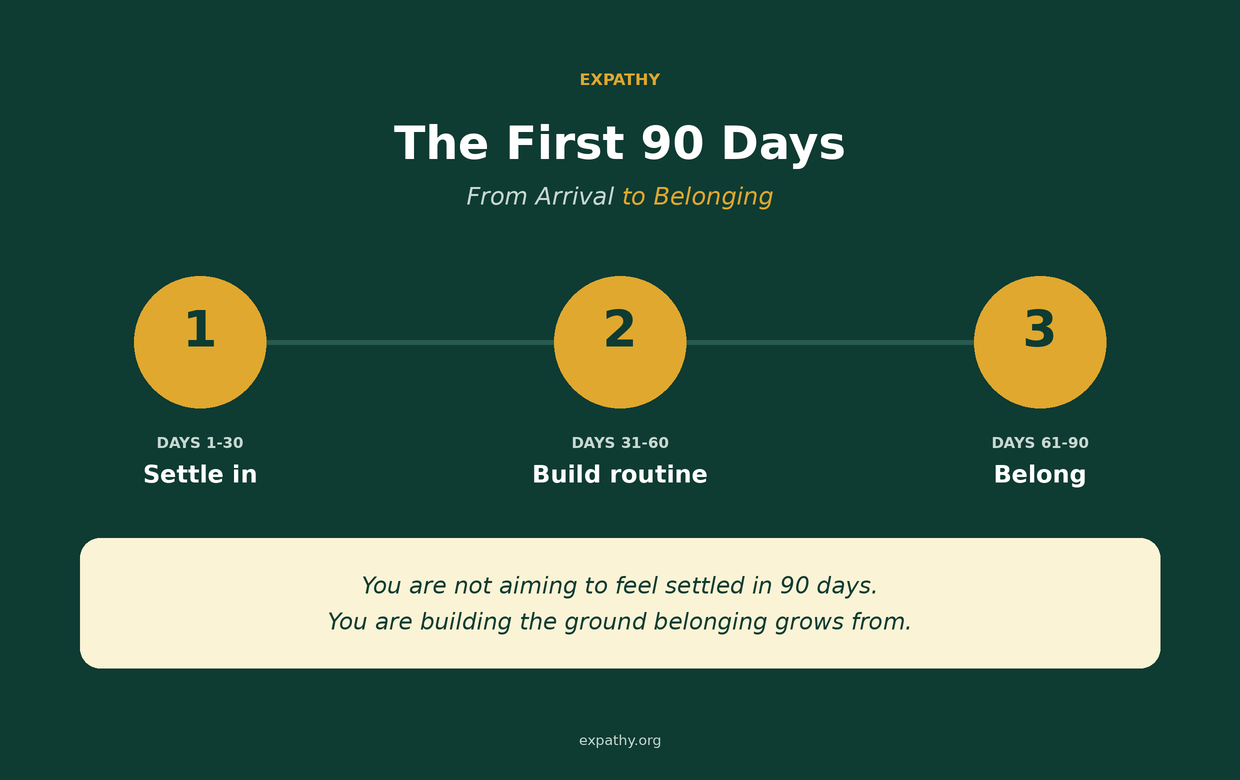
The first 90 days should focus on legal stability, basic routines, healthcare access, early language learning, and real social contact, not on feeling fully settled right away. Belonging takes far longer than three months, so the goal is a stable foundation, not instant comfort.
- Complete registration and essential admin. Address registration, residency steps, tax number, and a local bank account come first; everything else depends on them.
- Learn how local healthcare works. Find out how to register with a doctor and what to do in an emergency before you need it.
- Build a weekly routine. Anchors like a regular market, gym, or cafe create stability fast.
- Start learning the local language immediately. Even basic fluency changes how welcome you feel and how much you can do alone.
- Join one recurring local activity. A class, club, or league you attend weekly is how acquaintances slowly become friends.
- Keep contact with home without living entirely online. Stay connected, but do not let your whole social life stay back in the US.
- Discuss expectations with a partner or family. Name the adjustment out loud, especially if one person moved for the other.
- Watch for persistent anxiety, isolation, or emotional exhaustion. Note it if the low mood does not lift as the weeks pass.
Protecting your basic wellbeing in this window matters more than optimizing anything, and our guide to protecting your health and routines after moving abroad is built for exactly this stretch. If your move is employer-sponsored, it is also worth understanding why the first 90 days matter in employee relocation, since good companies build support into this period.
When Does Normal Adjustment Become a Mental-Health Concern?
Culture shock, frustration, and homesickness are normal parts of relocating. Professional support becomes worth considering when anxiety, low mood, sleep problems, social withdrawal, panic, relationship conflict, or an inability to function persist or intensify over weeks rather than easing as you settle in.
Watch for patterns like these: avoiding local administration because it feels overwhelming, constantly second-guessing the entire move, withdrawing from new people, fighting repeatedly with a partner, losing motivation at work, or feeling that going home is the only possible escape. One hard week is adjustment. A month of these stacking up is a signal.
Reaching out for support does not mean the relocation failed. A good psychologist helps you separate what is ordinary culture shock, what is personal stress the move amplified, and what needs more focused care. If you want that from someone who has lived the expat experience themselves, online therapy for Americans and other expats living abroad matches you with a psychologist in your native language, without a waiting list.
How Should an American Decide Whether Europe Is Right for Them?
Base the decision on your legal route, income source, career priorities, family needs, language tolerance, desired social life, healthcare expectations, and honest willingness to trade American convenience for a different rhythm. The fantasy of Europe is easy; the daily reality is what you actually have to live in.
- Identify the real reason for moving. Lifestyle, career, family, safety, or a fresh start each point to different countries.
- Confirm the legal route. No plan is real until you know how you qualify to stay.
- Compare take-home income, not gross salary. Taxes and cost of living change the picture completely.
- Research exact cities, not just countries. Housing, jobs, and social life vary enormously within a country.
- Speak to Americans already living there. Recent, on-the-ground experience beats any ranking.
- Test the location outside holiday season. A rainy Tuesday in February tells you more than a sunny week in June.
- Discuss partner and family expectations. Align on the hard parts before you go, not after.
- Make a plan for belonging, not only logistics. Decide in advance how you will build a life, not just a household.
The best European country is not the one that looks most impressive from America. It is the one where your everyday life still works after the excitement wears off.
Frequently Asked Questions
What is the best place for American expats to live in Europe?
There is no single best place; it depends on your profile. Spain and Portugal suit remote workers and retirees with foreign income, the Netherlands and Ireland suit English-speaking career professionals, and Italy appeals to retirees and those with ancestry. Match the country to how you earn, your visa route, and your family situation rather than to lifestyle content alone.
How can an American legally move to Europe?
Americans need a country-specific residence route for stays beyond the short tourist limit. The main options are employer-sponsored work, digital nomad or remote-work visas, study, family reunification, ancestry or citizenship, and retirement or passive-income residence. Each country sets its own income rules, work rights, and renewal conditions, so confirm current requirements with the official consular source.
What is living in Europe like for an American?
Most Americans find Europe more walkable, slower-paced, less work-centered, and safer, with accessible healthcare and easy travel. In return, expect smaller homes, lower local salaries, more bureaucracy, higher visible taxes, and friendships that form more slowly. The lifestyle gains are real, but so is an adjustment period that tests patience in the first months.
What are the biggest challenges for Americans living abroad?
The biggest challenges are bureaucracy, language barriers, lower salaries, distance from family, and difficulty forming close friendships. Many Americans also feel a loss of everyday competence, since ordinary tasks like banking or booking a doctor suddenly take longer in an unfamiliar system and language. These practical frustrations often carry a real emotional weight.
Is it cheaper for Americans to live in Europe?
It depends heavily on the country and your income source. Cities in Spain, Portugal, and parts of Southern and Eastern Europe can be significantly cheaper than major US cities, especially on an American remote salary. Western European hubs like Amsterdam, Dublin, and Paris can be as expensive or more, particularly for housing.
Can an American work remotely while living in Europe?
Yes. Several European countries offer digital nomad or remote-work visas for Americans, including Spain, Portugal, Italy, Greece, Croatia, Estonia, and Malta. Each sets its own income threshold, often €2,700 to €3,300 per month or more, plus health insurance and proof of foreign employment. Tax obligations can arise in both the US and the host country, so plan for that.
Which European countries are best for American families?
Spain, the Netherlands, and Ireland are strong choices for American families, balancing healthcare, safety, and international or English-friendly schooling. Families should weigh schooling options, housing, and especially how the accompanying partner will adjust, since a trailing partner's wellbeing and career interruption often determine whether the whole family thrives or eventually returns home.
Is healthcare better in Europe than in the United States?
Europe generally offers wider access and far lower out-of-pocket costs, with universal or heavily subsidized systems that remove the financial stress surrounding American healthcare. The trade-offs are structural: more referrals and longer waits for non-urgent care, and the challenge of learning an unfamiliar system in another language. Many Americans still consider it a major improvement.
How many Americans live in Europe?
More than 1.5 million US nationals are estimated to live across Europe, according to Global Citizen Solutions, part of a roughly 5.5 million Americans living abroad worldwide reported by the Association of Americans Resident Overseas for 2023. Numbers have risen sharply, with US expatriations in the first quarter of 2025 roughly doubling year on year.
Is it difficult for Americans to make friends in Europe?
Often, yes, at least at first. In many European countries people keep close, long-established social circles, so acquaintances come easily but deep friendships form slowly. It is rarely coldness; it is a different pace of trust. Joining recurring local activities and learning the language are the two things that most reliably turn acquaintances into real friends.
Europe Is a Trade, Not a Fairytale
Europe can offer Americans a genuinely richer life: more time, more safety, more balance, and a healthcare system that does not punish you for getting sick. But the outcome depends far less on the fantasy of Europe and far more on the fit: your income source, your legal route, your family, your personality, and your social needs. Get that matching right and the trade is well worth making.
What no one tells you is how much the move rearranges you. It changes your routines, your relationships, your sense of who you are, and quietly, the meaning of the word home. That is the real work of living abroad, and it starts long after the suitcases are empty.
If you are wrestling with anxiety, loneliness, homesickness, or the strain a move has put on your relationship, you do not have to sort it out alone. Expathy connects you with a psychologist who has lived the expat experience themselves, in your native language, so the support actually fits the life you are building.
Need support? We're here.
Book a free 15-min consultation with our expat-specialized therapists.