
Key takeaway
Losing a job abroad is structurally more complex than losing one at home. For expats, a layoff combines financial stress with visa pressure, social isolation, identity rupture, and distance from familiar support, often all at once. Research consistently shows that expats face higher baseline rates of anxiety and depression than the general population, and that job loss intensifies these effects. If you've recently been laid off or fear it's coming, the heavy weight you're feeling is a reasonable response to a genuinely difficult situation, and culturally aligned support is one of the most effective ways through it.
Losing a job is destabilizing for anyone. Losing it while living thousands of miles from home, in a country whose language, healthcare system, and emotional support networks may not be your own, is a different kind of crisis altogether. For expats, job loss isn't just a financial event. It's often a legal event, an identity event, and a mental health event all at once.
If you've recently been laid off, are watching restructuring rumors at your company, or are quietly bracing for an impact you sense is coming, you're not overreacting. The stress you're feeling has measurable causes, and understanding them is the first step toward managing them.
The data behind expat job loss stress
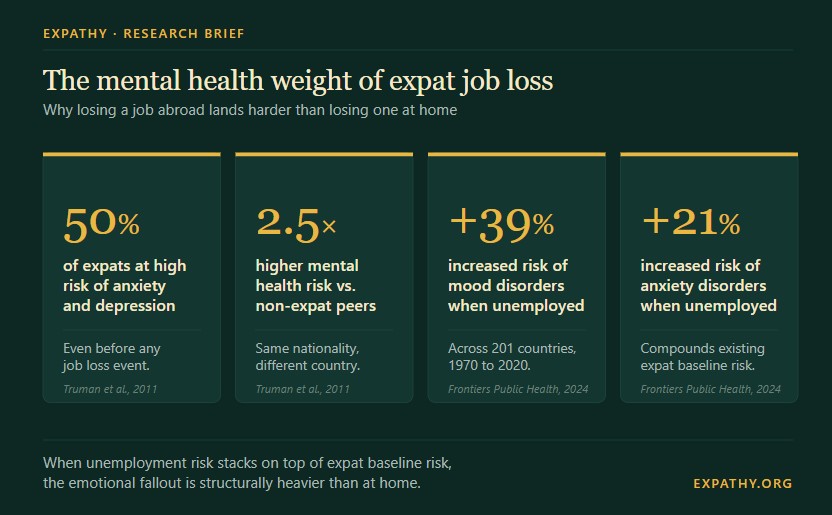
Research on expatriate mental health has consistently found that expats experience higher baseline rates of anxiety and depression than the general population, even when employment is stable. Studies on expatriate workers have repeatedly identified adjustment stress, isolation, and loss of social support as primary drivers of mental health concerns among this population.
When you add job loss to that baseline, the picture becomes more complex. Research on unemployment and mental health has found that involuntary job loss is associated with significant increases in depression, anxiety, and substance use, with effects that often persist for months or years even after re-employment. For expats, those effects are layered on top of pre-existing acculturation stress.
In short, the expat employment situation is structurally more fragile, and when it breaks, the emotional fallout tends to land harder.
Why expat job loss hits differently
Most career stress advice is written for someone who can lean on their family this weekend, take a long walk through their hometown, or call an old friend who actually picks up the phone. Expats often can't do any of those things on short notice. The unique pressures of losing a job abroad fall into four overlapping categories.
Legal and visa stress
For many expats, employment isn't just a paycheck. It's the legal basis for being in the country at all. Work sponsored visas, residency permits, and even healthcare coverage can be tied directly to your job. The moment your employment ends, you may be facing a countdown clock measured in weeks or months, during which you must either find new sponsorship, change visa categories, or leave the country.
This pressure compresses an already difficult job search into a high stakes legal puzzle. The cognitive load of researching visa rules in a second language, while managing the emotional weight of unemployment, is something most career advice simply doesn't address.
Loss of social infrastructure
When you lose a job at home, your social network usually remains intact. When you lose a job abroad, you may be losing your social network at the same time. Many expats build their friendships through work. Colleagues become weekend plans, work events become the framework of social life, and the office is often the place where the local language is most accessible.
Job loss can therefore trigger a sudden social isolation that compounds the emotional weight of the layoff itself. Researchers studying expatriate social networks have noted that work based friendships often don't survive the end of employment, leaving the unemployed expat in a quieter, lonelier daily reality almost overnight.
Identity and self concept rupture
For people who relocated specifically to take a job, and many expats did, the role isn't just what they do. It's the entire reason they're where they are. Losing it can trigger a deeper question. If I'm not here for this job, what am I doing here at all?
This identity rupture is a recognized phenomenon in expat psychology. Clinical literature describes it as a form of role loss grief, where the professional self that justified the relocation disappears, and the geographic self begins to feel unmoored. It can produce a peculiar mix of grief, shame, and disorientation that feels confusing because it doesn't match the standard narrative of "I lost my job, I need a new one."
Distance from established support
Therapy, family support, religious community, longtime friendships. Most adults rely on a stable matrix of these to weather major life setbacks. Expats, almost by definition, have left most of that matrix behind. Time zones complicate phone calls. Local mental health services may not be available in your native language, may have long waitlists, or may not understand the cultural context of your distress. The result is that the moment you most need support is often the moment your usual support sources are hardest to reach.
What the stress actually looks like
Job loss stress in expats often presents in ways that are easy to dismiss as "just stress" until they begin to affect daily functioning. Common patterns include sleep disruption that doesn't resolve after the first week, persistent rumination about the layoff conversation or the events leading up to it, a sharp drop in appetite or sudden overeating, withdrawal from people who are still trying to reach you, and a low grade dread that follows you even into activities that used to be relaxing.
Many expats also describe a specific cognitive pattern of replaying the decision to relocate. Was this the right move? Should I have stayed home? What was I thinking? These thoughts are normal in the wake of a major setback, but when they become constant, they can spiral into a destabilizing form of regret that makes it harder to take the practical steps your situation requires.
A note on the clinical line. Occasional sadness, anxiety, and self doubt after job loss are part of a healthy response to a real loss. When those symptoms last longer than two to three weeks, intensify rather than gradually ease, or begin to affect your ability to eat, sleep, or care for yourself, that's the threshold where professional support becomes valuable. It's not a sign of weakness. It's the same threshold that applies in any country, in any language, to anyone going through this kind of life event.
Why expats often delay seeking help
Research on cross cultural mental health has documented several reasons expats are slower than non expat populations to seek therapy after a major life setback. The most common are practical. Language barriers, unfamiliarity with the local mental health system, uncertainty about insurance coverage when employment has just ended, and the assumption that local therapists won't understand the expat experience.
There are also emotional barriers. Some expats describe feeling that they "don't have the right" to struggle, because relocation was their choice. Others feel that admitting to job loss stress would validate the worry of family back home who never wanted them to leave in the first place. These feelings are common, and they're worth naming because they often delay help seeking until symptoms have already intensified.
The expat specific reality is that culturally aligned therapy, therapy with someone who has personally navigated the expat experience and who understands the unique stack of pressures you're facing, tends to be significantly more effective than generic support, because the therapist doesn't need to be educated about why your situation is different. They already know.
What helps, according to the research
The interventions with the strongest evidence base for unemployment related mental health are well established and apply equally to expats. Cognitive behavioral therapy for the anxious rumination patterns that often accompany job loss, structured behavioral activation to counter withdrawal, and active social re engagement to rebuild the support network that work based relationships often provided.
For expats specifically, a few additional factors show up consistently in the research.
- Connection with other expats who have navigated similar transitions reduces the sense of isolation more effectively than connection with non expats, even when the non expats are well meaning.
- Maintaining language exposure, continuing to use the local language even when you're not working, helps preserve the sense of integration that unemployment can erode.
- Establishing a daily structure independent of job search activities helps prevent the kind of unmoored, time blurry days that make depression worse.
- Working with a therapist who shares your cultural background or has direct expat experience tends to shorten the time to meaningful recovery, because cultural calibration of advice matters more than people often expect.
When to seek professional support
If you're reading this and recognizing yourself, here's a practical guide. Sadness, frustration, and worry in the first two weeks after a layoff are an expected human response, not a problem to solve. They typically begin to ease as you move from shock into action. If, after two to three weeks, you notice that your sleep is consistently disrupted, your mood hasn't lifted at all, you're isolating from people who try to reach you, or you're having thoughts that frighten you, those are signals that professional support would help, not signals that you're failing.
You don't have to navigate this in a second language, with a therapist who needs you to explain expat life to them, or alone. Culturally aligned therapy exists specifically for situations like this one, and reaching out for it is a practical step, not a last resort.
A final word
Expat job loss is not just unemployment. It's unemployment, plus visa pressure, plus social disruption, plus identity rupture, plus distance from your usual support, usually all at once, usually in a language that isn't your first. If the stress feels disproportionate to "just losing a job," that's because your situation is structurally more complex than that phrase captures.
You are not overreacting. The research is clear that expat job loss carries a heavier mental health burden than the same event would carry at home, and that culturally aligned support is one of the most effective ways to move through it. Whatever you're feeling right now is a reasonable response to a genuinely difficult situation, and it's also something that can change.
Need support? We're here.
Book a free 15-min consultation with our expat-specialized therapists.