
Key takeaway
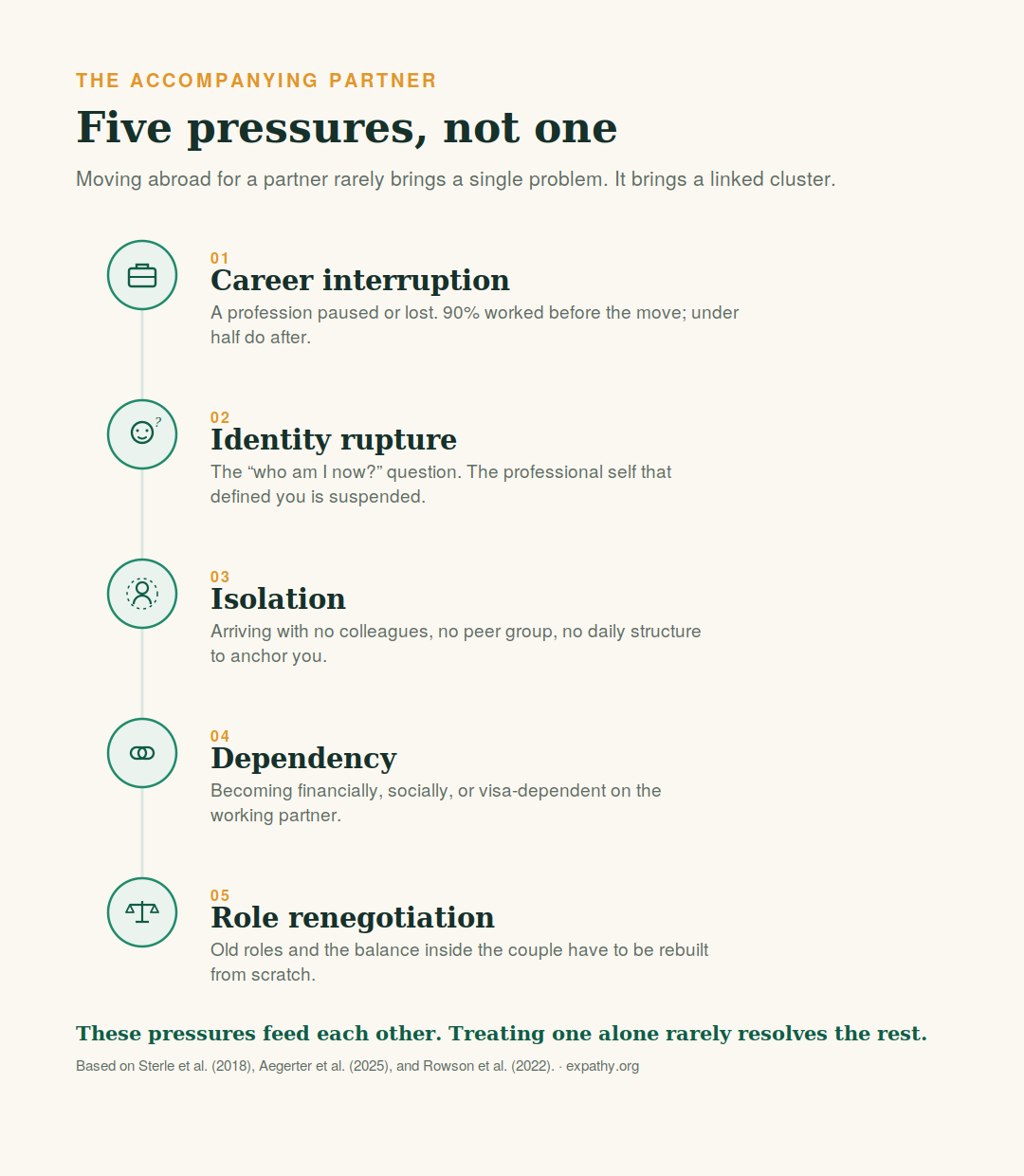
The literature is consistent on one central point: the accompanying partner is not a peripheral figure in expatriation, but one of its main determinants. In academic, mobility, and policy literature, the older term “trailing spouse” is still widely used, but it increasingly sits alongside “accompanying partner” or “expat partner” because the older label is seen as gendered, heteronormative, and overly passive for a population that now includes men, same-sex partners, unmarried partners, and dual-career couples. The strongest evidence on lived experience points less to a single syndrome than to a cluster of linked pressures: career interruption, identity rupture, isolation, dependency, and role renegotiation inside the couple . A 2025 study of accompanying partners found that perceived stress was the strongest unique predictor of well-being, with isolation the second strongest; social support mattered especially in combination with stress and loneliness. Foundational and review literature links expatriate-family stress to psychosocial distress, anxiety, depression, lowered self-esteem, identity confusion, and lower marital satisfaction.
Trailing Spouses and Accompanying Partners Abroad
If you moved abroad for your partner and feel like you've lost yourself in the process, you don't have to navigate it alone, Expathy matches you with a licensed psychologist who shares your language and has lived the expat experience, often within 30 seconds.
What often makes the partner’s adjustment different from the employee’s is not simply “culture shock,” but the lack of an institutional anchor. The working partner usually receives a job, colleagues, a schedule, and sometimes HR support. By contrast, the accompanying partner may arrive with no workplace, no immediate peer group, and no daily structure; this helps explain why research repeatedly finds isolation, “reduced self,” and career discontinuity among the dominant stressors.
The relationship dimension is not incidental. Expatriate-family research shows clear crossover effects: one partner’s adjustment affects the other’s, and poor adjustment can spiral into family strain and even assignment failure. But robust evidence on divorce risk is much thinner than popular commentary suggests. The careful conclusion is that relocation can intensify existing inequalities and conflict, not that there is a settled, well-measured “expat divorce rate.”
The evidence base also has blind spots. It still leans heavily toward heterosexual, female, Western, highly skilled, corporate or diplomatic households, often in OECD or Gulf settings. Research is much thinner on male trailing partners, LGBTQ+ couples, partners from the Global South, and moves shaped more by immigration law or racialised labour markets than by classic corporate expatriation.
Key figures to keep in view
- In UN DESA’s 2022 policy brief, family migration was described as a major driver of migration, including “accompanying family members of workers”; it also noted that data on family migration are limited, which is one reason there is no authoritative global count of accompanying partners. In OECD countries, around 1.9 million migrants moved for family reasons in 2018, representing 41% of total migration into OECD countries.
- In the 2016 Brookfield Global Mobility Trends Survey, cited in the 2018 Frontiers review, 73% of expatriates were accompanied by a partner and 52% by children.
- In the Permits Foundation 2022 partner survey of 730 spouses and partners in 103 host countries, 76% were women and 22% were men; that compares with 85% women in the Foundation’s 2008 survey, suggesting a real, though still incomplete, shift toward more male accompanying partners.
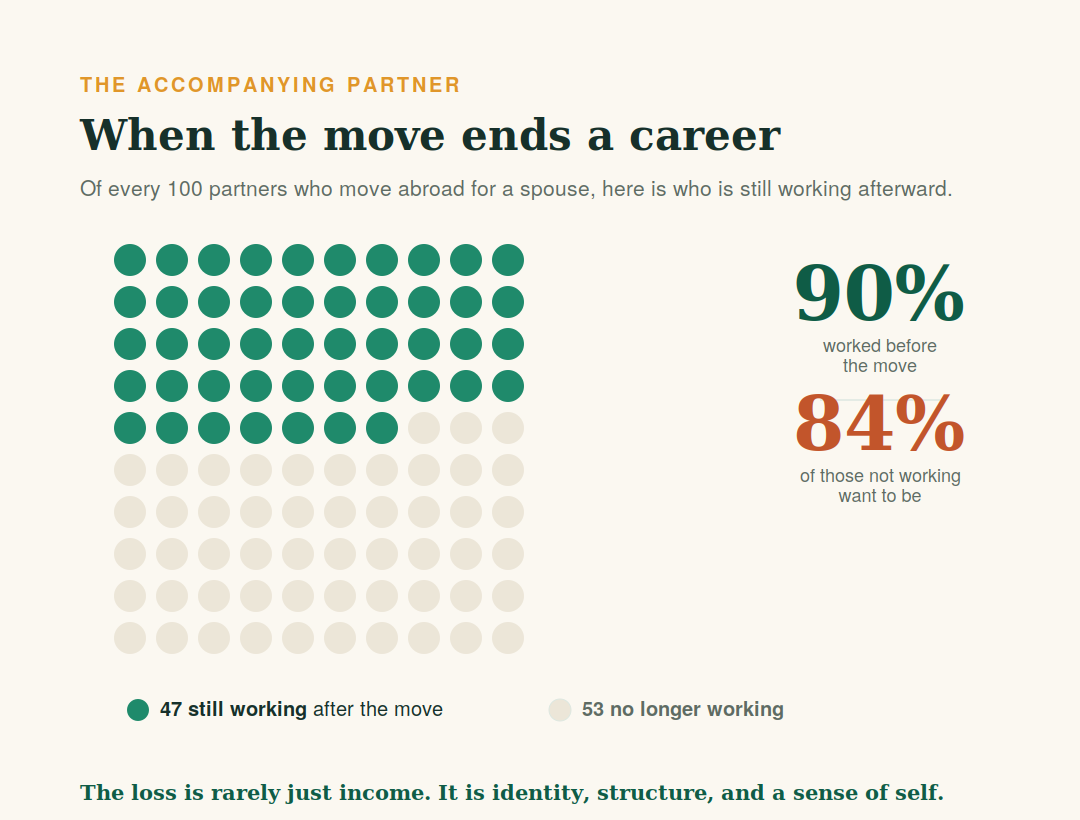
- In the same 2022 survey, 90% had been employed before the move, but less than half were employed afterward; 53% were not working in the host country, and 84% of those not employed wanted to be.
- Also in 2022, more than a quarter of partner respondents said they were considering leaving the host country because of work-access restrictions.
- In the Permits Foundation 2022 HR survey, 59% of organisations said an employee had turned down an international assignment before the pandemic because of partner career concerns, and 44% said an employee had returned home early in 2018–21 for the same reason.
Definition, scale and shifting demographics
Terminology is changing because the older language no longer fits the population well
Older international-HR and expatriate literature often used “trailing spouse” to describe the partner who moved because another partner’s job took precedence. That term remains common in academic titles and HR discussions, but more recent literature increasingly prefers “accompanying partner” or “expat partner.” A 2024 qualitative study notes that, over roughly the last two decades, discussion of the “trailing spouse” has increasingly been replaced by discussion of the “accompanying partner.” The underlying reason is not just stylistic. It reflects the fact that the older label implies a secondary, dependent, usually female spouse, whereas today’s internationally mobile households include male partners, same-sex partners, unmarried partners, and couples in which both careers matter.
The 2018 Frontiers in Psychology review gives a good sense of this conceptual broadening. It cites McNulty’s definition of the expatriate family as including married, de facto, live-in, or long-term partners of the opposite or same sex, with or without children, and explicitly notes that newer research is moving beyond “traditional expatriates” toward non-traditional family forms and statuses. That is a large step away from older HR models that implicitly assumed a male employee and a non-working wife.
At the same time, not all current studies use the broader framing consistently. Some recent work still defines the trailing spouse as the person who follows the expatriate “without the intent to work in a foreign country,” which captures one important subgroup but is too narrow for many contemporary cases, especially dual-career households or partners trying to re-enter work after arrival. This inconsistency is part of the reason terminology matters: it shapes which experiences become visible in research and employer policy.
There is no precise global count of accompanying partners
A key problem for anyone trying to quantify this population is that migration systems generally count migrants, workers, or family migrants, not “trailing spouses” as a discrete analytical category. UN DESA’s 2022 policy brief explicitly says that global data on migration are fragmented, incomplete, and rarely disaggregated enough for good family policy design. The same brief says family migration includes accompanying family members of workers, but also notes that data remain limited. That means the scale of accompanying partners is usually inferred from OECD family-migration statistics, visa data, and mobility-industry surveys rather than measured directly.
Within that limitation, the macro picture is still clear. UN DESA reported 281 million international migrants in 2020, up from 173 million in 2000, and described family as a major driver of migration. For OECD destinations specifically, family migration accounted for 41% of total migration in 2018. Those figures do not mean all family migrants are accompanying partners in the corporate-expat sense, but they do show that worker-centred migration frameworks miss a very large family dimension.
What mobility surveys tell us about the accompanying-partner profile
For corporate and high-skilled mobility, the most useful demographic evidence comes from sector surveys. The 2016 Brookfield survey, cited in the 2018 Frontiers review, reported that 73% of expatriates were accompanied by a partner. That is an older number, but it remains widely cited because there are still few better public estimates of accompanied assignment patterns.
The Permits Foundation 2022 partner survey is especially useful because it is recent and explicitly focused on spouse and partner experience. It surveyed 730 spouses and partners from 67 nationalities in 103 host countries. The most common host country in the sample was the United States, followed by China, the United Kingdom, Singapore, the United Arab Emirates, India, and Luxembourg. The respondents were overwhelmingly highly educated, and accompanying partners were often accomplished professionals in their own right: the Foundation reported that 88% held a bachelor’s degree or higher, 90% had worked before the move, and education and healthcare were among the most common prior sectors.
This profile matters for interpretation. The accompanying partner in recent high-skilled mobility is often not someone with weak labour-market attachment. In the 2022 survey, the dominant pattern was the opposite: a highly qualified adult whose labour-market participation collapsed after relocation. That structural drop in work access is one reason the emotional and identity stakes are so high.
The profile is changing, but not evenly
The gender mix is changing, but it is not yet balanced. In Permits Foundation’s 2008 survey, 85% of accompanying partners were women; in 2022, the figure was 76%, with 22% men. That is a meaningful change, and it aligns with research on male accompanying partners and female breadwinner families. But the balance still leans strongly female, especially in employer-sponsored mobility.
Academic work on male partners supports the idea that this is a growing but still under-studied group. Cole’s 2012 study of 45 male expatriate accompanying partners in the Asia-Pacific found that male partners were often personally comfortable with the role, yet faced other people’s discomfort with male dependency and female breadwinning. A 2023 UAE study similarly describes the number of female expatriates with male trailing partners as increasing, and argues that this trend is likely to continue.
The other major change is the rise of dual-career expatriation. Labour-economics work outside the expatriate field helps explain why this matters. A 2024 NBER working paper using German and Swedish administrative data finds that partnered relocation still disproportionately benefits men’s earnings and is shaped not only by earnings potential but by gender norms that place greater weight on men’s careers. That work is not about expats specifically, but it is highly relevant: it shows that even in countries with strong female labour-force participation, relocation decisions can still encode male-career precedence.
Psychological experience
The literature is strong on mechanisms, weaker on prevalence rates
There is now substantial evidence on what accompanying partners struggle with, but much less robust evidence on how many meet clinical thresholds for depression or anxiety. The 2018 Frontiers review explicitly notes that empirical work on expatriate family members is still relatively sparse compared with research on employee adjustment. For this subgroup, the evidence base is dominated by qualitative studies, narrative reviews, and smaller cross-sectional surveys rather than large population studies. That means claims about exact prevalence should be treated cautiously.
Even with that caveat, the direction of evidence is consistent. The literature links expatriate-family stress to psychosocial distress, depression, anxiety, decreased mental well-being, lower self-esteem, and emotional complaints tied to identity issues, uprooting, repeated goodbyes, losses, and unresolved grief. In other words, the psychological burden is well documented, even if the subgroup lacks high-quality epidemiological prevalence estimates.
Stress and isolation are the most consistently documented drivers
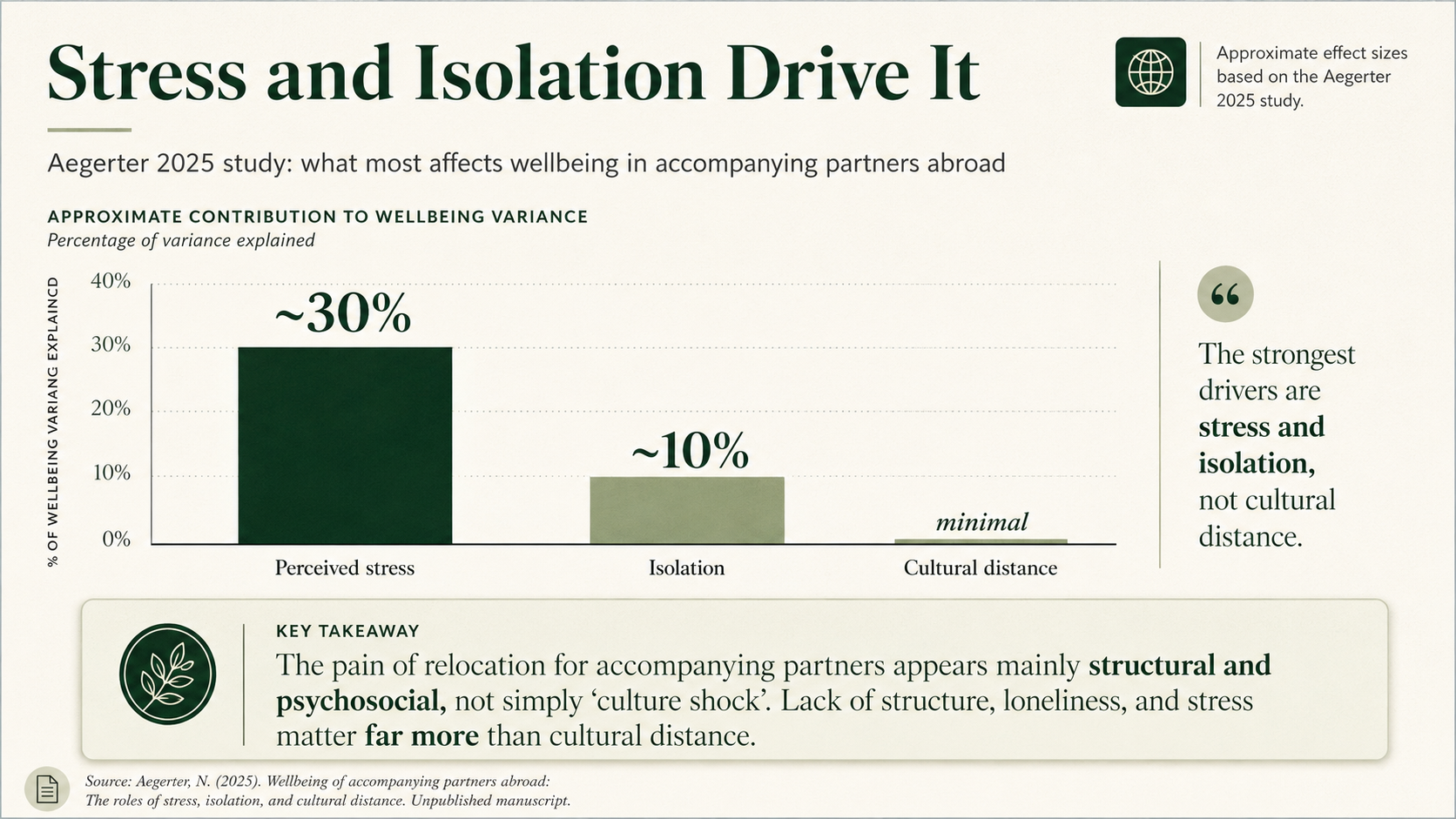
The best recent quantitative study is Aegerter et al. (2025), a cross-sectional study of 207 internationally mobile spouses and partners. It found that perceived stress was the strongest unique predictor of well-being, accounting for around 30% of explained variance, while isolation was the second strongest unique predictor, explaining about 9.9%. Perceived social support mattered less as a stand-alone variable, but it had a substantial combined effect with stress and isolation, which is clinically important: support seems to be most protective when loneliness and stress are already high.
Just as important is what did not dominate in that study. Perceived cultural distance contributed only marginally to well-being in that sample, partly because many participants had moved between relatively similar Western settings. That is a useful corrective to over-simple “culture shock” narratives. For many accompanying partners, the sharper pain point may be the loss of work, structure, and social embeddedness rather than cultural difference as such.
This fits older but still influential evidence. Brown’s 2008 study of expatriate couples found that spouses were more stressed than employees by “Reduced Self,” local pressures, and isolation, while employees were more stressed by relationship strains. “Reduced Self” is an especially revealing label because it captures the subjective contraction of identity, agency, and significance that many partners describe after a move.
Career loss is often experienced as identity rupture, not just lost income
The literature on accompanying partners is unusually explicit about identity. The 2018 Frontiers review cites Shaffer and Harrison’s framing of personal adjustment as identity reformation, where the personal and social roles built around home-country routines are broken and must be redefined. That is close to what accompanying partners often mean when they describe the move as a “who am I now?” rupture. At Expathy, you can speak with a psychologist who understands expat life, cultural adjustment, and the quiet pressure of being the accompanying partner. Explore expat partner therapy and take the first step toward feeling supported again.
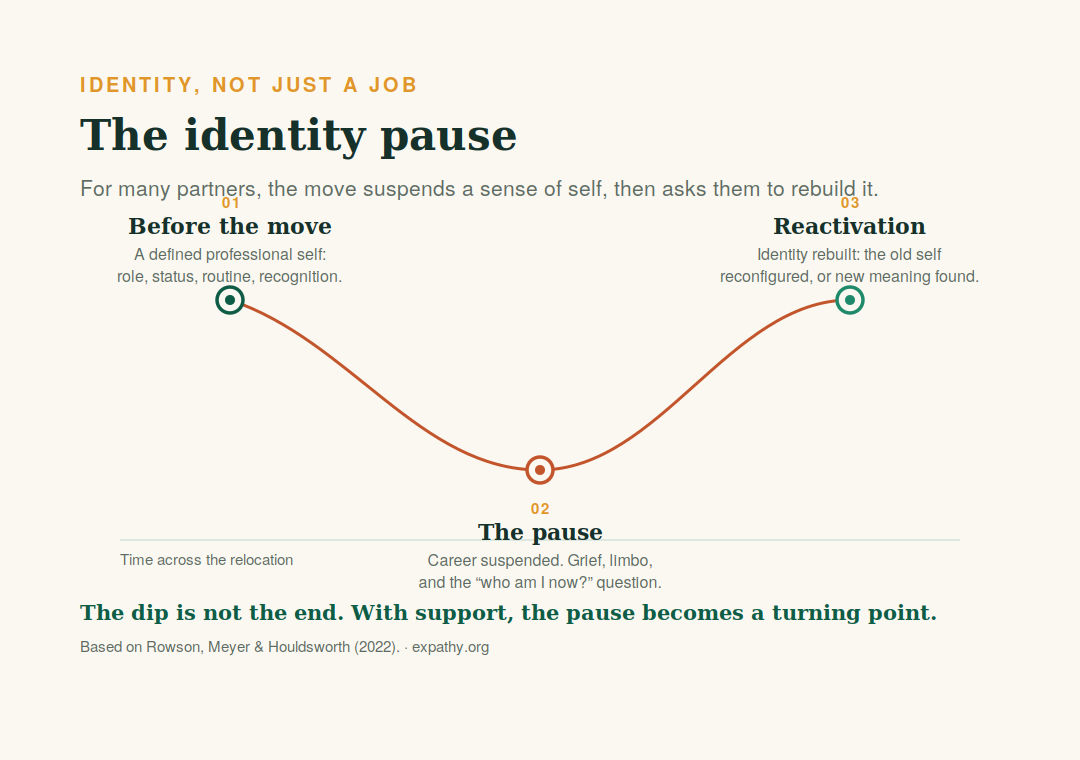
Recent qualitative research deepens this. Rowson, Meyer, and Houldsworth’s 2022 study of 28 trailing wives in Dubai describes a process of “work identity pause and reactivation.” The point is not simply that women stop working; it is that they often experience a sequential identity transition in which a previous professional self is suspended, then either partially reconfigured or reactivated in another form. Slobodin’s 2025 study of trailing mothers similarly argues that expatriation can threaten or challenge identity, and shows how motherhood may become a compensatory or newly central identity when professional identity is interrupted.
This is one of the most important clinical implications for an expat mental-health platform: the accompanying partner’s distress is often misread as simple homesickness, when it is frequently closer to a loss of role coherence, status, and future orientation. The person has not only moved countries; they may have lost the social mirror that previously told them who they were.
If you moved abroad for your partner and feel like you've lost yourself in the process, you don't have to navigate it alone, Expathy matches you with a licensed psychologist who shares your language and has lived the expat experience, often within 30 seconds.
Dependency changes the emotional texture of the move
Becoming dependent on the working partner is both a practical and emotional shift. It can involve financial dependence, visa dependence, social dependence, or all three at once. Expatriate-family research repeatedly links marital stress to spouse career abandonment, altered financial status, changed relationship dynamics, and loss of social support networks.
The emotional meaning of dependence is not uniform, however. Cole’s 2012 study of male accompanying partners found that many men reported being personally comfortable with financial dependence on their wives, while people around them—other expatriates, locals, and hiring managers—were less comfortable. That is an important non-obvious finding: dependency can feel stressful not only because of internal shame or loss, but because the social environment treats the arrangement as abnormal.
For female partners, the literature more often describes dependency as bound up with gender-role intensification, invisibility, and reduced bargaining power. That does not mean every accompanying woman feels financially diminished, but it does mean that the move can reactivate older norms in ways that are psychologically costly, especially when the partner had a strong professional identity before relocation.
Why the adjustment curve is often harsher for the partner than for the employee
Classic expatriate-adjustment theory often assumes that everyone in the family is adapting to the same host society. In practice, the employee and the partner often inhabit very different versions of the move. The 2025 Aegerter study notes that the employee’s new professional role may leave the partner without contacts, careers, and support, thereby increasing isolation. The 2018 Frontiers review similarly highlights that partners may need to engage more directly with the general environment and local culture than the employee, who is buffered by the workplace.
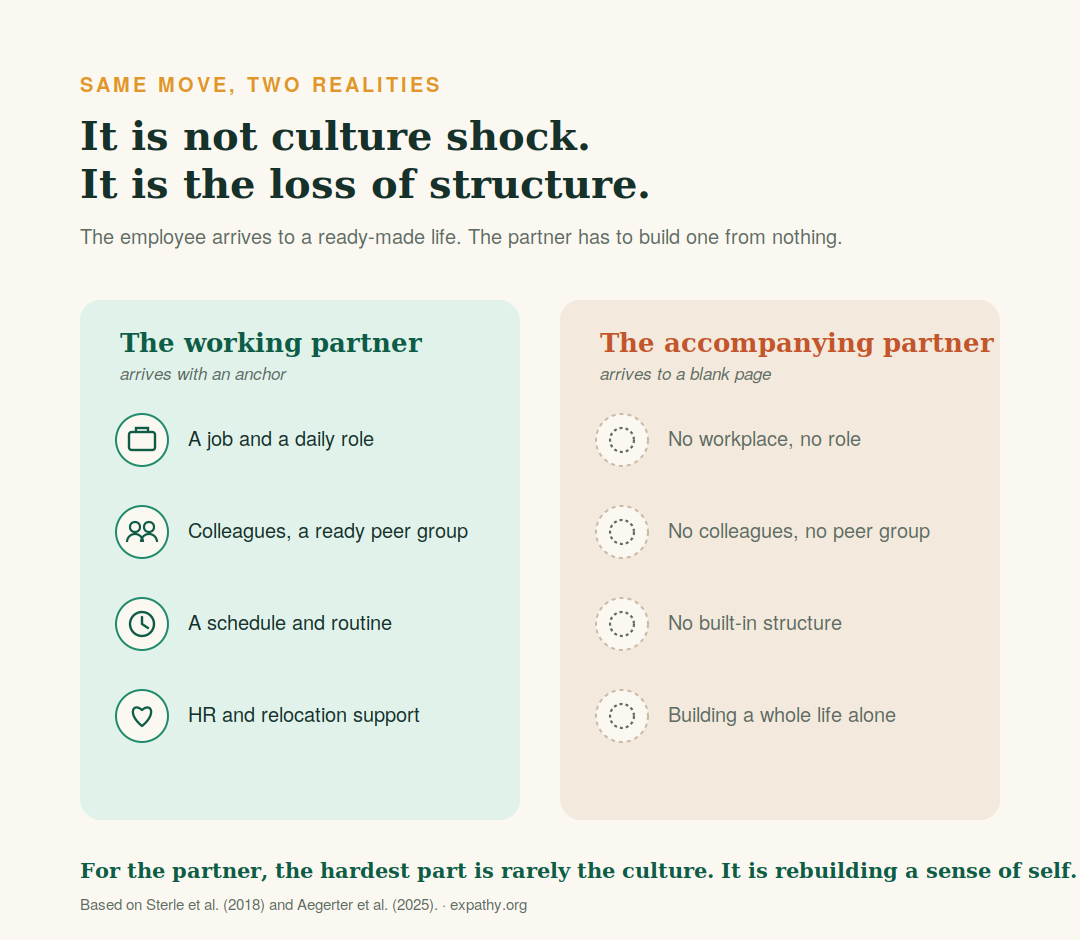
That distinction is important. The employee often has a ready-made structure: an office, colleagues, deadlines, and feedback. The partner often has to build a whole life from scratch, usually while managing logistics such as housing, schools, healthcare, and bureaucracy. That is why the accompanying partner’s adjustment curve is often less about “learning the culture” and more about reconstructing everyday life without institutional scaffolding.
Couple and relationship dynamics
Expatriation changes the balance of the relationship, not just the address
The couple literature around mobility consistently shows that relocation can shift power, obligation, and emotional accounting inside the relationship. The broader labour-economics evidence is helpful here: Jayachandran and colleagues find that relocation tends to raise men’s earnings more than women’s and that couples are more likely to move when a man loses a job than when a woman does, which they interpret as evidence that households place less weight on women’s earnings than men’s. That does not prove that every expatriate couple reproduces this pattern, but it strongly supports the idea that relocation is often embedded in a larger structure of male-career precedence.
Qualitative expatriate studies tell the same story more intimately. Slobodin’s 2017 chapter on the “voice of trailing women” asks whether women’s own preferences are truly heard in relocation decisions and concludes that gender ideologies shape both why women move and how their considerations are weighed. That is highly relevant to later resentment: the more the move is experienced as “his opportunity that became our sacrifice,” the more likely hidden emotional imbalances are to emerge after the practical adrenaline of relocation wears off.
Research shows strong crossover effects between partners
One of the most established findings in expatriate-family research is that one partner’s adjustment affects the other’s. The 2018 Frontiers review summarises multiple studies showing reciprocal crossover and spillover effects between expatriates and their partners. Black and Stephens found that a partner’s favourable opinion of the assignment predicts the partner’s own adjustment; Takeuchi and colleagues found reciprocal crossover effects between employee and partner adjustment; and the review notes that a negative synergy can become a downward spiral of losses leading to premature assignment termination.
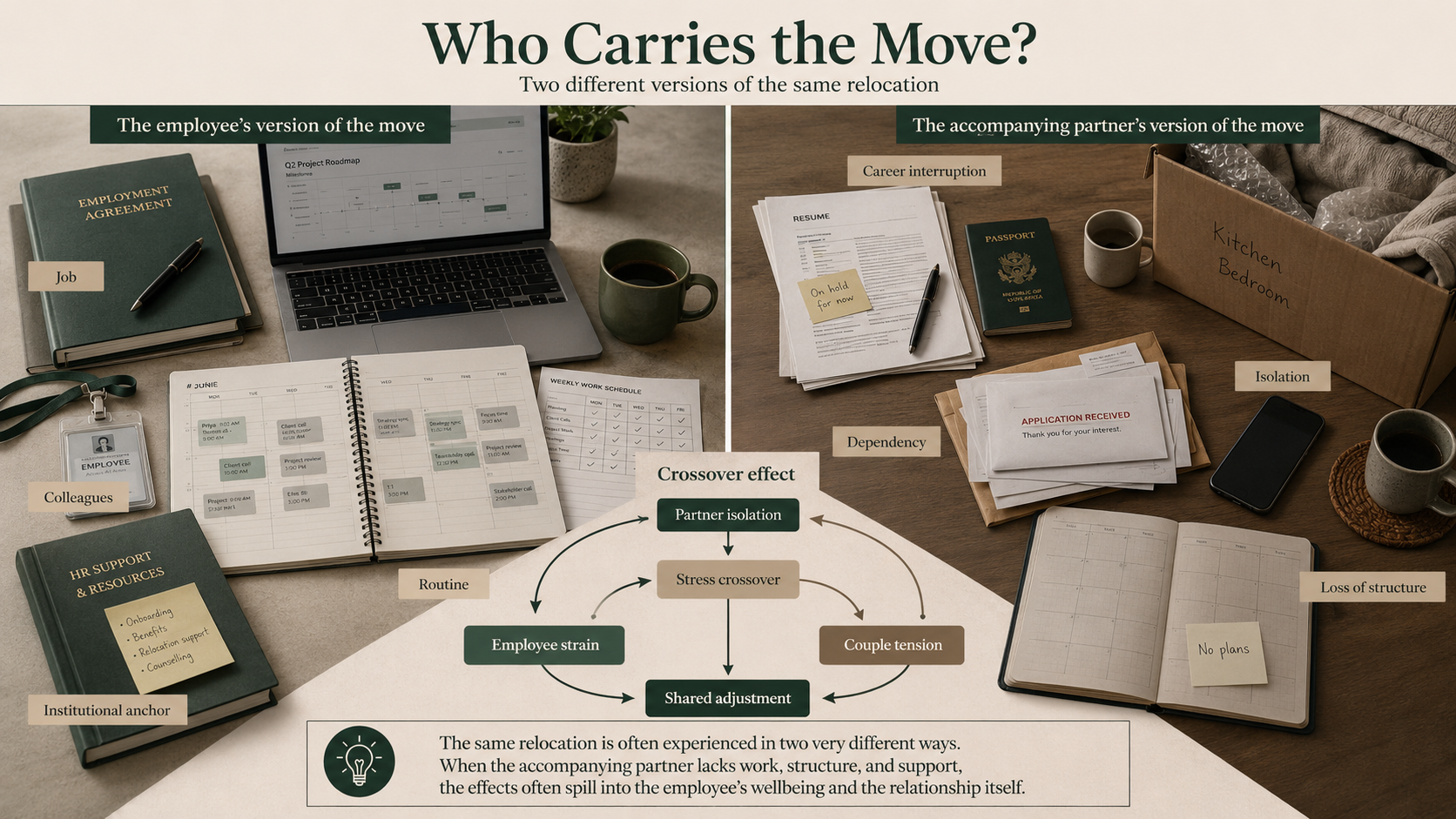
That matters clinically because the accompanying partner’s distress is sometimes framed as a private problem to be solved individually. The evidence suggests otherwise. When the partner is isolated, low in self-worth, or locked out of employment, that distress does not stay neatly on one side of the relationship; it crosses over into the employee’s adjustment, the couple’s climate, and sometimes children’s well-being.
Common tensions include resentment, gratitude, guilt and unrealistic expectations
Peer-reviewed research does not usually label these dynamics in exactly the same language used by therapists—“gratitude-guilt dynamic” versus “resentment ledger,” for example—but the phenomena are visible in the evidence. McNulty’s work on organisational support notes that marital tension can arise from time conflict, spouse career abandonment, altered finances, changed relationship dynamics, and loss of social support. Brown’s work shows employees and spouses are stressed by different domains, which is exactly the kind of asymmetry that can produce the feeling that “we are living the same relocation, but not the same life.”
This helps explain a familiar but under-theorised tension in expat couples: the employee may feel grateful that the partner moved “for us,” while the partner may feel pressure to perform gratitude for the assignment because it was costly and is supposed to be worthwhile. That can produce the silent rule, “you moved here for us, so you should be happy,” which is emotionally corrosive because it blocks grief, ambivalence, and anger. The underlying mechanism is well supported even if the exact phrase is not a formal research term.
What is known about relationship satisfaction, separation and divorce risk
The evidence is strongest on relationship strain, not on clean divorce-rate estimates. The literature shows lower marital satisfaction can accompany expatriate-family stress, and McNulty’s 2015 article is the first empirical study explicitly focused on expatriate divorce. It documents serious consequences of divorce in expatriate contexts and explicitly calls for better longitudinal couple research. Crucially, the paper also notes its own limitations: the data were cross-sectional and not designed to estimate a population divorce rate among expats.
That is why widely repeated figures such as “expat divorce is 49% higher” or “one in three expatriate couples divorce” should be handled carefully. They are often traced to non-peer-reviewed or hard-to-verify sources such as a 2008 Sofres survey repeated in blogs and media summaries, not to a stable, replicable body of demographic evidence. Likewise, blogged claims that “60% of ADB marriages fail” do not appear to rest on publicly verifiable primary data. For an expat mental-health platform, these are better treated as examples of how public discourse dramatizes a real risk with weak numbers, not as reliable statistics.
The more defensible conclusion is narrower: relocation can worsen inequality, reduce one partner’s autonomy, and intensify strain in already vulnerable relationships; but the field still lacks strong longitudinal evidence on how much international relocation causally raises separation or divorce risk.
Compounding pressures
Visa dependence is not only bureaucratic; it changes power and belonging
Immigration status can materially shape the accompanying partner’s mental state. In some destinations, partners can work relatively freely; in others, they can only work conditionally or not at all. Permits Foundation’s 2019 global summary reported that 35 countries allowed accompanying spouses or partners to be freely employed or self-employed during an expatriate assignment, which also implies that many destinations still did not. Its 2022 partner survey found that work restrictions were strong enough to make more than a quarter consider leaving the host country.
The legal differences are sharp. In the Netherlands, the IND states that partners of highly skilled migrants, Blue Card holders, intra-corporate transferees, and certain researchers are free to work. In the United Kingdom, dependent-visa guidance summarised by Cambridge HR states that dependent visa holders generally have an unlimited right to work, subject to a few exceptions. In the United States, by contrast, certain H-4 spouses may apply for employment authorization, meaning work rights are conditional rather than automatic.
Dependence also extends to right to stay. UK government guidance says people whose visa is based on the relationship must usually tell the Home Office if they separate or divorce, and Citizens Advice notes that being in the UK as a dependant on a partner’s visa can mean your immigration status changes if the relationship ends. That legal precariousness has obvious psychological consequences: it makes relationship conflict existential as well as emotional.
Language barriers increase isolation and reduce access to support
Language barriers affect accompanying partners twice over: they intensify everyday isolation and they reduce access to help. WHO’s 2025 fact sheet on refugee and migrant mental health says that language barriers, lack of awareness, and confidentiality concerns often prevent migrants from accessing mental-health care. A 2021 systematic review found that more than half the available evidence linked patient–provider language concordance with better health outcomes, and a 2025 meta-review on migrant healthcare access likewise found better access where language concordance was present.
For an accompanying partner population, the implication is straightforward: native-language or culturally fluent care is not a luxury add-on. It is often the difference between surface-level and emotionally usable support. Emerging psychotherapy literature also suggests that native-language therapy can enable more nuanced emotional expression and stronger trust, although the direct evidence base specific to expatriate spouses remains thin.
Children often reallocate unpaid labour toward the accompanying partner
Several studies show that children can be both a source of purpose and a source of heavier invisible labour. Végh and colleagues’ 2023 longitudinal study in Malaysia found that children play a significant role in accompanying partners’ relationship networks and social embeddedness. But newer identity research also shows that professional identity may be displaced by caregiving identity. Slobodin’s 2025 study of trailing mothers argues that expatriation often reinforces traditional gender roles and can turn mothering into “the job now,” partly as a way to replace lost professional meaning.
Broader UN DESA analysis of migration and families points in the same direction. It stresses the continuing unequal distribution of unpaid care work and the need for more equal parental labour. Although that brief is not specifically about expat spouses, it is highly relevant to internationally mobile families: when the working partner’s career drives migration, care and adaptation work still has to be done, and it often defaults to the accompanying partner.
Destination region and local norms matter
Destination context shapes both objective opportunities and subjective experience. UN DESA’s review of integration-policy evidence notes that migrants in major destination countries such as Australia, Canada, New Zealand, and the United States generally encounter more favourable rights and opportunities than migrants in many parts of the Middle East and Asia, where there are often more obstacles across integration dimensions. That matters for accompanying partners because the same move can feel very different depending on local work rights, schooling, gender norms, transport, and everyday social inclusion.
Research on male partners also shows that destination-specific gender norms matter. Cole’s Asia-Pacific work and the 2023 UAE study both suggest that male accompanying partners may be individually adaptable but encounter stronger social friction where female breadwinning or male dependence is culturally less legible. Conversely, some women in more conservative or expat-enclave environments may experience a sharper re-traditionalisation of family roles than they expected.
What helps
The strongest evidence points to social support, structure and realistic preparation
The most evidence-based interventions are not glamorous. They are the basics that reduce stress and isolation before they harden into identity loss or relationship strain. The 2025 Aegerter study argues for tailored interventions, including partner-inclusive screening, structured social support systems, and community-building measures that reduce isolation. Its practical recommendations include introducing incoming families to existing networks, arranging partner contacts before relocation, and offering employer-linked online support groups.
The 2018 Frontiers review reaches a similar conclusion from a broader evidence base. It recommends pre-departure cross-cultural and language training for the whole family, inclusion of family members’ motives and expectations in preparation, and discussion of the availability of psychological support in the new location. It also explicitly suggests family counselling to clarify roles and functioning before strains escalate.
For accompanying partners specifically, the key protective factors appear to be: predictable structure, social connectedness, permission to grieve losses, and some form of agency-restoring purpose whether through paid work, volunteering, study, entrepreneurship, or serious community contribution. Research does not show that paid employment is the only route to well-being, but it does show that blocked aspiration is harmful and that isolation is corrosive.
Work and purpose matter, but the exact model varies
Work access matters because it helps with both money and meaning. In the diplomat-partner study, non-working partners who wanted employment had the lowest locational adjustment, while partners who worked had the highest general stress and those not seeking employment had the highest quality of life. That sounds contradictory only if work is treated as a simple cure. In practice, the findings suggest that unrealised aspiration is especially damaging, while employment can improve adjustment but also create new work–life strain.
That makes career support especially important. Rosenbaum-Feldbrügge and colleagues recommend services related to job search and career development, alongside work–life-balance support for dual-earner couples. The implication for an expat mental-health platform is that purpose should be treated broadly: some people chiefly need a route back to profession; others need social recognition, routine, and self-efficacy more than formal employment per se.
Native-language and culturally matched mental-health support is especially valuable
Direct evidence focused only on expatriate partners is limited, but the broader migrant-mental-health literature is strong enough to draw practical conclusions. WHO identifies language barriers as a major obstacle to care. Systematic reviews show that language concordance improves access and is associated with better outcomes, while newer psychotherapy work suggests that native-language therapy can help clients express affectively loaded material more fully and build trust more quickly.
For accompanying partners, this matters because the distress is often saturated with identity, shame, ambivalence, and couple dynamics. Those are precisely the areas where subtle language and cultural fit matter most. Someone may function perfectly well in a second language for daily life and still need their first language to discuss grief over career loss, resentment toward a partner, or confusion about who they have become. The direct expat-spouse evidence is thin, but the clinical inference from migrant-language literature is strong.
Employer support helps, but it is often late, narrow or employee-centred
The best employer evidence suggests that organisational support does matter. Shah and colleagues’ 2022 study of expatriates and spouses in China found that organisational support positively influenced the adjustment of expatriates, spouses, and children. The 2022 Permits Foundation HR survey likewise concluded that partner employment access has positive effects on attraction, retention, employee experience, diversity, inclusion, and host-country reputation.
The problem is that many employer programmes still under-serve partners. Permits Foundation’s surveys show that partner career barriers continue to affect assignment acceptance and early return. Earlier trailing-spouse research found widespread disappointment with organisational support and especially weak provision around career help and social integration, even when practical relocation logistics were covered. In other words: companies often help the family move, but not necessarily live.
The most useful employer interventions, judged across the literature, are the ones that treat the partner as a stakeholder rather than an appendage: pre-departure inclusion, clear visa/work-rights information, networking introductions, language support, career coaching, peer groups, and family-sensitive counselling or EAP pathways.
Gaps, disputed claims and segments that need separate treatment
Where the research is thin
The field still over-represents a particular household: heterosexual, female accompanying partner, male employee, highly skilled mobility, often in corporate or diplomatic settings. The 2018 Frontiers review explicitly calls for more work on non-traditional family structures, self-initiated expatriate families, and dual-career families. The low shares of same-sex and non-married relationships in recent partner surveys suggest both real legal barriers and continued under-representation in research samples.
The evidence is also geographically uneven. Gulf destinations, China, and other major hubs appear often in case studies, but comparative work across destination regimes remains limited. Research on partners from the Global South, racialised minorities, or families whose difficulties are shaped by immigration status rather than employer sponsorship is especially underdeveloped.
Useful under-reported findings
One under-reported finding is that culture shock may be overemphasised relative to stress, isolation, and blocked purpose. In Aegerter et al. (2025), cultural distance made only a marginal contribution to partner well-being in a largely Western-moving sample, whereas stress and isolation dominated. This does not mean culture is irrelevant. It means that, in many cases, the everyday loss of structure and role may be more psychologically damaging than the host culture itself.
Another under-reported insight is that employment is not a magic bullet. The diplomat-partner study shows that working partners can be the most stressed, even while unemployed partners who want work are often the least well adjusted, and non-working-by-choice partners can report the best quality of life. The clinical lesson is not “everyone should get a job.” It is “people need a credible path to agency, choice, and self-definition.”
A third is the evolving picture of male accompanying partners. The newer literature does not support a simplistic “men cope worse” narrative. Some male partners cope well personally but are destabilised by social expectations, gender-role incongruity, or poor employer understanding. That makes them a distinct segment rather than just a gender-flipped version of female partners.
Distinct sub-segments worth treating separately
For product, counselling, and content design, these sub-segments should probably not be collapsed into one generic “trailing spouse” profile:
Male accompanying partners. They are still a minority in most datasets, but the share is rising. Their experience can include stigma around dependency and weaker peer infrastructure because most existing communities were designed around women.
Dual-career couples. This is a structurally different population from families in which one partner planned not to work. Here the central problems are often blocked career continuation, bargaining over whose career takes precedence, and resentment around unequal sacrifice.
LGBTQ+ and non-married couples. These families face additional legal and recognition constraints, and they remain under-represented in both employer provision and research samples.
Partners in restrictive visa regimes. Their mental-health risk is often more structurally driven because employment, autonomy, and even residence rights may depend on a partner’s status.
Partners relocating to Gulf or some Asian settings versus intra-European movers. In more restrictive regimes, the main pain points may be work rights, gender norms, and enclave sociality; in intra-European or Anglophone settings, the sharper issue may be hidden identity loss in an environment that appears “easy” from the outside.
Commonly cited statistics that are weak, outdated or poorly sourced
The statistic that expat divorce is “49% higher” than for non-relocating couples is widely repeated in blogs and media summaries, often attributed to a 2008 Sofres survey, but it is not a well-established academic estimate and the underlying methodology is not usually presented. Treat it as a cautionary media number, not a settled fact.
Claims that “spouse maladjustment is the number-one cause of assignment failure” are directionally consistent with older HR literature, but they are also vulnerable to definitional problems because “assignment failure” can mean early return, refusal, poor performance, or psychological withdrawal. Modern mobility evidence is better framed this way: partner adjustment is one of the most important and most neglected assignment variables, not necessarily a universally measured single top cause.
Claims such as “60% of ADB marriages fail” appear in secondary commentary without accessible primary evidence and should be treated as anecdotal or unsourced.
References
Aegerter, K. H., Meyer, A. H., Gaab, J., & Ooi, Y. P. (2025). Expatriation stressors and the well-being of accompanying partners: a commonality analysis approach. Frontiers in Psychology, published 4 June 2025.
Black, J. S., & Stephens, G. K. (1989). The Influence of the Spouse on American Expatriate Adjustment and Intent to Stay in Pacific Rim Overseas Assignments. Journal of Management.
Brookfield Global Relocation Services. (2016). Global Mobility Trends Survey. Cited in Sterle et al. (2018).
Cano-Ibáñez, N., et al. (2021). Physician–Patient Language Discordance and Poor Health Outcomes: A Systematic Scoping Review. Frontiers in Public Health.
Cole, N. D. (2012). Expatriate accompanying partners: the males speak. Asia Pacific Journal of Human Resources.
Du Plessis, R. (2024). Gender, careers, and kids: a qualitative study of the partners of international employees in Aotearoa New Zealand. New Zealand Journal of Employment Relations.
Díaz-Millón, M., et al. (2025). Systematic meta-review on migrant healthcare access. Peer-reviewed review article.
IND Netherlands. (2026). Residence permit for partner. Updated 20 May 2026.
Jayachandran, S., Nassal, L., Notowidigdo, M. J., Paul, M., Sarsons, H., & Sundberg, E. (2024). Moving to Opportunity, Together. NBER Working Paper 32970.
Kaczmarska, R., & Ono, M. (2022). UN DESA Policy Brief No. 133: Migration Trends and Families. United Nations Department of Economic and Social Affairs, 12 May 2022.
McNulty, Y. (2015). Till stress do us part: the causes and consequences of expatriate divorce. Journal of Global Mobility.
McNulty, Y. (2014). Expatriate families. Foundational definition cited in later reviews.
Mavisakalyan, A., et al. (2025). Linguistic integration improves refugee physical and mental health. Scientific Reports.
Permits Foundation. (2012). International Mobility and Dual Career Survey of Employers.
Permits Foundation. (2019). Global summary of work authorisation for family members.
Permits Foundation. (2022). International Dual Careers Survey Report: Partners.
Permits Foundation. (2022). International Dual Careers Survey Report: HR/Global Mobility Professionals.
Rosenbaum-Feldbrügge, M. T., Waibel, S., Fliege, H., Bellinger, M. M., & Rüger, H. (2022). How does diplomat partners’ employment situation affect their adjustment abroad? Evidence from the German Foreign Service. Journal of Global Mobility.
Rowson, T. S., Meyer, A., & Houldsworth, E. (2022). Work identity pause and reactivation: a study of cross-domain identity transitions of trailing wives in Dubai. Work, Employment and Society.
Shah, D., de Oliveira, R. T., Barker, M., Moeller, M., & Chidlow, A. (2022). Expatriate family adjustment: How organisational support on international assignments matters. Journal of International Management.
Slobodin, O. (2017). The Voice of Trailing Women in the Decision to Relocate. IntechOpen chapter.
Slobodin, O. (2018/2019). “Out of time”: A temporal view on identity change in trailing spouses. The Sociological Review.
Slobodin, O. (2025). “This is my job now”: Exploring the identity shift of trailing mothers through the lens of feminist mothering. Gender, Work & Organization.
Sterle, M. F., Fontaine, J. R. J., De Mol, J., & Verhofstadt, L. L. (2018). Expatriate Family Adjustment: An Overview of Empirical Evidence on Challenges and Resources. Frontiers in Psychology.
USCIS. (2015). Employment Authorization for Certain H-4 Dependent Spouses. U.S. Citizenship and Immigration Services.
Végh, J., Dúll, A., & Luu, L. A. N. (2023). Relationship dynamics of trailing spouses before and during a time of crisis. Journal of Global Mobility.
WHO. (2025). Refugee and migrant mental health. World Health Organization fact sheet, updated 1 September 2025.
UK Government. (2025/2026). Dependent family members in work routes; Visas when you separate or divorce. GOV.UK guidance.
Cambridge Human Resources. (current guidance accessed via indexed page). Dependant visa: conditions of leave. University of Cambridge HR summary of UK dependant work rights.
Need support? We're here.
Book a free 15-min consultation with our expat-specialized therapists.