
Key takeaway
In international schools, bullying rarely looks loud. It shows up as repeated comments, exclusion and humiliation tied to a student's accent, name, nationality, religion or food , often disguised as banter and often missed by adults who see only friendly joking. This article sets out what identity-based bullying looks like in real school life, why it gets minimised inside diverse schools, what it does to belonging and mental health, how to tell a one-off comment from a pattern, why students rarely report it clearly, the ten-step response leaders should follow , the mistakes staff make most often, and when outside support becomes necessary.
He laughs the first time. Someone imitates the way he says "th" and the table laughs with him, so he laughs too, because that is what you do.
A teacher walks past and sees a group of boys getting on well. Nothing to log.
By November he has stopped volunteering answers. He asks to work alone. He is late on the days his class has group projects. In January his mother emails to say he has stomach aches every Sunday evening.
Nobody bullied him, as far as the school records show. He simply became quiet.
What Racial and Cultural Bullying Can Look Like in an International School
Identity-based bullying is repeated behaviour targeting who a student is rather than what they did. In international schools it is usually social rather than physical, and it hides easily inside humour, friendship groups and the ordinary noise of a multicultural corridor. The defining features are repetition, power imbalance and harm.
It often looks like:
- Mocking a student's accent, name, grammar or pronunciation, including "helpful" corrections in front of others.
- Repeated jokes about nationality, race, religion or food, especially at lunch.
- Exclusion from groups because someone is "different", "too new" or "doesn't get it".
- Stereotyping based on passport country or ethnicity, including so-called compliments about being good at maths or sport.
- Social media humiliation tied to identity, often visible to the whole year group.
- "Harmless" banter that repeatedly lands on the same student.
- Pressure to represent or explain an entire culture in class discussions.
- Staff minimising it because the students are international and "should be open-minded".
That last one matters. A school can be genuinely diverse and still have a group of students who are quietly ranked.
Why It Is Often Missed or Minimised
This is missed because it does not look like the version adults are trained to spot. There is no fight, no obvious victim, no complaint. What there is instead is a student who slowly disengages, and a set of reasonable-sounding explanations that let everyone move on.
Several things get in the way:
- Adults read it as normal adjustment difficulty for a new arrival.
- Students fear being seen as too sensitive, so they minimise it first.
- Staff interpret it as cultural misunderstanding rather than harm.
- The school is proud of its diversity, which can make exclusion inside that diversity harder to see.
- Students who move often have already learned to hide distress quickly.
- High-achieving or compliant students do not look bullied, so nobody checks.
The early signals are usually behavioural rather than verbal, which is why patterns of withdrawal deserve the same attention as incidents. Our guide to student mental-health warning signs in international schools covers what those signals look like day to day.
Why This Hurts So Deeply
Identity-based bullying does more damage than ordinary conflict because a student cannot fix it by changing their behaviour. They can apologise for an argument. They cannot apologise for their accent. The message received is that belonging is conditional, and that lands directly on identity at the age when identity is being built.
In practice it produces loss of belonging, constant vigilance, shame about their own background, withdrawal from peers, fear of speaking in class, school avoidance, and a mixture of anxiety, sadness and anger the student cannot name. Underneath sits the question that keeps them silent: is this even real enough to report?
The evidence is clear. UNESCO reports that roughly one in three students worldwide has been bullied by peers at school in the past month, and that after physical appearance, race, nationality or skin colour is the second most common reason students are targeted. Frequently bullied children are nearly three times more likely to feel like an outsider at school and more than twice as likely to miss school.
The belonging side is measurable too. In PISA 2022, the OECD found that on average 17 percent of 15-year-olds felt like an outsider or left out at school, and that students in systems with a stronger sense of belonging reported feeling safer and less exposed to bullying. Belonging and safety rise and fall together.
Important: A student who feels like an outsider is not simply unhappy. They are more likely to disengage, miss school and underperform, which means belonging is an academic issue as much as a pastoral one.
A Conflict, a One-Off Incident or a Pattern of Bullying?
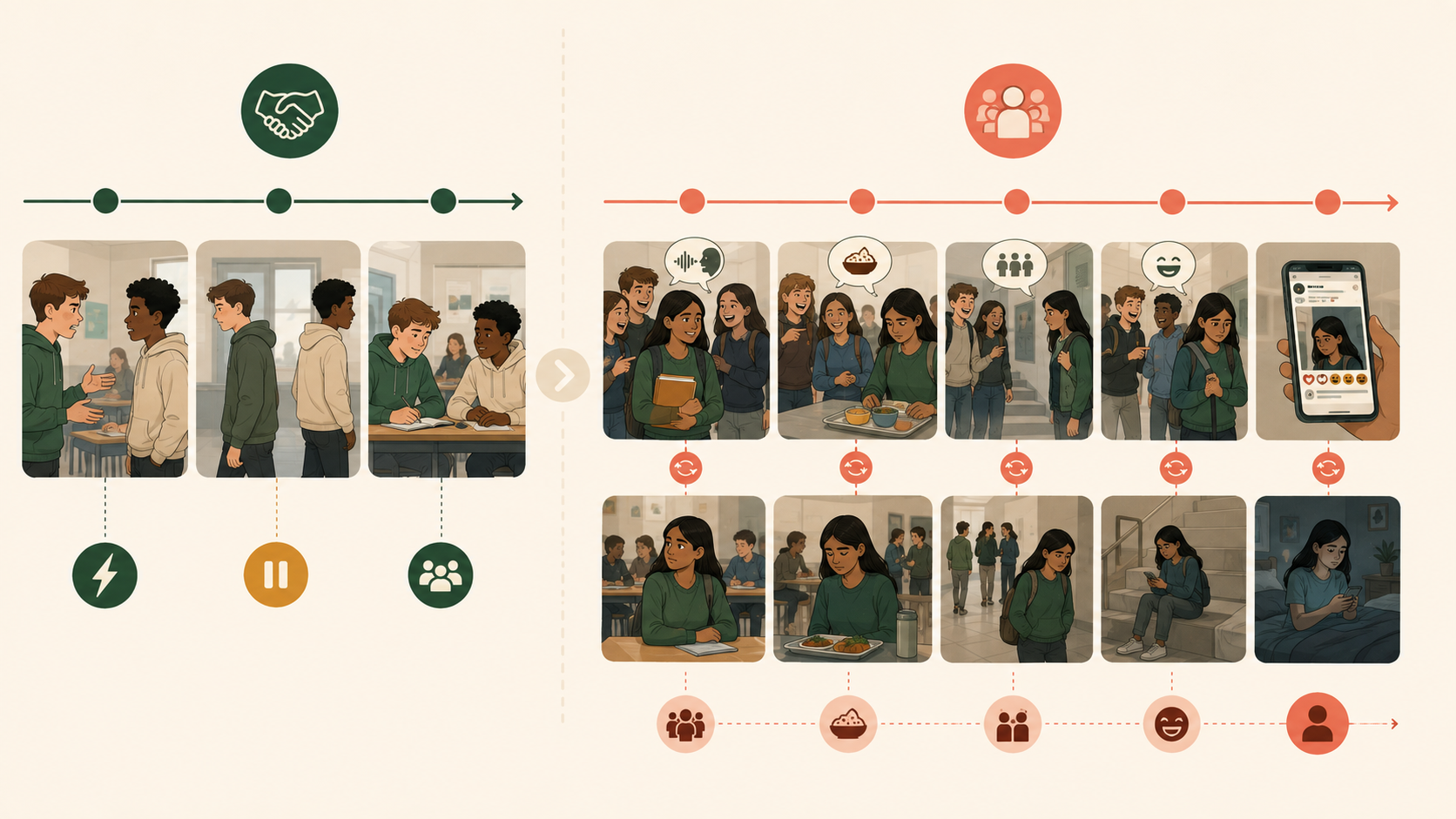
The useful question for staff is not whether the student meant harm. It is whether there is pattern, power and harm. Intent matters for how you respond to the perpetrator. It does not change what the targeted student is experiencing, and treating impact as secondary to intent is where most school responses go wrong.
| Situation | What it looks like | What the school should do |
|---|---|---|
| Ordinary peer conflict | A disagreement between roughly equal peers, both upset, no identity element | Mediate, restore, monitor briefly |
| Insensitive or ignorant comment | A one-off remark about background, no pattern, genuine surprise when challenged | Correct clearly, educate, check the student is okay |
| Repeated identity-based bullying | The same student targeted over time, power imbalance, identity is the hook | Investigate the pattern, act on behaviour, actively rebuild belonging |
| Safeguarding concern | Threats, physical harm, sustained humiliation, self-harm indicators, online spread | Escalate immediately under safeguarding procedures |
Most cases begin in the second column and end in the third because nobody logged the first three incidents.
Why Students Often Do Not Report It Clearly

Students almost never arrive with a clean account. They downplay it, laugh along, say they are fine, or report a stomach ache instead of an insult. This is not dishonesty. It is a rational calculation about social survival in a small school community where the alternative may be losing the only friendship group they have.
You are more likely to see:
- Requests to avoid a class, a table or group work with no clear reason.
- Physical complaints, especially headaches and stomach aches on school mornings.
- Becoming quieter rather than louder.
- Insisting it was "just a joke" while looking uncomfortable.
- Worry that reporting will make things worse or mark them as the problem.
- A belief that adults will not understand the cultural layer of what was said.
So the duty sits with the school to notice patterns, not to wait for a perfect disclosure. If three separate teachers have a vague sense that something is off with the same student, that is already data.
What Schools Should Do
An effective response addresses both the behaviour and the belonging. Stopping the visible incident is the easy half. The harder half is making sure the targeted student is not left isolated, watched, or known as the one who reported. Follow a consistent sequence rather than improvising each time.
- Take the report or the pattern seriously, including when it arrives second-hand or as a vague concern.
- Record specific incidents and context. Dates, words used, who was present, what followed.
- Separate impact from intent. Both matter. Impact determines the support; intent shapes the consequence.
- Speak with the student safely and privately, away from the corridor and never in front of peers.
- Investigate patterns, not only isolated episodes. Ask other staff what they have noticed.
- Respond to the behaviour clearly and consistently, so the standard is visible to the whole year group.
- Protect the targeted student's belonging, not just their physical safety. Rebuild group access deliberately.
- Communicate with parents carefully, on both sides, without turning the student into a case file.
- Review whether staff culture or school systems allowed the pattern to continue unchallenged.
- Offer ongoing wellbeing support. This is not a one-day incident with a one-day resolution.
Important: A school response is not effective if it stops the visible incident but leaves the targeted student feeling alone, watched or still unsafe.
What Staff Should Avoid
Most damage after a report comes from well-intentioned responses that close the case too quickly. The student reads that speed accurately: the school wanted this resolved more than it wanted them safe. After that, they stop telling you things.
Avoid:
- Calling it "just a joke" before you have looked at the pattern.
- Forcing a quick apology and treating the matter as finished.
- Asking the targeted student to educate the others about their culture.
- Treating it purely as a behaviour problem while ignoring belonging.
- Waiting for repeated formal complaints before acting.
- Assuming internationally mobile students are automatically resilient.
- Focusing only on punishment without restoring the student's safety in the group.
When Mental-Health Support Becomes Important
A good school response resolves most situations. Some students need more, particularly when the effects outlast the bullying itself. If a student is still anxious, withdrawn, angry or physically unwell weeks after the behaviour has stopped, the incident has been handled but the injury has not.
Watch for continued difficulty with sleep, confidence, participation, attendance, emotional regulation, physical symptoms or trust in peers and adults. Students who have moved countries several times may be carrying an older layer of loss underneath this one, which our article on supporting third culture kids through school transitions explores, alongside our guidance on child adaptation in expat families.
Support in the student's native language matters more here than most people expect. Shame about identity is hard enough to describe at fifteen. Describing it in your second language, to an adult from the culture that made the joke, is harder still. The same principle applies to adults facing unfair treatment, as we set out in our guide to discrimination and mental health.
Schools building a structured referral route can see how this works through our international school mental-health support offer.
How Expathy Makes Support Easier
Expathy matches families with licensed psychologists who speak their native language, usually within about 30 seconds. Many of our psychologists are expats themselves, so they understand both the culture a student comes from and what it is like to build an identity across several countries. Families can start with online therapy for expats from wherever they are posted.
Final Thought
A diverse school is not automatically a psychologically safe school. Thirty nationalities in a building tells you about admissions, not about belonging.
What makes a school safe is adults who recognise identity-based harm early, name it clearly, and treat belonging as seriously as grades. That is the difference between multicultural branding and a place where a fourteen-year-old can say their own name out loud without bracing for the echo.
Sources
- UNESCO, Behind the Numbers: Ending School Violence and Bullying (2019)
- OECD, PISA 2022 Results (Volume II): Learning During and From Disruption
Frequently Asked Questions
What is racial or cultural bullying in an international school?
It is repeated behaviour that targets a student's race, ethnicity, nationality, religion, language or accent rather than anything they have done. It includes mocking, exclusion, stereotyping and online humiliation. The behaviour is often social and disguised as humour, which is why it is frequently missed by adults who see only friendly joking.
How is cultural bullying different from normal conflict?
Ordinary conflict happens between roughly equal peers and usually ends. Identity-based bullying repeats, involves a power imbalance, and targets something the student cannot change. The practical test is pattern, power and harm. Whether the other students meant it that way affects the consequence, not whether the targeted student was harmed.
Why do students often stay quiet about this kind of bullying?
Because reporting carries social cost. Students fear being labelled oversensitive, losing their only friendship group, or making things worse. Many have moved countries before and have learned to absorb discomfort quickly. Some doubt that adults will understand the cultural layer of what was said, so they say they are fine instead.
What are the warning signs that a student may be experiencing it?
Look for withdrawal rather than distress. Avoiding group work, sitting alone at lunch, going quiet in class, arriving late on specific days, headaches or stomach aches on school mornings, and reluctance to attend. A previously confident student who stops volunteering answers is worth a private conversation, not a wait-and-see.
How should an international school respond?
Take the pattern seriously, record specific incidents, separate impact from intent, speak with the student privately, investigate across staff rather than in isolation, respond to the behaviour consistently, and actively rebuild the student's belonging in the group. Then review whether school systems allowed the pattern to continue, and keep supporting afterwards.
When should parents or schools seek outside mental-health support?
When the effects outlast the incident. If a student remains anxious, withdrawn, angry or physically unwell weeks after the bullying has been addressed, or if sleep, attendance and confidence have not recovered, external support is appropriate. Earlier is better than waiting for a crisis, and it works alongside the school response.
Can therapy help a student recover after identity-based bullying?
Yes. Therapy can help a young person separate what was said from what is true about them, rebuild confidence and trust in peers, manage the anxiety and physical symptoms, and reconnect with their own cultural identity rather than distancing from it. Working in the student's native language usually makes that process considerably faster.
Need support? We're here.
Book a free 15-min consultation with our expat-specialized therapists.