
Key takeaway
School transitions affect Third Culture Kids differently because the student is often changing country, language, curriculum and friendship group at once, while also carrying losses from previous moves. Visible adaptability can mask grief and identity uncertainty, so a student who settles quickly is not necessarily settled. Schools help most through structured pre-arrival preparation, one consistent adult, and follow-up that continues well past the first fortnight.
The student who already knows how to be new
She arrives on a Tuesday in November, halfway through the term. She introduces herself without being prompted, finds her locker, and answers the "so where are you from?" question with the practised two-sentence version that covers three countries.
By break she is sitting with a group. By Friday two teachers have independently described her as remarkably well adjusted.
In March her closest friend announces a move to Singapore, and the reaction is out of proportion to a five-month friendship. In a wellbeing check-in she cannot answer a simple question about where home is, and looks genuinely distressed at being asked.
Nothing went wrong in November. What the school observed was transition competence: the practical skill of entering a new environment, which mobile students develop early and perform well. Emotional adjustment is a separate process on a much slower timeline, and it is largely invisible from outside. That gap is where international-school transition support either works or quietly fails, and it sits alongside the wider picture in international school mental health support.
A Third Culture Kid may know how to enter a new school quickly while still carrying grief, identity disruption and uncertainty that remain invisible behind apparent confidence.
What Is a Third Culture Kid?
A Third Culture Kid is generally understood as someone who spends a significant part of their developmental years outside their parents' passport culture. The term was coined by sociologist Ruth Hill Useem in the 1950s during research with American families in India, and later refined by David Pollock and Ruth Van Reken into the definition most widely used today (Interaction International).
Their formulation is useful for schools because of one phrase: the student builds relationships with all of the cultures involved while not having full ownership of any.
- Not every international-school student is a Third Culture Kid, and not everyone who fits the description identifies with the label.
- TCK describes a life context, not a diagnosis. It carries genuine strengths as well as vulnerabilities.
- Speaking several languages or travelling frequently does not on its own produce the identity questions the term points at.
- Two students with near-identical mobility histories may experience them completely differently.
Why Can School Transitions Affect Third Culture Kids Differently?

Repeated beginnings and endings
For many TCKs this is a fifth transition rather than a first. Each one adds practical skill and, often, more caution about investing in people.
Loss that others may not recognise
The student is grieving friends, a house, a language, a version of themselves. None of it is visible to the new school, and there is no social convention for acknowledging it.
Identity questions
Adolescence involves working out who you are. Doing that while the answer to "where are you from?" keeps changing adds a layer most peers never encounter.
Academic discontinuity
Curricula rarely align across systems. A student can arrive strong in a subject and still have gaps that look like weakness rather than sequencing.
Language and communication pressure
Changing language of instruction affects processing speed long before it affects comprehension, and fatigue accumulates through the day.
Pressure to appear adaptable
Students praised for coping often conclude that struggling would disappoint people. Some conceal difficulty precisely because adults have called them resilient.
Uncertainty about relationships
If friendships have previously ended abruptly, forming new ones feels risky. Keeping things pleasant but shallow is a rational strategy, not a social deficit.
Returning to a passport country
Re-entry is frequently the hardest move. Everyone assumes the student is going home, while the student experiences an unfamiliar place where they are expected to already know the rules. The mechanics resemble culture shock, with the added problem that nobody expects it.
What Might Schools Notice?
These are patterns worth noticing, not evidence of a problem.
Social signs
- Making friends quickly but keeping relationships noticeably shallow
- Reluctance to join clubs, teams or trips
- Visible distress when classmates announce departures
Emotional signs
- Irritability that seems out of character
- Flatness or withdrawal after an initially bright start
- Homesickness surfacing weeks after arrival rather than immediately
Academic signs
- Uneven performance across subjects reflecting curriculum gaps
- Slower written output than comprehension would predict
- Perfectionism, or reluctance to submit unfinished work
Behavioural signs
- Avoiding conversations about previous countries, or talking about little else
- Concentration changes, particularly later in the day
Signs that can be mistaken for successful adjustment
- Unusual independence and low demand on staff
- Rapid friendship formation
- Polished answers about their background
- Never asking for help
Key point: A student who settles quickly may still be grieving people, places and versions of themselves that the new school cannot see.
Normal Adjustment or a Pattern That Needs Attention?
Duration, intensity and impact matter far more than any single difficult day.
| Situation | What it may look like | Helpful school response | When to consider more support |
|---|---|---|---|
| First-week uncertainty | Quiet, tired, disoriented | Consistent adult contact, clear routines | Rarely needed at this stage |
| Temporary homesickness | Sadness in waves, missing specific people | Acknowledge without rushing them past it | If it worsens over several weeks |
| Language adjustment | Slower output, hesitancy to speak | Extra processing time, private feedback | If avoidance spreads across subjects |
| Repeated withdrawal | Declining invitations, isolating at break | Structured low-pressure connection | If sustained beyond a few weeks |
| Sustained academic change | Decline continuing past the first term | Curriculum gap analysis, targeted support | If it continues despite support |
| Intense anxiety or distress | Panic, school avoidance, tearfulness | Counsellor involvement, family contact | Promptly |
| Difficulty across settings | Problems at school and at home | Coordinated response with parents | Refer to appropriate professionals |
Before the Student Arrives
Transition support that starts on day one has already missed its most useful window.
- Gather transition history, not just academic records: how many moves, how recent, how they went.
- Identify language-of-instruction changes. A student moving between languages needs different support from one continuing in the same one.
- Ask what the student is leaving behind. Friends, a sport, a music teacher, a grandparent nearby. This single question reshapes a transition plan.
- Learn how the student prefers to describe their background. Some want it mentioned; others want to arrive without a label.
- Assign one consistent adult contact who will still be checking in at week ten.
- Brief teachers proportionately: enough context to be useful, not detail that should stay private.
- Send a realistic first-week schedule to the student, not only to the parents.
Key point: A strong transition plan begins with the life the student is leaving, not only the timetable they are entering.
The First Day and First Two Weeks
Priorities in order: predictability, one trusted contact, manageable social exposure.
Give clear routines and explain the unwritten ones, since those are what newcomers actually trip over. Where do you sit at lunch, what happens if you are late, is it acceptable to ask a question mid-lesson. Nobody writes these down.
Choose the peer buddy deliberately rather than by availability. The most sociable student is often the wrong choice; someone steady and slightly on the periphery is frequently better, and a student who has moved before understands it from the inside.
Allow observation time before social performance. Some students need a week of watching before joining, and pushing them into welcome activities produces compliance rather than connection.
Keep academic expectations realistic for the first fortnight, check in early, and look for one continuity thread from their previous life they can pick up straight away.
Supporting the Student Through the First Term
A good first week proves the student can perform arrival. It proves nothing about belonging.
Schedule follow-up rather than waiting for a problem. Weeks six and ten matter more than week one, because that is when the welcome period ends and the student discovers whether early friendliness became actual friendship.
Monitor belonging alongside grades. OECD's PISA 2022 found that 75 percent of students across OECD countries agreed they felt they belong at school, and that belonging was closely associated with feeling safe and with life satisfaction (OECD, PISA 2022 Volume II). That research was not specific to internationally mobile students, but the implication holds: belonging is a measurable outcome, not a soft extra, and it is worth asking about directly.
Also check language fatigue, which typically appears in weeks three to eight rather than immediately. Help the student join something meaningful rather than everything. And prepare, in advance, for the departures that will happen in their year group.
How Teachers Can Support Third Culture Kids
- Make expectations explicit, including format, length and what a good answer looks like here.
- Explain references and conventions rather than assuming shared context.
- Separate language speed from subject knowledge. A slower answer is not a weaker one, and this is the most common misreading.
- Do not ask the student to represent a country. "You lived in Brazil, tell us about it" is well meant and frequently mortifying.
- Offer thoughtful participation routes: written responses, advance notice of questions, small-group discussion first.
- Notice perfectionism and silence. Both are easy to read as fine.
- Give corrective feedback privately in the early weeks.
- Raise concerns early rather than waiting for a pattern.
How School Counsellors and Wellbeing Teams Can Help
Most Third Culture Kids do not need counselling. What they need is a system that notices.
Wellbeing teams add most value through structure: scheduled transition check-ins at set intervals, small belonging groups for new arrivals, and support built around both arrivals and departures. Goodbye rituals matter more than they sound, because the alternative is a culture where people disappear over the summer and nobody names it.
Identity conversations should be offered rather than imposed, with room for complicated answers. Students who have moved repeatedly often benefit from talking to others with similar histories, which normalises the experience faster than adult reassurance does.
Define your referral thresholds, who holds what information, and where confidentiality ends and safeguarding begins. Students test this quickly, and vague answers cost trust.
Helping Students Build Belonging Without Erasing Their Past
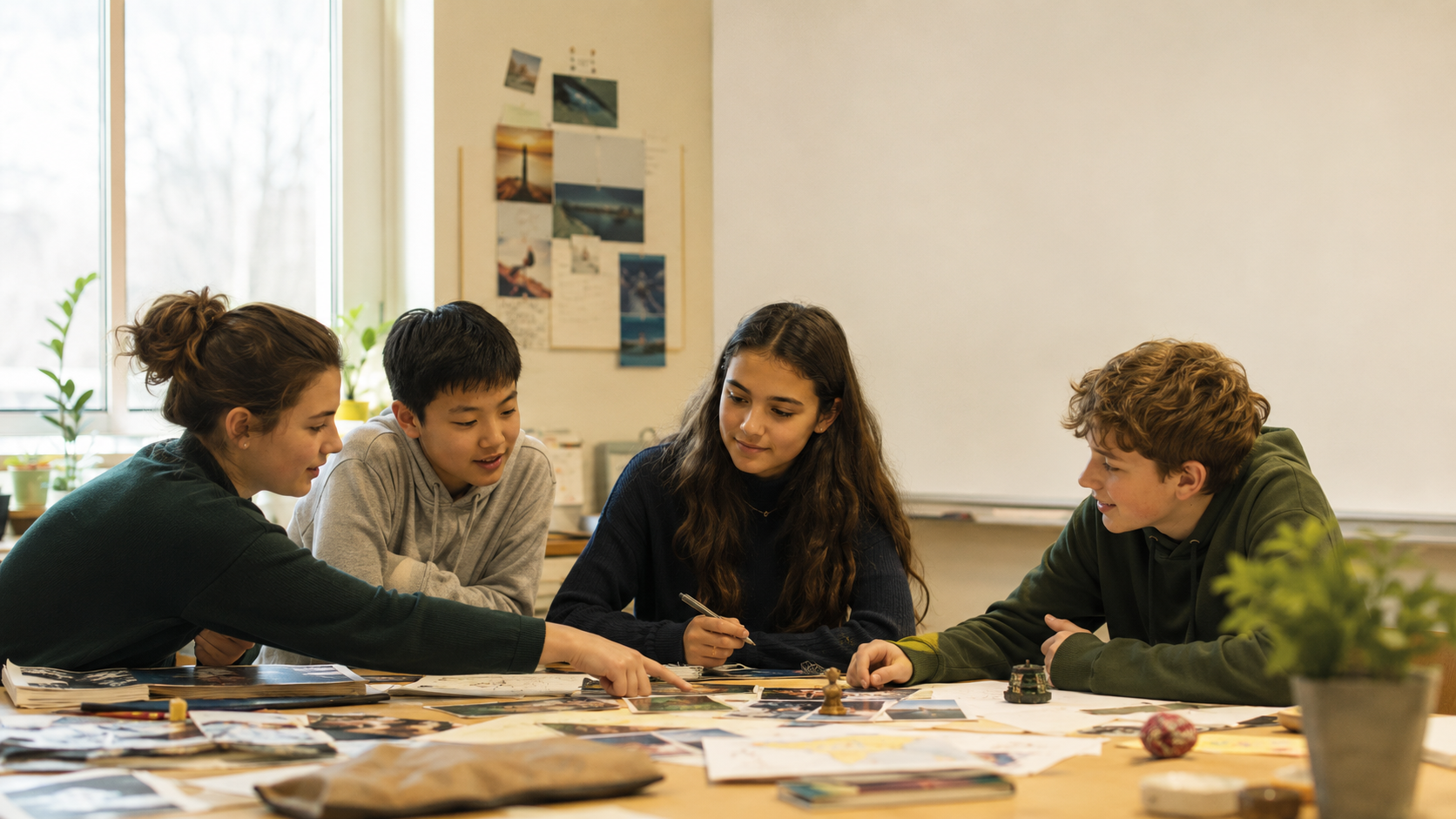
Belonging does not require choosing one country, one identity or one version of home. Schools sometimes push integration in a way that implicitly asks students to put the previous place away, which produces compliance rather than connection.
- Allow complex answers to "where are you from?" and model them yourself.
- Treat previous friendships as ongoing rather than finished.
- Support selected continuity: a maintained connection, a familiar activity, a language kept alive.
- Let new relationships form gradually rather than assigning them.
- Avoid framing full integration as a deadline.
- Recognise that belonging can be plural, and that this is a strength.
PISA data points at something concrete here: across OECD countries, peer-to-peer tutoring was associated with a strengthened sense of belonging at school (OECD). Structured peer roles seem to do more than social encouragement alone. The identity side is explored further in the search for belonging abroad.
Key point: The goal is not to make the student replace one home with another. It is to help them build continuity across both.
Arrivals Matter, but Departures Matter Too

Most international schools have an admissions process and no departure process. That imbalance is felt by everyone who stays.
Departures affect the leaving student, the friends remaining, and whole classes managing repeated turnover. Over time it produces the pattern where students avoid closeness because they assume it will end, which is the quiet cost of an unmanaged mobility culture.
- Prepare in advance rather than announcing a leaving date late
- Hold goodbye rituals scaled to age and to the student's wishes
- Transfer records and relevant support information properly to the receiving school
- Help students name mixed feelings, including relief and guilt
- Support selected connections rather than clean breaks
- Prepare re-entry students specifically, since a passport country is frequently harder than somewhere new
How Schools and Parents Should Coordinate
Ask parents, ideally before arrival: what has changed recently in the family, how the student responded to previous transitions, which languages are used at home, whether sleep or behaviour has shifted, how much the student knows about why the move happened, and whether further moves are expected. That last question is rarely asked and it changes everything about how a student invests.
Tell parents clearly: who their contact is, when the check-in points are, what you will raise immediately, and what you will monitor rather than escalate.
Keep the school's role bounded. You are supporting a student, not managing a family, and parents may be under considerable pressure themselves. The parent-facing side is covered in child adaptation in expat families, which is useful to share rather than summarise.
Common School Mistakes
- Assuming previous international experience makes transition easy. It usually makes arrival easier and grief heavier.
- Focusing on grades as the measure of adjustment. Academic performance is often the last thing to fall.
- Treating quick friendships as proof of belonging. Speed and depth are different variables.
- Assigning an unsuitable peer buddy. The most confident student is rarely the right one.
- Overwhelming the student with questions on day one. Curiosity feels like interrogation when you are exhausted.
- Ignoring departures. Unprocessed goodbyes teach students not to invest.
- Confusing language hesitation with lower ability. This misjudgement can follow a student for years.
- Ending support after the first fortnight. Difficulty typically surfaces in weeks six to twelve.
When May Additional Support Be Needed?
Consider additional support when distress is persistent or worsening rather than easing, when withdrawal is sustained, when there are major changes in sleep or appetite, when physical complaints recur without a clear cause, when academic decline continues despite support, or when the student shows panic symptoms or significant school avoidance.
Expressions of hopelessness, or any indication of self-harm, should be acted on promptly through your safeguarding procedures.
These signs have many possible causes, and mobility may not be the relevant one. Appropriate involvement may include the school counsellor, safeguarding staff, the family doctor or a paediatric professional, or a licensed child and adolescent mental health professional. For urgent safety concerns, contact local emergency services or a crisis line.
Older students managing homesickness alongside academic pressure may find coping with homesickness while studying abroad a useful reference.
How Expathy Can Fit Into the Wider Support System
Expathy quickly matches expats with licensed psychologists who speak their native language. Many Expathy psychologists are expats themselves, so they understand both the student or family's cultural background and the challenges of building a life abroad.
Within a school context, that is most relevant for parents managing relocation pressure, for internationally mobile staff, and for older students where clinically and legally appropriate with the right consents in place.
Expathy does not replace school safeguarding, school counselling, child-specific assessment, medical services or emergency care. It sits alongside them. If it would be useful for your community, you can explore online therapy for expats.
Final thought
A successful transition is not simply a student attending classes, achieving good grades, making friends quickly and appearing resilient. All four can be true while the student is still holding a great deal alone.
A transition has worked when a student feels safe enough to belong here, to grieve what they left, to ask questions without performing certainty, and to stay connected to the parts of their life that came before. Schools cannot remove the loss that mobility involves. They can make sure no student carries it unnoticed.
Sources and further reading
- Third Culture Kid definition and origins, Interaction International
- Third culture kid, EBSCO Research Starters
- PISA 2022 Results (Volume II): Life at school and support from home, OECD
- Building emotional resilience in times of change: insights from PISA, OECD
Frequently asked questions about supporting Third Culture Kids
What is a Third Culture Kid?
Someone who spends a significant part of their developmental years outside their parents' passport culture. The term originated with sociologist Ruth Hill Useem in the 1950s and was later refined by Pollock and Van Reken. It describes a life context rather than a condition, and carries real strengths alongside its challenges.
Are all international-school students Third Culture Kids?
No. Local students at an international school, and students who have moved only within one country, generally would not fit the description. Some students who do fit it dislike the label. Use it descriptively rather than assigning it to a whole cohort.
Why can school transitions be difficult for Third Culture Kids?
Because several changes happen at once: country, language, curriculum, friendship group and routine. The student may also be carrying unprocessed losses from previous moves. Practical transition skill develops faster than emotional adjustment, so difficulty often appears weeks after an apparently smooth arrival.
How long does it take a child to adjust to a new international school?
There is no fixed timeline, and it varies by age, temperament, language change and number of previous moves. What schools should not assume is that a good first fortnight means the transition is complete. Many students find weeks six to twelve harder than the first week.
What signs show that a student is struggling with a transition?
Sustained withdrawal, distress at classmates leaving, uneven academic performance, reluctance to join activities, perfectionism, and difficulty talking about home or previous schools. Unusual independence and rapid friendship formation also warrant attention, since both are easily read as successful adjustment.
How can teachers support Third Culture Kids?
Make expectations explicit, explain unwritten conventions, distinguish language processing speed from subject knowledge, avoid asking the student to represent a country, offer alternative participation routes, give corrective feedback privately in the early weeks, and raise concerns early rather than waiting for a clear pattern.
Should schools provide arrival and departure programmes?
Both, ideally as one system. Most schools have a strong admissions process and no departure process, which leaves leaving students unsupported and teaches those remaining that friendships end without acknowledgement. Structured goodbyes, proper handover and specific preparation for re-entry all improve the wider school culture.
When should a Third Culture Kid receive professional support?
When difficulties are persistent, worsening, intense or appearing across settings, particularly if sleep, appetite, academic functioning or friendships are affected. Expressions of hopelessness or any self-harm concern should be acted on promptly through safeguarding procedures. Assessment belongs with a qualified professional rather than with school observation alone.
Need support? We're here.
Book a free 15-min consultation with our expat-specialized therapists.