
Key takeaway
Germany has some of Europe's most detailed discrimination data, a federal agency that tracks complaints by category, a field experiment that isolated exactly how much an accent alone costs a job applicant, and a legal system with a genuine, well-documented gap when it comes to discrimination by public authorities themselves. All of this makes Germany one of the better-evidenced countries in this pillar, and also one of the easier ones to misread if the numbers aren't handled carefully. This article covers what current research actually shows about discrimination against foreigners and minority groups in Germany, how the AGG works and where it doesn't reach, and what to do if you think you're experiencing it.
You've heard both things said about Germany: that it's rule-bound and fair, and that being foreign here can feel like carrying an invisible file nobody explains to you. This article holds both, carefully, against the actual evidence.
High discrimination figures from one racialized population cannot be converted into a claim about everyone living in Germany.
What does current evidence show about discrimination in Germany?
Germany combines strong survey evidence on a specific racialized population, high and rising caseloads at its federal anti-discrimination agency, and direct experimental evidence of hiring bias, but none of these sources should be read as a single national prevalence rate for all foreigners. Each measures something different, and precision about which population each figure describes matters more here than almost anywhere else in this pillar.
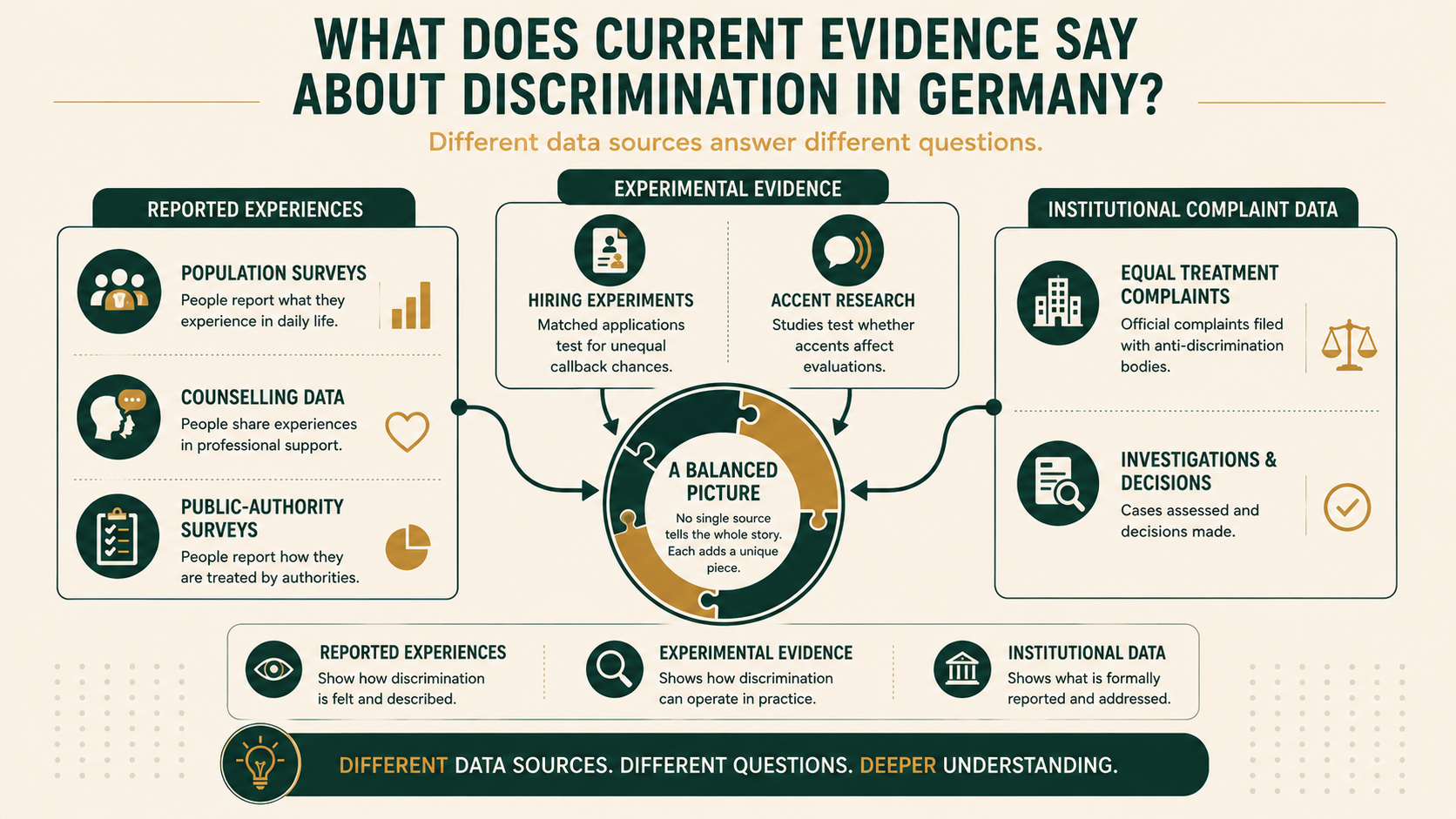
The EU's largest recent study of discrimination against people of African descent found particularly high figures among its German sample specifically: 64% reported racial discrimination in the preceding year, and 76% over five years. These numbers describe a specific, targeted survey population, not Germany's foreign-born residents or international workforce as a whole, and should never be generalized beyond that.
Germany's Federal Anti-Discrimination Agency received 11,405 counselling enquiries in 2024, with 43% related to racial discrimination, up from 10,772 enquiries the year before. Neither figure is an estimate of how common discrimination actually is. Complaint and enquiry volumes reflect awareness, access to services and willingness to reach out, alongside whatever underlying prevalence exists, and rising numbers can mean more discrimination, more awareness, or both at once.
Complaint numbers show what reaches an institution. They do not tell us how common discrimination is in the entire population.
What does research show about workplace discrimination in Germany?
German hiring research includes some of the most precise experimental evidence available anywhere on this topic, directly isolating accent as a variable separate from name or origin. In a telephone field experiment, applicants speaking standard German received positive responses roughly 80% of the time. The same applicant profile with a Turkish name, still speaking standard German, received a nearly identical response rate. The Turkish-accented version of the same application dropped to roughly 73%. The name alone barely moved the number. The accent did.
Two versions of the identical applicant, distinguished only by how they sounded, received meaningfully different treatment. That is about as close to isolating bias as social science gets.
A separate harmonized European hiring experiment found measurable penalties for Muslim women wearing a hijab in German hiring processes, particularly in customer-facing roles, a pattern shared with the Netherlands and, to a smaller degree, Spain. Together, these findings show discrimination in German hiring can operate through more than one signal at once, accent, religious visibility, name, each carrying its own separately measured effect. For the fuller picture of how accent bias specifically works and what the broader research shows about competence judgments, accent discrimination abroad covers that in depth, and workplace discrimination abroad covers ongoing treatment beyond the hiring stage.
Can accent discrimination happen in Germany?
Yes, and the evidence extends beyond hiring into other institutional settings, including education. Beyond the recruitment field experiment described above, a 2024 German study found that teachers formed lower academic expectations of first-grade students with non-native accents, even after accounting for the children's actual measured abilities and backgrounds, including in mathematics, a subject where spoken-language performance should have had limited relevance to the judgment being made.
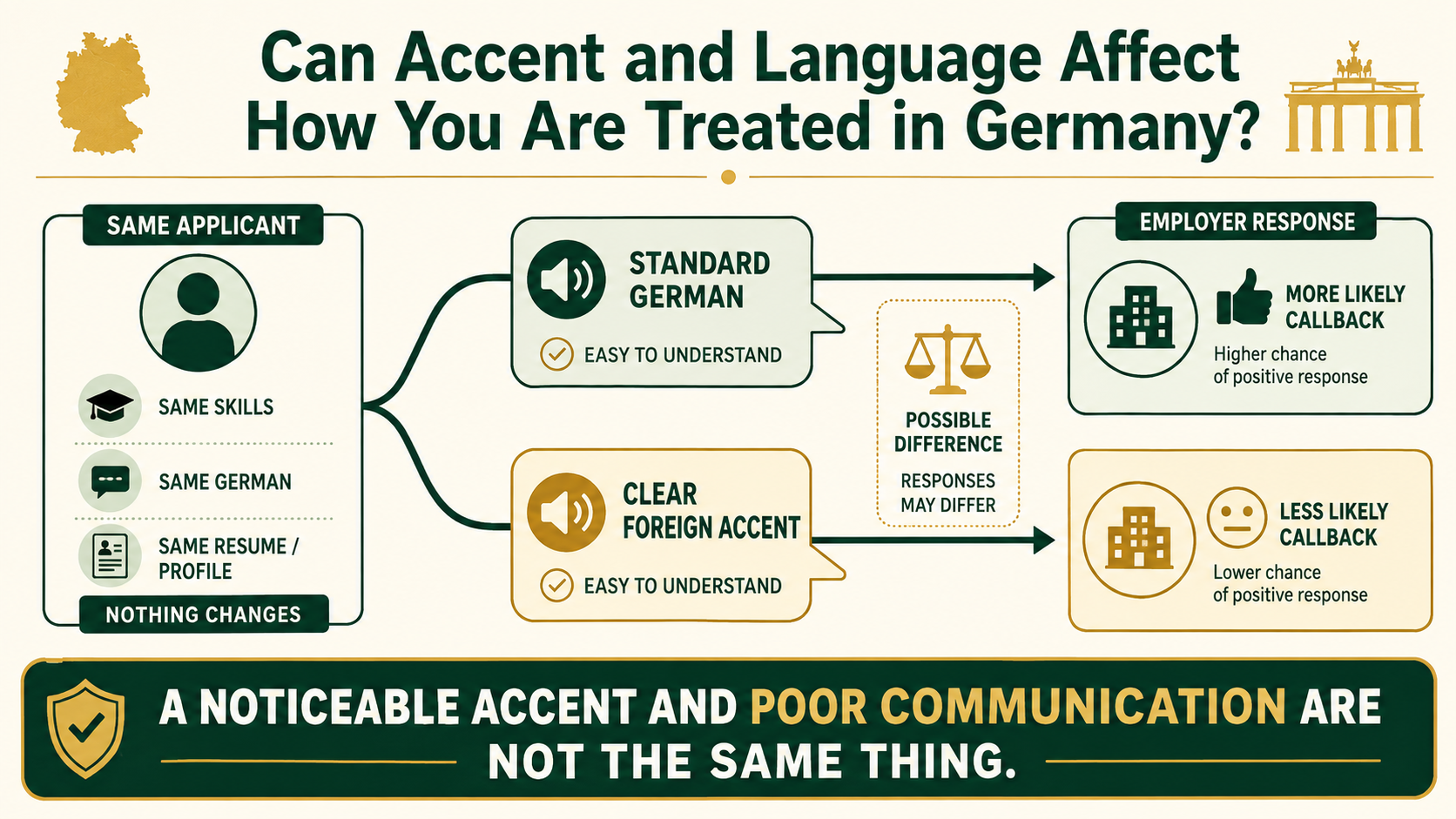
That finding matters beyond the classroom itself. It shows that accent-linked assumptions about competence are not confined to job interviews. They can show up anywhere someone is being evaluated by another person, in ways that are measurable even when the evaluator has no intention of being unfair.
Can public authorities discriminate against foreigners in Germany?
Yes, and Germany's legal framework has a documented, specific gap here that makes this domain more complicated than employment or housing discrimination. A 2025 representative survey of 2,000 people found that 19% reported unequal or poor treatment by public authorities in general, and 16% by police specifically. Among people with a family migration history, the public-authority figure rose to 33%.
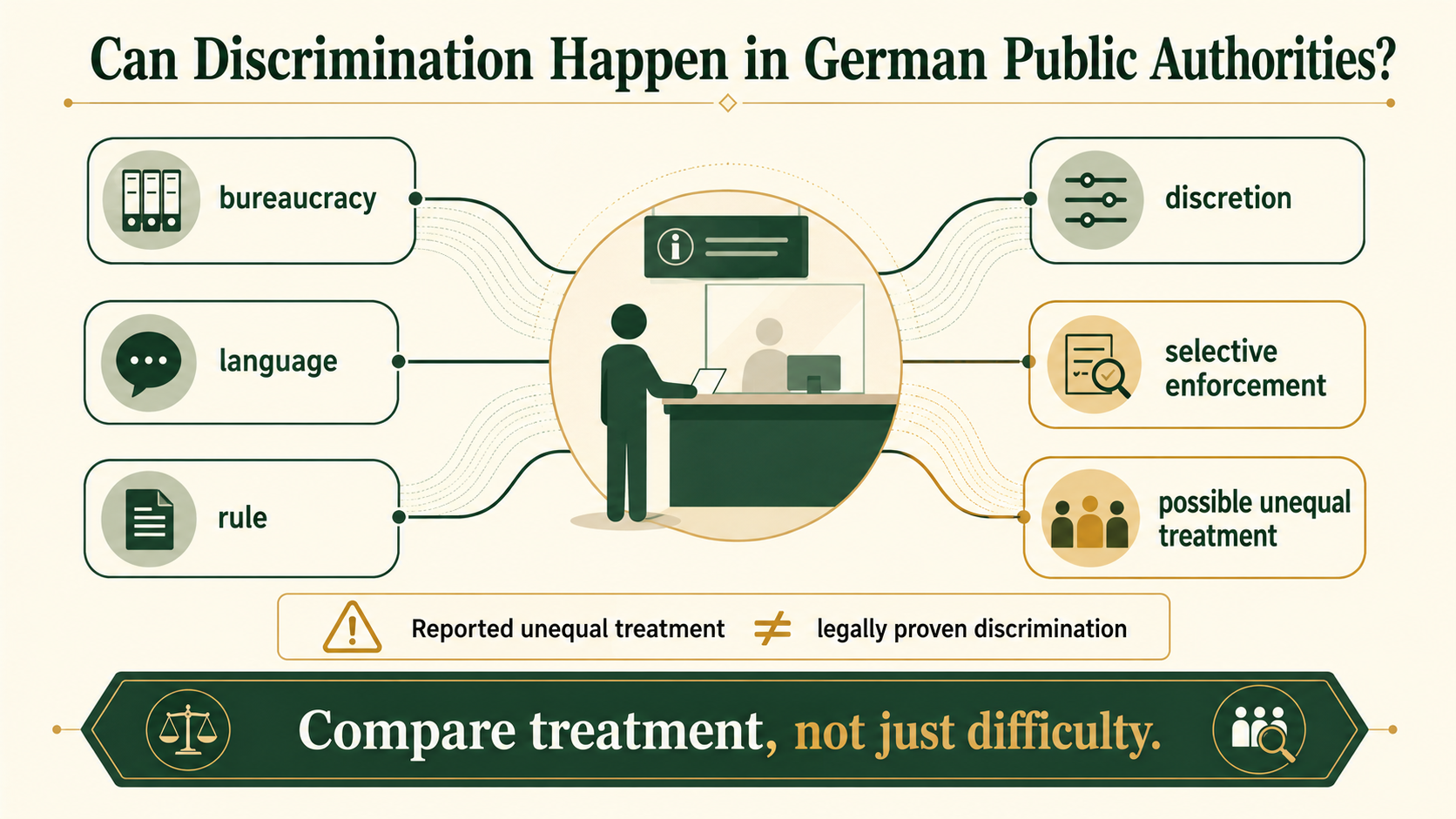
The complication is legal. The AGG, Germany's main anti-discrimination law, was designed primarily to govern employment and important private transactions, not the relationship between citizens and the state. This leaves a real gap in the direct legal route available when the alleged discrimination comes from a government office rather than an employer or landlord, though constitutional and state-level protections can still apply in these situations.
The same unequal treatment can have a clear legal remedy from an employer and a genuinely murkier one from a government office. The experience can feel identical. The legal path is not. For a general framework on separating ordinary bureaucratic friction from genuinely unequal institutional treatment, which applies directly to this German legal gap, discrimination or bureaucracy abroad covers that distinction in depth.
Is discrimination in Germany always explicit, or can it be indirect?
German law explicitly recognizes that discrimination doesn't require an openly stated motive, and both the Federal Anti-Discrimination Agency and courts have addressed cases where a formally neutral rule produced unequal outcomes. The agency itself gives a clear, concrete example: requiring a "native German speaker" for a role, where native-level fluency isn't genuinely necessary to perform the job, can constitute indirect discrimination, even though the requirement never mentions ethnicity or nationality by name.
A related and important example: a blanket refusal to rent to people of a specific nationality, Syrians has been the agency's own cited case, can amount to indirect racial or ethnic-origin discrimination under German law, even though nationality itself is not a directly protected AGG category. This is a genuinely useful legal nuance, and it's worth understanding clearly before assuming that because nationality isn't named explicitly in the law, nationality-based treatment falls outside its protection entirely.
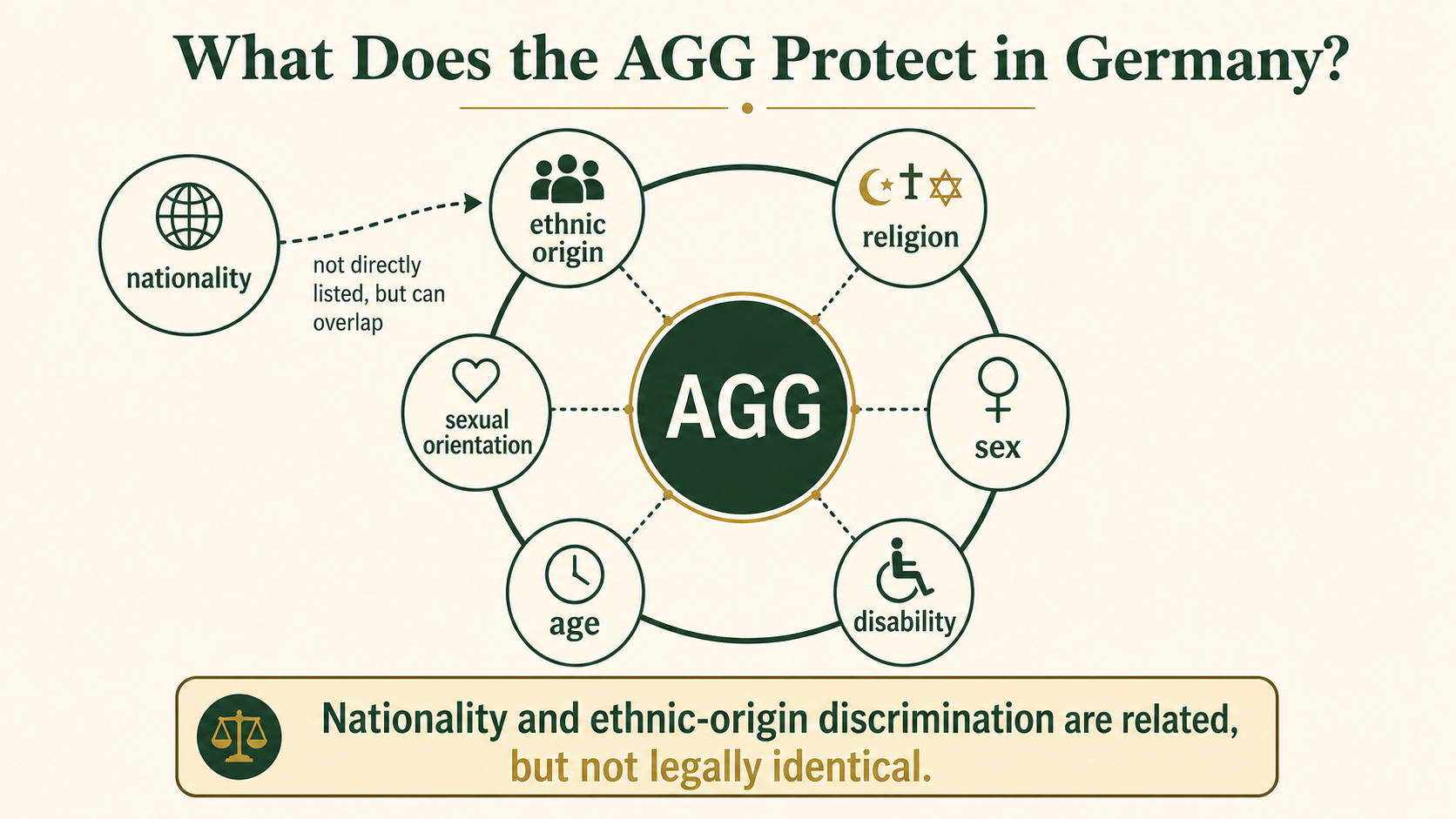
In Germany, nationality is not directly listed as an AGG ground, but nationality-based treatment can still overlap with racial or ethnic-origin discrimination.
For a broader look at how subtle, hard-to-prove discrimination tends to operate across settings beyond Germany specifically, subtle discrimination abroad covers the general patterns and how to weigh them.
What does the AGG actually protect, and where does that protection stop?
The Allgemeines Gleichbehandlungsgesetz, Germany's General Equal Treatment Act, protects against discrimination based on racial or ethnic origin, sex, religion or belief, disability, age and sexual orientation, primarily in employment and in important private and civil transactions such as housing. It does not include nationality as a directly named category, and it does not generally govern the relationship between individuals and government authorities in the way it governs employers and landlords.
In practical terms, this means:
Employment discrimination based on race, ethnic origin, religion, disability, age or sexual orientation falls clearly under AGG protection.
Housing and major civil transactions are also covered, subject to some exceptions.
Nationality-based treatment is not directly named, but can be addressed where it overlaps with racial or ethnic-origin discrimination, as in the rental example above.
Treatment by public authorities, immigration offices, municipalities, police, sits in a genuine legal gap where the AGG's direct coverage is limited, though other constitutional and state-level protections may apply depending on the specific situation.
This is general information, not individualized legal advice, and anyone facing a specific situation involving public authorities should seek advice on which protections actually apply to their case.
Where can you report discrimination in Germany?
Germany's Federal Anti-Discrimination Agency offers counselling by phone and email and is the most established general starting point for understanding your situation and options. It handles a wide range of enquiries and, as the 43% figure above shows, racial discrimination makes up a substantial share of what it receives, but its counselling role is broader than that single category.
Which specific route makes sense, the agency, a workplace's internal process, a housing-specific channel, or independent legal advice, depends heavily on where the discrimination happened and who was involved. For a general framework on documenting what happened, separating fact from interpretation, and deciding whether and how to escalate, how to report discrimination abroad covers that process in depth and applies directly here.
How should you think about your own experience without overgeneralizing from national statistics?
None of the figures in this article can tell you what happened in your specific situation, and that's true even for the strongest, most rigorous evidence available. The FRA figures describe a specific surveyed population of African descent, not all foreigners in Germany. The accent field experiment describes one manipulated variable in one recruitment context. The 2025 public-authority survey describes self-reported unequal treatment, not legally adjudicated findings.
What these sources are genuinely useful for is establishing that the mechanisms are real and documented, that accent alone can move a callback rate, that public-authority treatment can differ by migration background, that a neutral-sounding rule can still function unequally. Whether any one of those mechanisms explains your specific experience is a separate question, best answered by looking for repetition, comparison and pattern rather than a single incident. If you're sitting with genuine uncertainty about one specific, ambiguous moment, discrimination abroad lays out the broader landscape this Germany-specific evidence sits inside. If the weight of a discriminatory experience, proven or not, has been affecting you, discrimination and mental health abroad covers what tends to help.
Frequently asked questions
Is discrimination against foreigners illegal in Germany?
Discrimination based on racial or ethnic origin, religion, disability, age and sexual orientation is prohibited under the AGG in employment and major private transactions. Nationality itself is not a directly named AGG category, though nationality-based treatment can still be addressed where it overlaps with ethnic-origin discrimination.
Is nationality protected under the AGG?
Not directly. The AGG names racial or ethnic origin, sex, religion or belief, disability, age and sexual orientation as protected grounds, but does not list nationality on its own. Nationality-based exclusion can still constitute indirect racial or ethnic-origin discrimination depending on the specific circumstances.
Can accent discrimination happen in Germany?
Yes, and it has been demonstrated experimentally. A field experiment found a measurable callback penalty for a Turkish-accented job applicant compared with the same applicant speaking standard German, and a separate study found teachers formed lower expectations of students with non-native accents even after accounting for measured ability.
What does research show about workplace discrimination in Germany?
Field experiments show accent alone can reduce hiring callback rates, and a separate harmonized European study found hiring penalties for Muslim women wearing a hijab, particularly in customer-facing roles. These represent distinct, separately measured mechanisms rather than a single uniform pattern.
Can public authorities discriminate against foreigners in Germany?
Self-reported unequal treatment by public authorities is documented in representative survey data, with notably higher rates among people with a family migration history. Legally, this domain is more complicated than employment discrimination, since the AGG does not generally govern the relationship between individuals and government bodies.
How do I know whether I was discriminated against in Germany?
National statistics describe patterns across populations and cannot confirm what happened in any single case. Looking for repetition across multiple situations, a comparison point with how someone else was treated, and whether a plausible non-discriminatory explanation fits just as well tends to be more informative than judging one incident alone.
Need support? We're here.
Book a free 15-min consultation with our expat-specialized therapists.