
Key takeaway
Everyone on the team gets invited to the informal Friday drinks except you, again, and there's never a stated reason. A mistake you make gets flagged in a meeting; the same mistake made by a local colleague gets quietly fixed. A landlord who answered every message within the hour goes silent the day your surname arrives on the application. None of these moments, taken alone, prove anything. That is exactly what makes subtle discrimination difficult: individually, almost every incident has a plausible innocent explanation. This article covers what subtle and covert discrimination actually looks like, why it survives explanation so easily, what research shows about its patterns and effects, and how to tell it apart from ordinary unfairness, cultural misunderstanding or a personality clash.
The barbecue chat stops when you walk over. Somebody translates a joke for you a beat too late, after everyone has already laughed. Your manager describes your communication style as "difficult to follow" in a review that praises your actual output. Each of these is small enough to shrug off on its own.
Subtle discrimination often survives because every individual incident can be explained away.
What is subtle discrimination?
Subtle discrimination is unequal treatment connected to nationality, race, ethnicity, accent or foreign status that occurs through indirect, ambiguous or plausibly deniable behavior rather than an explicit statement of prejudice. It includes differential warmth, heightened scrutiny, selective enforcement of rules, coded language about "fit," repeated exclusion from informal networks, and competence being questioned more than it is for colleagues in an identical position.
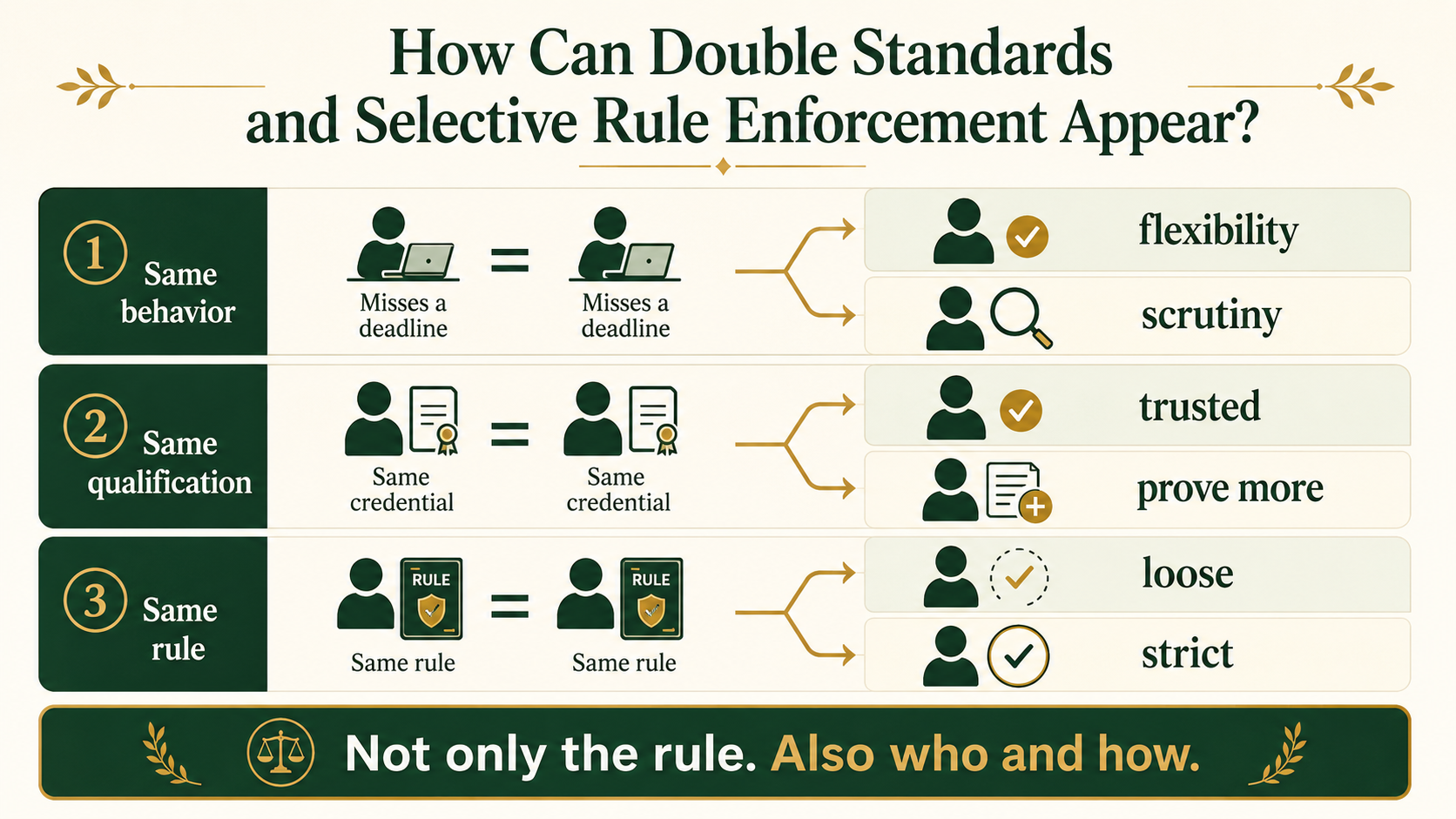
Discrimination research generally splits behavior into two categories. Overt discrimination is comparatively easy to identify: an explicit refusal to rent to foreigners, a slur, a stated policy against hiring someone because of their nationality. Subtle or covert discrimination lacks that clarity. It shows up through patterns, not declarations, which is precisely what makes it both real and hard to prove.
Why is subtle discrimination harder to recognize than overt discrimination?
Because almost any single instance of subtle discrimination has an innocent alternative explanation, and that alternative explanation is often genuinely plausible. Overt discrimination announces itself. Subtle discrimination has to be inferred from a pattern, and inferring a pattern takes more time, more instances and more comparison than most people have the patience or evidence for in the moment.
This is not a flaw in your judgment. It is a structural feature of how covert discrimination operates. A landlord who stops responding could be busy, could have rented the flat already, or could have reacted to your name. A manager who repeatedly flags your communication style could have a genuine point, could have unconscious bias about accented speech, or both at once. The behavior is designed, whether consciously or not, to be deniable.
What does subtle discrimination actually look like?
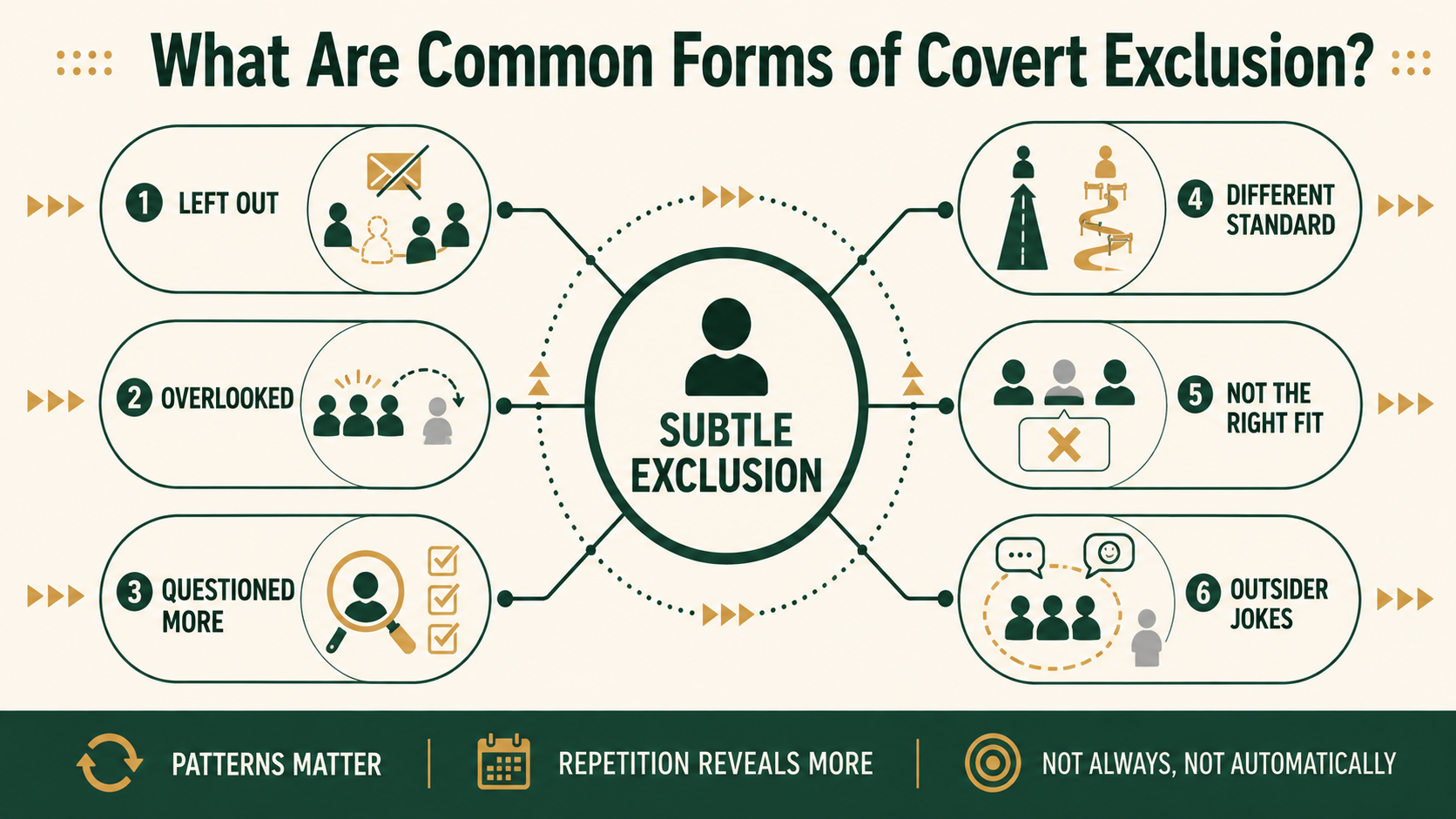
Subtle discrimination commonly appears as differential warmth, selective scrutiny of the same behavior, exclusion from informal networks, coded explanations like "fit," and jokes or comments that repeatedly position someone as an outsider. None of these require an explicit statement of motive to occur, and none of them show up on a policy document.
Some of the most consistently described forms:
Differential warmth. The same request, question or greeting lands differently depending on who you are. Colder responses, shorter replies, less eye contact, a subtle drop in enthusiasm.
Selective scrutiny. Your work gets checked more closely than a colleague's. Your accent gets "clarified" in meetings where a local colleague's ambiguous phrasing goes unquestioned. Errors that would be waved off for someone else get flagged for you.
Informal exclusion. The real decisions happen at the coffee machine, on the group chat you were never added to, at the drinks you weren't invited to. You can be fully included on the org chart and functionally excluded from where influence actually moves.
Coded language. "Not quite the right fit," "communication style," "cultural mismatch," used in ways that never specify what the actual problem is, applied disproportionately to people who are foreign, accented or visibly different.
Outsider-positioning humor. Jokes about your accent, your country, your food, presented as harmless and requiring you to either laugh along or be the person who "can't take a joke."
Field research backs up why these patterns are common and not isolated. The EU's Fundamental Rights Agency found that among people of African descent who reported racial discrimination over five years, 67% had experienced it in more than one area of life, supporting the idea that discrimination tends to show up as a recurring pattern across contexts rather than as one isolated event.
Discrimination does not need to be openly hostile to affect who gets trusted, included or given opportunities.
Where does the concept of microaggressions fit in, and where does it have limits?
Microaggressions are generally defined as subtle interpersonal or environmental slights that communicate a derogatory or outsider-related message, and a large body of research links them to worse psychological and physical wellbeing. A 2023 meta-analytic review synthesizing 141 articles and 154 samples found microaggression measures were negatively associated with both wellbeing and physical health outcomes.
The limits matter here too. The underlying research is mostly observational, meaning it captures association rather than proof of cause, and definitions of what counts as a microaggression vary considerably between studies. It's accurate to say that reported microaggressions are associated with poorer wellbeing. It is not accurate to claim that any specific ambiguous comment definitively "is" a microaggression, or that microaggressions independently cause depression. The concept is a useful lens for recognizing a pattern. It is not a diagnostic tool for a single interaction.
A single ambiguous comment rarely settles anything on its own. A pattern of them is what the research actually speaks to.
How do you distinguish discrimination from cultural misunderstanding or ordinary unfairness?
You look for repetition, comparison and consistency rather than trying to judge a single moment on its own. Cultural misunderstanding tends to be a one-time confusion that resolves once clarified. Personality conflict tends to be specific to one relationship rather than a pattern across many. Discrimination tends to be recognizable through its persistence and its selectivity.
Useful questions to hold up against a suspected pattern:
- Has this happened more than once, in more than one context?
- Would someone without your background, in the identical situation, likely have been treated the same way?
- Is a rule or standard being applied consistently to everyone, or only strictly to you?
- Did the tone or treatment change noticeably after your name, accent or background became apparent?
- Is there a plausible, ordinary explanation, workload, timing, an unrelated bad day, that fits just as well?
- Have other people with a similar background described something comparable from the same source?
None of these questions, alone, deliver a verdict. Together, they move you from "something feels off" toward an informed judgment.
A pattern does not automatically prove motive, but patterns can reveal differences that one isolated interaction cannot.
If what you're sitting with right now is genuinely one ambiguous incident rather than an established pattern, was that discrimination or am I imagining it goes deeper into that specific, exhausting uncertainty.
What does subtle discrimination look like at work?
At work, subtle discrimination most often shows up as unequal scrutiny of the same performance, exclusion from informal decision-making, and vague feedback that never quite explains what needs to change. A foreign employee may receive strong formal reviews while consistently being passed over for stretch projects that go to less experienced local colleagues. Accented English might repeatedly get flagged as a "communication issue" in performance conversations, even when comprehension was never actually a problem in the room.
Correspondence-test research demonstrates the underlying mechanism clearly, even outside the workplace itself: in a German recruitment field experiment, applicants with standard German accents received callbacks at roughly 80%, compared with about 73% for otherwise identical applicants with a Turkish accent. The applications were the same. Only the accent signal changed. A broader meta-analysis of 139 effects across 4,576 participants found standard-accented candidates were consistently rated as more hireable than accented candidates, and comprehensibility alone did not explain the gap.
For a fuller picture of what subtle and overt discrimination can look like across an entire employment relationship, from hiring through promotion, workplace discrimination abroad covers it in depth, and accent discrimination abroad covers the accent research specifically.
What does subtle discrimination look like in housing and everyday life?
In housing, subtle discrimination often shows up as landlords or agents becoming slower to respond, less flexible, or less available once a foreign name or accent becomes apparent, without ever stating a reason. A large Dutch correspondence study involving over 3,000 tests found applicants with Moroccan-sounding names had an 18% lower probability of receiving a viewing invitation than otherwise identical applicants. Nobody in that dataset had to say anything explicit for the pattern to be measurable.
In everyday life, the pattern tends to be quieter still: being asked repeatedly where you are "really" from despite years of residence, being the one whose accent gets imitated at a party "affectionately," being the person a group defaults to speaking slowly around. Individually, small. Repeated, they add up to something coherent. For the housing mechanics and evidence in full, see housing discrimination abroad.
What should you avoid concluding from a single ambiguous moment?
Avoid concluding either that one uncomfortable interaction proves discrimination, or that because you cannot prove it, nothing happened. Both conclusions feel like relief because they end the uncertainty, and both are frequently wrong. Intent also matters less than people assume: unequal treatment can happen through habit or unexamined bias without anyone consciously deciding to discriminate, which does not make the effect on you any less real, but also does not mean every instance of different treatment is discriminatory.
One incident being ambiguous does not mean nothing happened. It means you do not yet have enough information to be certain what happened. Those are different conclusions, and holding the second one, uncomfortable as it is, tends to be more accurate than forcing yourself toward either extreme.
You do not have to choose between "I imagined it" and "this proves everything." Most honest answers sit uncomfortably in between.
What can you do once you start noticing a pattern?
Start documenting specific incidents as they happen, including dates, what was said or done, and how comparable situations involving other people were handled, so that an emerging pattern becomes something you can actually evaluate rather than something you're carrying entirely in memory. A pattern you can point to is far more useful, to yourself and to anyone you eventually decide to involve, than a general feeling that something has been wrong for a while.
From there, your options depend on the setting and the severity of what you're seeing. Sometimes an honest conversation with the person involved resolves a misunderstanding that was never actually discrimination. Sometimes the pattern is clear enough, and serious enough, to warrant a formal process. How to report discrimination abroad walks through documentation and reporting routes in detail. For the broader landscape of how different forms of discrimination relate to each other, discrimination abroad is the place to start. And if the accumulated weight of these patterns, not any single incident, has been affecting your mood, sleep or confidence, discrimination and mental health abroad covers what tends to help.
A pattern you can point to is worth far more, to yourself and to anyone you eventually tell, than a feeling you've been carrying alone.
Frequently asked questions
What is subtle discrimination?
Subtle discrimination is unequal treatment linked to nationality, race, accent or foreign status that occurs through indirect or deniable behavior rather than an explicit statement of prejudice. It includes differential warmth, selective scrutiny, informal exclusion and coded language, and it is documented in research even though any single instance can usually be explained away.
What are examples of covert discrimination?
Common examples include being consistently excluded from informal social or decision-making circles, having the same mistake treated more harshly than when a colleague makes it, receiving vague "fit" or "communication style" feedback that never specifies the actual issue, and jokes about accent or nationality framed as harmless.
What is the difference between subtle discrimination and microaggressions?
Microaggressions are a specific concept within the broader category of subtle discrimination, referring to brief interpersonal or environmental slights that communicate a derogatory or outsider message. Research links reported microaggressions to worse wellbeing, but definitions vary across studies, and the concept works better for recognizing a pattern than for judging a single ambiguous remark.
Can discrimination happen without anyone saying something openly prejudiced?
Yes. Discrimination can occur through patterns of differential treatment, selective enforcement of rules, or systems that produce unequal outcomes, all without anyone stating an explicitly prejudiced motive. Institutional and covert discrimination are both well documented forms of this.
How can you recognize a pattern of discrimination?
Look for repetition across multiple situations, compare how you were treated to how someone without your background would likely have been treated in the same circumstance, and check whether standards or rules are applied consistently to everyone or selectively to you. Documentation over time makes this comparison far more reliable than memory alone.
Is being excluded socially discrimination?
It can be, particularly when the exclusion is consistent, tied to identifiable group membership, and affects access to information or opportunity, such as being left out of informal workplace networks where real decisions happen. A single missed invitation is not conclusive on its own; a consistent pattern of exclusion is more informative.
What are workplace examples of subtle discrimination?
Common examples include accented speech being repeatedly flagged as a "communication issue" despite no actual comprehension problem, being passed over for informal opportunities despite strong formal reviews, and vague "culture fit" language used to explain decisions that disproportionately affect foreign employees.
How do you know whether unequal treatment is intentional?
You often cannot know with certainty, and it matters less than people assume. Unequal treatment can result from unconscious bias or institutional habit rather than deliberate intent, and its effect on the person experiencing it is real either way. Focusing on the pattern of impact, rather than trying to prove intent, is usually more productive.
Need support? We're here.
Book a free 15-min consultation with our expat-specialized therapists.