
Key takeaway
A colleague makes a joke about your accent in a meeting, everyone laughs, and you laugh too because that felt like the only option. A landlord goes quiet after your name arrives on the application, the one with letters that don't sit the way local names do. A manager praises your work in private and then, somehow, never quite puts you forward for the opportunities that go to everyone else. Nothing was explicit enough to point to. You cannot prove any of it, and you cannot stop thinking about it either. This article is about that specific kind of exhausting uncertainty, why it happens, what research actually shows about its psychological cost, and how to think clearly about an ambiguous incident without forcing yourself into either "I'm imagining things" or "everything is discrimination."
You replay the meeting on the drive home. You reread the message twice, three times, checking the tone. You ask yourself the same question in a dozen different phrasings, and none of the answers stick.
Was that discrimination, or am I imagining it?
What does it mean when discrimination is ambiguous?
Ambiguous discrimination is a situation where you cannot be certain whether unfair treatment happened because of your nationality, race, accent or background, or for some other, unrelated reason. Unlike an explicit remark or a stated policy, nothing confirms the motive. You are left holding an interaction that felt wrong, with no way to verify why.
Blatant discrimination is, in a strange way, easier to carry. Someone says the thing out loud, and the explanation is handed to you. Ambiguous discrimination hands you nothing. You become the one who has to generate the explanation, and that work does not stop just because you want it to.
A 2024 study published in BMC Public Health, based on a representative panel of 1,810 US adults, was the first large population study to directly measure this experience. It asked people whether they had recently encountered a situation they were unsure was racial discrimination. 16.5% said yes within the previous six months. The rate was far from evenly spread: 26.6% of Black respondents and 20.7% of Hispanic respondents reported this uncertainty, compared with 4.4% of White respondents. This is a study of racial discrimination in the United States, not a study of expats or international relocation, but the psychological mechanism it isolates, uncertainty itself as a source of strain, is directly relevant here.
Why is subtle discrimination harder to process than blatant discrimination?
Subtle discrimination is harder to process because it removes the one thing that makes blatant discrimination easier to metabolize: certainty. With an explicit incident, you know what happened and can direct your response at it. With an ambiguous one, you are stuck doing ongoing interpretive work, replaying the moment, searching for confirmation, and never quite reaching a stopping point.
Two older experimental studies help explain the mechanism. Researchers Cihangir, Barreto and Ellemers ran two experiments, with 108 and 118 participants, comparing ambiguous versus unambiguous discrimination. Ambiguous discrimination produced more negative self-directed emotion, more self-doubt and worse task performance, particularly among people who had been put in a lower self-esteem state beforehand. In a separate study, Salvatore and Shelton found that participants exposed to ambiguously prejudiced treatment showed greater cognitive impairment afterward than participants exposed to blatant prejudice.
That finding is counterintuitive and worth sitting with. The uncertain version was harder on the mind than the obvious one. Not knowing takes more out of you than knowing something bad.
Blatant discrimination gives you an explanation. Ambiguous discrimination can leave you generating the explanation yourself, over and over.
Can uncertainty about discrimination affect your mental health?
Yes. The 2024 population study found that people who reported this kind of uncertainty scored meaningfully worse on measures of depressive symptoms and self-rated mental health than people who did not. Among those who experienced ambiguity, the people who ruminated more on it, and the people who described being more bothered by it, showed correspondingly worse outcomes. The study was cross-sectional, meaning it captured a single moment in time, so it cannot prove that ambiguity causes depression. What it does show is a real, measurable association, worth taking seriously rather than waving away.
This matters because ambiguous incidents are easy to minimize precisely because they are ambiguous. There's a temptation to reason that if you cannot prove it, it shouldn't bother you. The research says otherwise. The psychological cost of uncertainty is not conditional on the uncertainty being resolved.
Not knowing whether something was discrimination does not mean the uncertainty has no psychological cost.
Why do you keep replaying the interaction?
Because your mind is trying to close an open loop, and an ambiguous incident refuses to close. Rumination, going back over the same interaction searching for a definitive read, is a natural response to unresolved threat. The problem is that ambiguous discrimination is often unresolvable by nature. There may be no additional information coming. The loop can stay open indefinitely if you let it run unchecked.
This does not mean you are overreacting, and it does not mean the questions you're asking yourself are unreasonable. It means the situation itself, not your response to it, is structured in a way that invites this exact pattern.
Common questions that surface in this loop:
- Was it my nationality, or my accent, or something else entirely?
- Am I certain the rule applied differently to me, or did I only assume that?
- Would a local colleague, in the identical situation, have been treated the same way?
- Am I becoming too sensitive to this, or not sensitive enough?
- Is there a plausible, ordinary explanation I'm not considering?
None of these questions have to be answered perfectly in the moment. The goal isn't certainty. It's finding a way to stop the loop from running on its own indefinitely.
How do you tell discrimination apart from cultural misunderstanding or ordinary unfairness?
You look for comparison and pattern rather than trying to read a single moment's intent. One ambiguous interaction genuinely cannot reveal someone's motive. What strengthens or weakens an interpretation is what happens around it: whether the same thing recurs, whether comparable people were treated differently, and whether there's a plausible explanation that has nothing to do with your background.
A useful set of questions, not as a checklist that produces a verdict, but as a way to think more clearly:
- Was anything explicit said or written, even in passing?
- Was a rule, deadline or standard applied differently to someone in a comparable position?
- Has this exact pattern happened more than once, with more than one person involved?
- Did the way you were treated change noticeably once your accent, name or background became visible?
- Is there a plausible, ordinary explanation, workload, personality, a bad day, that fits the facts just as well?
- Have other people, especially people with different backgrounds, mentioned experiencing something similar from the same source?
- Is there anything in writing, or a documented decision, that a pattern could later be checked against?
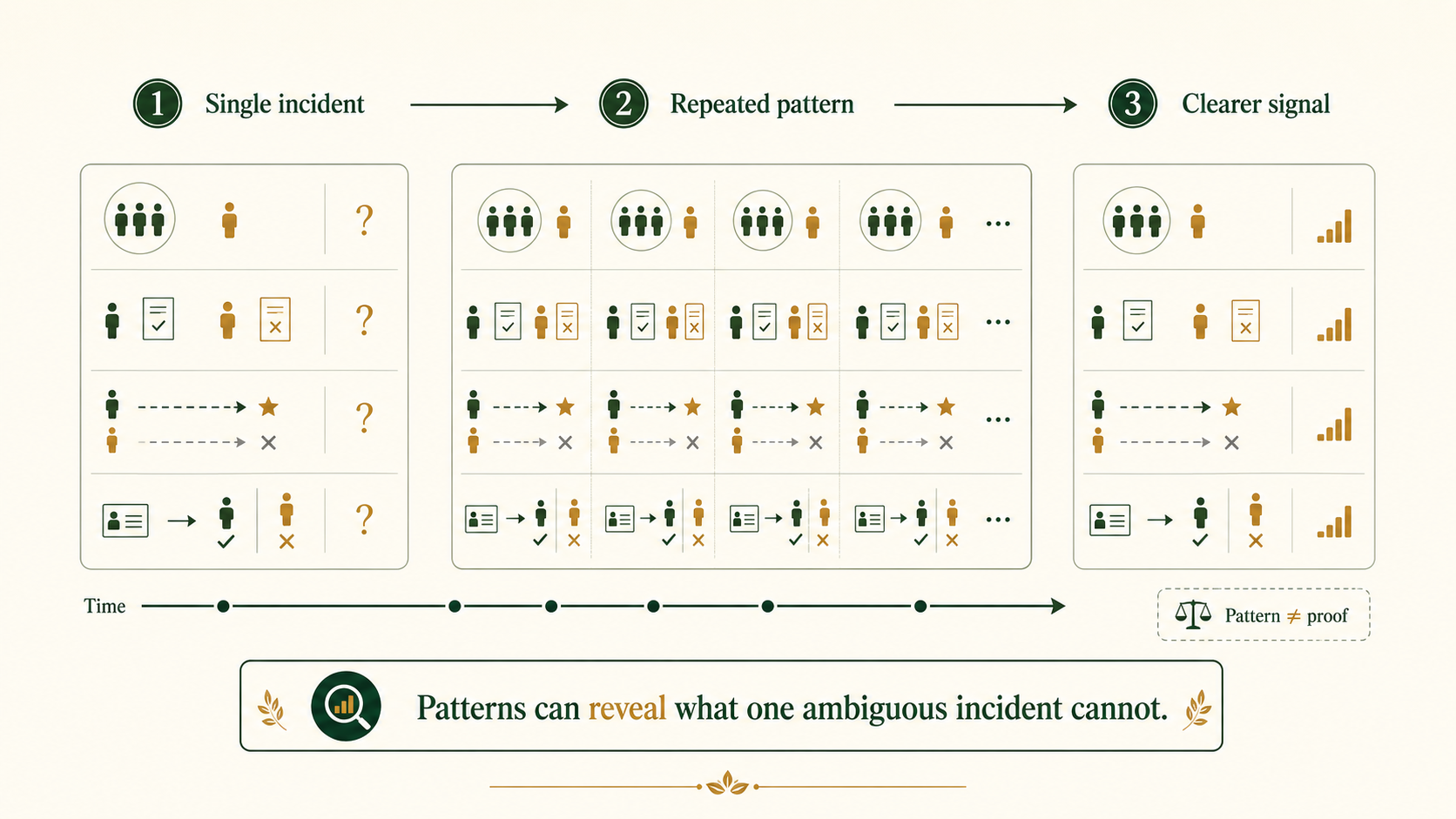
One uncomfortable interaction may not reveal motive. A repeated pattern can tell you much more.
A single incident being ambiguous does not mean nothing happened. It means you don't yet have enough information to be certain what happened. Those are different conclusions, and the second one leaves room for continuing to pay attention rather than forcing a premature answer either way.
For a broader look at how discrimination shows up in less ambiguous, more clearly patterned forms, subtle discrimination abroad covers coded exclusion, double standards and the kind of repeated behavior that starts to look less like coincidence.
What should you avoid telling yourself in this situation?
Avoid collapsing into either extreme: assuming every uncomfortable interaction is discrimination, or assuming that if you can't prove it, it must be nothing. Both extremes feel like relief in the moment because they end the uncertainty. Neither is actually accurate, and both cost you something.
Telling yourself "I'm probably just being too sensitive" dismisses a real and researched psychological experience. Telling yourself "this confirms everyone here is against me" forecloses on explanations that may genuinely be ordinary. The goal is not to convince yourself that discrimination happened. It is to stop forcing yourself to choose between "I am imagining everything" and "every bad interaction is discrimination." Most honest answers sit somewhere in between, and staying there, uncomfortable as it is, is usually more accurate than resolving the tension artificially in either direction.
Intent also matters less than people often assume when it comes to impact. Someone can produce unequal treatment without consciously intending to, through habit, bias they haven't examined, or a system they didn't design. That doesn't mean every different-treatment situation is discriminatory. It means intent is one factor among several, not the deciding one.
What can you actually do when you still cannot be certain?
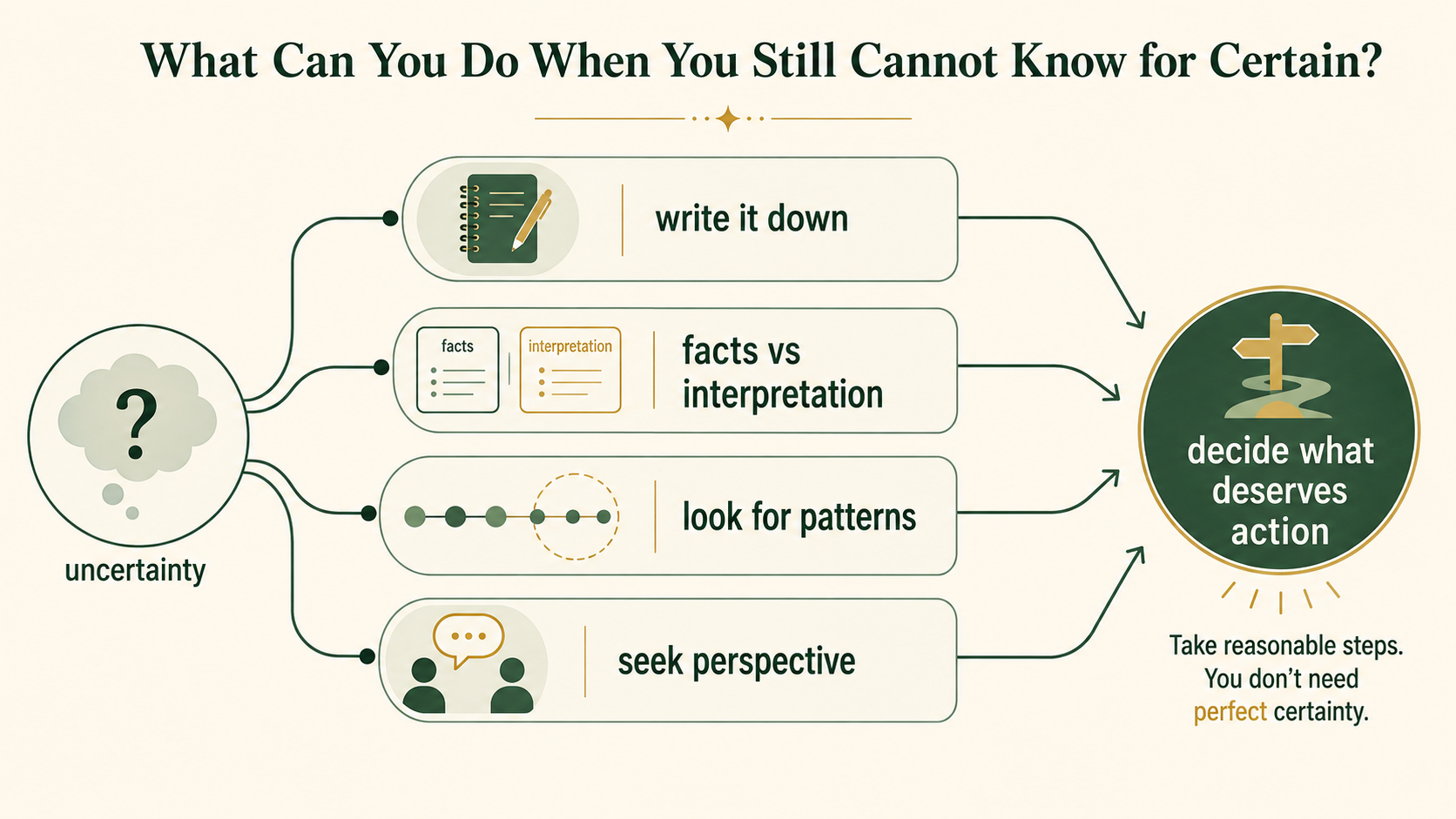
You can document what happened while it's fresh, watch for whether the pattern repeats, and decide your next step based on accumulating information rather than on resolving one single incident. Certainty is not a precondition for taking an incident seriously or for protecting yourself going forward.
A few concrete moves:
Write it down while it's fresh. Date, what was said or done, who else was present, and what led up to it. Not to build a legal case necessarily, just so that if it happens again, you have something more reliable than memory to compare it against.
Give yourself permission to wait. You do not need to decide today whether this was discrimination. Watching whether the pattern recurs is itself useful information, and it costs you nothing to wait for more data before drawing a conclusion.
Talk to someone outside the situation. A friend, partner or therapist who isn't involved can help you reality-test without either dismissing your experience or amplifying it. This is different from asking someone to confirm your suspicion. It's asking someone to think alongside you.
Consider whether the pattern, if it continues, would be worth documenting formally. If the interaction was workplace-related and part of a recurring pattern, workplace discrimination abroad covers what that pattern can look like in practice. If you reach a point where you want to understand your formal options, how to report discrimination abroad walks through documentation and reporting routes in more depth than makes sense here.
For a broader map of what discrimination can look like across different areas of life, and how the different forms relate to each other, discrimination abroad is the place to start.
When is it worth talking to someone about the toll this is taking?
It's worth seeking support when the uncertainty itself, not just the original incident, starts affecting your mood, sleep, concentration or confidence in social situations. You do not need a confirmed, provable case of discrimination to justify getting help with what the ongoing uncertainty is doing to you. The research is clear that ambiguity carries a real psychological cost independent of whether the underlying event can ever be proven.
A therapist cannot tell you with certainty whether a specific interaction was discriminatory. What a therapist can do is help you carry the uncertainty without it consuming your attention indefinitely, and help you distinguish between healthy vigilance and a rumination loop that has stopped being useful. If discrimination-related stress more broadly, not just this specific kind of ambiguity, has been building up, discrimination and mental health abroad covers the wider psychological picture and what support can realistically help with.
You do not need proof to deserve support with how something made you feel.
Frequently asked questions
How do I know if something was discrimination?
You often cannot know with certainty from a single incident. Look instead at pattern and comparison: whether the treatment recurred, whether someone in a comparable position without your background was treated differently, and whether a plausible, ordinary explanation fits the facts just as well. Repetition and comparison give you far more information than any one moment can.
Can discrimination be subtle?
Yes. Subtle discrimination, differential warmth, selective scrutiny, coded exclusion, is harder to prove than an explicit statement but is well documented and can be just as real. The difficulty is evidentiary, not a sign that subtle mistreatment doesn't count.
What is attributional ambiguity?
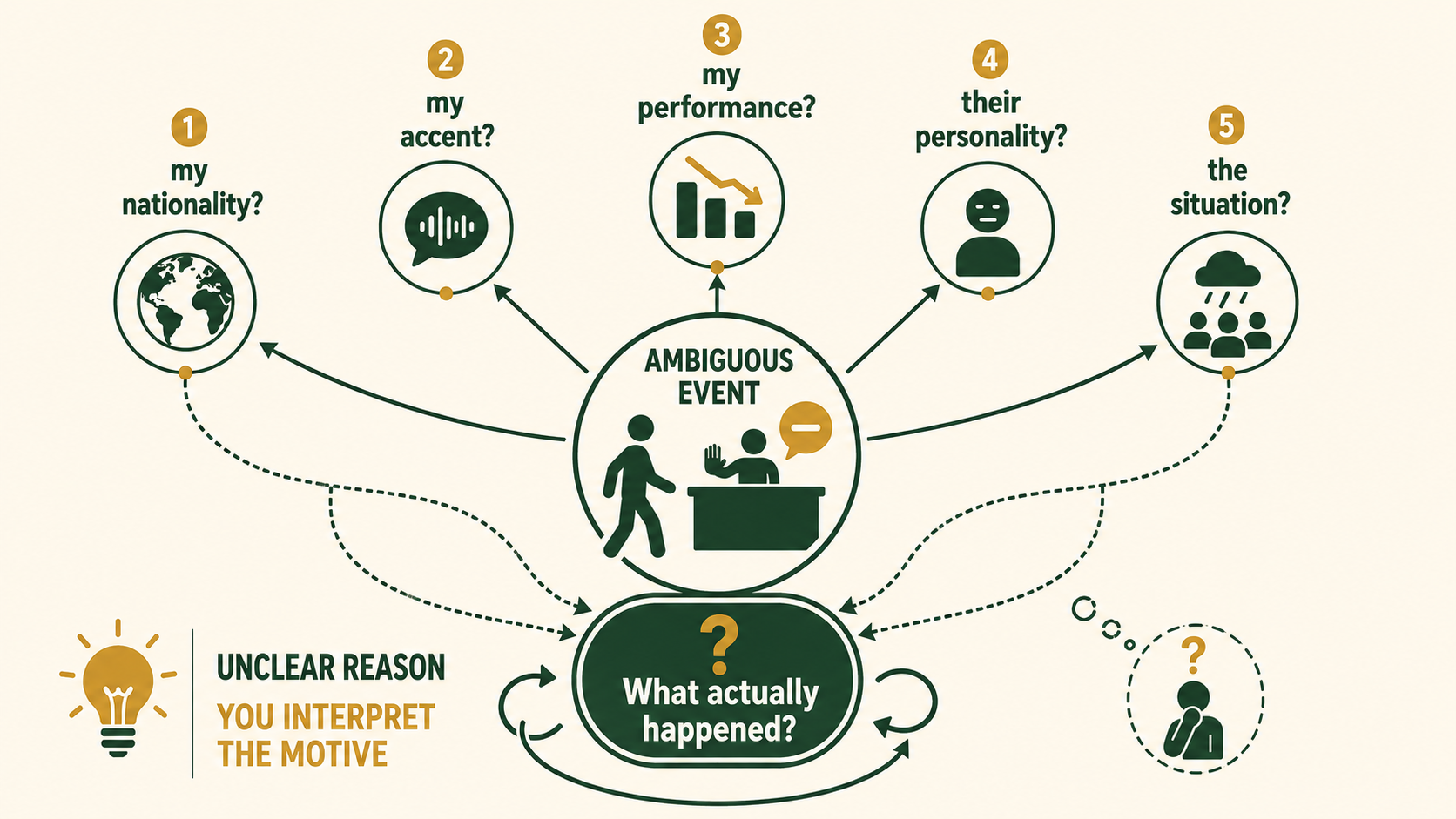
Attributional ambiguity is the psychological state of being unsure whether negative treatment happened because of your background or for some unrelated reason. A 2024 US study found 16.5% of adults had experienced this kind of uncertain situation within six months, and that the uncertainty itself was associated with worse mental health.
Why do I keep replaying a discriminatory interaction in my head?
Because your mind is trying to resolve an open question, and an ambiguous incident often has no available resolution. This rumination is a normal response to unresolved uncertainty, not a sign that you are overreacting or imagining things.
Can uncertainty about discrimination affect mental health even without proof?
Yes. Research links this specific kind of uncertainty with higher depressive symptoms and worse self-rated mental health, independent of whether the underlying incident is ever confirmed. The not knowing is itself a documented psychological burden.
How can I tell discrimination from cultural misunderstanding?
Cultural misunderstanding tends to be a one-off, explainable by different norms or expectations, and doesn't typically repeat in a consistent pattern once clarified. Discrimination is more likely to show up as a recurring pattern that persists even after misunderstanding would reasonably have been resolved.
Does one incident prove discrimination happened?
Rarely. A single ambiguous interaction usually cannot reveal someone's motive with confidence. A repeated pattern, especially one involving comparison with how others were treated, provides considerably stronger grounds for a conclusion.
What should I do if I can never know for certain what happened?
Document what you can while it's fresh, pay attention to whether the pattern continues, and consider talking to someone outside the situation. You do not need certainty to take the experience seriously, to protect yourself going forward, or to seek support for how it's affecting you.
Need support? We're here.
Book a free 15-min consultation with our expat-specialized therapists.