
Key takeaway
Spain runs one of Europe's more detailed discrimination victim surveys, one that asks not just whether people experienced discrimination but where, how often they reported it, why they didn't, and what it cost them psychologically. That level of detail is genuinely useful, and it also means Spain's evidence base rewards careful reading rather than a single headline number. This article covers what current research actually shows about discrimination against foreigners and minority groups in Spain, where it tends to be reported most, why so few people formally complain, and what protections and support routes exist.
You've heard Spain described as warm, informal, easy to settle into. You've also wondered, after a landlord goes quiet or a rental application disappears, whether that reputation tells the whole story. This article holds both realities against the actual evidence.
Survey reports, field experiments and complaint records measure different things. They should not be treated as interchangeable.
What does current evidence show about discrimination in Spain?
Spain's most detailed recent evidence comes from CEDRE's 2024 victim survey of 2,200 people across nine racial and ethnic groups, which found that 33% felt discriminated against because of their racial or ethnic origin, up from 31% in a comparable 2020 survey. This figure describes a specific, deliberately selected set of racial and ethnic populations. It is not a measurement of how common discrimination is among Spain's foreign residents or international workforce as a whole, and shouldn't be generalized beyond the groups actually surveyed.
That precision matters more than it might seem. A survey built to capture the experiences of groups known to face discrimination will naturally show different numbers than a survey of the general population, and both are legitimate, useful data sources for different questions. CEDRE's is designed specifically to understand the experience of people already identified as facing racial and ethnic discrimination, which is exactly why its detail on domains, reporting and impact is so valuable.
Where is discrimination most commonly reported in Spain?
In CEDRE's 2024 survey, housing was the most frequently reported domain at 27.5%, followed by public space at 22% and police interactions at 20%. This domain breakdown is one of the more useful features of Spain's evidence base, since it shows discrimination isn't concentrated in any single part of life but spans housing, everyday public encounters and interactions with authorities.
A separate data source, CEDRE's own 2025 service caseload, shows a different but related picture: among the cases the organization directly handled that year, 434 involved private employment, 373 other goods and services, 332 housing, 327 health and 226 education. This is not a prevalence measure. It describes the composition of who actually contacted CEDRE for help, not the relative risk of discrimination in each area of life. Someone might be far more likely to experience discrimination in one domain and far less likely to seek formal help for it, which is exactly why these two types of data need to be read separately rather than combined into one number.
A caseload tells you who walked through the door. It does not tell you who never did.
Can landlords discriminate against foreigners in Spain?
Yes, and this has been demonstrated through controlled field experiments, not just reported in surveys. A 2025 Madrid experiment contacted 1,600 real landlords using fictitious WhatsApp rental profiles that varied between native Spanish and Chinese-origin signals. Discrimination against visibly Chinese-background applicants was statistically significant.
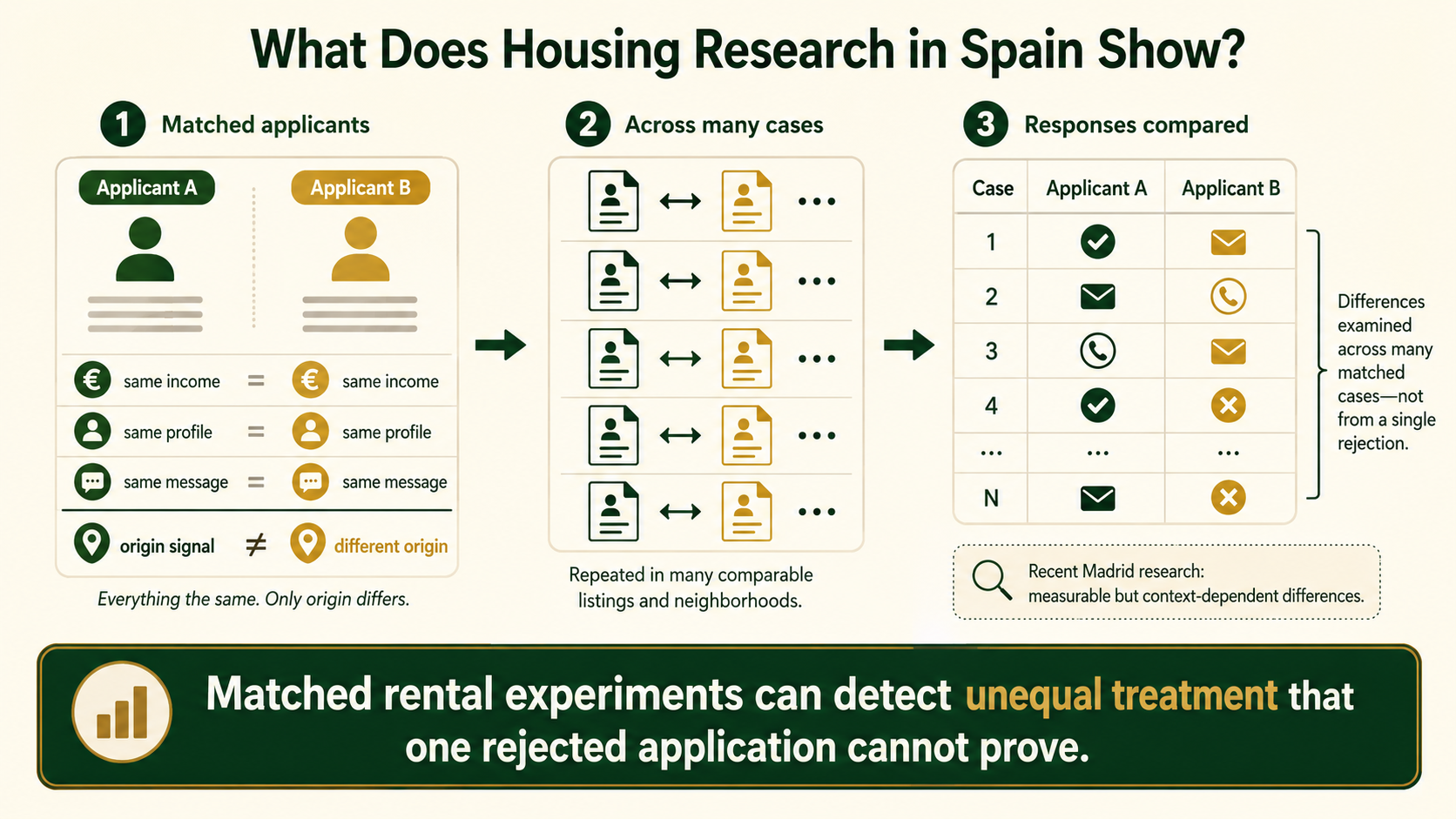
The experiment found something worth understanding in detail: the size of the disadvantage depended heavily on how the applicant's identity was presented. It was noticeably smaller when a profile combined a Spanish first name with a Chinese surname and a Spanish cultural cue than when the full name and cultural presentation signaled Chinese origin more strongly. Adding reassuring income information did not eliminate the gap in either version. Separately, older Spanish research found Moroccan-named applicants roughly 15 percentage points less likely to be contacted than Spanish-named applicants, a disparity that narrowed but did not disappear even with positive financial information attached.
Housing discrimination can occur before an applicant ever meets the landlord.
For the full methodology behind these correspondence and messaging experiments, and how similar patterns compare across France, Germany and the Netherlands, housing discrimination abroad covers that in depth.
What does workplace and everyday discrimination look like in Spain?
Workplace discrimination in Spain shows up through similar mechanisms documented elsewhere in Europe, name and origin signals affecting hiring responses, though the evidence specifically isolating Spain is thinner than for housing. One notable nuance comes from a harmonized European hiring experiment testing hijab-related hiring penalties for Muslim women: the effect found in Spain was smaller than the penalties detected in Germany and the Netherlands for the same experimental design, particularly in customer-facing roles.
That difference is worth taking seriously without over-reading it. A smaller measured effect in one specific experiment doesn't establish that Spain is broadly less discriminatory, since a single study captures one mechanism in one context. It does suggest that discrimination doesn't operate identically across countries even when the underlying bias exists in more than one place. For the general patterns of how workplace discrimination tends to appear and what employees can do, workplace discrimination abroad covers that broadly.
Why is discrimination underreported in Spain?
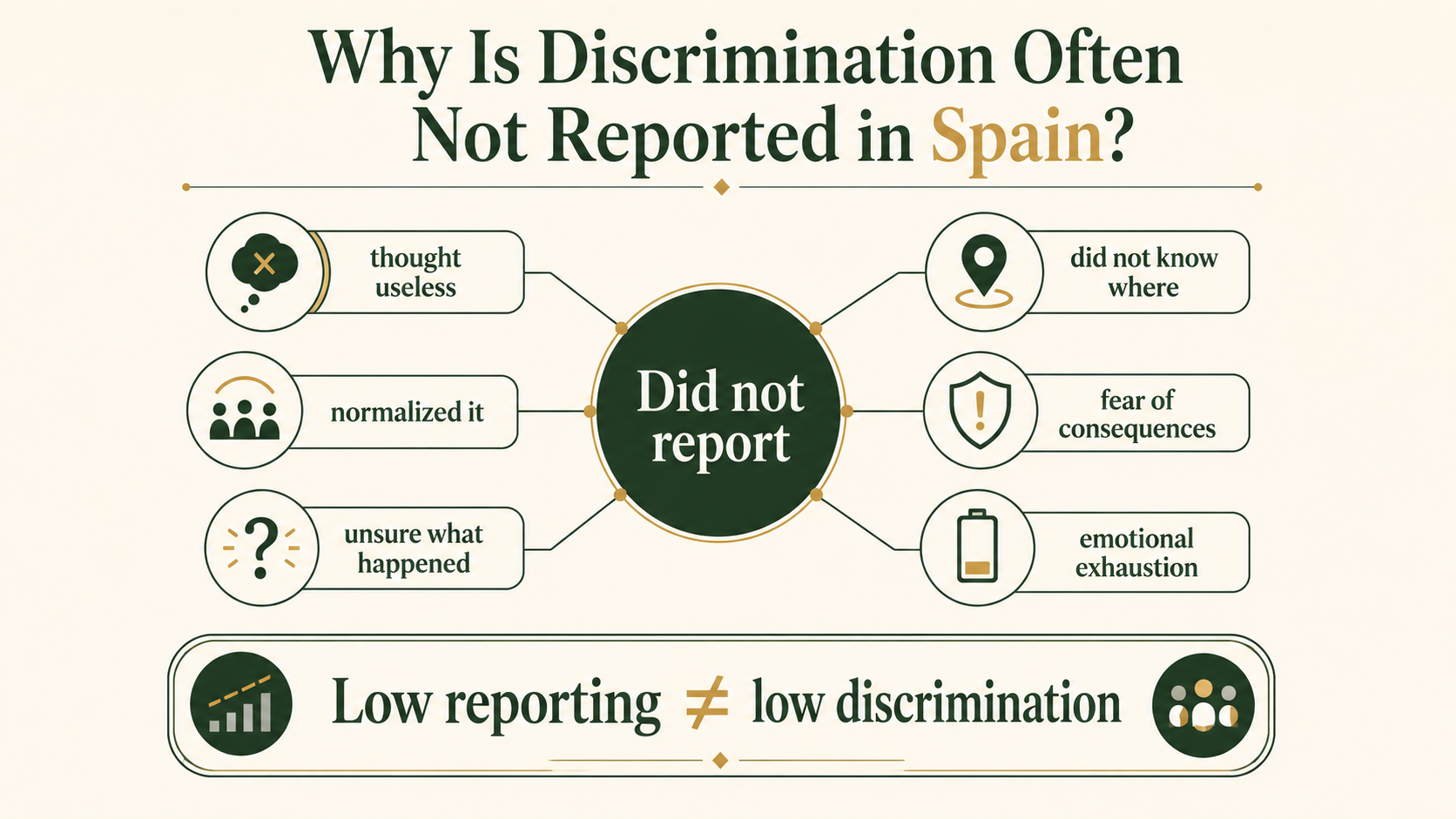
Only 22.4% of people in CEDRE's 2024 survey who felt discriminated against actually made a formal complaint or report, and the reasons people gave for not reporting were remarkably consistent and specific. Among those who didn't report: 20.6% believed reporting would be useless, 18.6% minimized the event to themselves, 18.3% considered it something normalized, and 13.6% simply didn't know where or how to report it.
Low reporting does not mean discrimination is rare. It also reflects whether people believe reporting is safe, useful and accessible.
The same survey captured something equally important: 23% of respondents described sadness, depression or other psychological consequences connected to their discriminatory experiences. This is a self-reported impact, not a clinical diagnosis, but it's a meaningful data point precisely because it comes from the same people describing low reporting rates. The experience clearly mattered to a substantial share of people, even though most never formally reported it.
Roughly a quarter of people affected described real psychological consequences. Barely a fifth reported what happened. Distress and documentation are not the same thing, and one does not require the other.
For a broader framework on documenting what happened and deciding whether and how to report, applicable directly to the Spanish context, how to report discrimination abroad covers that process.
Is discrimination in Spain always explicit, or can it be subtle?
Much of what Spain's evidence actually captures is subtle rather than overt: a landlord who simply doesn't respond, a callback rate that quietly shifts once an applicant's origin becomes visible, treatment in public space that never involves an explicit statement. The Madrid rental experiment is a clear illustration, discrimination measured through response patterns across matched profiles, not through any landlord ever stating a discriminatory reason out loud.
This is exactly the kind of pattern that's hard to read from a single personal experience but becomes clear at scale through careful research. For the broader landscape of how covert, hard-to-prove discrimination tends to operate and how to think about a pattern you've started noticing, subtle discrimination abroad covers that territory in depth.
What does Spanish law currently protect?
Law 15/2022 provides Spain's broad national framework for equal treatment and non-discrimination, establishing protections connected to racial or ethnic origin, among other grounds, across areas of public and private life. This is general information about the existence and scope of the legal framework, not individualized legal advice, and anyone facing a specific situation should seek advice about how the law applies to their particular circumstances.
Where can you seek help or report discrimination in Spain?
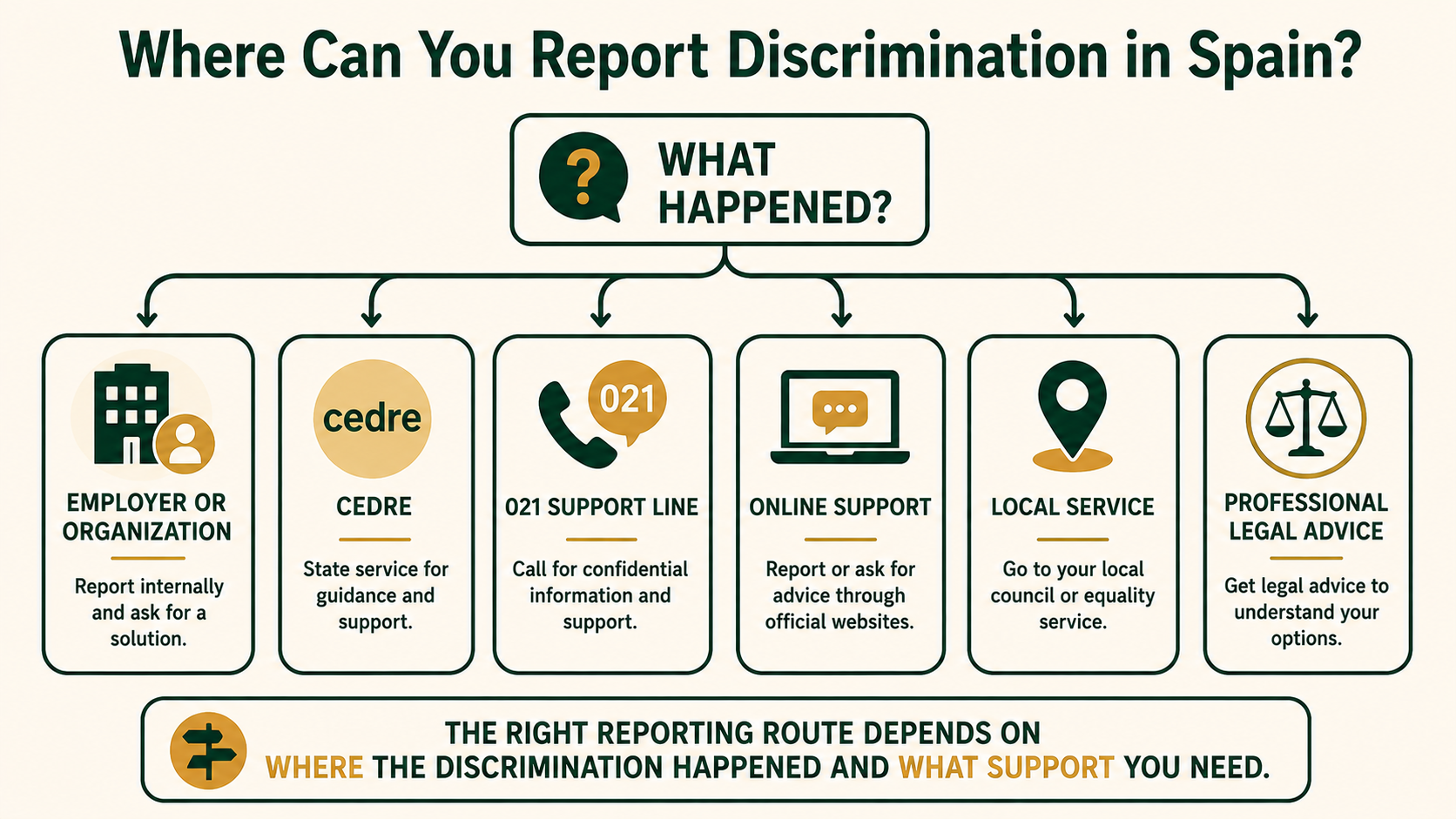
CEDRE provides dedicated racial and ethnic discrimination support through a free telephone line, 021, alongside WhatsApp, email, online channels and 23 physical offices across the country. In 2025, CEDRE handled 2,703 cases involving 3,280 people, including 1,302 classified as direct discrimination and 884 as indirect discrimination. As with the domain-composition figures above, this caseload describes what reached CEDRE, not how many people in Spain actually experienced discrimination that year.
Reaching out to CEDRE doesn't require having already decided to make a formal complaint. Its support routes are designed to help someone understand their situation and options, not only to process finished cases. For general guidance on documenting an incident and thinking through whether and how to escalate it, beyond what's specific to Spain, how to report discrimination abroad covers that process step by step.
How should you think about your own experience without overgeneralizing?
None of the figures in this article can tell you what happened in your own specific situation, even the most detailed and well-designed among them. The 33% CEDRE figure describes nine specifically selected racial and ethnic groups, not all foreigners in Spain. The Madrid housing experiment describes one manipulated identity signal in one rental context. Caseload numbers describe who sought help, not who experienced discrimination.
What this evidence is genuinely useful for is establishing that the underlying mechanisms are real, that housing responses can shift measurably based on origin signals, that most people who experience discrimination in Spain don't formally report it, and that the psychological impact when they do experience it is often real even without a report ever being filed. Whether any of this explains your specific experience is a separate question, better answered by looking at repetition and comparison than by a single incident. For the broader landscape this Spain-specific evidence sits inside, discrimination abroad is a useful starting point. If the weight of a discriminatory experience, reported or not, has been affecting you, discrimination and mental health abroad covers what tends to help.
Frequently asked questions
Is discrimination against foreigners illegal in Spain?
Yes. Law 15/2022 provides Spain's broad national framework prohibiting discrimination based on racial or ethnic origin and other protected grounds. This is general information and not a substitute for legal advice about a specific situation.
What does research show about discrimination in Spain?
CEDRE's 2024 survey of 2,200 people across nine racial and ethnic groups found 33% felt discriminated against due to racial or ethnic origin, with housing, public space and police interactions the most frequently reported domains. A 2025 Madrid field experiment separately found measurable rental discrimination against Chinese-origin applicant signals.
Can landlords discriminate against foreigners in Spain?
Research demonstrates this has happened in practice. A 2025 field experiment involving 1,600 real landlords found statistically significant discrimination against applicants with Chinese-origin signals, with the size of the effect depending on how strongly the profile signaled foreign origin. Older research found a similar pattern for Moroccan-named applicants.
What is CEDRE?
CEDRE is Spain's dedicated service for racial and ethnic discrimination support, providing both survey research on discrimination prevalence and direct assistance to people who believe they have experienced it, through phone, WhatsApp, email, online and in-person channels.
What is Spain's 021 discrimination helpline?
The 021 line is CEDRE's free telephone service for people seeking support or wanting to report racial or ethnic discrimination in Spain. It is one of several access channels CEDRE offers alongside WhatsApp, email and its network of offices.
Need support? We're here.
Book a free 15-min consultation with our expat-specialized therapists.