
Key takeaway
The Netherlands ranks consistently among Europe's most desirable places to work as a foreigner, and it also has some of the most rigorous experimental evidence anywhere in Europe showing that landlords and employers can treat comparable applicants differently based on name, background or accent. Both things are true at once, and neither cancels the other out. This article covers what current research actually shows about discrimination against foreigners and minority groups in the Netherlands, where it has been documented, what Dutch law protects, and where to turn if you think you're experiencing it.
You've heard the Netherlands described as tolerant, direct, internationally minded. You've also messaged a landlord and watched the reply arrive slower than it did for a friend with a Dutch-sounding name. This article is about holding both realities honestly.
Dutch discrimination data do not support a simple conclusion that "the Netherlands is discriminatory" or "discrimination does not happen." Different methods reveal different parts of the picture.
What does current evidence show about discrimination in the Netherlands?
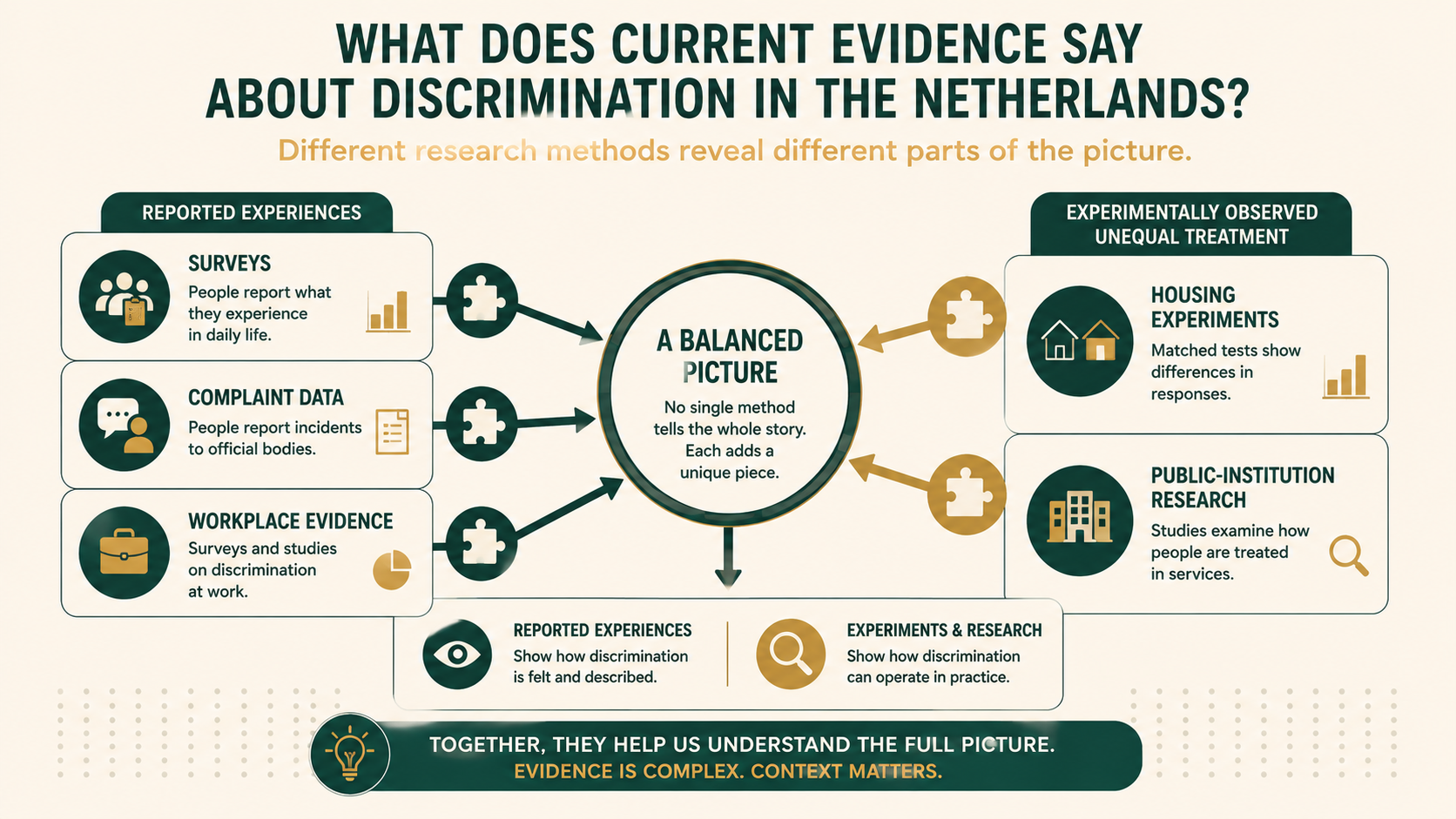
The Netherlands has some of the strongest experimental discrimination evidence in Europe, particularly in housing, showing measurable unequal treatment of applicants with foreign or ethnic-minority names, alongside government survey data indicating real but harder-to-quantify unequal treatment in workplaces and public institutions. The evidence is genuinely mixed in what it shows, methodologically strong in some areas, thinner in others, and it changes over time, which is itself an important finding rather than a limitation to explain away.
A government survey of 4,481 Dutch civil servants found that roughly 10% reported personally experiencing racism in the preceding year, inside the public sector itself. Separately, OECD integration indicators estimate that around 19% of foreign-born residents, across the survey periods measured, reported discrimination linked to ethnicity, nationality or race, though this figure combines data from different points in time rather than reflecting a single current snapshot.
Even public institutions built to model equal treatment report the phenomenon internally. That alone should settle the question of whether it happens here.
What does research show about housing discrimination in the Netherlands specifically?
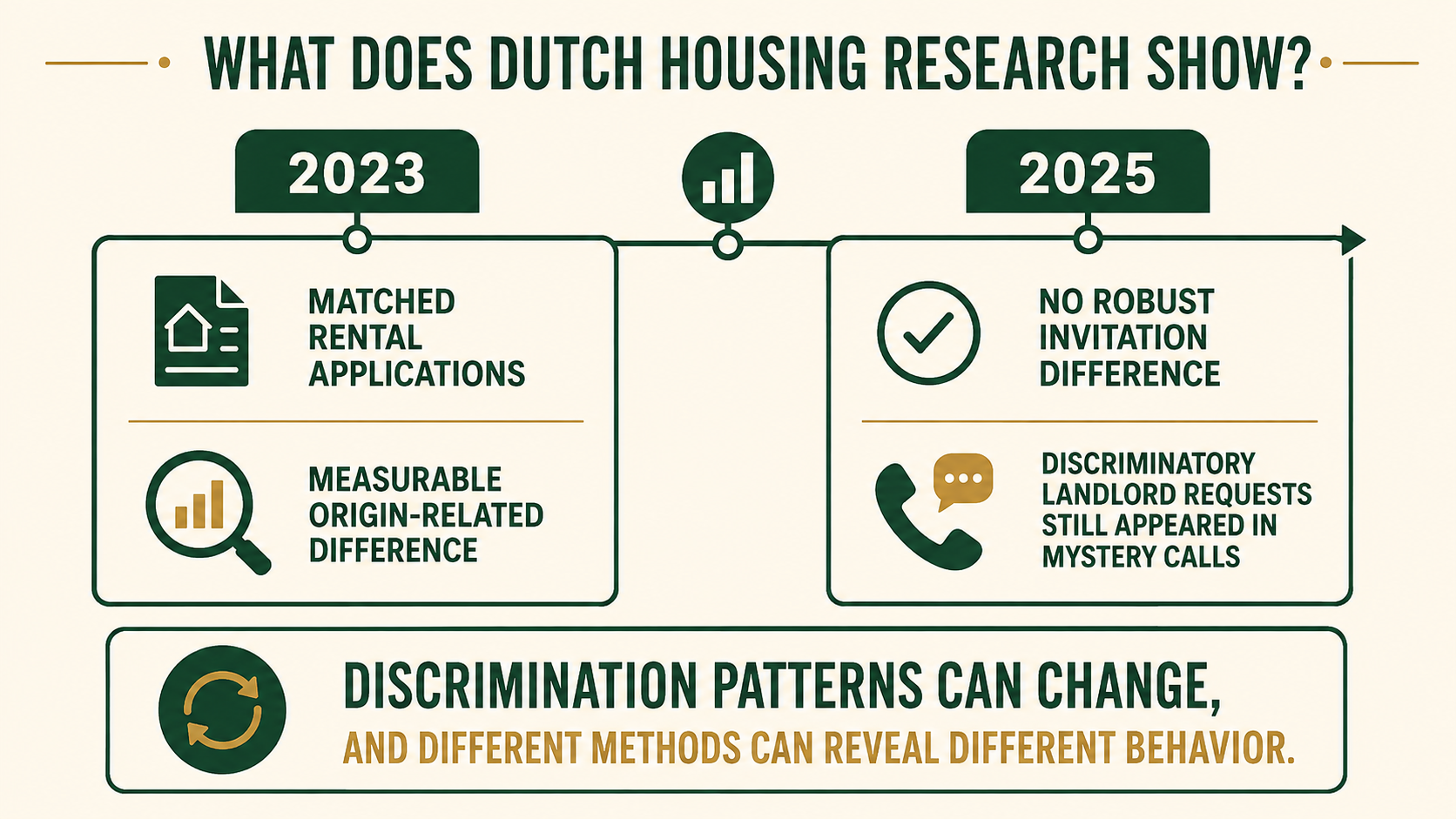
The Netherlands runs one of Europe's most methodologically rigorous, repeated national housing discrimination monitoring programmes, and its results have genuinely changed between rounds, which is itself an important finding. The 2023 national housing discrimination monitor, based on 3,030 successful correspondence tests, sending matched rental applications that varied only in the applicant's name, found that male applicants with Moroccan-sounding names had an 18% lower probability of receiving a viewing invitation than otherwise identical applicants with Dutch-sounding names.
The 2025 follow-up round told a more complicated story. It did not detect statistically robust origin-based differences in viewing invitation rates through the correspondence-test method. But the same round used a second method, mystery calling, where researchers posed as landlords and directly asked rental intermediaries to discriminate on their behalf. More than half of the intermediaries contacted were willing to cooperate with the discriminatory request to some degree.
A national housing experiment can detect patterns that one rejected rental application cannot.
Read together, these two rounds and two methods suggest something more nuanced than either "discrimination is over" or "nothing has changed." Initial application screening may have genuinely improved. The underlying willingness to discriminate, when asked directly, had not necessarily gone anywhere.
A landlord who never gets asked to discriminate and an intermediary who agrees the moment someone asks are not the same finding, even if both show up as "no discrimination detected" in a standard test.
Full detail on how these correspondence and mystery-calling methods work, and how similar patterns look in France and Spain, is covered at housing discrimination abroad.
Can workplace discrimination affect foreigners in the Netherlands?
Yes, and it can involve both hiring decisions and the treatment of religious or cultural markers once someone is employed. A harmonized European hiring experiment testing the effect of wearing a hijab found measurable hiring penalties for Muslim women in the Netherlands, particularly for customer-facing roles, a pattern also found in Germany, with a smaller effect detected in Spain. This shows discrimination in Dutch hiring can interact with religious visibility specifically, not only with name or accent alone, and that the size of a penalty can vary meaningfully depending on the kind of role being applied for.
The same qualified candidate can face a different hiring outcome in the Netherlands depending on whether a religious marker is visible, and depending on whether the role involves facing customers.
Discrimination at work can also show up more subtly, through accent-related judgments about competence, exclusion from informal decision-making, or being asked to prove qualifications more rigorously than local colleagues. These patterns are not unique to the Netherlands, and the general mechanisms are covered in depth at workplace discrimination abroad and, specifically for accent, at accent discrimination abroad.
Can discrimination in the Netherlands be subtle rather than explicit?
Yes. Much of what current Dutch evidence captures, differential response rates, willingness to cooperate with a discriminatory request when asked directly, is precisely the kind of subtle, hard-to-prove treatment that never involves an explicit discriminatory statement. The mystery-calling finding from the 2025 housing round is a clear example: an intermediary agreeing to quietly filter out certain applicants for a landlord is a world away from a landlord publicly refusing to rent to foreigners, but the practical effect on an applicant can be identical.
This is exactly why one person's individual experience is so hard to interpret with confidence, and why the broader landscape of covert, patterned discrimination is worth understanding on its own terms. Subtle discrimination abroad covers this territory in more depth, including how to recognize a pattern versus an isolated incident. For situations involving Dutch public institutions and administrative bodies specifically, discrimination or bureaucracy abroad covers how to separate genuine bureaucratic friction from unequal treatment.
Is nationality protected from discrimination under Dutch law?
Yes. The Netherlands explicitly lists nationality among its protected grounds for equal treatment, alongside race, religion and other characteristics, making it one of the clearer legal positions in Europe on this specific point. This distinguishes Dutch law from some neighboring countries, where nationality is covered only indirectly through broader protections against ethnic or racial discrimination rather than being named as its own protected category.
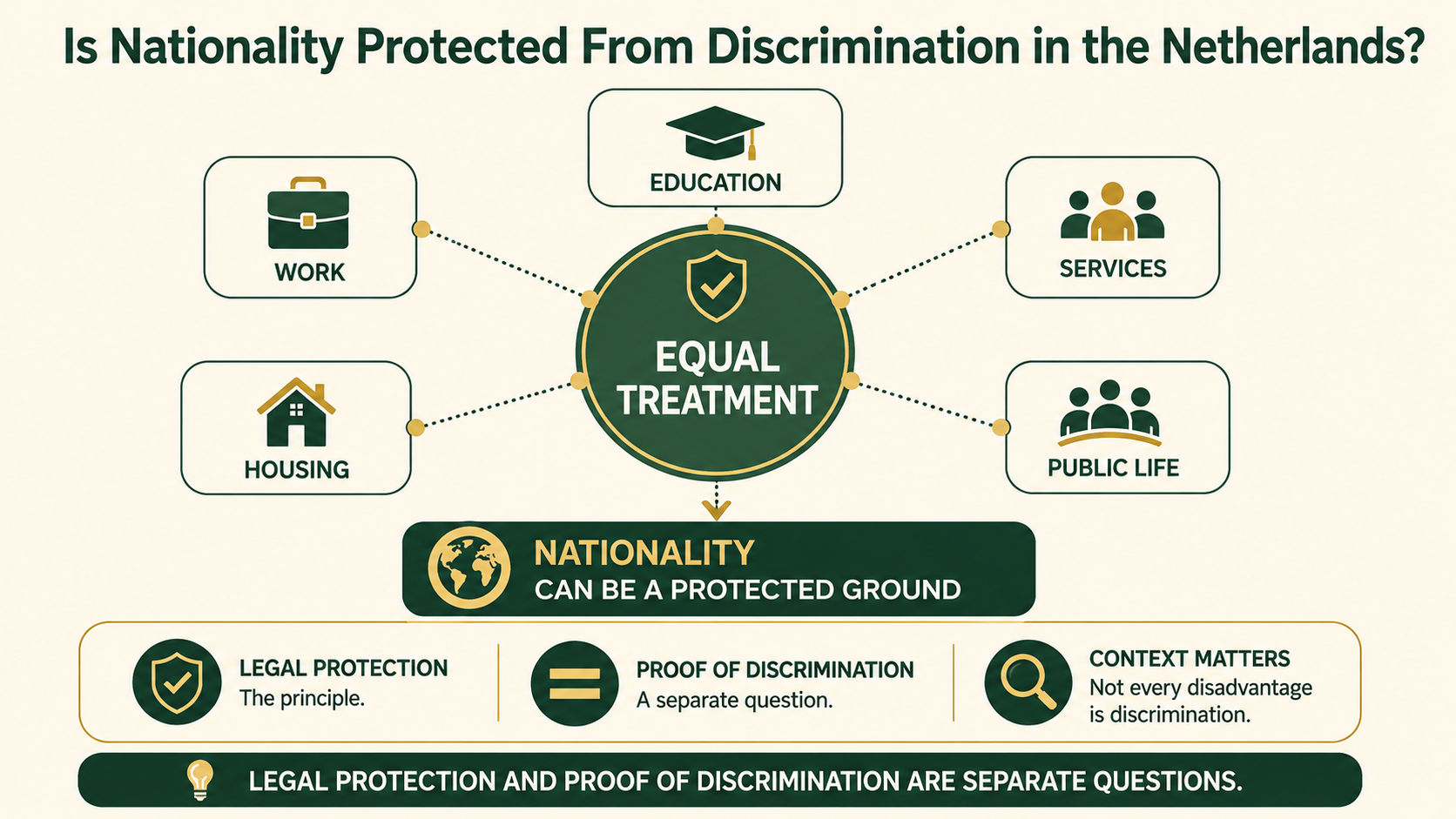
Dutch equal-treatment law prohibits discrimination in employment, housing and the provision of goods and services on these grounds. This article provides general information only and is not a substitute for individualized legal advice about your specific situation.
Where can you report discrimination in the Netherlands?
People who believe they have experienced discrimination in the Netherlands can bring a complaint to the Netherlands Institute for Human Rights, contact a local anti-discrimination service, or involve the police where relevant, and since 2024 municipalities have also been required to operate dedicated landlord-reporting points under the Good Landlord Act. That law also strengthened requirements around transparent, non-discriminatory tenant-selection criteria, giving housing discrimination specifically a clearer institutional reporting pathway than it had before.
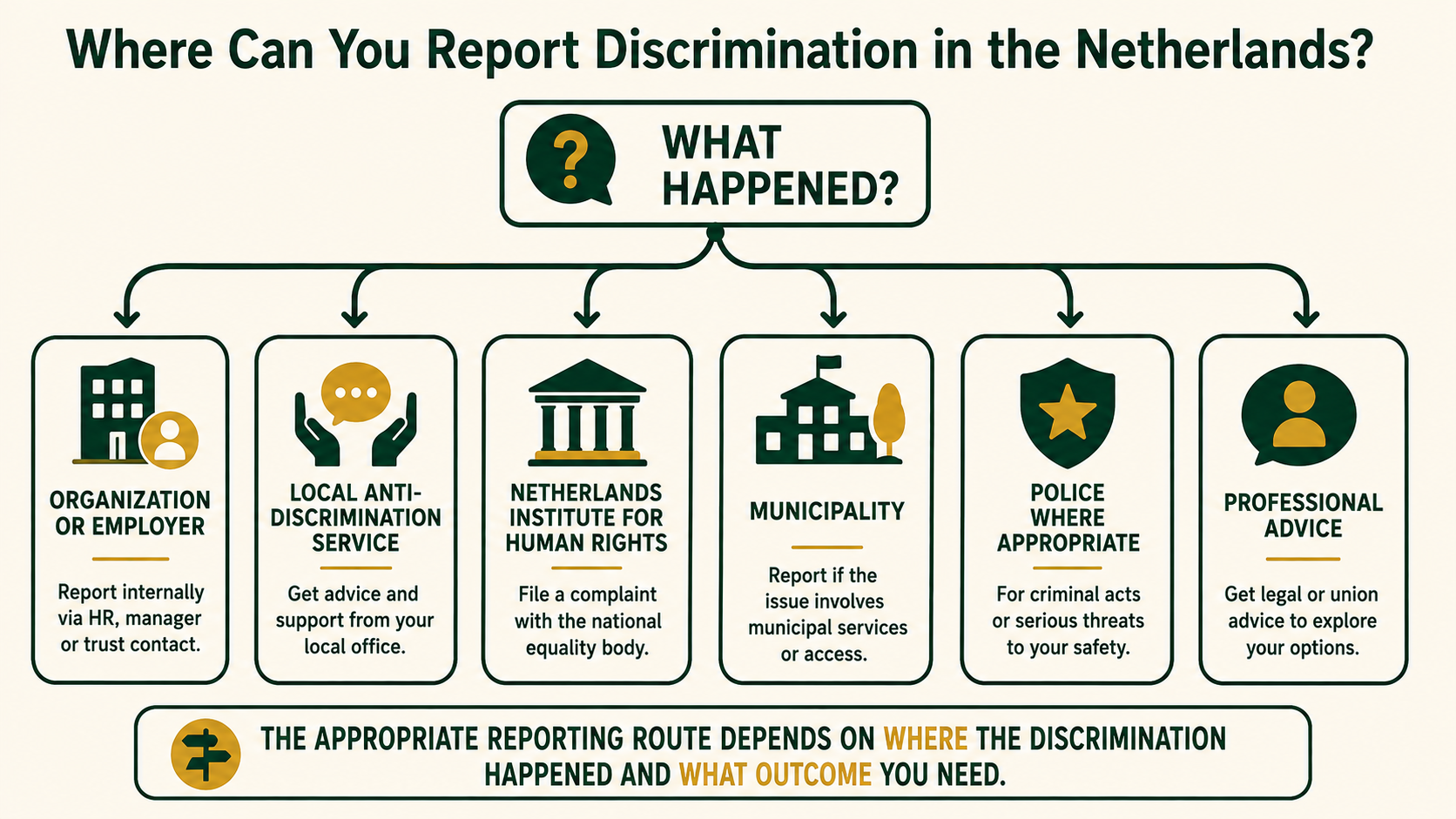
Which route makes sense depends on what happened and where. A workplace concern typically starts differently than a housing one. For a general framework on documenting what happened, separating fact from interpretation, and deciding whether and how to report, how to report discrimination abroad covers that process in depth and applies directly to the Dutch context.
How should you think about your own experience without overgeneralizing?
A single frustrating interaction, whether it's an unanswered rental message, a skeptical official, or an unexplained rejection, cannot on its own tell you whether you experienced discrimination, even in a country with strong documented evidence of the phenomenon at a population level. The research covered here demonstrates that unequal treatment is measurable across many matched comparisons. It does not, and cannot, tell you what happened in your specific case.
Strong legal protections do not automatically mean unequal treatment never occurs.
What tends to be more informative than any single incident is a pattern: the same kind of experience recurring across different situations, a clear comparison point with how someone else was treated, or a noticeable shift in tone once your background became apparent. If you're sitting with genuine uncertainty about one specific, ambiguous moment, that exact experience is covered at discrimination abroad, which lays out the broader landscape this Netherlands-specific evidence sits inside. If the weight of a discriminatory experience, proven or not, has been affecting you, discrimination and mental health abroad covers what tends to help.
Does discrimination in the Netherlands stay confined to one area of life?
Not necessarily. Discrimination documented in one setting, such as housing, does not mean a person's experience is limited to that domain, and broader European research finds that people who experience racial discrimination often encounter it across more than one area of life rather than in a single isolated context. This matters for how you interpret your own experience in the Netherlands specifically. A pattern noticed in housing might reasonably prompt more attention to how comparable situations play out at work, with public institutions, or in everyday social interactions, rather than being treated as an unrelated, one-off event.
This is also why the Dutch evidence base benefits from being read as a set of related findings rather than isolated statistics. A civil servant reporting internal racism, a rental applicant facing a slower response, and a job candidate facing a hijab-related hiring penalty are not necessarily describing the same person's experience, but they describe the same underlying dynamic showing up in different institutional settings across the same country.
Frequently asked questions
Is discrimination against foreigners illegal in the Netherlands?
Yes. Dutch equal-treatment law explicitly prohibits discrimination based on nationality, race, religion and other protected grounds across employment, housing and services. This is general information and not a substitute for legal advice about a specific situation.
Can landlords discriminate against foreigners in the Netherlands?
Landlords are not legally permitted to discriminate based on nationality or ethnicity, though research shows this has happened in practice. A 2023 national correspondence-testing study found applicants with Moroccan-sounding names had an 18% lower chance of receiving a viewing invitation than comparable applicants with Dutch-sounding names.
What does research show about housing discrimination in the Netherlands?
The 2023 national housing monitor found significant name-based disparities in viewing invitations. The 2025 follow-up did not detect the same statistically robust pattern through correspondence testing, but mystery calls in the same round found more than half of rental intermediaries willing to cooperate with a discriminatory landlord request when asked directly.
Can workplace discrimination affect foreigners in the Netherlands?
Yes. Documented patterns include hiring penalties linked to religious visibility, such as wearing a hijab, particularly in customer-facing roles, alongside more general accent-related bias and exclusion from informal workplace networks that has been documented across European labor markets more broadly.
How do I know whether I was discriminated against in the Netherlands?
A single incident rarely provides enough information to be certain, since Dutch research demonstrates unequal treatment at a population level without being able to explain any individual case. Looking for repetition, comparison with how others were treated, and a plausible absence of alternative explanations tends to be more informative than judging one experience alone.
Need support? We're here.
Book a free 15-min consultation with our expat-specialized therapists.