
Key takeaway
You message a landlord about a flat, get an enthusiastic reply within the hour, ask two follow-up questions, and then nothing. Two days later a local friend messages the same listing with a comparable income and gets a viewing slot for Thursday. Neither of you can prove what happened from a single exchange. But researchers have run exactly this scenario, at scale, with controlled variables, thousands of times across European rental markets, and the pattern that emerges is measurable. This article covers what housing discrimination actually looks like abroad, how researchers detect it before you'd ever notice it yourself, what European field experiments have found, and how to separate a landlord's legitimate requirement from unequal treatment.
The reply comes fast for some names and slow, vague or absent for others, and the applicant never gets to see the comparison happening on the other side.
Housing discrimination can happen before a landlord ever meets you.
What is housing discrimination?
Housing discrimination is when someone renting or selling property treats a prospective tenant or buyer less favorably because of their nationality, ethnicity, race, religion or perceived foreign background, rather than because of legitimate factors like income, references or documentation. It can happen at the very first message, well before any conversation about the actual apartment takes place.
It can be direct, an explicit refusal to rent to foreigners, or indirect, a formally neutral requirement that ends up disadvantaging foreign applicants disproportionately without a genuine justification. Both forms are documented in the research, and indirect discrimination is often the harder one to notice because it never announces itself as bias.
How does housing discrimination appear before you even meet a landlord?
Housing discrimination frequently occurs at the earliest stage of contact, in whether a message gets answered at all, whether a viewing is offered, and how quickly and warmly the response comes, long before any face-to-face interaction with the landlord happens. This is precisely why it's so hard for any individual renter to detect. You only ever see your own applications. You never see the comparison set.
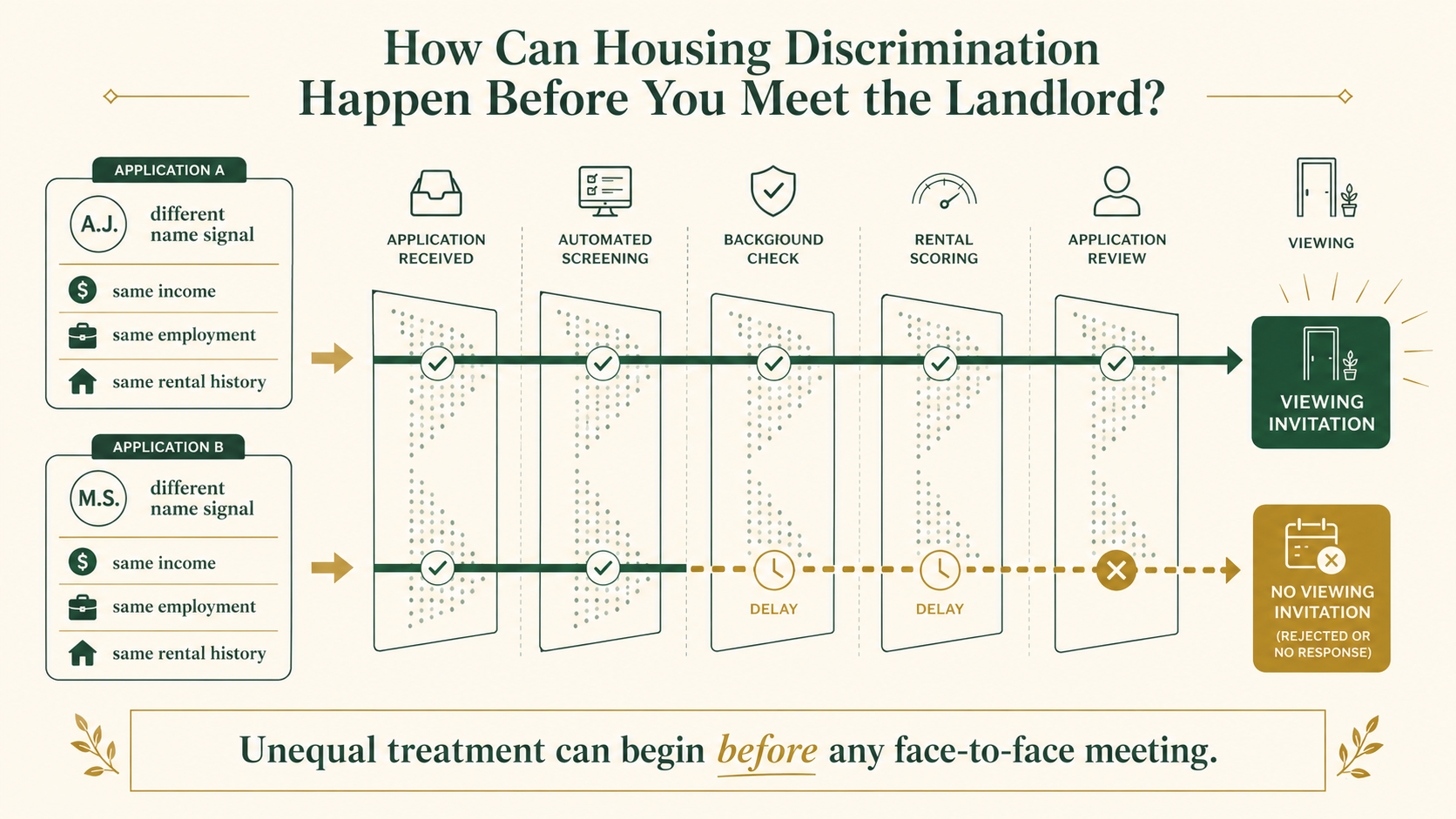
This is also exactly what makes the research method so valuable. Because researchers can send many nearly identical applications and compare outcomes directly, they can see the pattern that no single renter ever could.
How do researchers actually test for rental discrimination?
Researchers send matched correspondence tests, near-identical rental inquiries that vary only in the applicant's name or stated background, to real listings, then compare response and viewing-invitation rates. Because income, employment status and the substance of the message are held constant, any consistent gap in responses can be attributed to the one variable that changed.
One rejection is ambiguous. Thousands of matched rental applications can expose patterns that individuals cannot see.
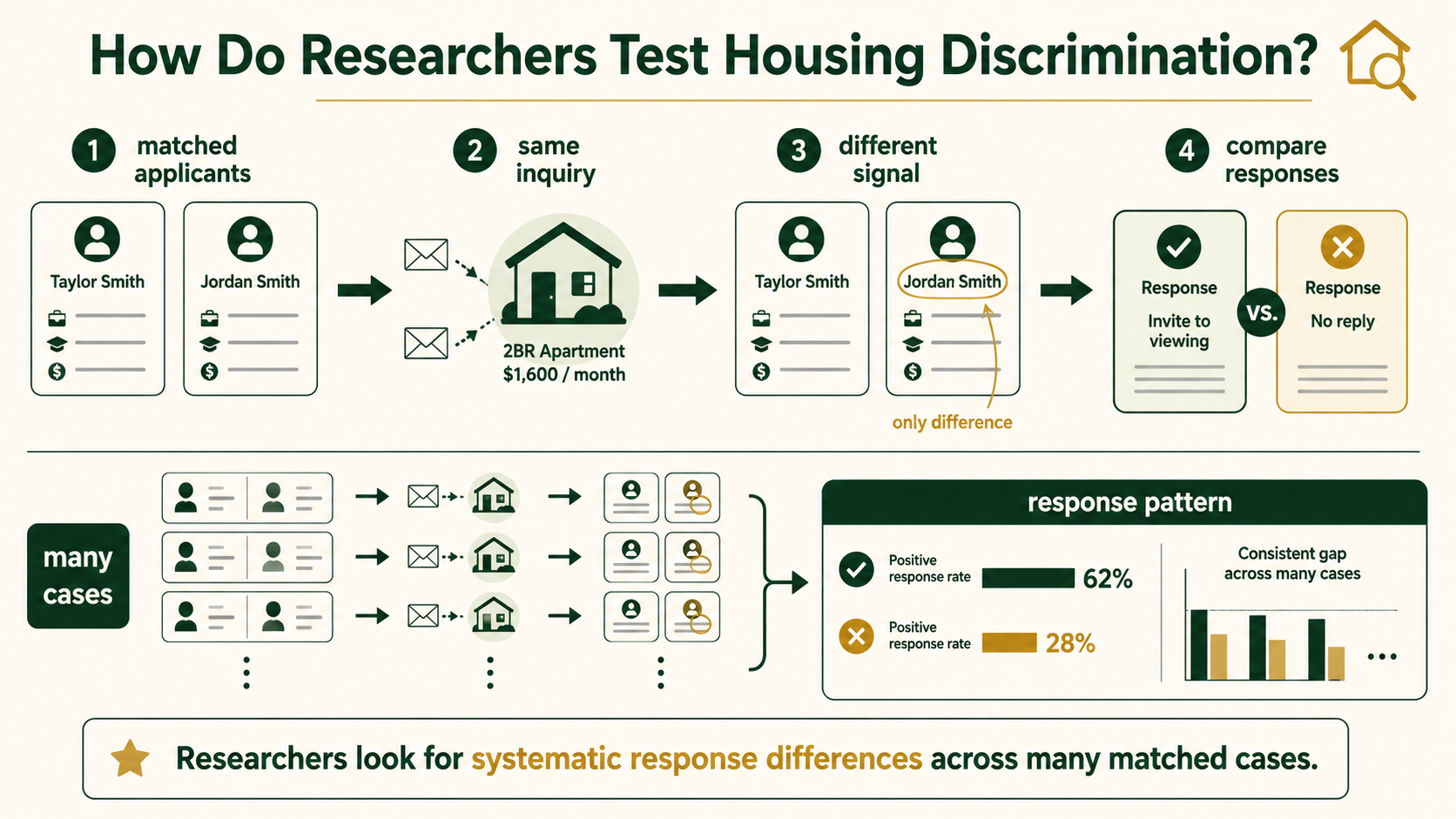
This method has been run repeatedly across several European countries, and the findings are some of the most concrete evidence available anywhere in discrimination research, because unlike a survey asking people how they feel, a correspondence test measures what landlords actually do.
What have European housing experiments actually found?
Large-scale correspondence tests in the Netherlands, France and Spain have found consistent and measurable gaps in response and viewing-invitation rates for applicants with foreign-sounding or ethnic-minority names, even when income and other application details were matched. The specific size of the gap varies by country, name signal and study design, but the direction of the finding is remarkably consistent.
The Netherlands' 2023 national housing discrimination monitor, based on 3,030 successful correspondence tests, found that male applicants with Moroccan-sounding names had an 18% lower probability of receiving a viewing invitation than otherwise comparable applicants with Dutch-sounding names.
French field experiments found applicants with names associated with North Africa, sub-Saharan Africa and Turkey were roughly 16 to 22 percentage points less likely to receive a response than applicants with French names. A separate Paris-based study, sending over 2,000 matched messages to more than 500 listings, found a pronounced disadvantage specifically for North-African-origin name signals.
A 2025 Madrid experiment contacted 1,600 real landlords using fictitious WhatsApp profiles varying between native Spanish and Chinese-origin signals. Discrimination against visibly Chinese-background applicants was statistically significant. Interestingly, it was noticeably smaller when a profile combined a Spanish first name with a Chinese surname and a Spanish cultural cue, and larger when the full name and cultural presentation signaled Chinese origin more strongly. Adding reassuring income information did not eliminate the gap. Earlier Spanish research separately found Moroccan-named applicants roughly 15 percentage points less likely to be contacted than Spanish-named applicants, a disparity that narrowed but did not disappear even with positive financial information attached.
Does this mean discrimination is constant and unchanging?
No, and this is one of the most important nuances in the research. The Netherlands ran its housing monitor again in 2025, and that round did not find statistically robust differences in viewing invitations based on origin signals in the correspondence tests. That looks like good news, and it may genuinely reflect improvement. But the same 2025 round used mystery calling, researchers posing as landlords and asking rental agents to discriminate on their behalf, and found that more than half of intermediaries were still willing to cooperate to some degree with a discriminatory request when asked directly.
Two methods measuring the same market in the same year told two different stories. One suggests progress in how initial applications are treated. The other suggests the willingness to discriminate, when explicitly invited to, hadn't gone away at all. This is a genuinely useful lesson: discrimination should be monitored repeatedly and through multiple methods, not assumed to be a fixed, permanent feature of a market based on one study from one year.
A market can look fairer in the applications landlords answer and still be entirely willing to discriminate the moment someone asks them to.
Is asking for extra documents or proof of income discriminatory?
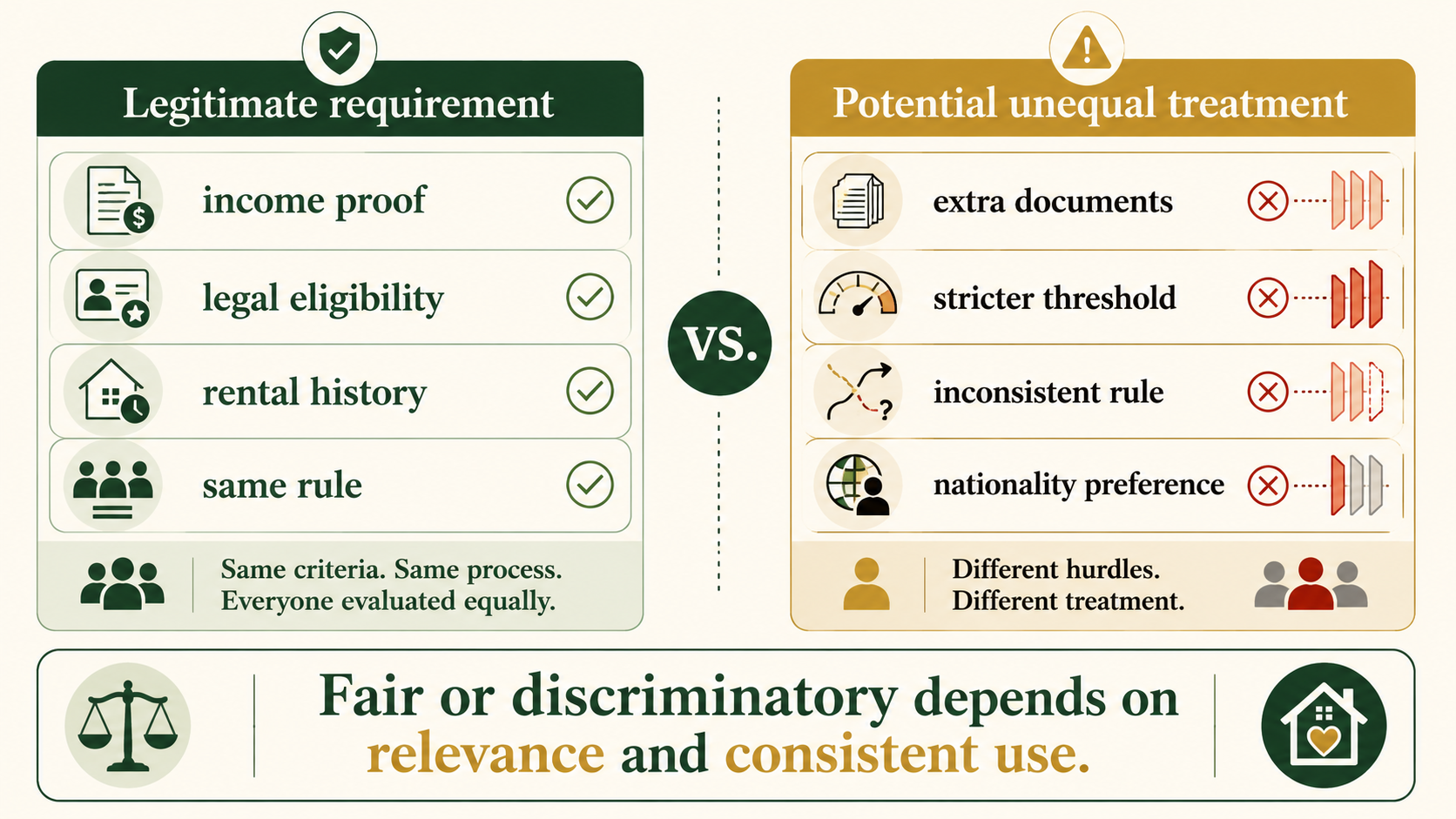
No, not on its own. A landlord asking for proof of income, employment verification or legal residence status is a common and often legitimate part of rental screening, and this alone does not constitute discrimination. The issue is not whether requirements exist. It's whether they're applied consistently and are genuinely necessary, rather than functioning as a pretext or being enforced more strictly for some applicants than others.
A landlord asking for proof of income or legal residence is not automatically discriminating. The issue is whether requirements are legitimate and applied consistently.
A useful test: would a local applicant with an equally thin credit history, an equally new job, or an equally unfamiliar employer be asked for the same additional documentation, applied with the same level of scrutiny? If the honest answer is that the same gap in your file would be waved through for someone else, the requirement is doing something other than genuine risk assessment.
What is the difference between direct and indirect housing discrimination?
Direct housing discrimination is an explicit refusal or statement tied to someone's background, such as a landlord stating outright they won't rent to foreigners. Indirect discrimination is a formally neutral policy that ends up disproportionately excluding foreign applicants without a legitimate justification, such as requiring a type of local guarantor or credit history that recent arrivals structurally cannot provide, applied without any flexibility or alternative path.
Indirect discrimination is often unintentional on the part of any one landlord or agent, which doesn't make its effect any less real. A policy can be discriminatory in practice even when nobody involved thinks of themselves as prejudiced.
A rule nobody designed to exclude anyone can still exclude people consistently. Intent and effect are not the same question.
Does one rental rejection prove you experienced discrimination?
No. A single unanswered message or unsuccessful application almost never provides enough information to conclude discrimination occurred, because there are many ordinary, non-discriminatory reasons a specific application might not succeed: the flat was already taken, the landlord had a stronger applicant, timing was off, or the message simply got lost among dozens of others.
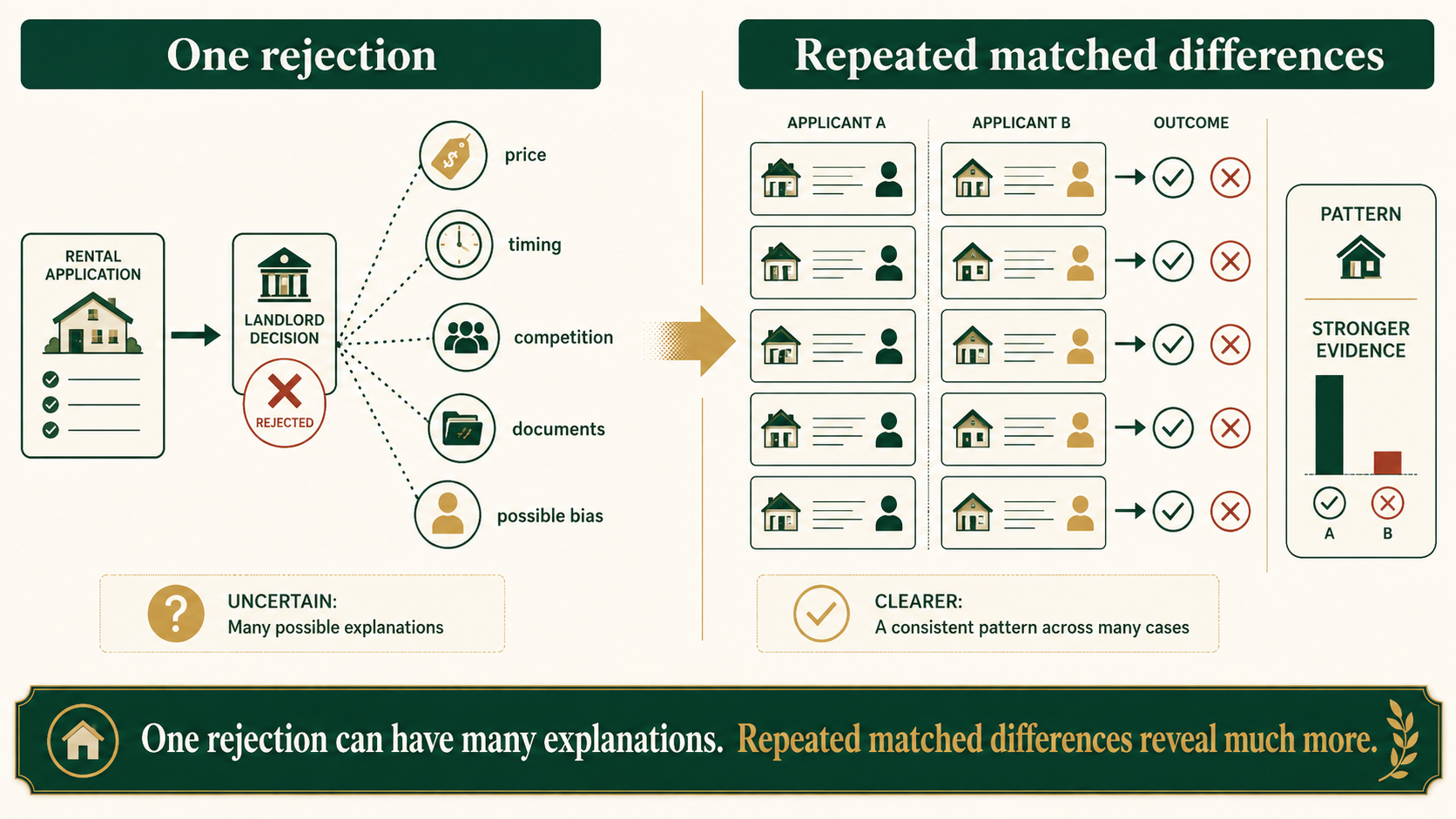
What the correspondence-test method demonstrates is a population-level pattern across many controlled comparisons, not a verdict on your specific experience. If you're trying to make sense of one ambiguous situation rather than an established pattern, was that discrimination or am I imagining it goes further into how to think through that particular kind of uncertainty, and subtle discrimination abroad covers the broader landscape of unequal treatment that's hard to prove from a single incident.
What should you do if you notice a repeated pattern?
If you notice a consistent pattern across multiple rental applications, slower or absent responses after your name or background becomes apparent, more scrutiny than comparable applicants seem to face, document what you can while it's fresh and consider whether the pattern is strong enough to act on. Dates, the exact wording of listings and responses, and any comparison points you have access to all strengthen your position, whether or not you ultimately pursue anything formally.
Housing discrimination in the Netherlands specifically has a defined reporting route: since 2024, municipalities are required to operate landlord-reporting points under the Good Landlord Act, alongside the Netherlands Institute for Human Rights and local anti-discrimination services. Reporting routes, protections and legal definitions differ meaningfully by country, and country-specific detail is covered at discrimination in the Netherlands, discrimination in Germany, discrimination in France, discrimination in Spain and discrimination in the UK. For a full walkthrough of documentation and formal reporting options across contexts, how to report discrimination abroad covers that in depth.
For the broader landscape of how discrimination shows up across different parts of life abroad, discrimination abroad is the place to start.
Frequently asked questions
What is housing discrimination?
Housing discrimination is unfavorable treatment of a prospective tenant or buyer based on nationality, ethnicity, race or perceived foreign background rather than legitimate factors like income or references. It can be direct, an explicit refusal, or indirect, a neutral-seeming policy that disproportionately excludes certain applicants.
Can landlords discriminate against foreigners?
Yes, and this has been demonstrated through controlled field experiments in multiple European countries, not just reported anecdotally. Correspondence tests consistently find lower response and viewing-invitation rates for applicants with foreign-sounding or ethnic-minority names compared with otherwise matched local applicants.
Can a foreign name affect rental applications?
Yes. A Dutch national housing monitor found applicants with Moroccan-sounding names had an 18% lower chance of receiving a viewing invitation. Similar patterns, with different specific magnitudes, have been documented in French and Spanish rental experiments involving other name and origin signals.
How do researchers test rental discrimination?
By sending large numbers of matched, often fictitious rental inquiries that are identical except for one signal, typically the applicant's name, and comparing response rates. Because everything else is held constant, a consistent gap can be attributed specifically to that one variable.
Is asking for extra documents discriminatory?
Not on its own. Requesting proof of income, employment or legal residence is common and often legitimate. It becomes questionable when the same standard isn't applied consistently, or when documentation demands are used more strictly against some applicants than others facing comparable circumstances.
How can you tell whether a rental rejection was discrimination?
A single rejection rarely tells you much on its own, since many ordinary explanations exist. Look instead for a pattern across multiple applications, whether responses changed noticeably after your name or background became apparent, and whether comparable local applicants seem to face less scrutiny in similar situations.
What should you do if you experience housing discrimination abroad?
Document specific incidents as they happen, including dates and exact wording, and watch for whether a pattern develops across multiple applications. Reporting routes and legal protections vary by country, so checking the specific process where you live is a useful next step once you have something concrete to point to.
Need support? We're here.
Book a free 15-min consultation with our expat-specialized therapists.