
Key takeaway
Discrimination abroad can be direct or indirect, interpersonal or institutional, overt or so subtle that you spend the drive home wondering whether you imagined it. It can show up in a rental application, a job interview, a doctor's office, a meeting where your idea lands differently once your accent registers, or a pattern of small exclusions that never quite amounts to one reportable incident. Roughly one in five people across the EU say they personally experienced discrimination or harassment in the past year , and research on racialized and migrant populations specifically shows much higher rates, alongside very low reporting. This guide explains the main forms discrimination takes, how to tell it apart from ordinary bureaucracy, bad luck or legitimate requirements, what it can do to mental health over time, and what your options are when you think it is happening to you.
You get a rejection email from a landlord an hour after a local friend with a nearly identical application got a viewing. A colleague repeats your point back to the room in accented English and it lands as insight, ten minutes after it landed as noise from you. Someone asks, warmly, where you are really from, for the third time this year, despite your residency, your taxes, your children's school run.
None of these prove anything by themselves. Together, they start to form a pattern. Learning to read that pattern, without either dismissing it or assuming the worst, is most of what this page is for.
What is discrimination abroad?
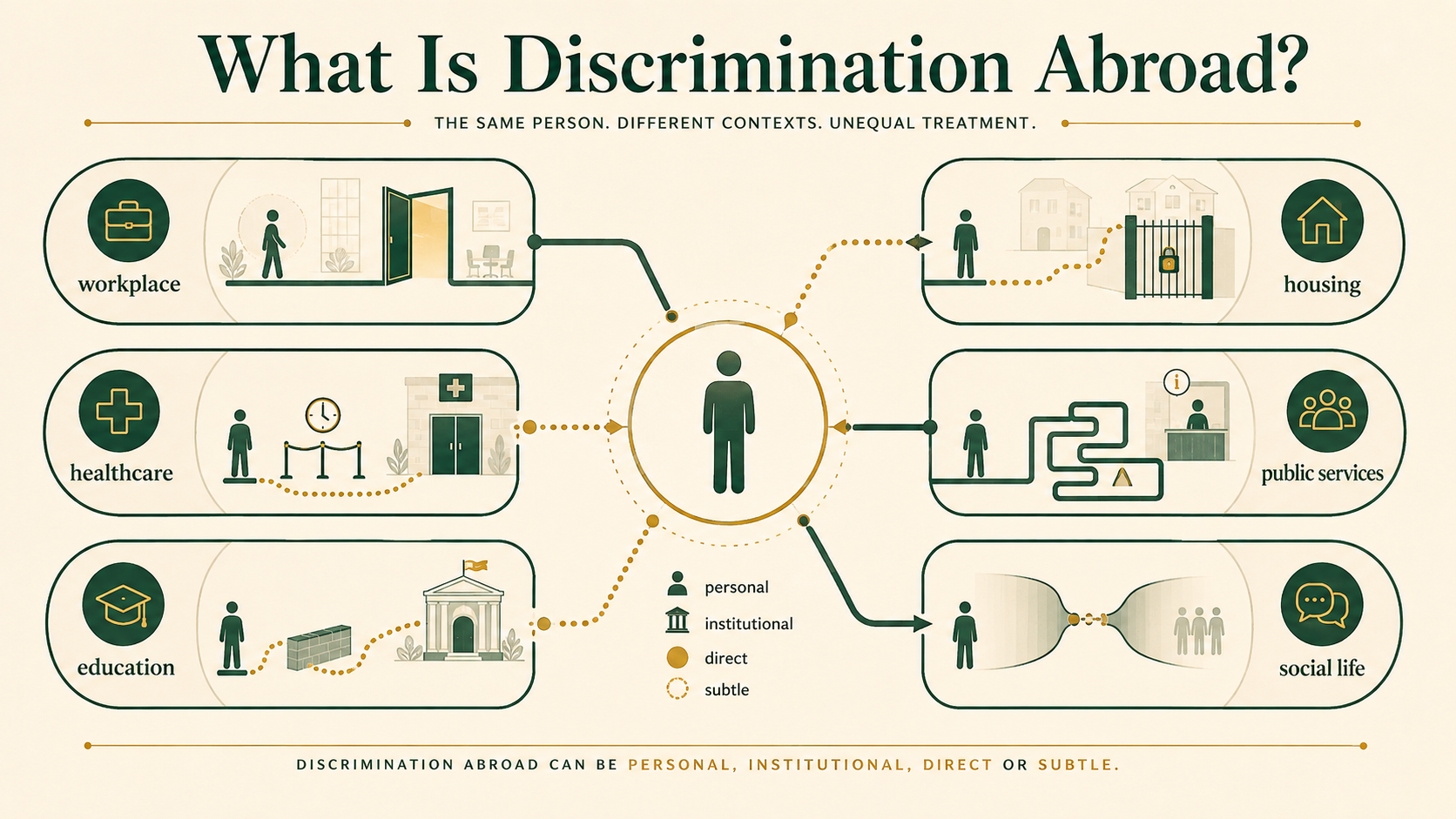
Discrimination abroad is unequal or unfavourable treatment connected to a characteristic such as nationality, race, ethnicity, religion, accent or migration status, occurring in a country where the person is a foreign resident. It can come from an individual, a company, a landlord, a public institution or a rule that looks neutral but functions unequally in practice. It ranges from an openly stated refusal to a quiet pattern nobody would admit to out loud.
The evidence base for this is substantial but population-specific. The EU Agency for Fundamental Rights surveyed almost 6,800 people of African descent across 13 EU countries, finding that 45% had experienced racial discrimination in the past five years and 34% in the past year alone. The broader 2023 Eurobarometer, covering 26,404 people across the EU27, found that 21% had personally experienced discrimination or harassment of any kind in the preceding year. These are two different populations answering two different questions, and neither number describes "expats" as a group, because no dataset of that size and quality currently defines that population consistently enough to measure.
Discrimination abroad is not always someone openly saying they do not want foreigners. It can also appear through patterns, rules and decisions that repeatedly produce unequal treatment.
What is the difference between direct and indirect discrimination?
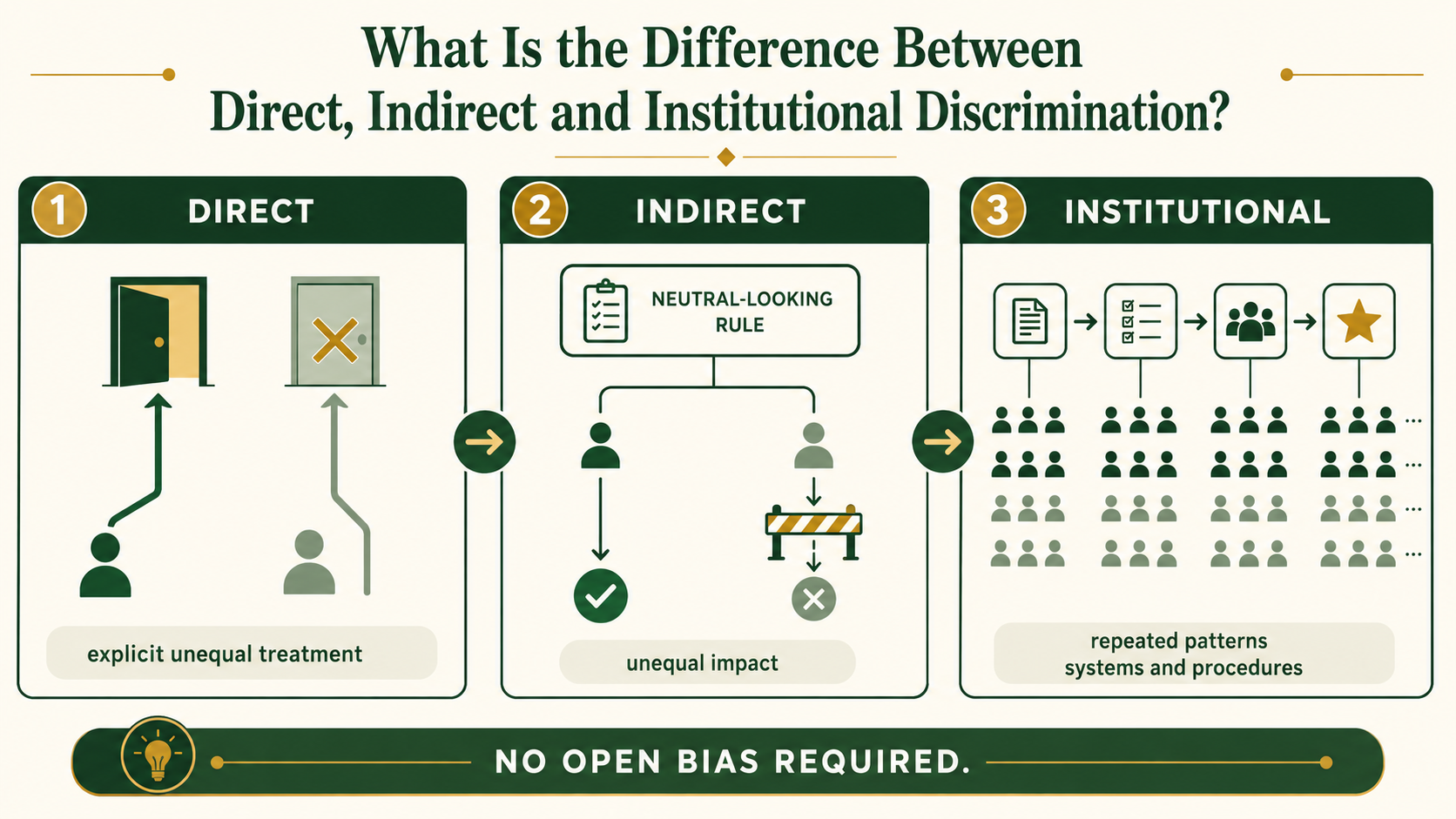
Direct discrimination is explicitly less favourable treatment tied to a characteristic, such as a landlord stating outright they do not rent to foreigners. Indirect discrimination is a formally neutral rule that disproportionately disadvantages a group and cannot be justified by genuine necessity, such as requiring native-level fluency for a role where strong working proficiency would suffice.
The distinction matters because indirect discrimination is often unintentional and easy to defend as "just policy." Germany's Federal Anti-Discrimination Agency uses exactly this example: an unwarranted "native German speaker only" requirement in recruitment can constitute indirect exclusion, even where no one involved thinks of themselves as prejudiced.
Not every language, licensing or experience requirement is discriminatory. A genuinely necessary competence standard is legitimate. The test is whether the requirement is actually needed to do the job or access the service, not whether it happens to exclude foreigners.
Is discrimination always interpersonal, or can institutions discriminate too?
Interpersonal discrimination comes from an identifiable person: a manager, landlord, doctor, teacher or stranger. Institutional discrimination comes from rules, procedures or systems that produce unequal outcomes without any single decision-maker acting maliciously. Both are real, and institutional discrimination can persist for years without anyone ever saying anything overtly prejudiced.
A statistical disparity alone does not prove institutional discrimination. It has to be examined against the actual decision mechanism and against plausible alternative explanations. This is precisely why the bureaucracy question deserves its own careful treatment, covered in discrimination or bureaucracy abroad.
Can discrimination be subtle, and does that make it less real?
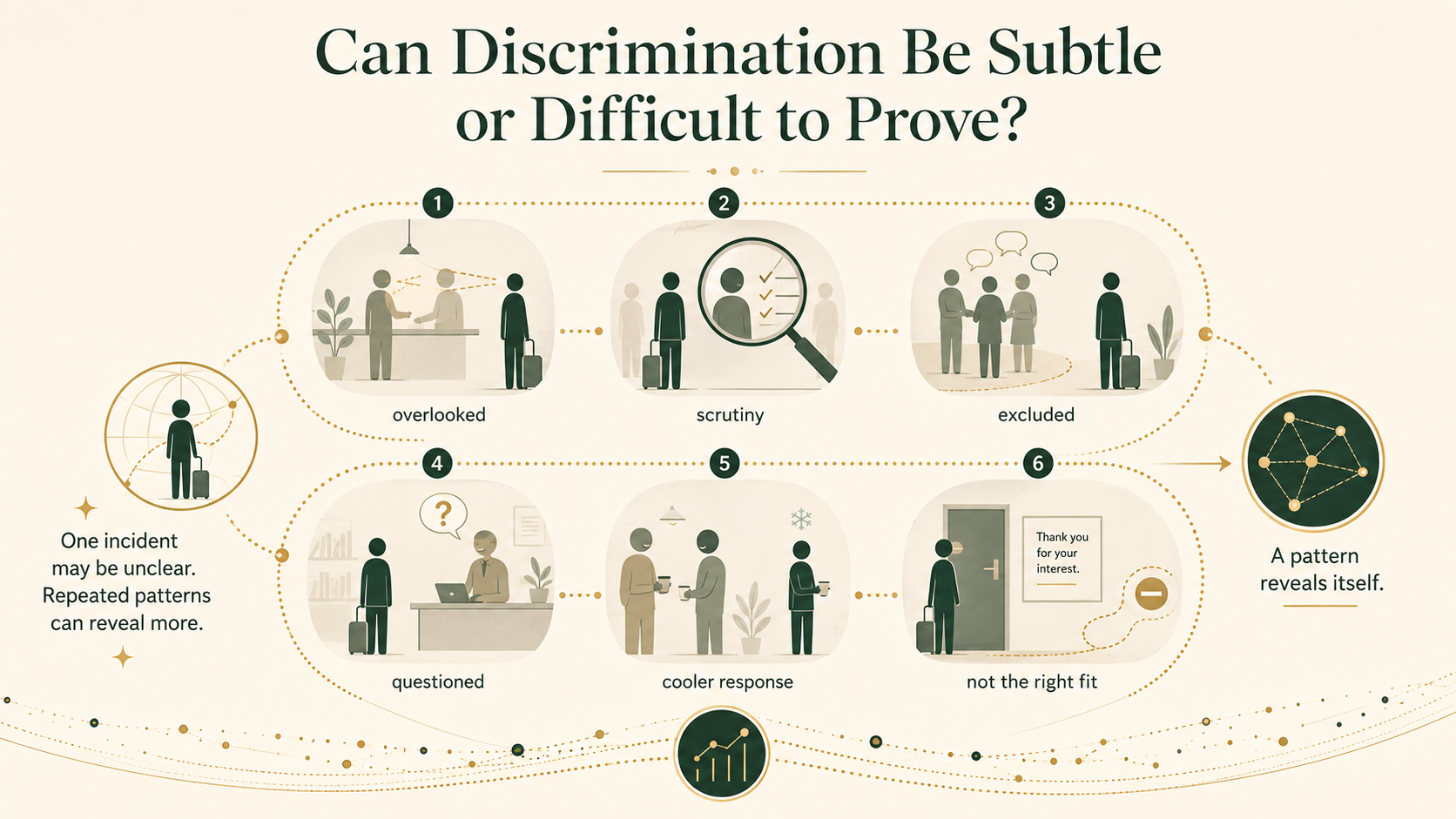
Yes, discrimination can be entirely subtle, and no, that does not make it less real. Overt discrimination is comparatively easy to identify: an explicit refusal, a slur, a stated policy. Subtle discrimination includes differential warmth, heightened scrutiny, selective enforcement of rules, being repeatedly passed over for informal opportunities, or having your competence questioned more than colleagues in an identical position.
The difficulty is evidentiary, not moral. Subtle treatment rarely comes with an explicit statement of motive, so any single incident is genuinely hard to classify with confidence. What research consistently shows is that patterns, comparisons and repetition are what separate a fair inference from a false one. One tense interaction with one difficult person is not evidence of anything. The same interaction, recurring across situations and people, starts to be.
Not every difficult experience abroad is discrimination, but discrimination does not stop being real simply because nobody says the motive out loud.
This uncertainty is common enough to deserve its own page. If you keep replaying a specific interaction and cannot decide whether it was discrimination or something else, was that discrimination or am I imagining it goes into that experience directly. For the wider category of coded exclusion and double standards, see subtle discrimination abroad.
Where can discrimination happen abroad?
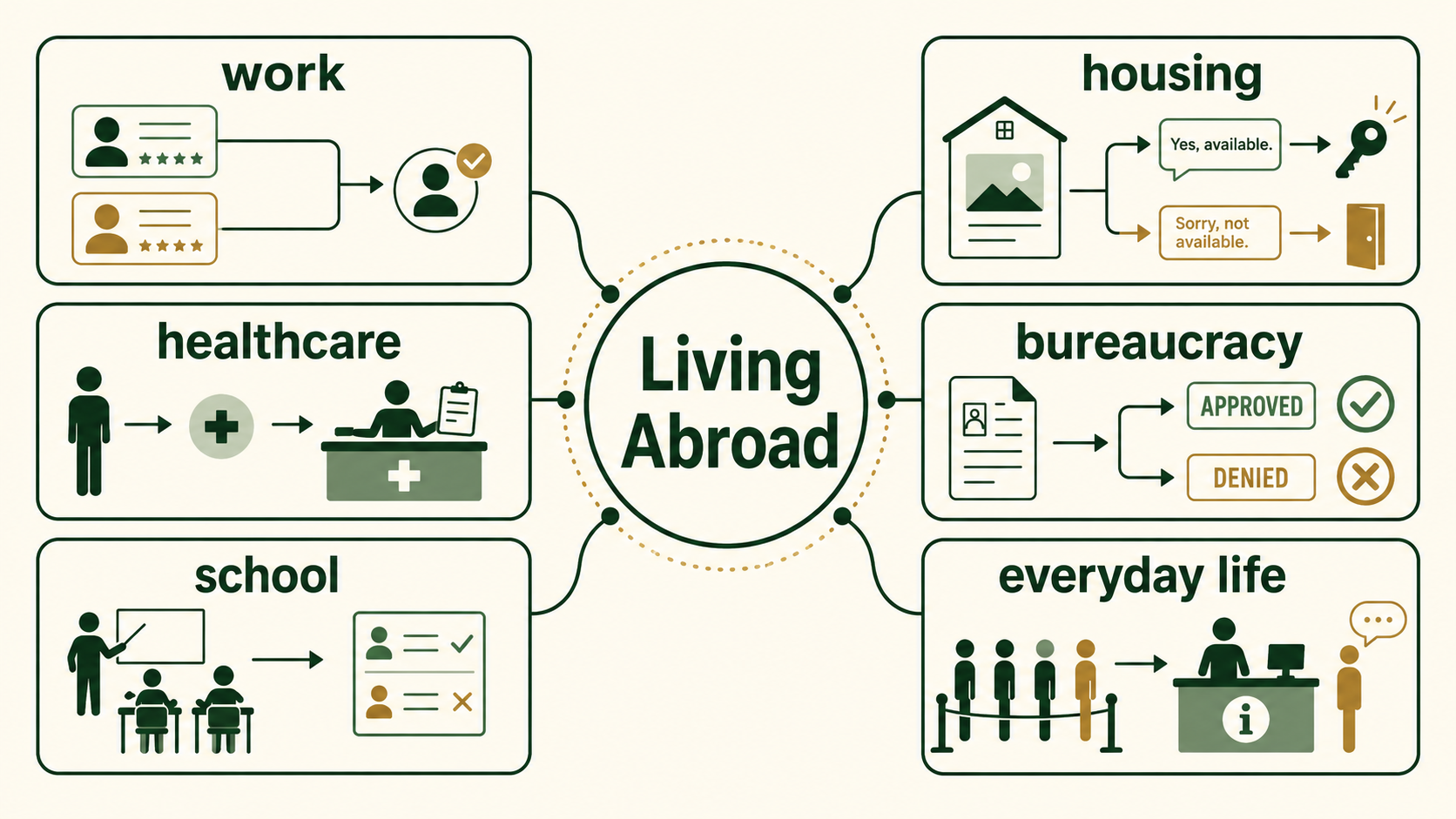
Discrimination linked to nationality, race, ethnicity, accent, religion or foreign status has been documented across recruitment, workplaces, housing, healthcare, public institutions and everyday social life. It rarely stays confined to one domain. FRA's data show that among people reporting racial discrimination over five years, 67% had experienced it in more than one area of life, which supports treating it as a cumulative pattern rather than a single-domain problem.
Hiring. Correspondence experiments, sending otherwise identical fictitious applications that vary only by name, are among the strongest evidence available anywhere in social science. In Australia, applications with English-sounding names received 26.8% positive responses for leadership roles versus 11.3% for non-English names, across more than 12,000 applications. Foreign names in hiring get their own detailed treatment at foreign name discrimination in hiring.
Accent. In a German telephone field experiment, applicants with standard German accents received callbacks at around 80%, against roughly 73% for Turkish-accented applicants. A meta-analysis of 139 effects across 4,576 participants found standard-accented speakers were consistently rated as more hireable. Full detail is at accent discrimination abroad.
Housing. A large 2023 Dutch correspondence study involving 3,030 tests found applicants with Moroccan-sounding names had an 18% lower probability of receiving a viewing invitation than otherwise identical applicants. Older Spanish research found a comparable gap for Moroccan-named applicants. See housing discrimination abroad for the full picture.
Qualifications and experience. International degrees and work history are sometimes discounted independently of genuine skill, separate from legitimate local licensing needs. This is examined at foreign qualifications and local experience discrimination.
Workplace. Beyond hiring, ongoing treatment by managers and colleagues, exclusion from informal networks, and unequal access to promotion are covered in full at workplace discrimination abroad.
Healthcare. This domain needs particular care. The World Health Organization identifies legal entitlement gaps, cost, interpreter shortages and restrictive policy as separate contributors to unequal migrant healthcare experiences, alongside documented cases of provider bias. Discrimination is one real mechanism among several, not the only one. Full treatment is at healthcare discrimination abroad.
Public institutions. A 2025 German survey of 2,000 people found 19% reported unequal treatment by public authorities overall, rising to 33% among people with a family migration history. Distinguishing this from ordinary administrative burden is the entire subject of discrimination or bureaucracy abroad.
Everyday life and long-term belonging. Some of the most persistent experiences are the quietest: being repeatedly asked where you are "really" from, regardless of your passport or years of residence.
International schools. Cultural, nationality and accent-based exclusion among students in international communities has its own dedicated coverage at cultural bullying in international schools.
When is a difficult experience not discrimination?
A difficult experience is not necessarily discrimination when it reflects a genuinely necessary requirement, ordinary bureaucratic friction affecting everyone, interpersonal dislike unconnected to your background, or a service problem that would frustrate a local person just as much. Confusing these categories in either direction causes real harm, either by dismissing genuine discrimination as bad luck, or by treating every unpleasant interaction as proof of prejudice.
A slow immigration office is not automatically discriminatory. A rude waiter having a bad shift is not automatically discriminatory. A job that genuinely requires fluent local-language proficiency for safety or legal reasons is not automatically discriminatory in requiring it. What tips an experience toward discrimination is comparison: would a local person, or someone with a different name, accent or background, have been treated the same way in the same situation? That question, asked honestly, is usually more useful than trying to read intent into a single moment.
The most useful question is rarely "was that person prejudiced." It is "would someone identical to me in every way except my background have gone through the same thing."
Can discrimination affect mental health?
Yes. Research consistently links perceived discrimination, including racial, ethnic and migration-related discrimination, with worse mental health outcomes, including higher rates of depressive symptoms, anxiety and disrupted sleep. A meta-analysis covering 22 studies and 2,932 people found discrimination exposure associated with same-day and longer-term mental health changes. A separate meta-analysis of 43 studies across seven countries, involving over 62,000 people, found small but statistically meaningful associations between discrimination and both suicidal ideation and suicide attempts.
Uncertainty itself carries a cost. A 2024 population study found that ambiguous discrimination, situations where someone cannot be sure whether unfair treatment was motivated by bias, was independently associated with higher depressive symptoms. This matters for internationally mobile people specifically, because so much of what gets experienced abroad sits exactly in that ambiguous zone: not severe enough to be certain, not minor enough to shake off.
Repetition compounds the effect. Over half of FRA respondents who experienced racial discrimination in the past year said it happened more than three times. Chronic low-level exposure, rather than one severe incident, is what many internationally mobile people actually describe. The full psychological picture, including what tends to help, is covered at discrimination and mental health abroad.
You do not need a single dramatic incident to justify taking your experience seriously. Frequent small ones can add up to something just as real.
Why is discrimination abroad underreported?
Discrimination abroad is significantly underreported, and low reporting rates do not mean incidents are rare. In FRA's survey, only 9% of people who experienced racial discrimination in the previous year reported or complained about their most recent incident. In Spain's 2024 CEDRE victim survey, only 22.4% of people who felt discriminated against made a formal complaint.
The most common reasons people give for not reporting: believing it would change nothing, minimizing the event to themselves, treating it as normal, or simply not knowing where to report it. For internationally mobile people specifically, additional plausible barriers include dependency on an employer for a visa, unfamiliarity with local law, language difficulty and uncertainty about whether a subtle incident could ever be proven. Complaint numbers going up over time usually reflects growing awareness and access to reporting channels, not necessarily a rising rate of discrimination itself. Germany's federal counselling enquiries roughly doubled between 2019 and 2024, which almost certainly reflects both.
What should you do if you think you are experiencing discrimination?
Start by documenting what happened as specifically and factually as possible, look for comparison points and patterns rather than relying on a single incident, and decide whether the situation calls for an internal conversation, a formal complaint, or professional support. Dates, exact words used, witnesses and how similar situations were handled for others all strengthen your position, whether or not you ultimately take formal action.
You are not obligated to report anything, and choosing not to is not the same as accepting mistreatment. Some situations are better addressed informally, some genuinely need a formal channel, and some are worth discussing with someone qualified before you decide anything at all. A full walkthrough of documentation, internal routes, equality bodies and when legal advice becomes worth pursuing is available at how to report discrimination abroad.
If your experience is workplace-specific and involves feeling unable to speak up, question decisions or admit mistakes as freely as local colleagues, that has its own research base at psychological safety for international employees.
Does the law differ by country?
Yes, significantly. What counts as a protected characteristic, which institutions handle complaints, and how nationality itself is treated legally varies considerably even within Europe. The Netherlands explicitly lists nationality as a protected ground. UK equality law places nationality within the broader protected characteristic of race. French law contains extensive protections tied to origin, name and related characteristics. Germany's federal anti-discrimination law does not directly protect nationality, though nationality-based exclusion can still constitute indirect racial or ethnic discrimination depending on context.
Because these differences genuinely change what you can do and where you can turn, country-specific detail is covered separately: Netherlands, Germany, France, Spain and the United Kingdom.
When can professional support help?
Professional support cannot change discriminatory laws, biased managers or unfair institutions, but it can help you process the psychological impact, think clearly under uncertainty, and decide what to do next without carrying the weight alone. Therapy treats the consequences of discrimination. It does not, and should not be expected to, fix the discrimination itself.
That distinction matters because expecting therapy to solve an external, structural problem sets people up for disappointment, while dismissing its real value in processing stress, rumination, self-doubt and cumulative exhaustion sells it short in the other direction. If persistent low mood, anxiety, sleep disruption or a sense of being constantly on guard has followed a pattern of unequal treatment, that is a reasonable and common reason to seek support. You can start with online therapy for expats.
Therapy will not make an unfair system fair. It can help you carry what that unfairness costs you without it costing everything.
Frequently asked questions
What is discrimination abroad?
Discrimination abroad is unequal or unfavourable treatment connected to nationality, race, ethnicity, religion, accent or migration status, experienced by someone living as a foreign resident. It can be direct or indirect, interpersonal or institutional, and overt or subtle.
What is indirect discrimination?
Indirect discrimination happens when a rule that appears neutral on its face ends up disadvantaging a particular group disproportionately, without a genuine justification. An unnecessary native-fluency requirement in a job posting is a commonly cited example.
What is institutional discrimination?
Institutional discrimination refers to patterns of unequal treatment produced by systems, procedures or organizational rules, rather than one identifiable prejudiced individual. It can persist for years without anyone involved holding openly discriminatory views.
Can discrimination be subtle and still be real?
Yes. Subtle discrimination, including selective scrutiny, differential warmth and coded exclusion, is harder to prove than an explicit statement but is documented and can meaningfully affect wellbeing. A single ambiguous incident is rarely conclusive; patterns and comparisons are what strengthen the picture.
Can foreigners face discrimination even if they speak the local language fluently?
Yes. Discrimination linked to accent, name, race, religion or nationality can occur regardless of language fluency. Research on long-term foreign residents also shows that people can continue to be treated as outsiders after many years and full local fluency.
How do you know whether something is discrimination or just a hard day?
Compare how someone without your background would likely have been treated in the identical situation. A single unpleasant interaction rarely proves anything on its own. Repetition, patterns across different people and situations, and comparison points are what turn a suspicion into a reasonable conclusion.
Where can discrimination happen abroad?
It has been documented across hiring, workplaces, housing, healthcare, public institutions and everyday social interactions, and research shows it frequently occurs across more than one of these domains for the same person rather than staying confined to one.
Can discrimination affect mental health?
Yes. Research links perceived discrimination with higher rates of depressive symptoms, anxiety and disrupted sleep, and even uncertainty about whether an incident was discriminatory has been linked to worse mental health. Effects tend to be cumulative with repeated exposure.
What should you do if you think you are experiencing discrimination?
Document what happened factually, look for patterns rather than relying on one incident, and decide whether an informal conversation, formal complaint or professional support fits your situation. None of these steps are mandatory, and choosing not to report something does not mean it was not real.
Is discrimination the same everywhere in Europe?
No. Legal definitions, protected characteristics and reporting institutions vary by country, and nationality in particular is treated very differently under Dutch, German, French, Spanish and UK law. Country-specific pages cover these differences in detail.
Need support? We're here.
Book a free 15-min consultation with our expat-specialized therapists.