
Key takeaway
Twenty years running engineering projects, a postgraduate degree, a career built on solving exactly the kind of problem now sitting on someone else's desk. Then a hiring manager reads the CV and asks, not unkindly, whether there's any local experience. The expertise didn't change when the border was crossed. Something about how it gets read did. This article explains what research actually shows about foreign qualifications and overseas experience being discounted in hiring, when a local-experience requirement is genuinely legitimate versus questionable, why highly qualified people can end up working well below their skill level after relocating, and how to think clearly about where your own situation sits on that line.
The job description asks for five years of experience. You have twelve, just not in this country's systems, this country's regulatory language, this country's professional shorthand. The interviewer is polite. The rejection, when it comes, mentions "fit."
Your experience did not disappear when you crossed a border. What changed was the system evaluating it.
Do foreign qualifications actually count for less abroad?
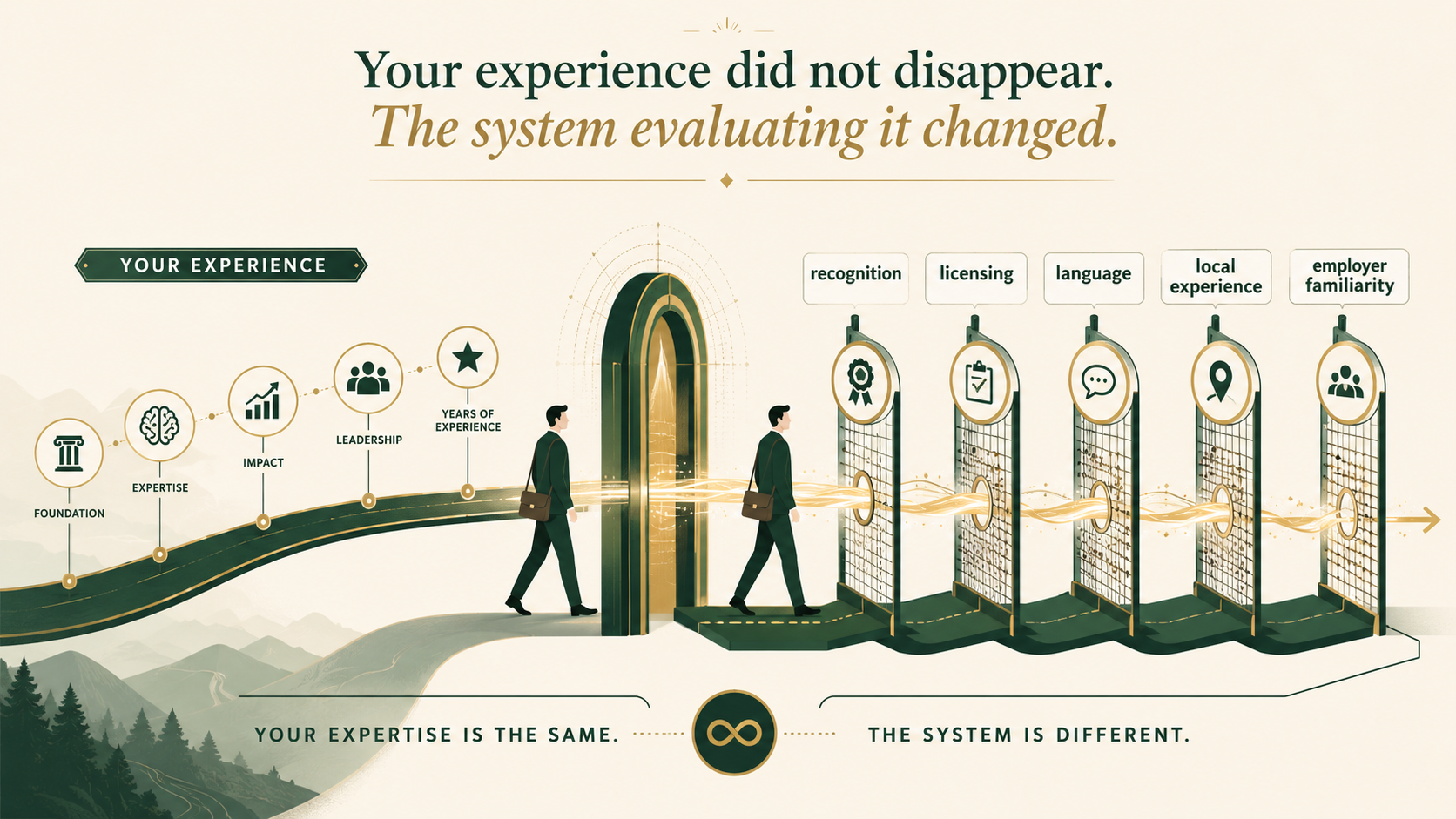
Yes, in measurable and researched ways. A 2026 meta-analysis covering 114 field experiments across 12 countries found that foreign educational credentials were associated with materially larger hiring disadvantages than place of birth alone, once the two signals were separated. In some comparisons, foreign-educated applicants faced callback reductions of up to roughly 35%. That is a real, experimentally demonstrated effect, not a subjective impression.
The same research offers a genuinely important nuance: place of birth by itself, once foreign education and citizenship signals were accounted for separately, produced a relatively limited average penalty. In plainer terms, it appears to matter more where your degree came from than simply where you were born. That distinction reframes the whole question. It suggests the discounting is happening to the credential, not automatically to the person carrying it, which has real implications for what can be done about it.
The penalty seems to travel with the diploma more than with the person. That is a different problem than plain prejudice against foreigners, and it points toward a different fix.
Why do employers ask for local experience in the first place?
Employers often require local experience because genuine differences exist between regulatory systems, professional norms, client expectations and institutional knowledge from one country to another, and someone unfamiliar with those specifics may need real time to become fully effective. This is a legitimate business consideration in many roles, and it would be dishonest to pretend otherwise.
A newly arrived lawyer needs to learn the local legal system regardless of how skilled they were elsewhere. A healthcare professional needs to understand local protocols, referral pathways and documentation standards. An accountant needs to know the specific tax code they'll be working under. None of this reflects a lower level of underlying skill. It reflects a genuinely different operating environment, and pretending local knowledge doesn't matter at all would do a disservice to both the professional and the people they'll eventually serve.
When does a local-experience requirement become questionable rather than legitimate?
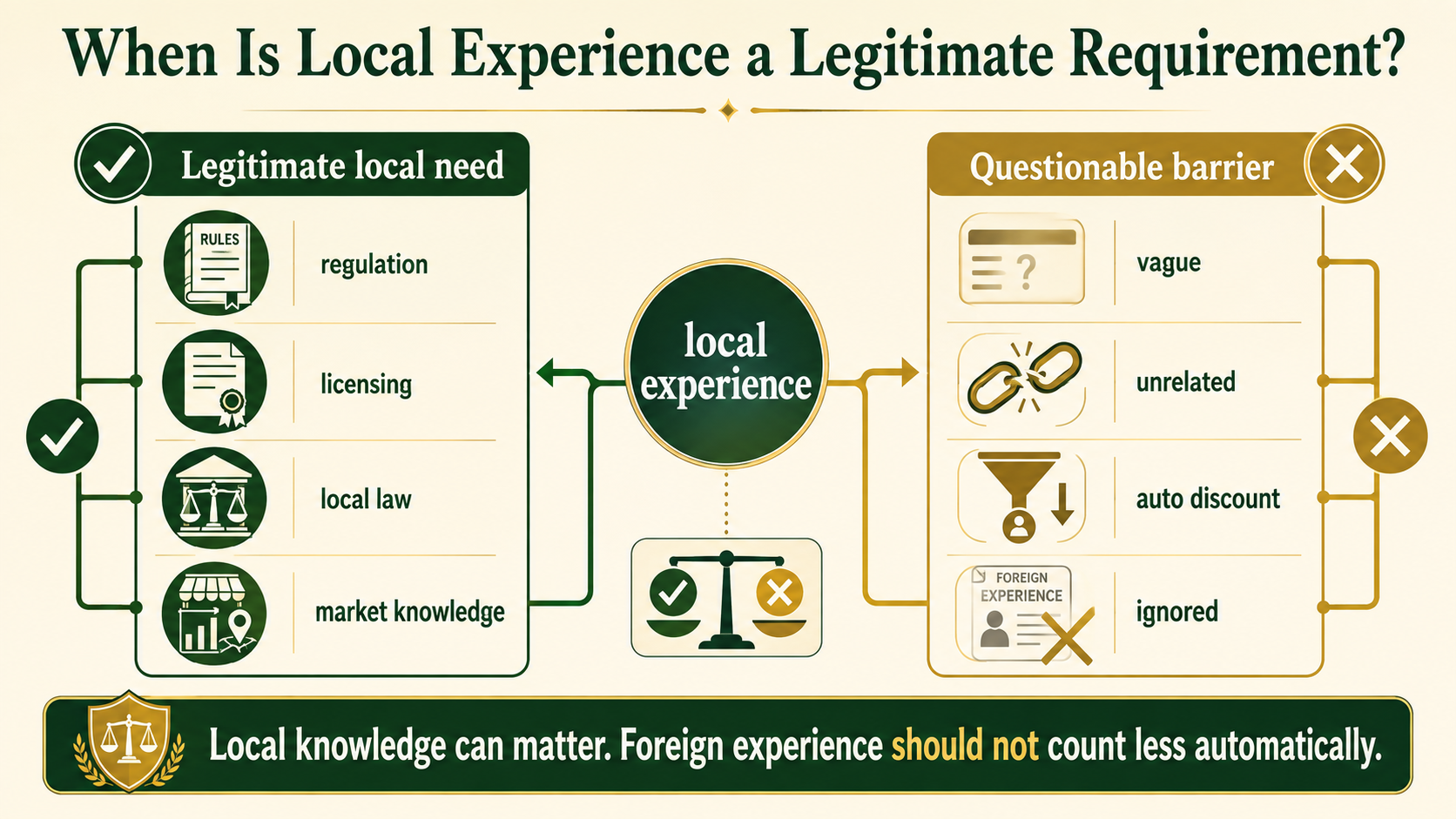
A local-experience requirement becomes questionable when it is applied more strictly or more broadly than the actual demands of the role justify, or when it functions as a blanket screen rather than a specific, assessable competency. The clearest parallel comes from language requirements: Germany's Federal Anti-Discrimination Agency explicitly cites an unwarranted "native German speaker only" requirement as an example of indirect discrimination in recruitment, precisely because native-level fluency is frequently unnecessary for the actual job, even though a genuine working-proficiency requirement can be entirely legitimate.
The same logic transfers cleanly to experience. "Must understand this specific regulatory environment" is a defensible, assessable requirement. "Must have local experience," applied as a vague filter regardless of how transferable the underlying skill actually is, functions much more like a proxy for familiarity and comfort than a genuine competency check.
Some jobs genuinely require local knowledge. That does not mean every foreign qualification deserves an automatic discount.
A useful test: would the requirement still make sense if applied consistently to a candidate who moved from a different region of the same country, with genuinely comparable but non-identical local knowledge? If the honest answer is that a domestic candidate with an unfamiliar background would get more benefit of the doubt than an international one with equivalent unfamiliarity, that gap is worth naming.
Is a foreign-qualification penalty proof that an employer is discriminating?
No, not automatically, and this distinction matters. Credential recognition processes, licensing requirements and genuine institutional knowledge gaps are legitimate factors that can lawfully affect hiring decisions, separate from bias. A foreign degree not being immediately recognized by a professional body, for instance, is often a regulatory reality rather than a discriminatory choice by any individual employer.
What the field-experiment evidence demonstrates is a pattern at the population level, across many matched comparisons, foreign-educated applicants receive fewer callbacks than domestically educated applicants with equivalent qualifications. That pattern is real and measurable. It does not tell you, and cannot tell you, whether any specific rejection you experienced was driven by legitimate licensing requirements, genuine skill gaps, unconscious bias, or some combination. Field experiments are built to detect a systemic pattern. They are not built to diagnose one individual decision, and being honest about that limit actually strengthens the credibility of what the evidence does show.
The evidence proves the pattern exists across many decisions. It was never designed to render a verdict on any single one, including yours.
Why are highly qualified international workers sometimes working well below their skill level?
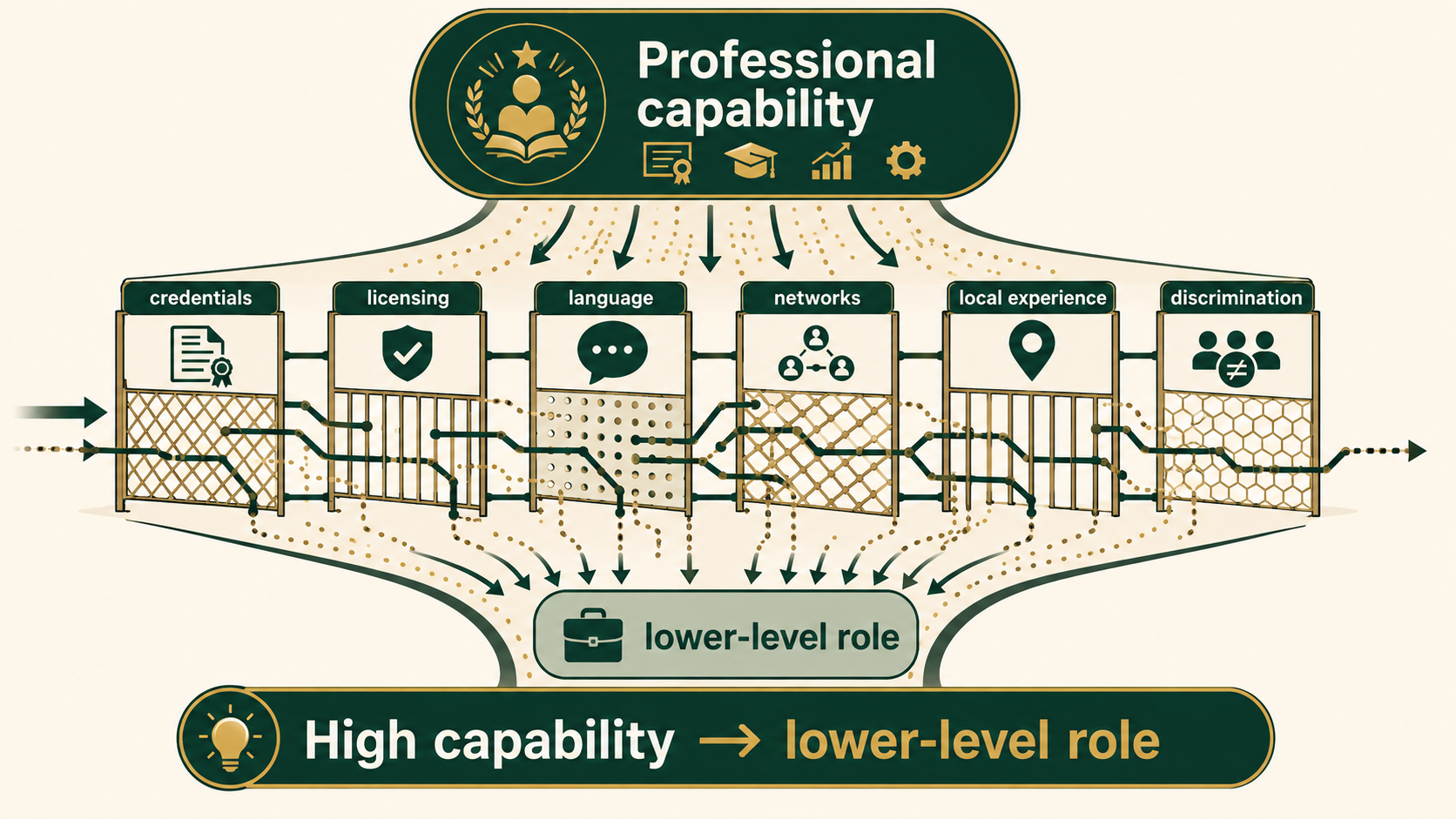
Overqualification among internationally mobile professionals reflects several overlapping barriers at once, credential recognition delays, licensing requirements, language, professional networks that didn't relocate with them, and discrimination, rather than any single cause. Research consistently documents the pattern without always being able to cleanly separate how much each factor contributes in any individual case.
The scale of it is worth sitting with. Among people of African descent surveyed across the EU, 35% reported being overqualified for their current job, compared with 21% in the general population of the same countries. OECD data separately show substantial employment disadvantages among highly educated foreign-born workers more broadly. None of these figures alone prove discrimination is the cause. They describe a real pattern of underused expertise that plausibly involves credential barriers, network loss, language and bias operating together, in proportions that differ from person to person and country to country.
Overqualification can reflect several barriers at once, including credential recognition, licensing, language, networks and discrimination.
This is a distinct question from how that experience feels day to day, the loss of professional identity, status and confidence that can come with working well below one's actual capability. That psychological terrain is covered in full at loss of status after international relocation.
How can you think clearly about what's happening in your own situation?
Rather than trying to reach a single verdict, it's more useful to separate the genuinely legitimate parts of a requirement from the parts that look more like a blanket assumption, and to notice whether the gap in how you're evaluated tracks a specific, nameable skill or simply unfamiliarity. A few honest questions can help:
- Is the local knowledge being asked for something specific and assessable, or a vague sense of "fit"?
- Would a domestic candidate with an equivalent unfamiliar background, say, someone from a different sector entirely, face the same level of scrutiny?
- Is there a credible path to closing the specific gap, a licensing exam, a certification, a defined period of local orientation, or does the requirement function as a permanent disqualifier regardless of effort?
- Has this happened once, or does it form part of a pattern across multiple applications or evaluations?
Starting again in a new system is not the same as starting again as a professional. The first involves real, sometimes substantial, adjustment. The second treats years of demonstrated competence as though they never happened. Distinguishing between the two, in your own case and in how you talk about it, tends to be clarifying rather than either falsely comforting or unnecessarily bleak.
If what you're noticing extends into a broader pattern at work, beyond hiring itself, workplace discrimination abroad covers ongoing treatment, and accent discrimination abroad and foreign name discrimination in hiring cover two closely related signals that often compound alongside credential discounting. For the harder-to-classify cases, where you genuinely cannot tell what's driving a decision, subtle discrimination abroad goes into how to weigh ambiguous evidence.
What can employers do to evaluate international experience more fairly?
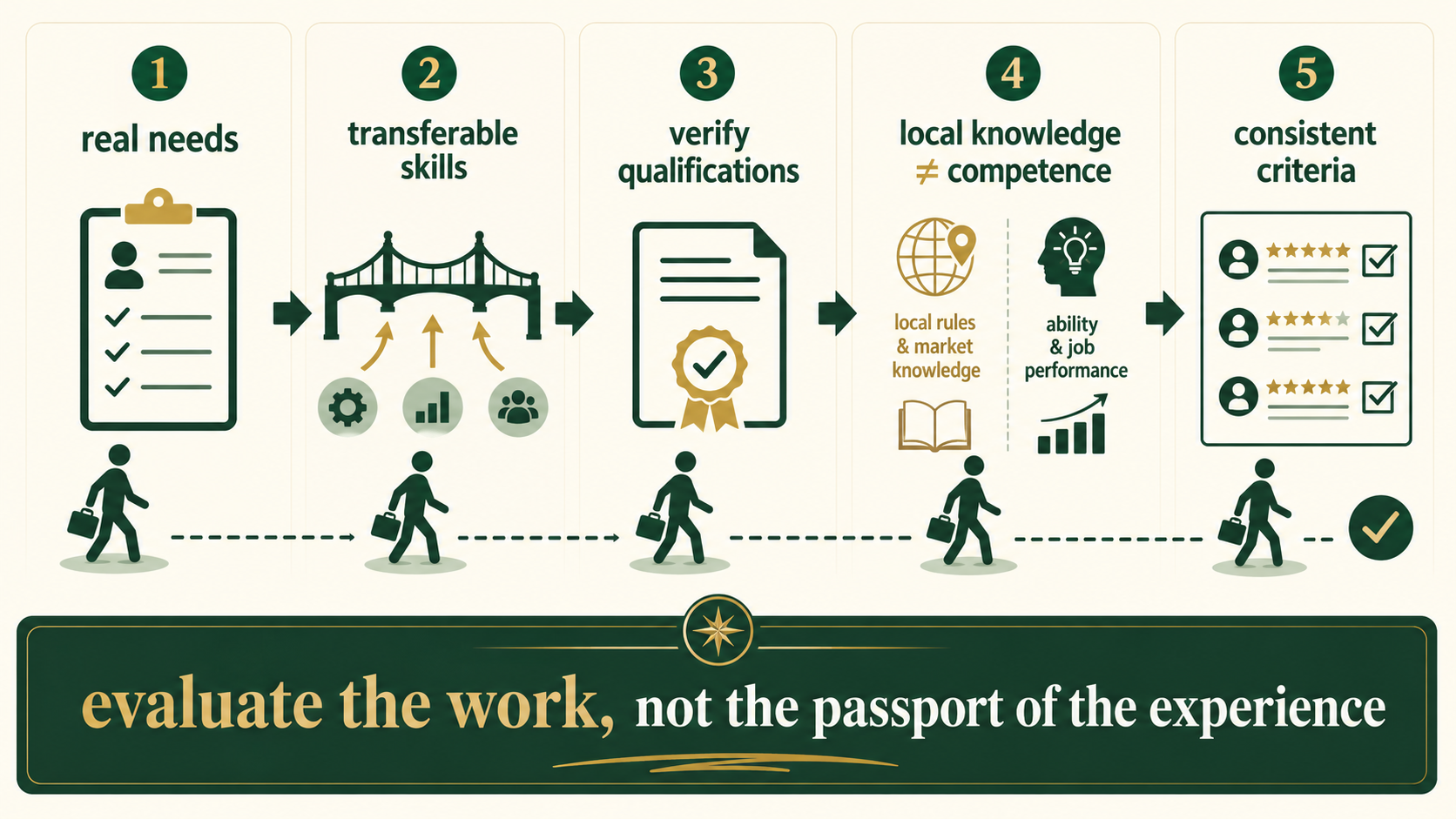
Employers can evaluate international experience more fairly by specifying exactly which local knowledge a role genuinely requires, distinguishing that from general professional competence, and building structured, criteria-based evaluation rather than relying on a vague sense of familiarity. In practice, that might mean naming the specific regulatory, systems or client knowledge a role needs, assessing it directly rather than assuming it correlates with where someone trained, and offering a defined bridge, a supervised period, a targeted course, a mentorship, where a genuine but closeable gap exists.
It's also worth being realistic about what fixes this and what doesn't. Broader research on organizational bias interventions has found that training alone tends to shift awareness more than actual decisions. Structural changes to how evaluation criteria are defined and applied consistently appear to matter more than a one-off session about the value of diverse hiring. For a wider view of what participation and inclusion look like for international employees once they've been hired, psychological safety for international employees covers that ground directly.
For the broader landscape of how discrimination shows up across different parts of professional and daily life abroad, discrimination abroad is the place to start.
Frequently asked questions
Do foreign qualifications count less abroad?
Often, yes, in ways that field experiments have measured directly. A 2026 meta-analysis across 12 countries found foreign-educated applicants faced meaningfully lower callback rates than domestically educated applicants with equivalent qualifications, with penalties in some comparisons reaching roughly 35%.
Why do employers ask for local experience?
Because genuine differences exist between countries in regulatory systems, professional norms and institutional knowledge, and some roles require real familiarity with the local operating environment to be effective from day one. This can be a legitimate consideration, separate from bias.
Is requiring local experience discriminatory?
Not automatically. It becomes questionable when applied as a vague, blanket filter rather than tied to a specific, assessable competency, or when the same standard of unfamiliarity would be tolerated for a domestic candidate but not an international one.
Why are immigrants and foreign workers sometimes overqualified for their jobs?
Research points to several overlapping causes, including delays in credential recognition, licensing barriers, language, the loss of professional networks, and discrimination, rather than any single explanation. Studies find higher overqualification rates among foreign-born and internationally educated workers compared with domestic populations.
Can employers discriminate against foreign qualifications?
Yes, this is documented at the population level through field experiments showing lower callback rates for foreign-educated applicants compared with equally qualified domestic candidates. Whether any individual hiring decision reflects discrimination, legitimate licensing requirements, or both is harder to determine from a single case.
How can employers fairly evaluate international experience?
By specifying exactly what local knowledge a role requires, assessing that knowledge directly rather than assuming it based on where someone trained, and building structured, consistent evaluation criteria rather than relying on general impressions of fit or familiarity.
Need support? We're here.
Book a free 15-min consultation with our expat-specialized therapists.