
Key takeaway
Two CVs, same degree, same years of experience, same job history, submitted for the same role. The only difference is the name at the top of the page. One gets a callback. The other doesn't. This is not a hypothetical. It is close to the actual design of the strongest evidence available on hiring discrimination , and it has been run thousands of times across European labour markets with strikingly consistent results. This article explains what these experiments actually measure, what they have found, why the effect varies significantly by country, occupation and gender, and what a single rejection can and cannot tell you about why it happened.
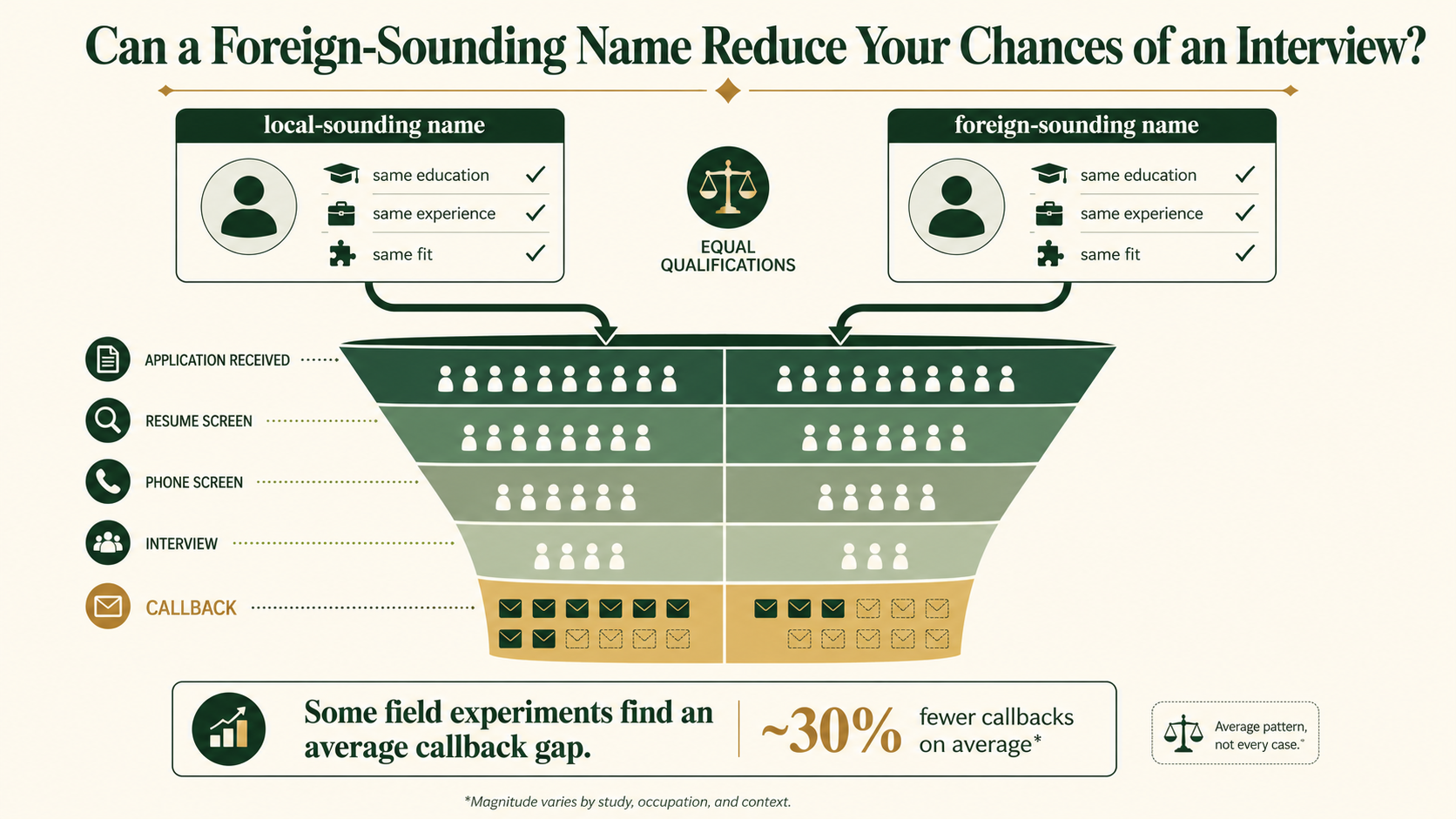
You send out forty applications with a name that marks you as foreign before anyone reads a single line about what you can actually do. Nine callbacks come back. A friend with a comparable CV and a local-sounding name sends out the same number and gets sixteen. Neither of you can prove anything from your own experience alone. This is exactly the gap researchers built an entire experimental method to measure.
What is foreign-name discrimination in hiring?
Foreign-name discrimination in hiring is when job applicants with names signaling a foreign, ethnic, religious or migration background receive fewer callbacks or interview invitations than equally qualified applicants with local-sounding names. It is one of the most rigorously documented forms of discrimination in the research literature, because it can be measured directly rather than inferred from surveys or self-report.
How do researchers actually prove this happens?
Researchers use correspondence experiments, sending large numbers of matched, often fictitious job applications that are identical in qualifications and experience but differ in the applicant's name, and then comparing the callback rates. Because everything except the name is held constant, any consistent difference in response rates can be attributed to that one variable rather than to genuine differences in ability.
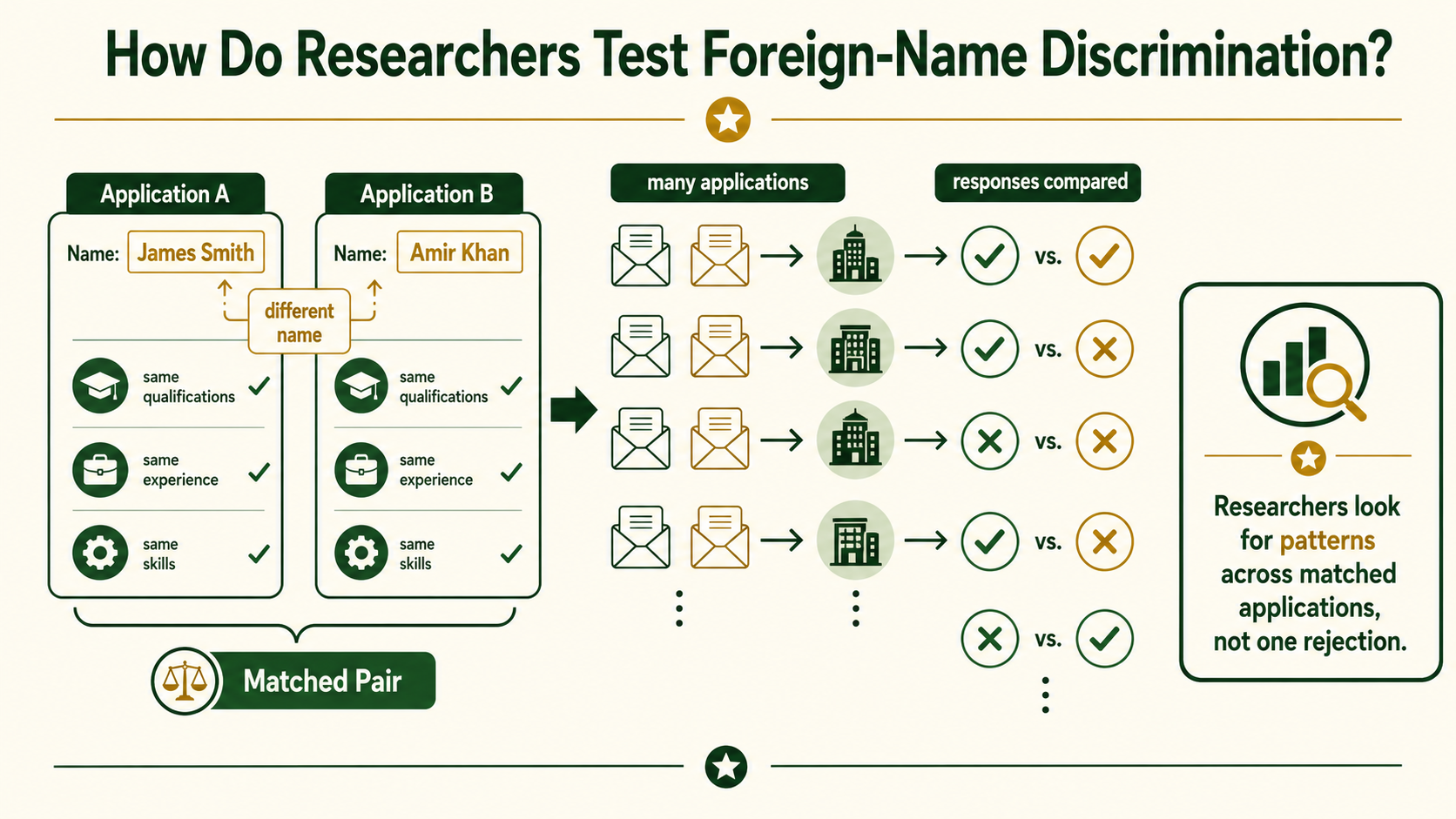
This is unusually strong evidence as social science goes. A single rejected application tells you almost nothing, there are countless ordinary reasons any one CV doesn't get a callback. But when the same fictitious profile, with only the name changed, is sent to hundreds or thousands of real job postings, and a consistent gap emerges across all of them, individual explanations stop accounting for the pattern. The applicants were, on paper, the same person.
One rejection proves almost nothing. Thousands of matched applications can reveal a pattern.
A 2023 meta-analysis by Lippens and colleagues synthesized a near-exhaustive body of recent correspondence experiments across ten different discrimination grounds and confirmed that racial and ethnic hiring discrimination remains persistent and measurable across studies.
What have European field experiments actually found?
Large-scale correspondence experiments across Germany, the Netherlands and Spain have found substantial hiring disadvantages tied to foreign-sounding names and ancestry signals, even when appearance and qualifications were controlled for. One major study, involving nearly 13,000 fictitious applications across those three countries, manipulated both ancestry and appearance signals and found meaningful racial discrimination in hiring responses in all three national labour markets.
Sweden offers a more recent and specific example: a 2024 field experiment sending 5,641 applications found consistently lower callback rates for foreign-sounding names, with the disadvantage more pronounced for men with foreign names than for women with foreign names. That gender difference is itself informative, it shows the effect isn't a flat, uniform penalty. It interacts with other characteristics of the applicant and the role.
When qualifications stay the same but employer responses change with the name, researchers can isolate a form of unequal treatment that ordinary statistics often miss.
Are all foreign names treated the same way?
No. The size and even presence of a name-based penalty varies meaningfully by country, employer type, occupation, seniority level and the specific origin signaled by the name. Treating "foreign name discrimination" as a single uniform phenomenon oversimplifies what the research actually shows.
A 2023 Belgian audit study found measurably less ethnic hiring discrimination in nonprofit organizations and large organizations than in smaller or for-profit employers, suggesting organizational context genuinely changes outcomes, not just the applicant's name. Seniority matters too. A large Australian study, submitting over 12,000 applications to more than 4,000 vacancies, found English-named applicants received positive responses for leadership roles 26.8% of the time versus 11.3% for non-English-named applicants, a gap roughly twice as wide as the one found for non-leadership roles in the same study, where the figures were 21.2% and 11.6%.
The same name can carry a bigger penalty the higher up the ladder it's applying to.
That study is Australian, not European, and its numbers should not be read as a European rate, but the underlying pattern, discrimination compounding at more senior, higher-trust levels, is a genuinely useful finding to be aware of regardless of which labour market you're in.
Why do employers react to names at all?
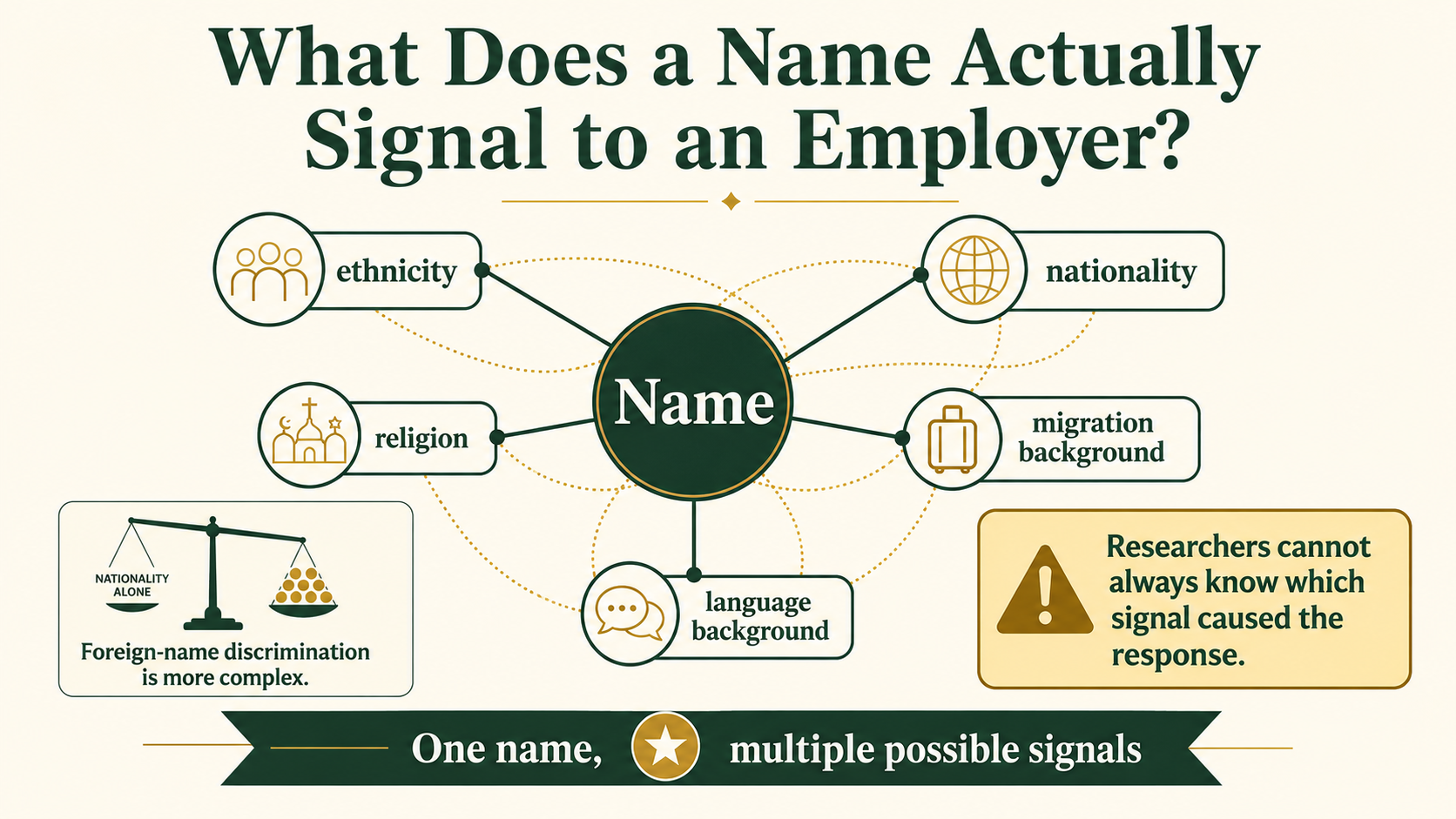
A name can function as a signal of ethnicity, nationality, religion or migration background all at once, and researchers frequently cannot determine with certainty which specific characteristic an employer was responding to. This is an honest limitation of the method, not a weakness that undermines its findings. The experiments prove that unequal treatment happens. They are less able to prove the exact psychological mechanism behind any single employer's reaction.
A foreign-sounding name can act as a signal of ethnicity, nationality, religion or migration background, but researchers cannot always know exactly which characteristic the employer reacted to.
What the evidence does suggest is that the penalty is rarely about the name as a sound or spelling in isolation. It functions as a proxy for a set of assumptions, about language ability, cultural fit, credential quality, all of which the applicant hasn't actually had a chance to demonstrate or disprove before being screened out.
Is this the same as being penalized for a foreign accent or foreign qualifications?
No, these are related but distinct mechanisms, and a name-based penalty can occur even when accent and credentials are never assessed at all, since a CV alone reveals neither. A name sits on the page before a single word is spoken or a single credential is evaluated. It is the earliest, and in some ways the most consequential, filter an applicant passes through.
A 2026 meta-analysis covering 114 field experiments across 12 countries helps separate these signals further. It found that place of birth alone produced relatively limited average penalties once other signals were accounted for, while foreign educational credentials and citizenship status were associated with meaningfully larger disadvantages, in some comparisons, foreign-educated applicants faced callback reductions of up to roughly 35%. This suggests the name on a CV and the university listed on it can be doing different, and sometimes cumulative, work in an employer's decision. The credential side of this picture is covered in full at foreign qualifications and local experience discrimination, and how accent affects treatment once someone actually reaches an interview or starts the job is covered at accent discrimination abroad.
Does one rejection prove you experienced discrimination?
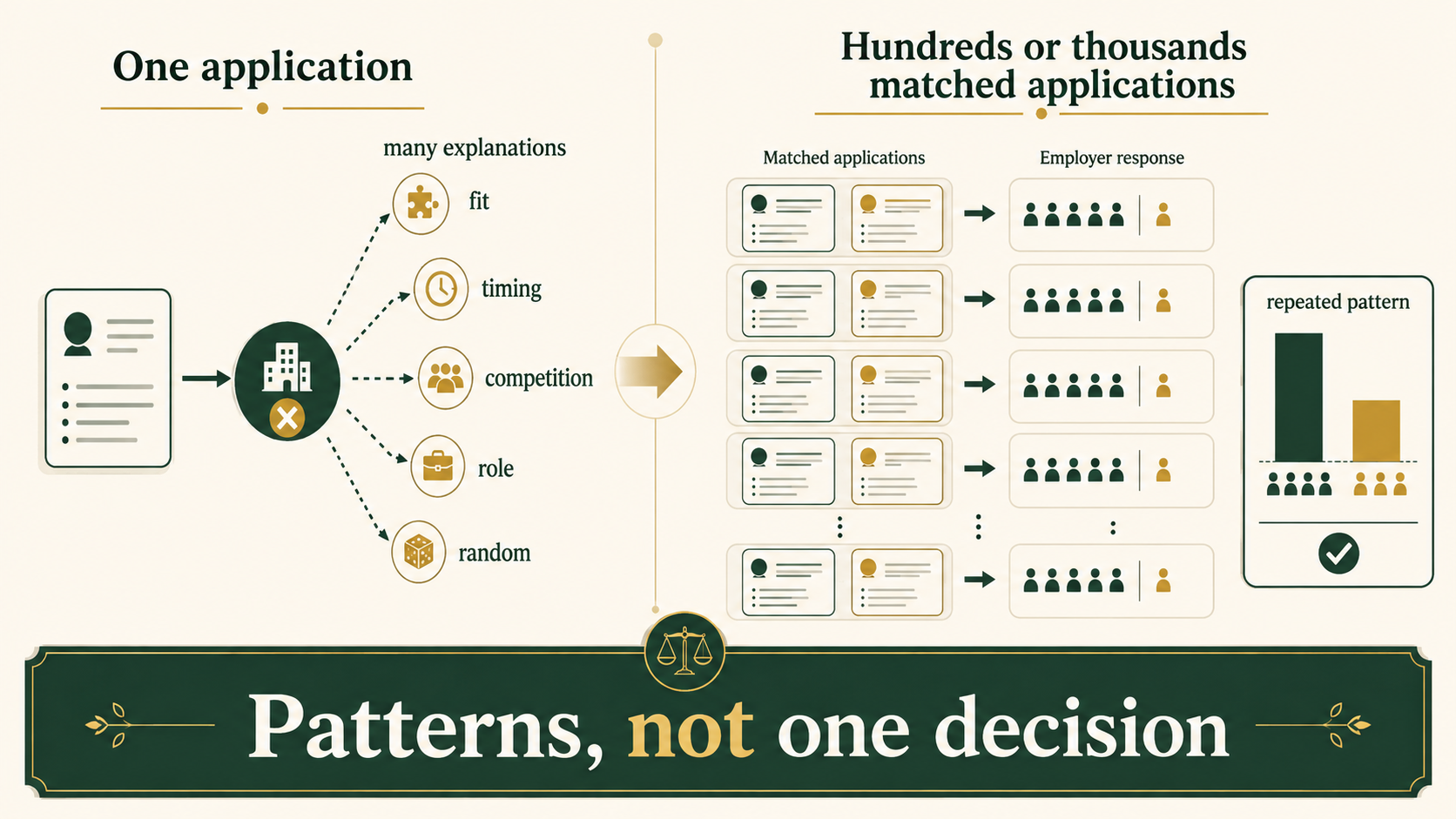
No, and this is worth being genuinely honest about. A single unsuccessful application almost never provides enough information to conclude discrimination occurred, because there are ordinary, non-discriminatory reasons any specific application might not succeed: timing, internal candidates, a slightly better-matched competitor, budget changes, an overlooked detail in the CV itself.
What the correspondence-experiment method demonstrates is a population-level pattern across many matched comparisons, not a verdict on any individual case. If you're trying to make sense of a specific experience or a pattern you've started noticing over multiple applications, the broader landscape of subtle, hard-to-prove discrimination at subtle discrimination abroad goes further into how to think it through.
What can applicants realistically do?
There is no single answer that applies to everyone, and no strategy erases the underlying bias documented in this research. Some applicants choose to adapt how they present their name; many reasonably decide not to, and both are defensible choices given what the evidence actually shows about where the problem sits. Some people use a shortened or anglicized version of their first name on applications, and research on this practice does suggest it can measurably change callback rates in some contexts. That doesn't make it the "correct" response. It is a personal trade-off between practical outcomes and not wanting to obscure your own identity to get a fair hearing, and reasonable people land in different places on it.
What's more consistently useful is knowing that a gap in callback rates, if you notice one over many applications, is not a reliable signal about your qualifications. The research is clear that matched, equally qualified applicants receive unequal treatment. That pattern says something about the labour market, not about you.
The applicants in these experiments were, on paper, identical. The gap in responses was never about their qualifications.
What can employers actually do to reduce this?
Employers can reduce name-based bias by structuring the initial screening process so that names and other identity signals are separated from the qualifications being evaluated, and by building consistent, criteria-based decision procedures rather than relying on individual reviewer judgment alone. Anonymized or name-blind initial screening is one concrete option worth piloting, since it directly addresses the mechanism the research identifies, unequal treatment triggered before qualifications are ever properly weighed.
It's worth being realistic about limits here too. Broader research on organizational diversity interventions has found that training alone tends to move awareness more than it moves actual decisions or outcomes. Structural changes to the decision process itself, not just training the people making it, appear to matter more. For a wider view of how this kind of bias shows up once someone is actually hired, workplace discrimination abroad covers ongoing treatment, promotion and inclusion, and psychological safety for international employees covers what happens to participation and voice once someone has made it through the door.
For the broader landscape of how discrimination shows up across different parts of life abroad, discrimination abroad is the place to start. Country-specific detail, including the German, Dutch and Spanish evidence referenced here, is covered at discrimination in Germany, discrimination in the Netherlands and discrimination in Spain.
Frequently asked questions
Can a foreign name reduce your chances of getting an interview?
Yes. Multiple large correspondence experiments across European countries have found that applicants with foreign-sounding names receive fewer callbacks than equally qualified applicants with local-sounding names, even when everything else about the application is held constant.
What is a hiring correspondence experiment?
It is a research method where nearly identical, often fictitious job applications are sent to real job postings, varying only one signal, such as the applicant's name, while keeping qualifications and experience constant. Comparing callback rates across many matched pairs isolates the effect of that one signal.
How do researchers prove name discrimination if they cannot read employers' minds?
They rely on pattern rather than intent. When callback rates consistently differ across hundreds or thousands of otherwise identical applications, the only variable that changed was the name, which allows researchers to conclude unequal treatment occurred, even without knowing exactly what any individual employer was thinking.
Does changing your name on a CV improve callbacks?
Some research suggests it can affect response rates in certain contexts, but this is a personal decision with real trade-offs, not a fix for the underlying bias. Many people reasonably choose not to alter how they present their name despite the documented gap.
Are all foreign names treated the same?
No. The size of any penalty varies by country, organization type, seniority level, gender and the specific origin the name signals. Some research finds smaller gaps in nonprofit and large organizations, and larger gaps at more senior levels than at entry level.
Is name discrimination illegal?
In most European countries, discrimination in hiring based on race, ethnicity, national origin or religion is prohibited by law, though the specific legal protections, definitions and enforcement mechanisms vary by country. Proving an individual case can still be difficult even where the law clearly prohibits the practice.
What can employers do to reduce name bias?
Structuring initial screening to separate identity signals from qualifications, using anonymized applications where feasible, and building consistent, criteria-based decision processes are more evidence-aligned responses than relying on awareness training alone, which research suggests changes attitudes more than actual decisions.
Need support? We're here.
Book a free 15-min consultation with our expat-specialized therapists.