
Key takeaway
The UK has one of Europe's clearest legal positions on nationality discrimination, it falls directly within the protected characteristic of race under the Equality Act, and one of the more instructive real-world policy evaluations anywhere in this pillar, the government's own review of the Right to Rent scheme. What the UK doesn't have, at least not yet, is the same scale of large, repeated experimental research that countries like the Netherlands, France and Spain have built around housing and hiring. This article covers what current evidence actually shows about discrimination against foreigners in the UK, what the law protects, and where to turn for support, while being honest about where that evidence is thinner than elsewhere in this pillar.
You've heard the UK described as legally protective and practically inconsistent, strong on paper, patchier in practice. This article looks at what's actually behind both halves of that impression.
A representation gap or one negative experience does not by itself prove discrimination. The strongest evidence comes from patterns, comparable treatment and well-designed research.
What does current evidence show about discrimination in the UK?
UK evidence on discrimination against foreigners is genuinely more fragmented than the large-scale correspondence experiments and national surveys available for some other European countries, with the strongest current material coming from domain-specific sources like the Right to Rent policy evaluation rather than a single comprehensive discrimination survey. This is worth stating plainly rather than papering over. It doesn't mean discrimination doesn't happen in the UK. It means the specific, rigorous, repeated measurement infrastructure that exists in places like the Netherlands' national housing monitor hasn't been built at the same scale here yet.
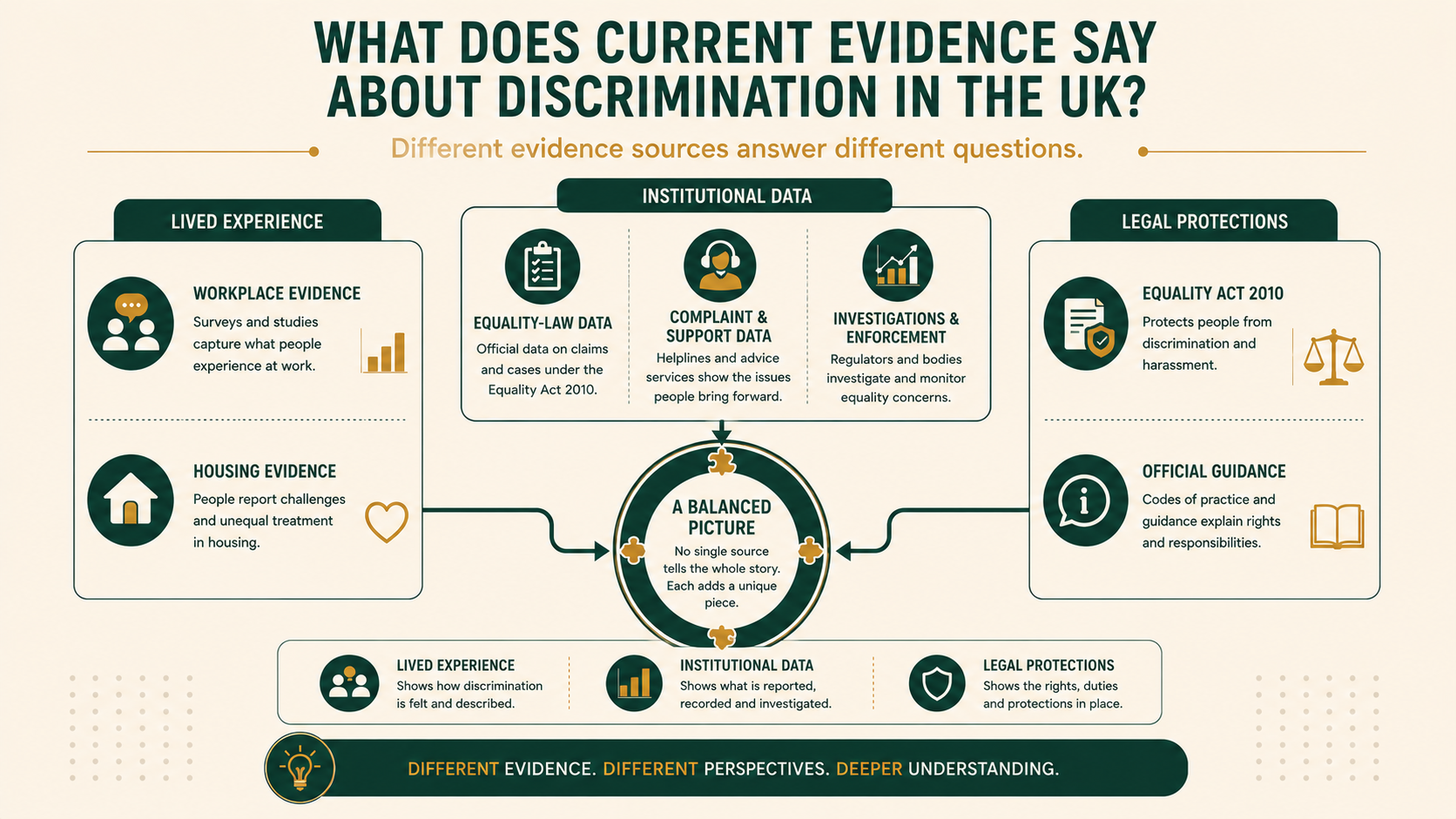
What the UK does have is unusual legal clarity. Under the Equality Act 2010, "race" includes colour, nationality, and ethnic or national origins. This means nationality-based discrimination has a direct, explicitly named legal route in the UK, in contrast to countries like Germany, where nationality is protected only indirectly through its overlap with ethnic-origin discrimination.
In UK equality law, nationality can fall within the protected characteristic of race.
Is nationality protected under the Equality Act?
Yes, directly and explicitly. The Equality Act 2010 defines race to include nationality alongside colour and ethnic or national origins, and this protection extends across employment, education, the provision of services and property. This is one of the clearer statutory positions on nationality discrimination anywhere in Europe, since some other countries protect nationality only indirectly, through its overlap with race or ethnicity, rather than naming it outright.
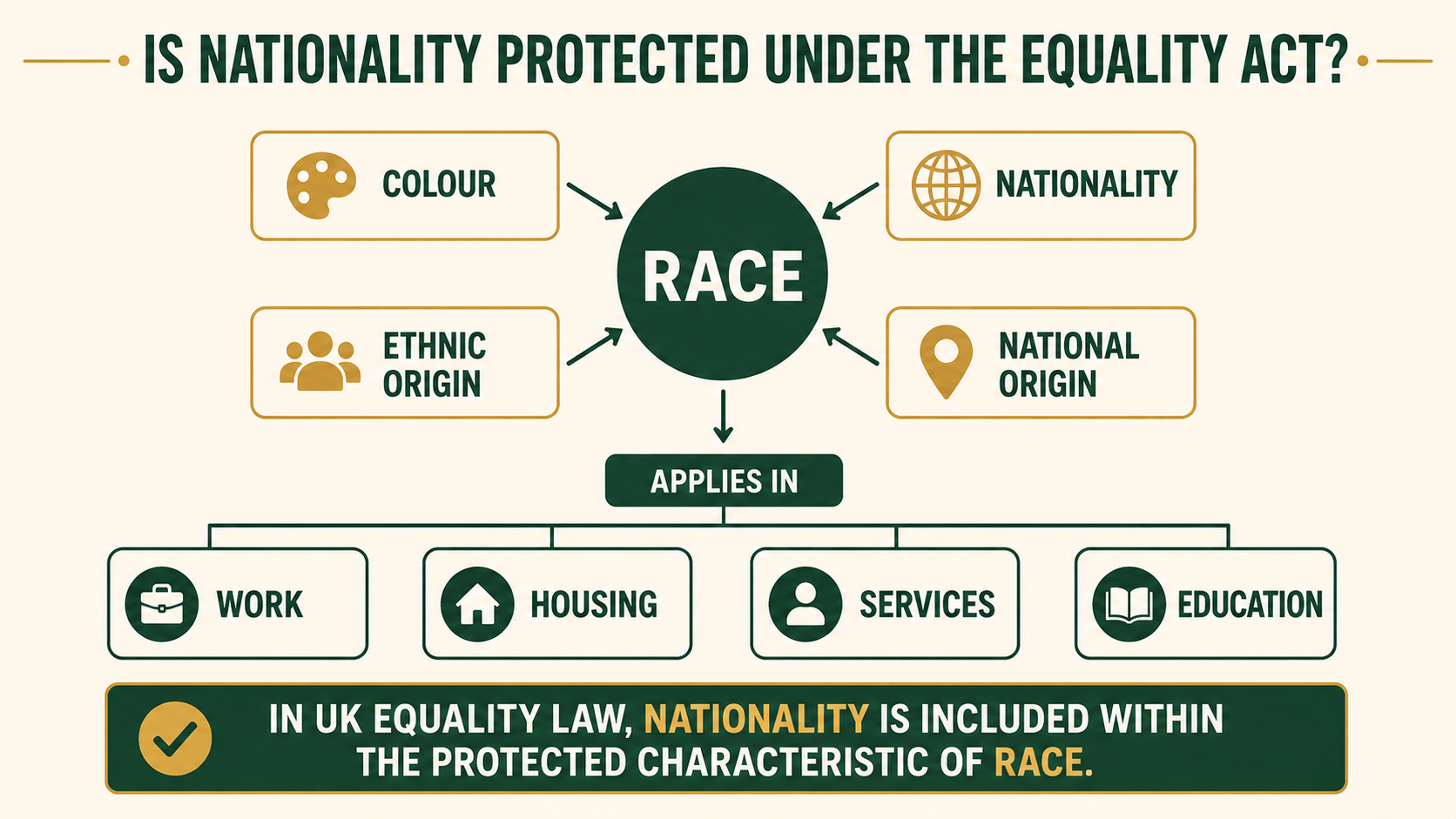
In practical terms, this means someone treated unfavorably specifically because of their nationality, separate from race or ethnicity more broadly, has a directly applicable legal category to work from, rather than needing to establish that the treatment also constituted broader ethnic-origin discrimination.
Can landlords discriminate against foreign tenants in the UK?
Landlords cannot lawfully reject tenants based on nationality or race, but the UK's Right to Rent scheme creates a genuinely useful and instructive example of how a legitimate legal requirement and discriminatory implementation of that requirement can coexist. Landlords are legally required to verify a prospective tenant's immigration status before renting to them. That verification requirement is not itself discriminatory. It's a legal obligation that applies to the rental process generally.
The problem the government's own evaluation of the scheme identified was different: it found some evidence of discriminatory attitudes among landlords, while not finding statistically significant evidence that the scheme itself had increased race discrimination overall during the phase evaluated.
A policy can coexist with real discriminatory attitudes among the people implementing it without the policy itself being the thing driving discrimination upward. Both findings can be true at once.
Official government guidance is direct about where the actual risk sits: landlords are explicitly warned against rejecting all international tenants outright, or checking only people who look or sound foreign, rather than applying the verification requirement consistently to everyone.
A legal immigration-status check and discriminatory treatment are not the same thing. The problem can lie in who is checked and how the rule is applied.
This distinction, a legitimate rule applied unevenly rather than the rule itself being the problem, is genuinely useful well beyond housing. It transfers directly to other institutional and workplace contexts where a legal requirement exists alongside real discretion in how it gets applied. For the broader research on how housing discrimination has been measured and documented in other European countries, housing discrimination abroad covers the correspondence-test methodology used in the Netherlands, France and Spain, which offers a useful comparison point even though equivalent large-scale UK data isn't yet available at the same scale.
Can employers discriminate based on nationality?
No, not lawfully. Nationality-based discrimination in employment falls within the Equality Act's protection of race, covering hiring, treatment during employment, and dismissal. In practice, this means a UK employer treating a candidate or employee less favorably specifically because of their nationality, separate from any legitimate right-to-work verification, has a direct legal exposure under the same framework that covers racial discrimination generally.
As with housing, the useful distinction is between a legitimate requirement, verifying someone's legal right to work, and its discriminatory implementation, applying extra scrutiny only to candidates who sound or appear foreign rather than checking documentation consistently. For the wider patterns of how workplace discrimination tends to show up beyond the UK specifically, including accent bias and informal exclusion, workplace discrimination abroad covers that ground in depth.
Is discrimination in the UK always explicit, or can it be indirect and subtle?
UK equality law recognizes indirect discrimination, where a formally neutral policy or practice disproportionately disadvantages a protected group without adequate justification, alongside direct and more subtle, harder-to-prove forms of unequal treatment. A Right to Rent style example makes this concrete: a landlord who nominally applies the same rule to everyone but, in practice, only actually enforces the identity check on tenants who sound or look foreign has moved from a neutral policy into discriminatory implementation, even without ever stating an explicitly prejudiced reason.
One important caution deserves emphasis here, since UK-specific representation data can be tempting to over-read. A gap in representation, fewer people of a certain nationality in senior roles, for instance, does not by itself prove discriminatory decision-making occurred. Representation gaps can result from many overlapping factors. They're a reasonable starting point for asking further questions, not a standalone proof of unequal treatment.
A gap invites the question. It is not, on its own, the answer. For the broader landscape of how covert, hard-to-prove discrimination tends to operate and how to weigh a pattern you're noticing, subtle discrimination abroad covers that territory in more depth. Where the concern involves a public institution rather than an employer or landlord, discrimination or bureaucracy abroad covers how to separate genuine administrative friction from unequal institutional treatment.
What exactly does the Equality Act protect?
The Equality Act 2010 protects against discrimination based on several characteristics, including race, which itself covers colour, nationality and ethnic or national origins, across employment, education, the provision of services and property. This is a broad statutory scope, meaning the same core protection applies whether the situation involves a job, a rental property, a school, or access to a public or private service.
This article provides general information about the scope of the law, not individualized legal advice. Anyone facing a specific situation should seek advice about how the Equality Act applies to their particular circumstances.
Where can you seek help or report discrimination in the UK?
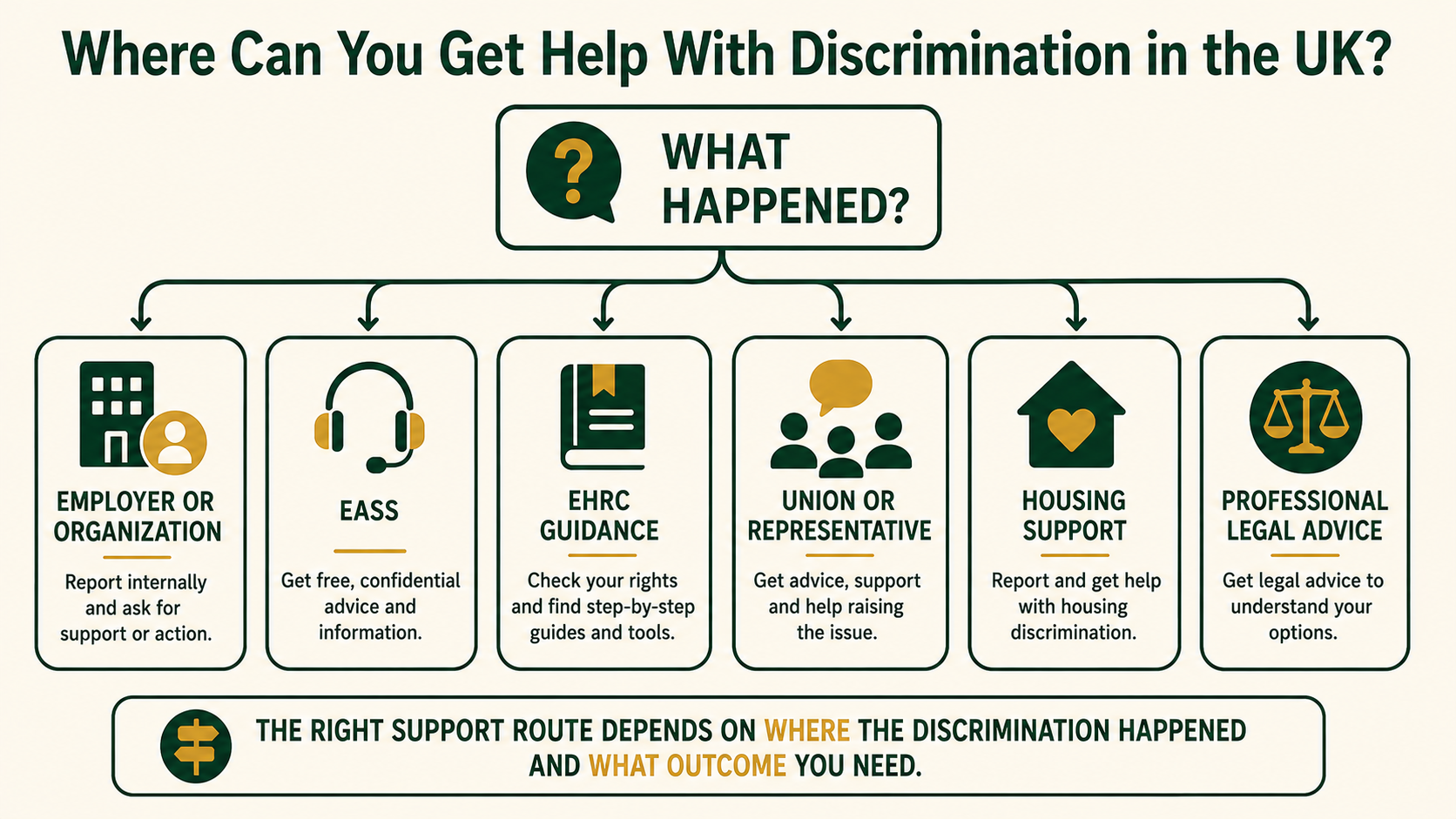
Members of the public in England, Scotland and Wales can access support through the Equality Advisory and Support Service, EASS, which handles individual enquiries and complaints, while the Equality and Human Rights Commission, EHRC, focuses more on broader enforcement and policy work and directs individual public enquiries toward EASS. This division of roles is worth understanding before reaching out, since EASS is generally the more appropriate first point of contact for someone with a specific personal situation, rather than the EHRC directly.
For general guidance on documenting what happened before reaching out to any formal body, separating fact from interpretation, and thinking through whether and how to escalate a concern, how to report discrimination abroad covers that process in depth and applies directly to the UK context.
How should you think about your own experience given the limits of current UK evidence?
Given that UK-specific research is thinner than in some neighboring countries, it's especially important not to treat the absence of a large statistical study as evidence that discrimination doesn't happen, and equally important not to treat one difficult experience, or a general impression, as proof that it does. The clearest UK-specific finding available, the Right to Rent evaluation, is itself a useful model for how to think about this: it found real discriminatory attitudes present without finding that the policy itself had measurably increased discrimination, a genuinely nuanced result rather than a simple verdict in either direction.
For your own situation, the same general principle that applies everywhere in this pillar holds here too: a single ambiguous incident rarely settles anything on its own, while a repeated pattern, and a fair comparison with how someone else was treated in the same situation, tends to be far more informative. If you're working through that kind of uncertainty right now, discrimination abroad lays out the broader framework this UK-specific evidence sits inside. If the experience, resolved or not, has been weighing on you, discrimination and mental health abroad covers what tends to help.
Frequently asked questions
Is discrimination against foreigners illegal in the UK?
Yes. Nationality falls within the protected characteristic of race under the Equality Act 2010, alongside colour and ethnic or national origins, and this protection covers employment, education, services and property. This is general information and not a substitute for legal advice about a specific situation.
Is nationality protected under the Equality Act?
Yes, directly. The Equality Act 2010 explicitly defines race to include nationality, which gives nationality-based discrimination a clear, direct legal route in the UK, compared with some other European countries where it is only protected indirectly.
Can landlords discriminate against foreign tenants in the UK?
Not lawfully. Landlords are required to verify immigration status under the Right to Rent scheme, which is a legitimate legal obligation, but official guidance explicitly warns against rejecting all international tenants or checking only people who appear or sound foreign, since that crosses into discriminatory implementation of the rule.
What is the difference between a Right to Rent check and discrimination?
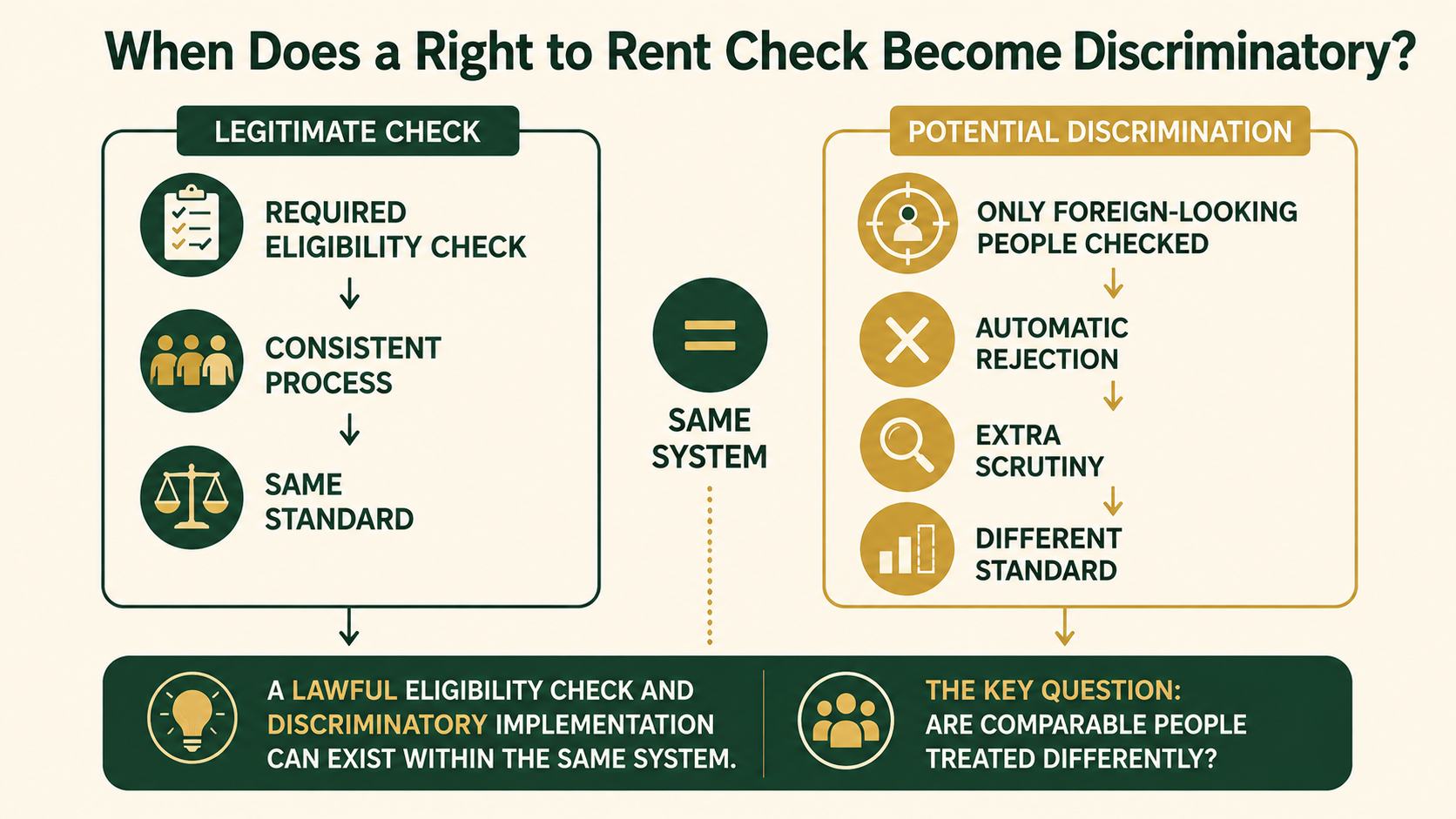
A Right to Rent check is a legal requirement to verify a tenant's immigration eligibility, applied consistently. It becomes discriminatory when it is applied selectively, based on appearance, accent or assumed nationality, rather than being carried out the same way for every prospective tenant.
What does EASS do?
EASS provides advice and support to individuals who believe they have experienced discrimination, helping people understand their rights and options under the Equality Act. It is generally the more appropriate first contact for a personal situation than the EHRC, which has a broader enforcement and policy role.
Need support? We're here.
Book a free 15-min consultation with our expat-specialized therapists.