
Key takeaway
Something happened, and you are fairly sure it wasn't right, but you haven't written anything down, told anyone, or decided what, if anything, to do about it. This is the far more common response than filing a formal complaint, and it says nothing about how serious what happened actually was. This article walks through why so few people report discrimination even when it's real, what's actually useful to document and why, how to separate what you know from what you suspect, and how to think about your options without treating reporting as a moral obligation you owe anyone.
You keep meaning to write it down properly. A week passes, then a month, and the details that once felt sharp and certain have gone soft at the edges.
Write down what happened before memory starts filling in the gaps.
Why do so few people report discrimination they experience?
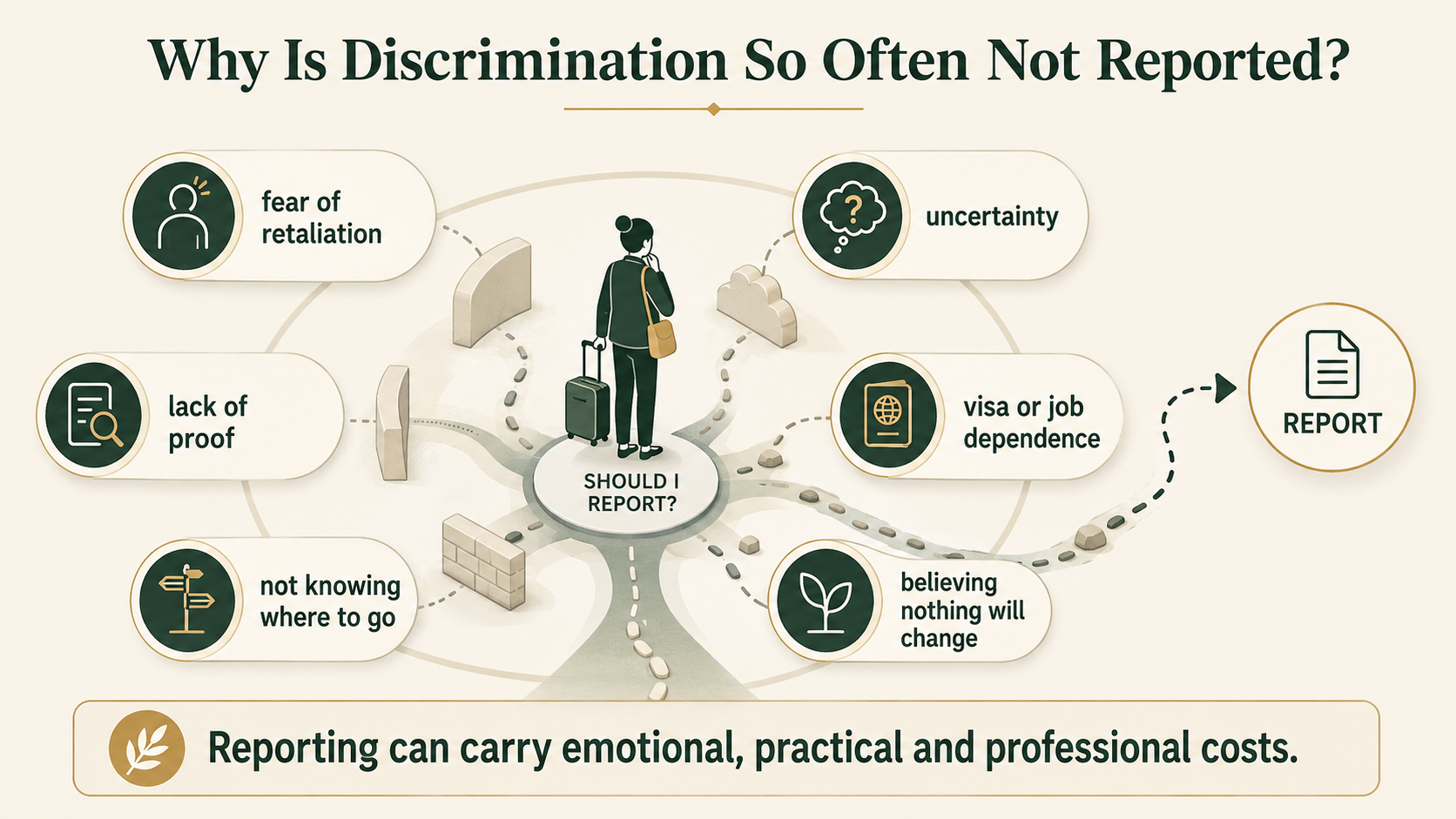
Most people who experience discrimination never formally report it, and the research on why is remarkably consistent: people doubt reporting will change anything, minimize what happened to themselves, treat it as something normalized, or simply don't know where to go. This isn't a personal failing. It's the typical pattern across multiple countries and populations studied.
In the EU's largest recent study of racial discrimination, involving nearly 6,800 people of African descent, only 9% of those who experienced racial discrimination in the previous year reported or complained about their most recent incident. In Spain's 2024 CEDRE victim survey, just 22.4% of people who felt discriminated against made a formal complaint. Among those who didn't report, 20.6% believed it would be useless, 18.6% minimized the event to themselves, 18.3% considered it normalized, and 13.6% simply didn't know where or how to report it. French equality-body research identifies similar barriers: fear of consequences, difficulty understanding the process, weak knowledge of one's rights, and general discouragement.
None of these reasons mean the underlying experience wasn't real or wasn't worth taking seriously. They mean reporting systems, everywhere, carry real friction, and most people reasonably weigh that friction against uncertain benefit and decide it isn't worth it in the moment. That calculation is entirely valid. It just shouldn't be confused with the experience itself being minor.
Nine in ten people who experienced racial discrimination in one major EU survey never reported their most recent incident. Silence is the statistical norm, not the exception.
Do you need proof before you can report discrimination?
No. You do not need certainty about someone's motive, or airtight proof, to write down what happened or to raise a concern. Documentation and reporting exist on a spectrum, from a private note to yourself, to raising something informally, to a formal complaint, and you can move along that spectrum at your own pace, or stop wherever feels right.
You do not need to prove motive before writing down what happened.
What's worth being honest about, in the other direction, is that documentation is not proof that discrimination occurred. A written record doesn't establish someone's intent. What it does is preserve facts, dates and comparisons accurately enough that if a pattern does emerge later, you have something more reliable than memory to evaluate it against.
What should you actually write down?
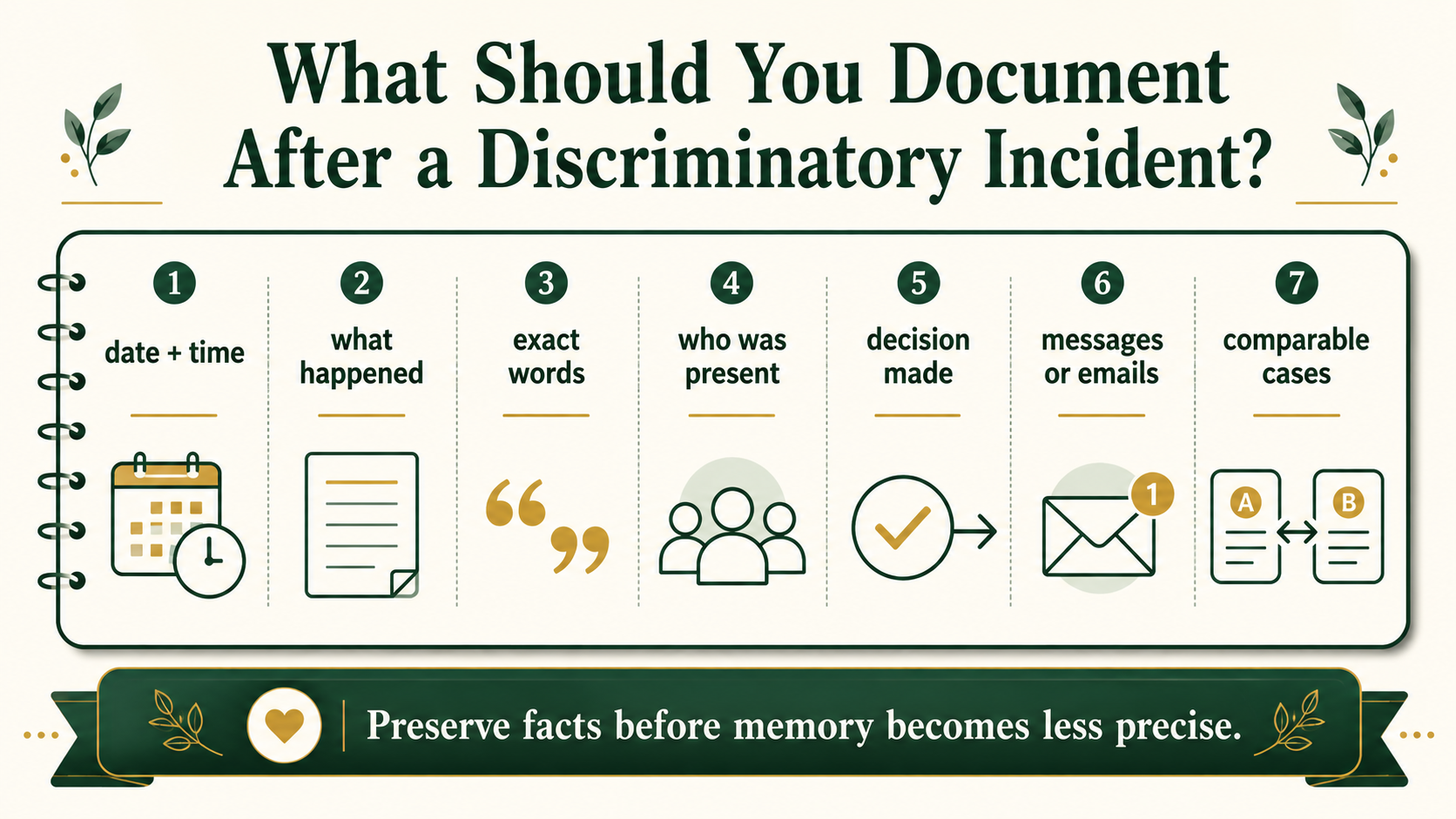
Useful documentation focuses on concrete, checkable facts: what happened, when, who was involved, the exact words used where you remember them, what decision was made, and how a comparable situation involving someone else was handled, rather than on your interpretation of what it meant. Facts hold up. Interpretations shift, understandably, as you process what happened.
A simple, practical record includes:
- The date and approximate time.
- Who was present, including anyone who might later be able to confirm what happened.
- What was said or done, in as close to exact wording as you can manage.
- What decision or outcome followed, a rejection, a piece of feedback, a requirement, a change in tone.
- Any written communication, emails, messages, forms, saved as they were sent.
- How a comparable person or situation was handled, if you know or can find out.
Separate what you know from what you suspect. Both matter, but they are not the same thing.
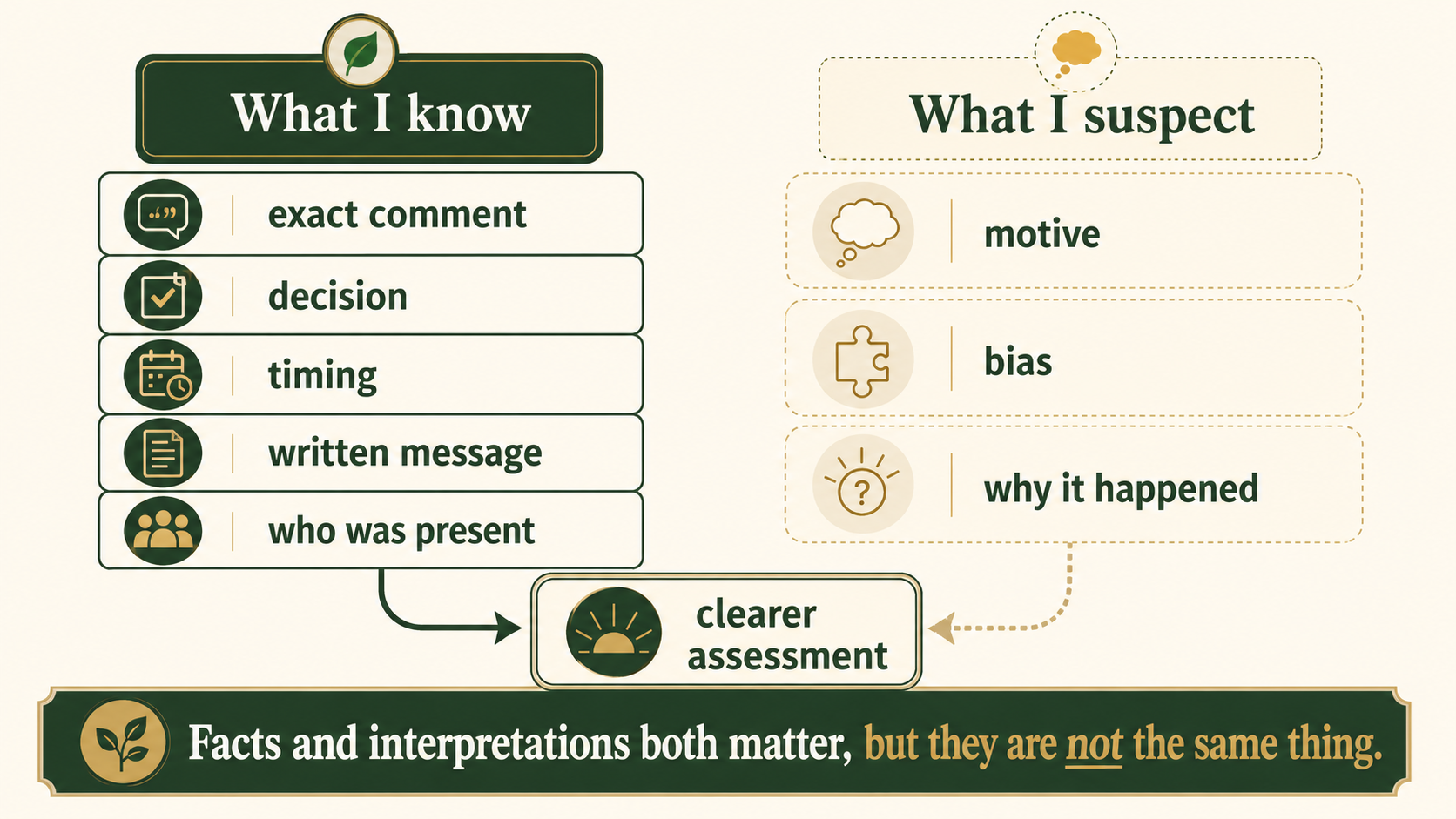
Write "I was told to provide two additional documents that a colleague in the same visa category told me she wasn't asked for" rather than "they were clearly targeting me because of my nationality." The first is a fact you can stand behind indefinitely. The second is an interpretation, possibly a correct one, but it belongs in a separate part of your notes, clearly labeled as your read on the situation rather than as something you could state under oath.
Should you act on one incident, or wait to see if a pattern forms?
Whether to act on a single incident or wait depends on its severity, but for anything short of clearly overt discrimination, waiting to see whether a pattern forms is often the more informative choice, since one ambiguous incident rarely provides enough to act on with confidence. Repetition, and comparison with how others were treated, consistently provide more useful information than a single moment ever can.
This doesn't mean you have to wait passively. Documenting the first incident properly means that if a second one happens, you're not starting from memory alone, you already have a record to compare it against. If what you're sitting with right now is genuine uncertainty about a single ambiguous moment, was that discrimination or am I imagining it goes further into that specific kind of exhausting not-knowing, and subtle discrimination abroad covers the broader patterns that repeated, hard-to-prove treatment tends to follow.
What's the difference between internal and external reporting routes?
Internal reporting means raising a concern within the organization where it happened, an employer's HR department, a landlord's agency, a school, while external reporting means going to an independent body outside that organization, such as an equality body, ombudsperson, union or regulator. Each has different strengths, and neither is automatically the "correct" first step.
Internal routes are often faster and can resolve a genuine misunderstanding without escalation, but they depend on the organization actually taking the concern seriously, and can create real discomfort if the person involved has ongoing authority over you. External routes carry more independence and formal weight, but tend to be slower, and often expect some form of documentation or pattern before they can act meaningfully. For workplace-specific situations, workplace discrimination abroad covers this decision in more depth, and for housing, housing discrimination abroad and for healthcare settings, healthcare discrimination abroad cover the specific dynamics of those contexts. If the situation involves a public authority or institution rather than an employer or landlord, discrimination or bureaucracy abroad covers how to think about that specific setting.
Reporting bodies, legal protections and specific procedures differ meaningfully by country. Detailed national routes are covered at discrimination in the Netherlands, discrimination in Germany, discrimination in France, discrimination in Spain and discrimination in the UK.
What if you're afraid of retaliation or consequences?
Fear of retaliation, damaged references, visa complications, strained relationships or simply being labeled as difficult is one of the most common and legitimate reasons people hesitate to report discrimination, and it deserves to be weighed honestly rather than dismissed. For internationally mobile people specifically, dependence on an employer for visa sponsorship, unfamiliarity with local employment law, language barriers and a thinner local support network can all add real weight to that hesitation, even where this hasn't been measured precisely for every population of international workers.
This fear is a legitimate factor in your decision, not a sign that you should push through it regardless. Weighing the realistic risk of retaliation against what reporting might achieve is a reasonable, adult calculation, not a failure of courage.
Deciding the risk of reporting outweighs the likely benefit is a judgment call, not a moral failure.
Where a genuine dependency, on a visa, an employer, a landlord, makes the stakes especially high, that's precisely the kind of situation where getting independent advice before acting formally, rather than after, tends to be most useful.
When is it worth getting professional legal advice?
Professional legal advice tends to be most useful once you have a documented pattern, are considering a formal complaint or legal action, or are facing a situation with real consequences attached, such as your job, housing or immigration status, rather than at the very first sign that something felt off. A lawyer or specialized advisor can help you understand what your specific legal protections actually are in your country and situation, which varies considerably and which this article, being general in nature, cannot responsibly tell you.
This is different from needing legal advice to simply take your own experience seriously or to start documenting. You can, and often should, begin keeping a record well before deciding whether formal advice or action makes sense.
Does choosing not to report mean the experience wasn't significant?
No. Choosing not to report discrimination is an extremely common, entirely reasonable response, and it says nothing about how real or serious the underlying experience was. Given how consistently underreporting shows up across every population studied, treating silence as evidence that something "wasn't that bad" gets the relationship backward. Silence is the norm. It reflects the friction and risk of reporting systems, not the weight of what happened.
Reporting is one possible response to discrimination, not a moral obligation placed on the person who experienced it.
You're allowed to document something carefully and then decide not to take it further. You're allowed to report something with an incomplete record because waiting for perfect documentation felt like it cost too much. There is no single correct path here, only the one that makes sense given your situation, your risk tolerance and what you actually want out of taking action.
If the weight of what happened, reported or not, has been affecting your mood, sleep or sense of safety, that's worth attending to regardless of what you decide to do formally. Discrimination and mental health abroad covers what tends to help. For the wider landscape of how discrimination shows up across different parts of life abroad, discrimination abroad is the place to start.
Frequently asked questions
How do I report discrimination abroad?
The process depends on where it happened and your country. It typically starts with documenting what happened, then choosing between an internal route, such as an employer's HR department, and an external one, such as an equality body or ombudsperson, depending on the severity and your specific situation.
What evidence should I collect?
Focus on concrete facts: dates, who was present, exact words where you remember them, decisions made, and any written communication like emails or messages. Also note how a comparable situation involving someone else was handled, if you know or can find out.
What should I write down after a discriminatory incident?
Write the facts as precisely as possible while they're fresh, separately from your interpretation of what they meant. A note like "I was asked for two extra documents a colleague in the same category wasn't asked for" holds up better over time than a conclusion about someone's motive.
Can I report discrimination without proof?
Yes. You do not need certainty about motive or airtight proof to raise a concern or make a report. What you document helps preserve facts and patterns accurately, but the absence of perfect proof does not disqualify you from reporting or seeking support.
Why do people not report discrimination?
Common reasons include believing it won't change anything, minimizing the incident, treating it as normalized, and not knowing where or how to report. Research across several European populations finds these reasons remarkably consistent, and underreporting is the norm rather than the exception.
What if I fear retaliation?
That fear is legitimate and worth weighing honestly, particularly where visa sponsorship, employer dependence or limited local support make the stakes higher. Getting independent advice before acting formally, rather than after, tends to be the most useful approach when a real dependency is involved.
Should I report one incident or wait for a pattern?
For anything short of clearly overt discrimination, documenting the first incident and watching for repetition often provides more clarity than acting immediately. A pattern, and comparison with how others were treated, generally offers more useful information than a single ambiguous moment.
Where can foreigners report discrimination?
Reporting routes vary significantly by country and typically include equality bodies, ombuds services, workplace HR departments, unions and, where relevant, legal advisors. Specific national institutions and procedures differ, so checking the process in your specific country is an important next step.
Need support? We're here.
Book a free 15-min consultation with our expat-specialized therapists.