
Key takeaway
A doctor hears your symptoms through a thick accent and reaches for the simplest explanation before running the tests a local patient with the same complaint would get. Or the explanation is much less loaded: there was no interpreter available, the appointment was fifteen minutes in an overloaded system, and the same rushed, incomplete conversation would have happened to anyone that day. Both scenarios can look identical from the inside. This article covers what research actually shows about discrimination in healthcare abroad, how to separate it from language barriers, system overload and ordinary bad luck, and what patterns are worth taking seriously enough to act on.
You describe the pain again, more slowly this time, and watch the same slightly skeptical nod. You wonder if a local patient using the same words, in their own language, would have already been sent for a scan.
A poor medical outcome does not prove discrimination, but repeated differences in how concerns are heard, investigated or acted on may deserve closer attention.
What is healthcare discrimination?
Healthcare discrimination is when a patient receives worse care, less thorough attention or different treatment because of their race, ethnicity, nationality, accent or perceived foreign background, rather than because of clinical need. It can appear as a provider dismissing symptoms more quickly, questioning a patient's account more skeptically, or offering a narrower set of options than a comparable local patient would receive for the same complaint.
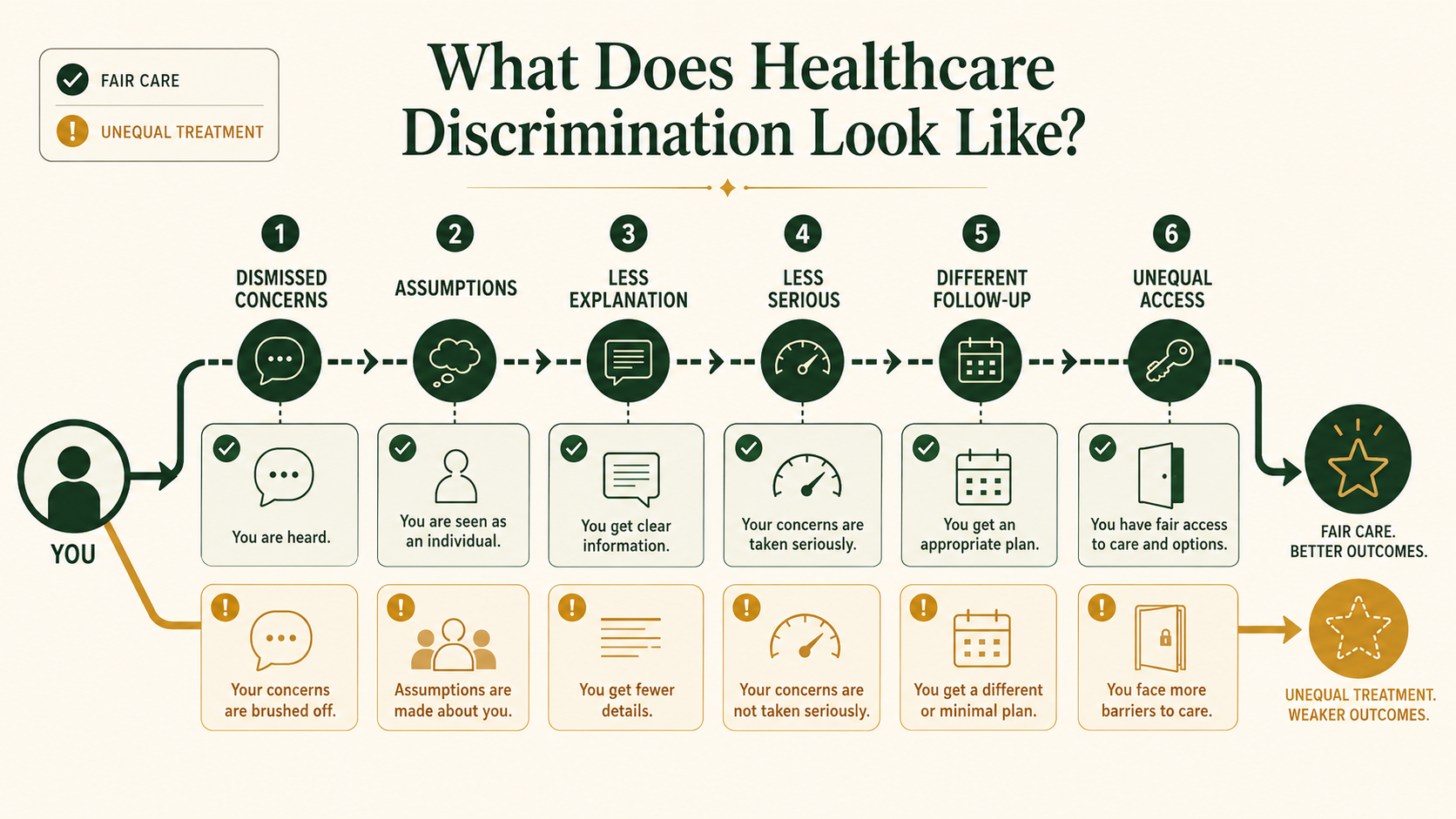
It is one of the harder forms of discrimination in this entire pillar to identify with confidence, and it's worth saying that plainly from the start rather than pretending otherwise.
Can foreign patients actually be treated differently by healthcare providers?
Yes. European research has documented both overt and covert forms of provider racism, stereotyping and differential diagnosis or treatment toward racialized migrant patients, though the evidence base remains more fragmented than in areas like hiring or housing discrimination. A 2023 European scoping review focused specifically on racism against racialized migrants found real evidence of these patterns, while its authors were explicit that the underlying research is still uneven and lacks the kind of large, systematic, generalizable studies available in other domains.
This matters for how confidently any single claim in this space should be made. The honest position is that healthcare discrimination is real and documented, and that the evidence for exactly how often it happens, and to whom, is still developing. Both things are true at once.
Taking a concern seriously and being certain about its cause are not the same thing. This is a domain where the first can happen well before the second.
Is a language barrier the same thing as discrimination?
No. A language barrier is a communication problem, whereas discrimination is unequal treatment based on identity, and the two can look nearly identical from a patient's side of the conversation while having entirely different causes. A rushed, confusing, unsatisfying appointment can result from an unavailable interpreter just as easily as from bias, and confusing the two leads to the wrong conclusion either way.
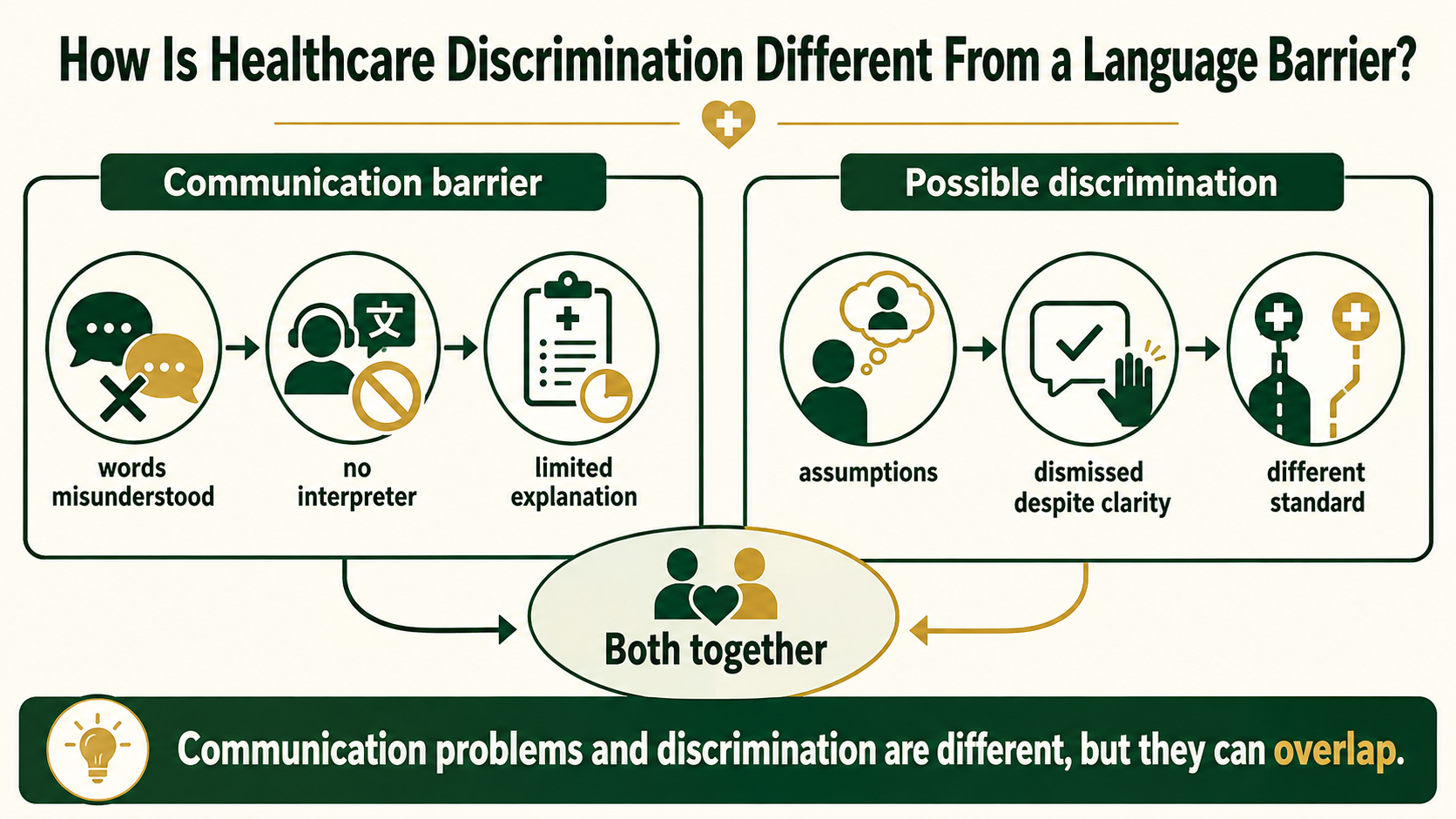
A systematic review drawing on 21 European studies of interpreter services found that unavailable interpreters, user fees for interpretation, restrictive entitlement rules and low awareness of available services could all produce delayed care and real safety risks for patients. None of that requires anyone to hold a prejudiced view. It requires an underfunded or poorly organized system, which is a structural problem rather than an interpersonal one, even though the patient experience at the receiving end can feel remarkably similar.
A language barrier can create unequal care without anyone intending to discriminate. Bias can also exist even when communication is perfectly clear.
That second half matters just as much as the first. Being fully fluent and perfectly understood does not automatically protect a patient from bias. The two problems are separate and can occur independently or, often, together.
Can cultural misunderstanding affect healthcare quality?
Yes. Differences in how symptoms are described, how pain is expressed, or what patients expect from a consultation can create genuine misunderstandings that reduce care quality without either party acting in bad faith. A provider unfamiliar with how a patient's cultural background shapes their communication style may misread hesitancy as evasiveness, or directness as demanding behavior, in ways that affect the quality of the interaction without anyone intending harm.
This is a distinct mechanism from prejudice, even though the resulting experience, feeling unheard, misjudged or dismissed, can feel much the same to the patient on the receiving end.
How do structural healthcare barriers differ from personal prejudice?
Structural barriers are systemic features, like eligibility rules, cost, interpreter shortages or administrative complexity, that produce unequal healthcare access or quality regardless of any individual provider's attitudes, while personal prejudice involves an individual clinician's biased judgment about a specific patient. WHO Europe treats these as genuinely separate contributors to unequal migrant and refugee health outcomes, alongside restrictive migration policy and cultural mediation gaps, rather than folding everything into a single explanation.
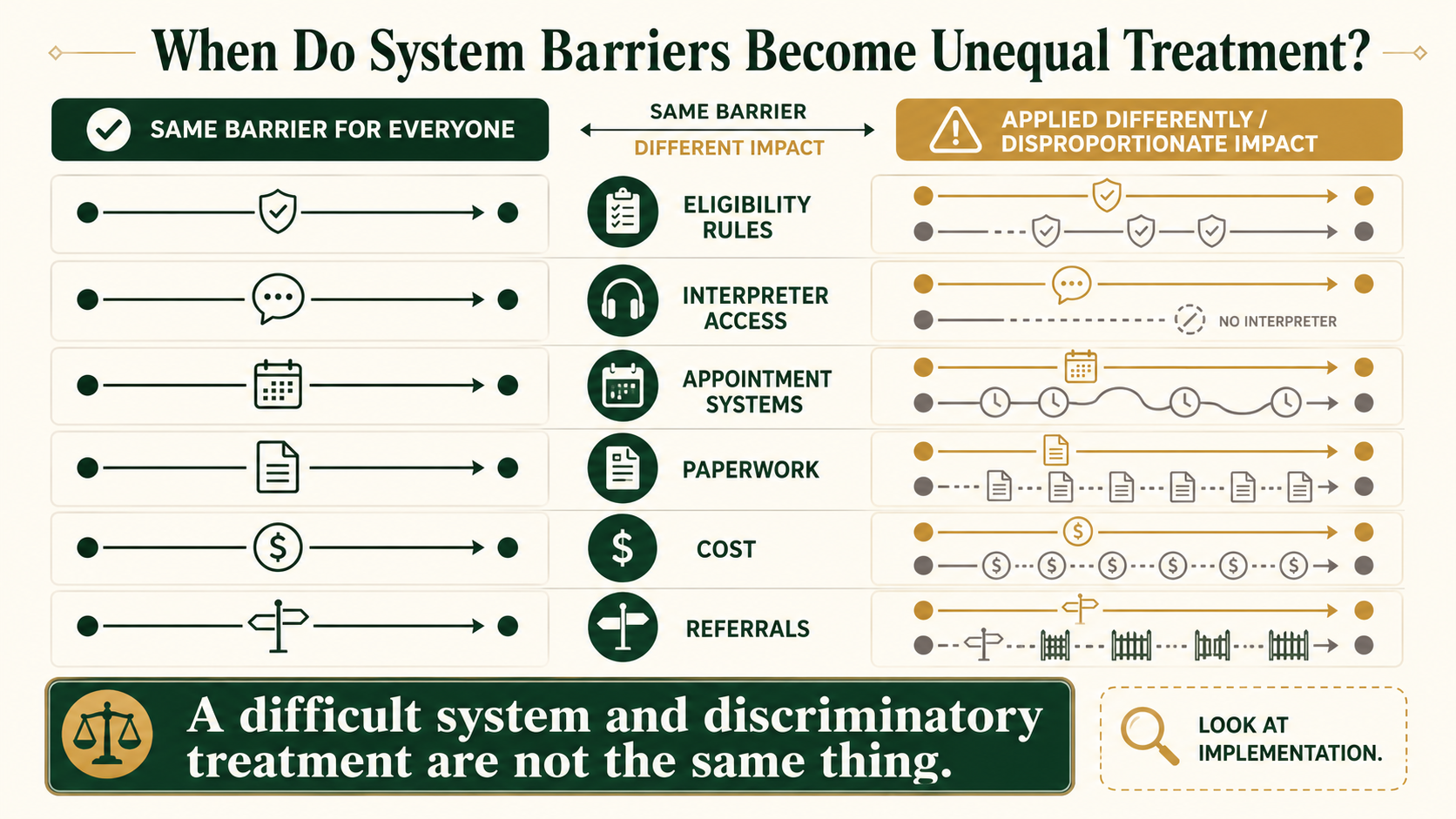
A 2025 review of reviews, covering 30 eligible reviews, reached a similar conclusion from a different angle: the barriers migrants face in European healthcare systems are typically intertwined rather than singular, involving inadequate interpreting, restrictive administrative procedures, cost, culturally insensitive practice and interpersonal racism all layered on top of each other. In practice, several of these can be operating in the same appointment at once, which is exactly why the question "was that discrimination?" is often genuinely hard to answer cleanly.
The hardest cases are often those where system barriers, communication problems and prejudice overlap.
Is being dismissed by a doctor automatically discrimination?
Not automatically. Being dismissed, rushed or not fully heard happens to many patients regardless of background, in overloaded healthcare systems, and a single frustrating appointment does not, by itself, establish that discrimination occurred. What starts to shift the picture is repetition and comparison: the same dismissive pattern recurring across different providers, or a clear sense that a local patient describing identical symptoms would have been taken further, investigated more thoroughly, or referred on more readily.
A single ambiguous appointment genuinely cannot answer this question with confidence. If you're sitting with that exact uncertainty after one specific experience, was that discrimination or am I imagining it covers how to think through that kind of ambiguity without either dismissing it or over-concluding from it. For the broader pattern of subtle, hard-to-prove treatment across different settings, subtle discrimination abroad covers similar ground.
What patterns are worth paying closer attention to?
A pattern worth taking seriously typically involves more than one incident, some form of comparison, and a consistent direction, such as symptoms being minimized repeatedly, being asked for more justification or proof than seems reasonable, or noticing a gap between how thoroughly your concerns are investigated versus how thoroughly a local patient's would be. No single element proves anything alone. Together, over time, they build a picture worth trusting more than a first instinct after one appointment.
Some useful questions to sit with, not as a checklist that delivers a verdict, but as a way to think more clearly:
- Has this happened with more than one provider, or only once?
- Was there a plausible non-discriminatory explanation, an overloaded clinic, a missing interpreter, a genuinely ambiguous case, that fits just as well?
- Did the quality of attention change noticeably once your accent, name or background became apparent, compared with how the interaction started?
- Would you reasonably expect a local patient describing the identical symptoms to have received a different level of follow-up?
Can interpreter problems create unequal healthcare on their own?
Yes, entirely independent of anyone's attitudes. The same systematic review of European interpreter services found that unavailable interpreters and restrictive entitlement to interpretation were directly linked to delayed care and documented safety risks, meaning patients received objectively worse care not because anyone treated them with prejudice, but because the system failed to provide a basic communication tool the interaction required. This is a genuine equity problem in European healthcare systems, and naming it clearly as a structural failure, rather than either ignoring it or mislabeling it as personal bias, tends to be the more accurate and more actionable framing.
A missing interpreter and a biased clinician can produce the exact same bad appointment. Only one of them is fixed by better funding.
For mental healthcare specifically, working through a second language carries its own particular weight, distance from certain emotional vocabulary, difficulty expressing nuance, a different relationship to what gets said aloud, that is worth being aware of separately from the question of discrimination itself.
What should you do if you suspect discrimination in a healthcare setting?
If you suspect discrimination, document the specific interaction while it's fresh, including what was said, what wasn't offered or investigated, and how it compared with previous experiences or what you know of how similar cases are usually handled, then decide whether the pattern is strong enough to raise formally. You do not need certainty to take your own experience seriously or to seek a second opinion from a different provider, which is often the most practical immediate step regardless of what was actually behind the first interaction.
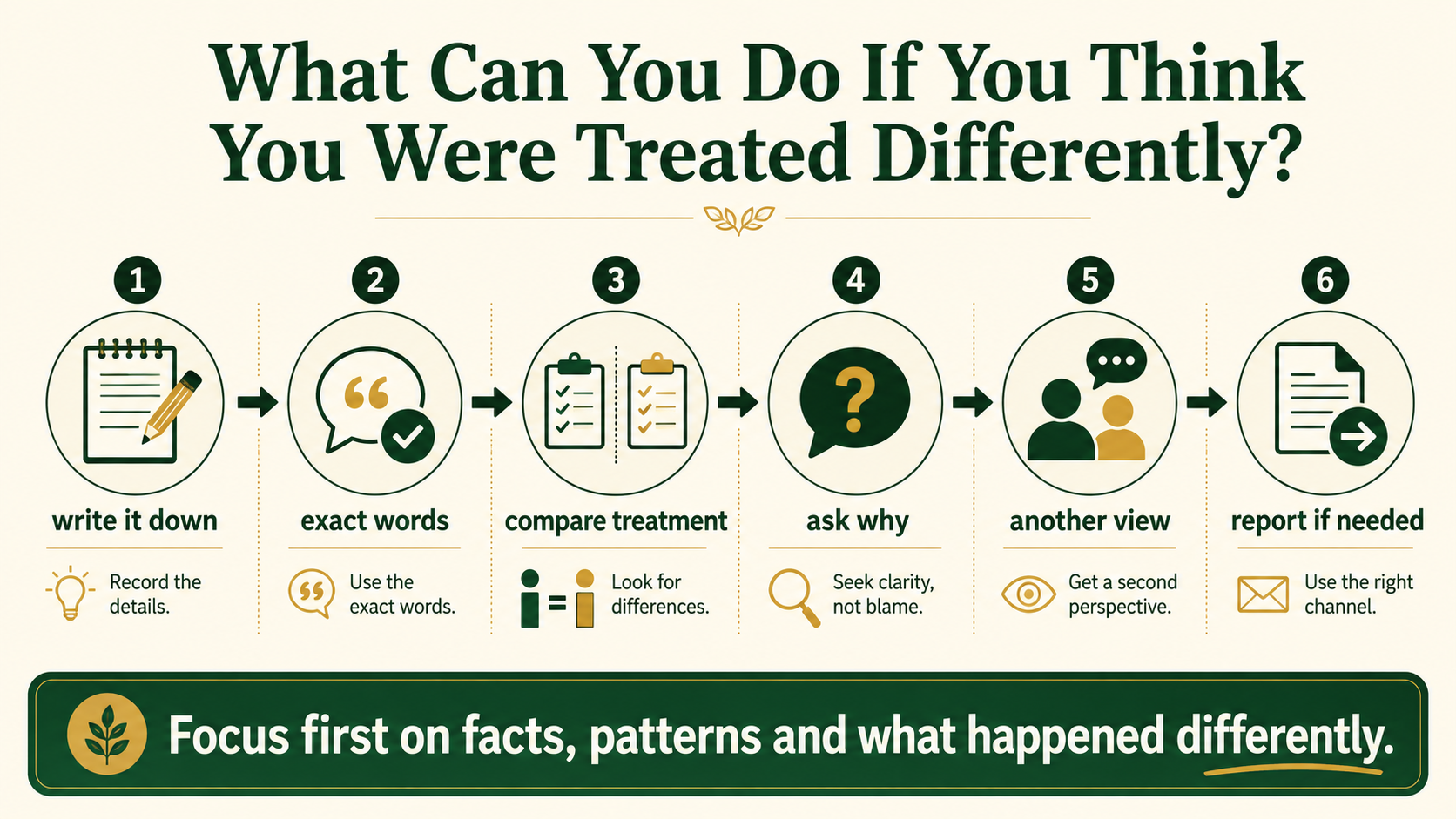
If a broader pattern points toward how a public healthcare system or institution is functioning more generally, rather than one provider's individual judgment, discrimination or bureaucracy abroad covers how to think about institutional patterns specifically. For documentation and formal reporting routes, how to report discrimination abroad walks through that process in more depth than makes sense here, and country-specific healthcare systems and complaint routes are covered in the relevant country pages. If the experience, whatever its actual cause, has left you carrying real distress, discrimination and mental health abroad covers what tends to help, independent of whether the underlying event can ever be fully proven.
For the wider landscape of how discrimination shows up across different parts of life abroad, discrimination abroad is the place to start.
Frequently asked questions
What is healthcare discrimination?
Healthcare discrimination is receiving worse care, less thorough attention, or different treatment because of race, ethnicity, nationality, accent or perceived foreign background rather than clinical need. It can range from overt prejudice to more covert patterns like symptoms being minimized more quickly than they would be for a local patient.
Can foreign patients be treated differently?
Yes, this is documented in European research on racialized migrant patients, including both overt and covert forms of provider bias and stereotyping. The evidence base is real but still described by researchers as fragmented compared with more experimentally established areas like hiring discrimination.
How can I tell discrimination from a language barrier?
Language barriers stem from communication breakdown, often due to interpreter shortages or system limitations, while discrimination stems from identity-based bias, and the two can produce similar-feeling experiences from entirely different causes. Being fully fluent does not rule out bias, and a language barrier does not require anyone to hold a prejudiced view.
Can cultural misunderstanding affect healthcare?
Yes. Differences in how symptoms are described or how pain is expressed can lead to genuine misreadings by a provider unfamiliar with a patient's communication style, reducing care quality without either party acting in bad faith. This is a distinct mechanism from discrimination, though it can feel similar to the patient.
Is being dismissed by a doctor discrimination?
Not automatically. Rushed or dismissive care happens to many patients in overloaded systems regardless of background. It becomes more likely to reflect discrimination when the pattern repeats across providers or clearly diverges from how a comparable local patient's identical symptoms would likely be handled.
Can interpreter problems create unequal healthcare?
Yes, independently of any individual provider's attitudes. Research on European interpreter services links unavailable interpreters and restrictive access to interpretation directly with delayed care and documented safety risks, making this a structural equity issue in its own right.
What should I do if I think I was discriminated against in healthcare?
Document the specific interaction while it's fresh, including what was and wasn't offered, and consider seeking a second opinion, which is a practical step regardless of the underlying cause. If a pattern becomes clear across multiple encounters, formal reporting routes vary by country and healthcare system.
Need support? We're here.
Book a free 15-min consultation with our expat-specialized therapists.