
Key takeaway
You wait forty minutes past your appointment time, get sent to a different counter than the one you were told, and leave with a form you're fairly sure wasn't required for the person ahead of you. Was that just bureaucracy, or was it something else? Public institutions abroad, immigration offices, municipalities, licensing bodies, can be genuinely difficult for everyone who passes through them. They can also treat some people differently than others. This article explains how to tell the two apart, what research shows about unequal treatment by public authorities, and what patterns are worth taking seriously rather than dismissing as ordinary red tape.
The clerk asks you three follow-up questions nobody asked the person in line before you. Maybe that's because your file genuinely looks different. Maybe it isn't. You leave without a clear answer either way.
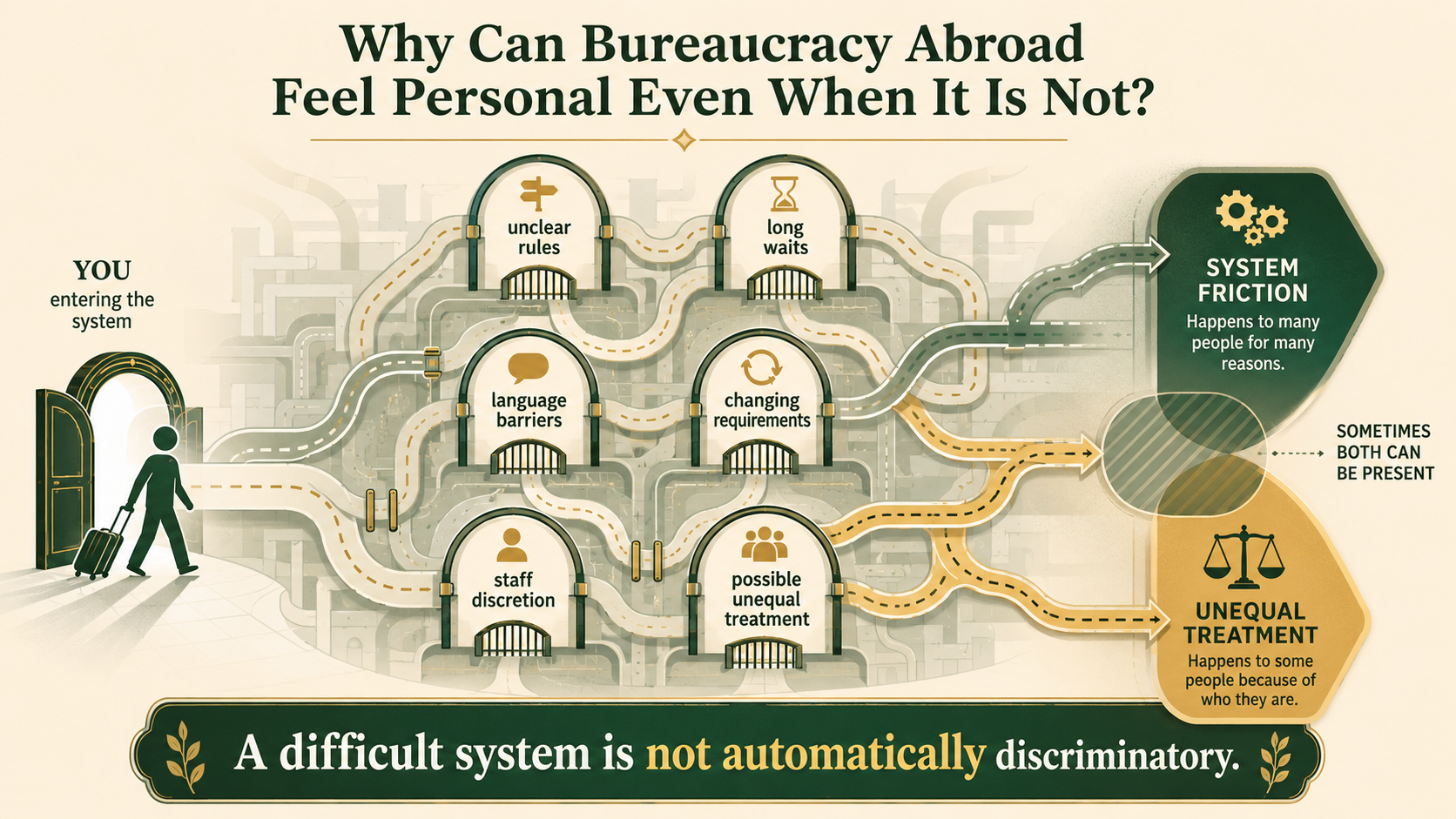
A difficult system can be unfair without being discriminatory. The important question is whether the difficulty is applied differently.
Can government bureaucracy actually be discriminatory?
Yes. While most bureaucratic friction is genuinely universal, applying to everyone regardless of background, public authorities can also apply rules, scrutiny and discretion unequally, and this has been documented in official research, not just anecdotally. A 2025 German survey of 2,000 people, commissioned by the country's Federal Anti-Discrimination Agency, found that 19% reported unequal or poor treatment by public authorities in general. Among people with a family migration history specifically, that figure rose to 33%.
Those numbers matter, but they need to be read precisely: this is self-reported unequal treatment from a representative survey, not a legally adjudicated finding of discrimination in any individual case. It tells you the experience is common enough to take seriously. It does not tell you what happened in your specific interaction.
What is institutional discrimination?
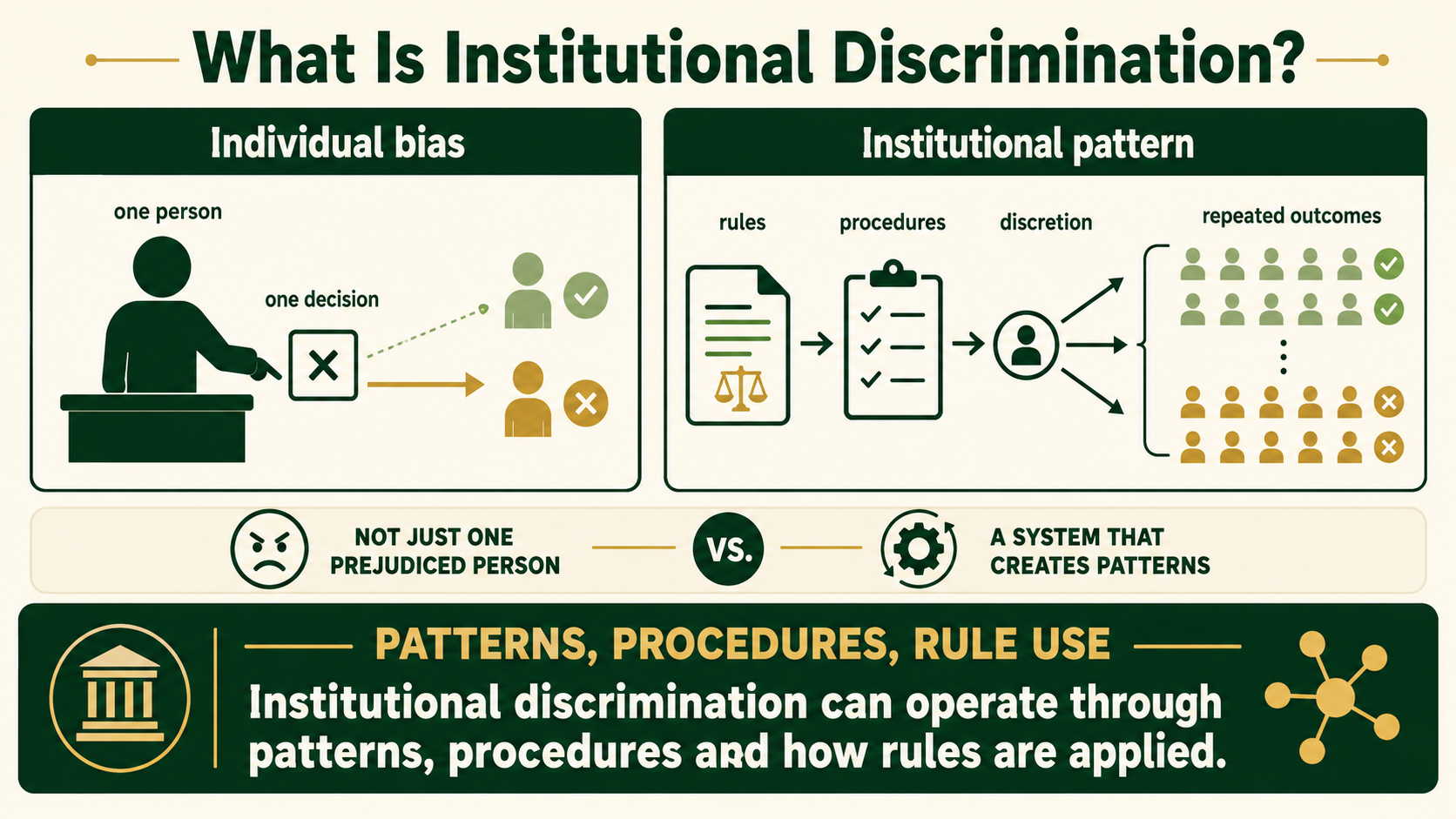
Institutional discrimination is a pattern of unequal treatment produced by an organization's rules, procedures or decision-making systems, rather than by one identifiable person acting with open prejudice. It can persist for years without any single official ever saying anything overtly biased, because the unequal effect comes from how a system is designed or discretionarily applied, not from a stated intention.
This is an important and genuinely difficult idea: a statistical disparity alone does not automatically prove institutional discrimination. Before concluding a pattern is discriminatory, it has to be weighed against alternative explanations, does the disparity reflect a genuinely different starting situation, a different legal category, a different set of requirements that legitimately apply, or does it reflect the same requirements being enforced unevenly on comparable people.
A number that looks unequal and a decision that was unequal are not automatically the same finding. The first invites the question. It doesn't answer it.
When is different treatment by a public authority legitimate?
Different treatment is legitimate when it reflects a genuine, consistently applied legal distinction, such as immigration status, residency category or eligibility rules that apply the same way to everyone in that category, rather than being applied more strictly or more skeptically to some people within the same category than others. A non-citizen being asked for documents a citizen doesn't need is not, by itself, discriminatory. That's simply what the relevant law requires.
The UK's Right to Rent scheme offers an unusually clear, government-documented example of exactly where this line sits. Landlords are legally required to verify a tenant's immigration status, a legitimate eligibility check. But official government guidance explicitly warns against checking only people who "look or sound foreign," and a government evaluation of the scheme found some discriminatory attitudes present even though it did not find statistically significant evidence that the scheme itself had increased race discrimination overall. The eligibility requirement was legitimate. Applying it selectively, based on appearance or accent rather than to everyone equally, would not have been.
A legitimate eligibility rule and discriminatory implementation of that same rule can coexist. One does not cancel out the other.
This distinction transfers directly to almost any institutional context: a residence permit requirement, a language proficiency threshold, a document verification process. The rule itself can be entirely legitimate while still being applied unevenly by the people enforcing it.
When does selective enforcement become concerning?
Selective enforcement becomes concerning when a rule that theoretically applies to everyone is, in practice, applied more strictly, more skeptically or more frequently to people from certain backgrounds than to others in the identical situation. This is harder to prove than an explicit statement of bias, because the rule itself provides genuine cover, technically, the authority is "just following procedure."
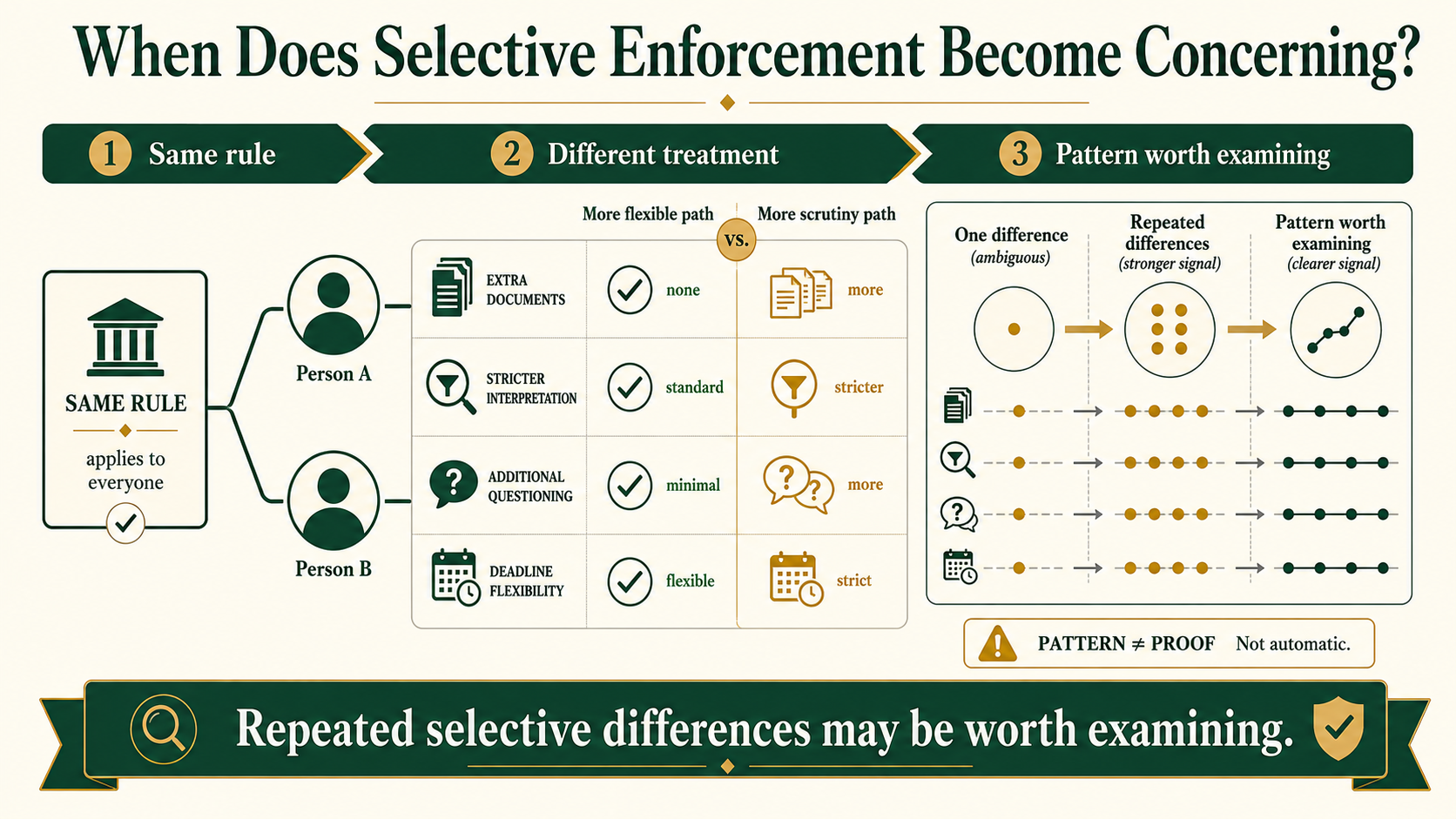
Germany offers a useful legal illustration of how this works even without a direct statement of prejudice. The country's Federal Anti-Discrimination Agency has stated that language and migrant background can function as markers of ethnic-origin discrimination, and that even a blanket, seemingly neutral policy, such as refusing a particular nationality across the board, can constitute indirect discrimination even where nationality itself isn't a directly protected category under German law. A rule can be worded neutrally and still function unequally.
"Just following procedure" can be entirely true and still not be the whole story of what happened.
Institutional discrimination does not always require one openly prejudiced official. Unequal treatment can emerge through rules, discretion and repeated procedures.
How do language and immigration status complicate the picture?
Language barriers and legitimate immigration procedures can produce experiences that feel identical to discrimination, longer waits, more forms, more explanation required, without actually being discriminatory, which is exactly what makes this domain so hard to reason about clearly. Needing an interpreter, additional documentation for a non-standard visa category, or more processing time for a complex case are often genuine features of the system rather than evidence of bias.
At the same time, this genuine complexity is also what allows real discretionary bias to hide comfortably inside "the process." An official who is more thorough, more skeptical or slower with certain nationalities than others can always point to the general slowness of the system as cover. The system being genuinely slow for everyone does not mean it's being equally slow for everyone. Both can be true, or only one can, and distinguishing between them from inside a single frustrating appointment is often close to impossible.
Does one difficult interaction prove discrimination?
No. A single frustrating appointment, being sent to the wrong counter, receiving inconsistent information, waiting longer than expected, is common in public administration everywhere and rarely provides enough information on its own to conclude discrimination occurred. Understaffing, unclear internal procedures, an official having a bad day, and genuine case complexity are all ordinary, non-discriminatory explanations that fit the same experience just as well.
One frustrating appointment may tell you very little. Repeated differences in how rules are applied can tell you much more.
What shifts the picture is comparison and repetition: the same pattern recurring across multiple visits or multiple offices, or a clear point of comparison, someone in an identical legal situation being treated noticeably differently. If you're working through this exact uncertainty after a single specific incident, was that discrimination or am I imagining it covers how to think clearly about ambiguity like this without forcing a premature conclusion either way.
What patterns deserve closer attention?
A pattern worth taking seriously usually involves more than one incident, a comparison point, and consistency in direction, extra scrutiny that recurs across different visits, documentation demands that don't match what others in your situation report needing, or a noticeable shift in how you're treated once your nationality or accent becomes apparent. No single element settles the question. Together, over time, they carry real weight.
Useful questions to hold up against a pattern you're noticing:
- Has this happened more than once, with more than one official or office?
- Would someone in an identical legal category, but from a different background, likely face the same requirements?
- Is there a plausible, ordinary explanation, genuine case complexity, general understaffing, that fits just as well?
- Did the tone or thoroughness of the interaction change noticeably once your background became apparent?
- Have other people in a comparable situation described something similar?
For the broader category of subtle, hard-to-pin-down treatment across settings beyond public institutions, subtle discrimination abroad covers similar reasoning applied more widely.
What should you do if you think a public authority is treating you differently?
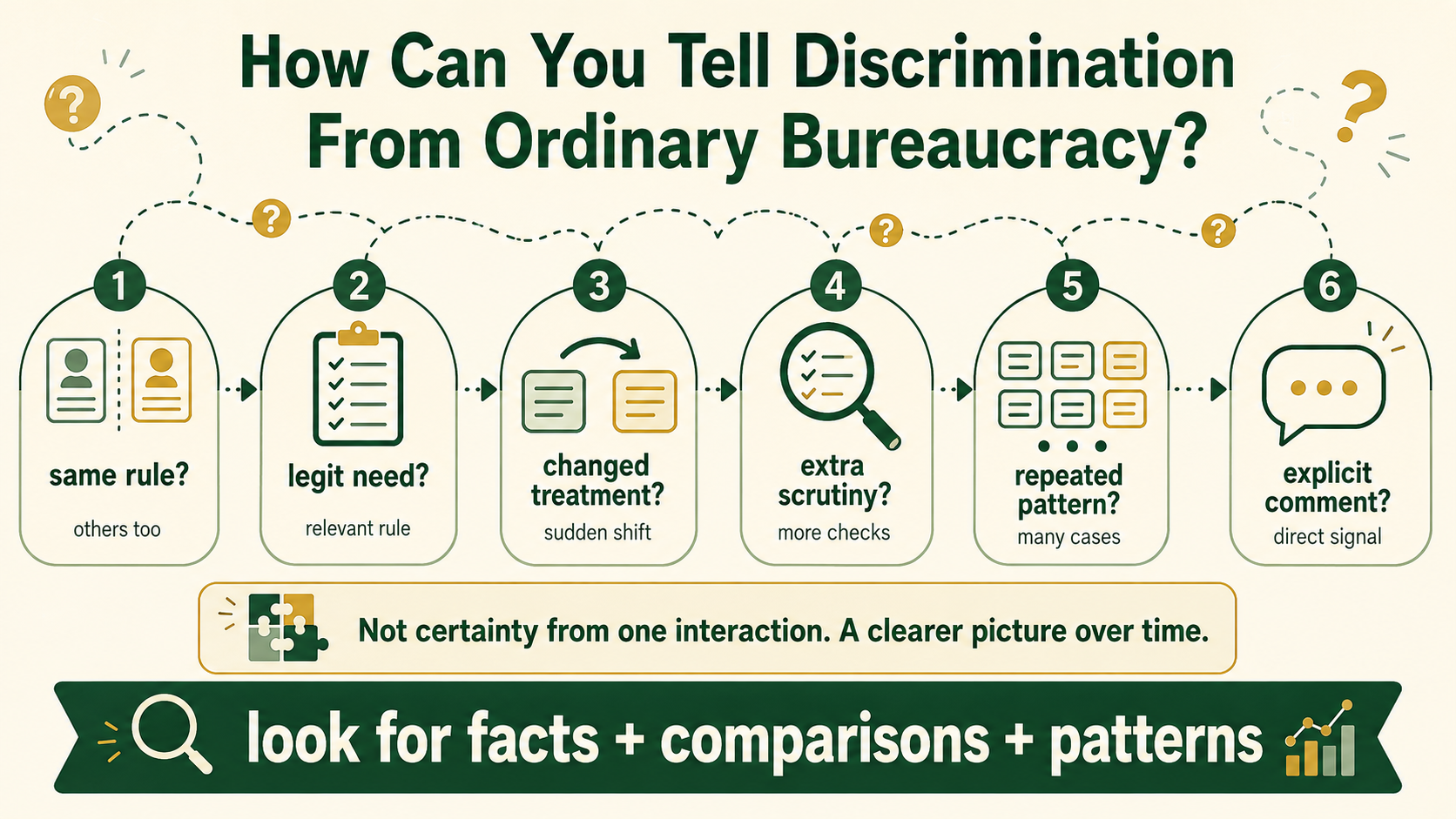
Document the specific interaction while it's fresh, including what was requested, by whom, and how it compared with what you know of how similar cases are usually handled, and consider whether the pattern is clear and repeated enough to raise formally rather than reacting to a single appointment. Keeping a simple record, dates, names of offices, exact requirements stated, makes any later pattern far easier to evaluate honestly than relying on memory and accumulated frustration alone.
Legal frameworks, complaint routes and the specific institutions that handle this kind of concern vary significantly by country. This article can't offer country-specific procedural or legal advice, but detailed national context is covered at discrimination in the Netherlands, discrimination in Germany, discrimination in France, discrimination in Spain and discrimination in the UK. For documentation practices and formal reporting steps in more depth, how to report discrimination abroad walks through that process. If the issue is specifically about healthcare institutions rather than administrative offices, healthcare discrimination abroad covers that setting directly.
For the wider landscape of how discrimination shows up across different parts of life abroad, discrimination abroad is the place to start.
Frequently asked questions
Can government bureaucracy be discriminatory?
Yes, though most bureaucratic friction is genuinely universal. Research shows public authorities can apply rules and discretion unequally, and a 2025 German survey found 19% of the general population, and 33% of people with a family migration history, reported unequal treatment by public authorities.
How do I know if an immigration officer is discriminating against me?
A single interaction rarely provides enough evidence on its own. Look for repetition across multiple visits, comparison with how someone in an identical legal situation was treated, and whether scrutiny or requirements changed noticeably once your background became apparent, rather than judging from one appointment alone.
Is asking foreigners for extra documents discrimination?
Not automatically. If the requirement reflects a genuine, consistently applied legal distinction, such as a residency category that legitimately requires additional documentation, it is not discriminatory on its own. It becomes concerning when the same documentation demand is applied more strictly to some people than to others in the identical legal category.
What is selective enforcement?
Selective enforcement is when a rule that formally applies to everyone is, in practice, enforced more strictly, more frequently or more skeptically against people from certain backgrounds than others in the same situation. It is harder to identify than explicit bias because the rule itself provides a technically neutral justification.
How can I tell discrimination from normal bureaucracy?
Normal bureaucracy is typically slow, confusing or demanding for everyone regardless of background. It starts to look more like discrimination when comparable people are treated differently, when extra scrutiny recurs across multiple interactions, or when treatment shifts noticeably once nationality or accent becomes known.
What should I do if a public authority treats me differently?
Document the specific details of the interaction while they're fresh, including exactly what was asked and by whom, and watch for whether the pattern repeats. Formal complaint routes and legal protections vary by country, so checking the specific process where you live is the appropriate next step once you have a documented pattern.
Need support? We're here.
Book a free 15-min consultation with our expat-specialized therapists.