
Key takeaway
The hardest part of workplace discrimination abroad is rarely a single incident. It is the doubt that follows it, the wondering whether you misread the culture, misunderstood the language or are simply being oversensitive. This article helps you name what may be happening, tell the difference between poor management, bullying and discrimination , understand what repeated exclusion does to your confidence and body, and take calm, documented steps before making a decision under pressure. It also looks honestly at why reporting feels dangerous when your visa, income or reference depends on the same employer, and why psychological support matters long before you decide whether to stay or leave .
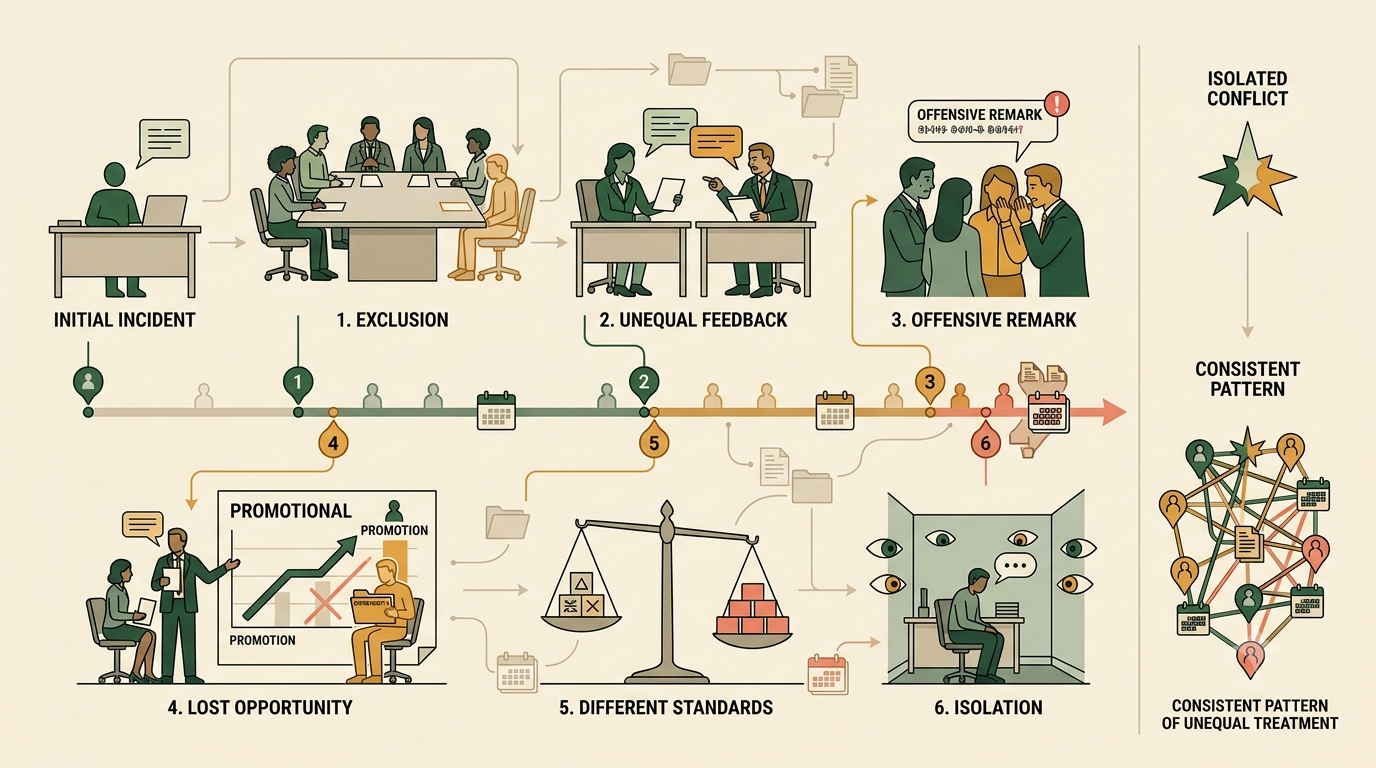
You notice it slowly. A project meeting you were not invited to. A client introduction that went to someone who joined after you. Friday drinks that reached everyone else in the team chat.
You ask your manager, carefully, in your second language. The answer is friendly and vague. We just kept it small this time. Nothing you could repeat to anyone. Nothing you could write down.
So you go home and replay it. Was that about me, or about the project? Is this how things work here? Am I becoming the person who sees a problem everywhere? That loop, not the meeting, is what wears people down.
What Workplace Discrimination Abroad Can Look Like
Workplace discrimination means being treated less favourably because of who you are rather than what you do. For international employees it is often quiet and cumulative rather than openly hostile. It usually shows up as access being withdrawn, standards applied unevenly, or your competence questioned in ways local colleagues never experience.
Common forms include:
- Being excluded from meetings, projects, client contact or the informal networks where decisions happen.
- Unequal access to promotion, training, visibility or high-profile work.
- Jokes or remarks about your nationality, race, religion, accent or immigration status.
- Being evaluated more harshly than local colleagues for the same work.
- Assumptions about your competence or "cultural fit" that were never tested.
- Being ignored until a local colleague repeats your idea and it lands.
- Pressure to tolerate treatment because the company sponsored your visa.
- Isolation, colder treatment or lost opportunities after you raised a concern.
Not every unfair experience is discrimination. Bad managers exist. Chaotic companies exist. What matters is whether the treatment forms a pattern, whether it is unequal compared with colleagues doing similar work, and whether it appears connected to a protected characteristic such as nationality, ethnicity, religion, gender, age or disability. This article cannot decide that for your situation, and is not a substitute for qualified local advice.
Why It Is So Difficult to Trust Your Own Interpretation
Self-doubt is the standard experience here, not a personal weakness. When you are new to a country you have no reliable baseline for what is normal, no trusted local colleague to sense-check with, and no clear picture of your rights. That missing reference point makes the ambiguity exhausting.
Several things stack up at once:
- Unfamiliar norms. Directness that would be rude at home may be ordinary here, or the reverse.
- Fear of appearing oversensitive. The worry that naming it will define you as difficult.
- Language uncertainty. You cannot always tell whether a comment was sharp or just blunt.
- Limited knowledge of local systems. Most people do not know what a works council or ombuds service is until they need one.
- Dependence on the employer for income, and often for residency.
- Fear that colleagues will close ranks, leaving you more isolated than before.
So you look for the innocent explanation. You find one. You feel better for a day. Then it happens again, and the search starts over. That repeated checking is a genuine drain, and close to the vigilance we describe in our article on anxiety at work abroad.
A Bad Experience, Bullying or Discrimination?
These categories overlap, and the same behaviour can belong to more than one. The practical difference is the target: poor management is usually indiscriminate, bullying targets a person, discrimination targets a characteristic, and retaliation follows a complaint. Legal definitions vary by country, and this article cannot tell you whether your situation meets a legal threshold.
| Situation | What it usually looks like | Key signal |
|---|---|---|
| Ordinary conflict or poor management | Disorganisation, unclear feedback, favouritism, one difficult person | Affects most of the team, not just you |
| Workplace bullying | Repeated humiliation, undermining, exclusion aimed at one person | Targets you, but not clearly your identity |
| Discrimination | Unequal treatment linked to nationality, ethnicity, religion, gender, age or disability | Tracks a characteristic, not performance |
| Retaliation | Cooling, isolation, lost work or worse reviews after you spoke up | Begins after you raised a concern |
The categories matter less than the record. Write down what happened either way.
What Repeated Exclusion Does to the Mind and Body
Repeated exclusion is a chronic stressor and the body treats it accordingly. People rarely arrive at a therapist saying "I am being discriminated against". They arrive saying they cannot sleep, they dread Mondays, and they no longer trust their own professional judgement. The damage hits confidence first.
It commonly looks like this:
- Overpreparing for every meeting, because you cannot afford to be wrong once.
- Losing confidence in skills you were previously excellent at.
- Monitoring your tone, accent, clothing or email phrasing constantly.
- Trouble sleeping, or waking early with work already running.
- Headaches, chest tension, stomach problems and other physical symptoms of anxiety abroad.
- Withdrawing from colleagues to avoid another ambiguous moment.
- Becoming irritable at home with people who had nothing to do with it.
- Quietly considering resignation, or moving home.
- Concluding that the real problem is you.
The evidence backs this up. In the first global survey of its kind, the International Labour Organization, Lloyd's Register Foundation and Gallup found that 22.8 percent of employed people, around 743 million worldwide, had experienced violence or harassment at work, with psychological forms the most widespread and migrant workers among the most affected. Roughly half had never told anyone.
In Europe, the EU Agency for Fundamental Rights found in its 2023 Being Black in the EU survey that 31 percent of respondents felt racially discriminated against at work in the previous five years, while only 9 percent reported it to any body.
The health effect is documented too. A meta-analysis of 134 samples published in Psychological Bulletin found that perceived discrimination has a significant negative effect on both mental and physical health, and produces measurably heightened stress responses.
In plain terms: this is common, badly under-reported, and it damages your body while you are still deciding whether it counts.
What to Do Before Making a Major Decision

The goal at this stage is not confrontation. It is clarity. Decisions made from exhaustion are the ones people regret, in both directions, whether that means resigning without a plan or staying silent for years. Slow the process down and build a record first.
- Write down specific incidents. Date, time, exact words if you recall them, what was decided, who was present, what the consequence was.
- Separate facts from interpretations. Keep both, but label them. "He said X" belongs in a different column from "I felt he meant Y".
- Look for patterns. Compare opportunities, feedback and responses over months, not moments. One incident is data. Six is a pattern.
- Save relevant evidence safely, following your workplace and local privacy rules. Do not take anything you are not entitled to hold.
- Identify a trustworthy route. A manager, HR contact, union, works council, ombuds service or external adviser. Some are neutral. Some are not. Find out which before you rely on one.
- Learn the local legal and visa implications from a qualified employment lawyer or immigration adviser. Rules differ enormously between countries, and this is not the place to guess.
- Protect your mental health while you decide. Do not wait until you are so depleted that every option feels urgent.
When Reporting Feels Risky
For many international employees, reporting is not a simple moral choice. When your residency, income, probation or future reference sits with the same employer, the cost of speaking up is real and specific. Acknowledging that is not cowardice. It is risk assessment, and it deserves a plan rather than an impulse.
Work through these questions before you act:
- What outcome do you actually want? An apology, a transfer, a changed decision, a formal record, or an exit with your reputation intact?
- What evidence exists, and what does it actually show?
- Who controls the process? Does HR report to the person involved?
- Can confidentiality realistically be expected in a team of this size?
- What support exists outside the employer, such as a union, equality body or external adviser?
- Do you need legal or immigration advice first? Often, yes.
- How will you cope with each possible response, including being disbelieved?
If your permit is tied to this job, the stakes are higher again, something we explore in our article on what happens when your visa depends on your job.
Important: You do not have to choose between saying nothing and confronting everyone immediately. A careful plan can protect both your position and your mental health.
Why Therapy Can Help Even When the Workplace Is the Problem

Therapy here is not about learning to tolerate mistreatment, and a good psychologist will never reframe genuine discrimination as your anxiety. The workplace is the problem. Therapy addresses what the workplace is doing to you while you decide what to do about it, which is a separate and equally important job.
Working with a psychologist can help you:
- Trust your own observations again after months of second-guessing.
- Separate fact from fear and self-blame, which also makes your documentation sharper.
- Manage sleep, vigilance and physical stress so your body stops running the meeting after the meeting.
- Prepare for difficult conversations, including the ones that may not go well.
- Set boundaries without escalating.
- Make career decisions from clarity rather than panic.
- Protect your confidence from being defined by one company.
- Process the anger, humiliation and isolation instead of carrying them into the next job.
- Decide whether to stay, report or leave without feeling psychologically trapped.
Therapy does not replace legal advice, union representation, an HR process or emergency support. It sits alongside them. For a broader view of how counselling supports people facing unfair treatment, see our guide to discrimination and mental health, or our dedicated discrimination therapy support.
Therapy cannot make an unfair workplace fair. It can help prevent that workplace from taking your confidence, health and future choices with it.
How Expathy Makes Support Easier
Expathy matches expats with licensed psychologists who speak their native language, usually within about 30 seconds. Many of our psychologists are expats themselves, so you do not have to explain what a residence permit is, or why a comment about your accent landed the way it did. You can start with online therapy for expats from wherever you are.
Final Thought
You may never know for certain whether what happened meets a legal definition. That uncertainty is uncomfortable and normal, and it is not a reason to wait.
You are allowed to take repeated exclusion seriously. You are allowed to write it down, ask questions, get advice and look after yourself, all before you have a verdict.
The real risk is not overreacting. It is letting self-doubt become the loudest voice in your career.
Sources and Further Reading
- International Labour Organization, Lloyd's Register Foundation and Gallup, Experiences of Violence and Harassment at Work: A Global First Survey (2022)
- EU Agency for Fundamental Rights, Being Black in the EU (2023)
- Pascoe and Smart Richman, Perceived Discrimination and Health: A Meta-Analytic Review, Psychological Bulletin (2009)
Frequently Asked Questions
What counts as workplace discrimination abroad?
Generally, being treated less favourably because of a characteristic such as nationality, ethnicity, religion, gender, age or disability, rather than because of your work. It can include exclusion from opportunities, harsher evaluation, remarks about your background, or retaliation after complaining. Legal definitions differ by country, so local advice is essential.
How do I know whether I am being discriminated against or simply treated badly?
Look for pattern and comparison. Poor management usually affects the whole team. Bullying targets you personally. Discrimination tracks a characteristic rather than your performance. Ask whether colleagues doing similar work receive the same treatment, and whether it repeats over months. Document either way, because the record is useful regardless.
Should I report discrimination to HR?
Sometimes, but not automatically. HR protects the organisation, which occasionally aligns with protecting you and occasionally does not. Before reporting, find out who controls the process, whether the person involved influences it, and what external routes exist such as a union or equality body. Get advice first when your visa is involved.
What should I document before making a complaint?
Dates, times, exact words where you recall them, who was present, what decision followed and what it cost you. Keep facts and interpretations in separate columns. Save only evidence you are entitled to hold. A quiet, consistent record built over months is far stronger than one detailed account.
What if my work visa depends on my employer?
Then the risk is real and the plan matters more. Speak to a qualified local immigration or employment adviser before making a formal complaint or resigning, because notice periods, permit conditions and grace periods vary widely. Keep documenting meanwhile. Understanding your actual options usually reduces the panic considerably.
Can workplace discrimination cause anxiety or physical symptoms?
Yes. Repeated exclusion works as a chronic stressor, and a meta-analysis of 134 samples found perceived discrimination significantly harms both mental and physical health. People commonly report disrupted sleep, headaches, chest tension and constant vigilance. These symptoms should still be assessed by a doctor rather than assumed to be stress.
Can therapy help after workplace discrimination?
Yes, though not by helping you accept it. Therapy helps you rebuild trust in your own judgement, manage the physical stress, prepare for difficult conversations and decide your next move from clarity rather than exhaustion. It works alongside legal, union or HR routes rather than replacing any of them.
Need support? We're here.
Book a free 15-min consultation with our expat-specialized therapists.