
Key takeaway
Work anxiety abroad is persistent worry, tension or anticipatory fear connected to your job while living in another country. It can intensify internationally because the job may also carry your income, professional identity, social life and residency, so ordinary signals start to feel high-stakes. It often continues after hours as replaying, checking and mental rehearsal. What generally helps is separating facts from predictions, reducing the checking habits that keep work mentally open, protecting sleep, verifying real risks with qualified local sources, and seeking support when the cycle becomes hard to interrupt alone.
When work continues after the workday ends
You closed the laptop forty minutes ago. You are chopping onions and still thinking about the moment in the 14:00 meeting when you said "actually" and your manager paused.
You check the thread again. Her reply was four words. It was probably fine. It might not have been fine.
Tomorrow there is a calendar invitation with no agenda, sent at 17:40. Twenty minutes, just the two of you. You have already decided what it is about, and you have already started preparing what you will say.
Nothing has happened. No bad news, no warning, no complaint. Your body has simply decided something is coming and has begun getting ready for it.
This is exhausting in a way that is hard to explain, partly because from the outside you look fine. You are performing well. That is often part of the confusion. If work pressure has spread across most areas of your life abroad, our guide to working abroad and mental health covers the wider picture.
Work anxiety abroad can make every ordinary workplace signal feel high-stakes because the job may be connected to your income, professional identity, residency and ability to remain in the country.
What Is Work Anxiety Abroad?
Work anxiety abroad is not a separate formal diagnosis. It describes persistent worry, tension or anticipatory anxiety attached to your job, experienced by someone whose work sits inside the additional pressures of international life.
It can appear before work, during work or long after it has ended, and it can exist even when your performance is objectively strong. That is why many people assume they must be imagining it.
Feeling nervous before a difficult presentation is not a mental health problem. It becomes worth attention when the anticipation is constant, continues without any real signal, and starts shaping how you behave.
What Can Work Anxiety Look Like Abroad?

These are patterns worth noticing, not a checklist that diagnoses you.
Before work
- Sunday-evening dread that starts a little earlier each week
- Waking before the alarm with work already running
- Checking email before getting out of bed
- Physical tension in the hour before a meeting
During work
- Fear of mistakes that is out of proportion to the mistake
- Overpreparing for routine tasks
- Difficulty speaking spontaneously, especially in groups
- Monitoring your manager's tone, phrasing and response time
- Avoiding questions in case they reveal something about you
After work
- Replaying meetings and rewriting what you should have said
- Rereading messages you already sent
- Checking whether colleagues are still online
- Being physically at home and psychologically still at work
Emotional and physical signs
- Irritability, restlessness, racing thoughts
- Stomach tension, headaches, shallow sleep
- Exhaustion that does not match your actual workload
- Difficulty being present with a partner, friends or children
Expat-specific signs
- Fear that a poor review could eventually affect your residency
- Feeling less intelligent in your second language than you are
- Reading unfamiliar communication styles as rejection
- Avoiding local colleagues because the interaction feels effortful
- Believing one visible mistake will expose you as unsuited to international work
Why Can Work Anxiety Feel Stronger Abroad?
Your job may be connected to your right to stay
When employment is tied to residency, a performance conversation is not only about performance. This is the largest amplifier, and it is covered fully in when your visa depends on your job.
You may be working in a second language
Speaking at the pace of a meeting, catching nuance and knowing whether your meaning landed all cost more in a second language. The uncertainty is the hard part: you often cannot tell whether a reaction was to what you meant or to how it came out.
Workplace communication may be unfamiliar
Feedback conventions, how hierarchy works and what a short reply signals vary between organisations. Before you have learned the local pattern, ambiguity gets filled in by anxiety rather than by knowledge.
You may feel you have more to prove
A relocation package, sponsorship or the label of international hire can create a quiet sense that you must keep justifying the decision to bring you. That turns ordinary work into a permanent audition.
Your professional identity may feel less secure
Your reputation and track record did not fully travel with you. In your old role, one bad meeting sat inside years of evidence. Here it can feel like the whole file.
Your support network may be smaller
Anxiety is easier to regulate when someone who knows you well can say "that message means nothing." Without those people nearby, worry circulates instead of resolving.
Your family may depend on the same job
When one contract supports housing, finances, a partner's status and a school place, the imagined consequences of a mistake expand well beyond your own career.
Job insecurity may feel existential
Restructuring is often real, and fearing it is not irrational. Abroad the feared consequences simply reach further. If the job loss has already happened, losing your job abroad covers that period.
Key point: Anxiety fills gaps. Abroad there are more gaps, because you have less local knowledge about what normal looks like and fewer people to check your interpretation against.
The Work-Anxiety Cycle
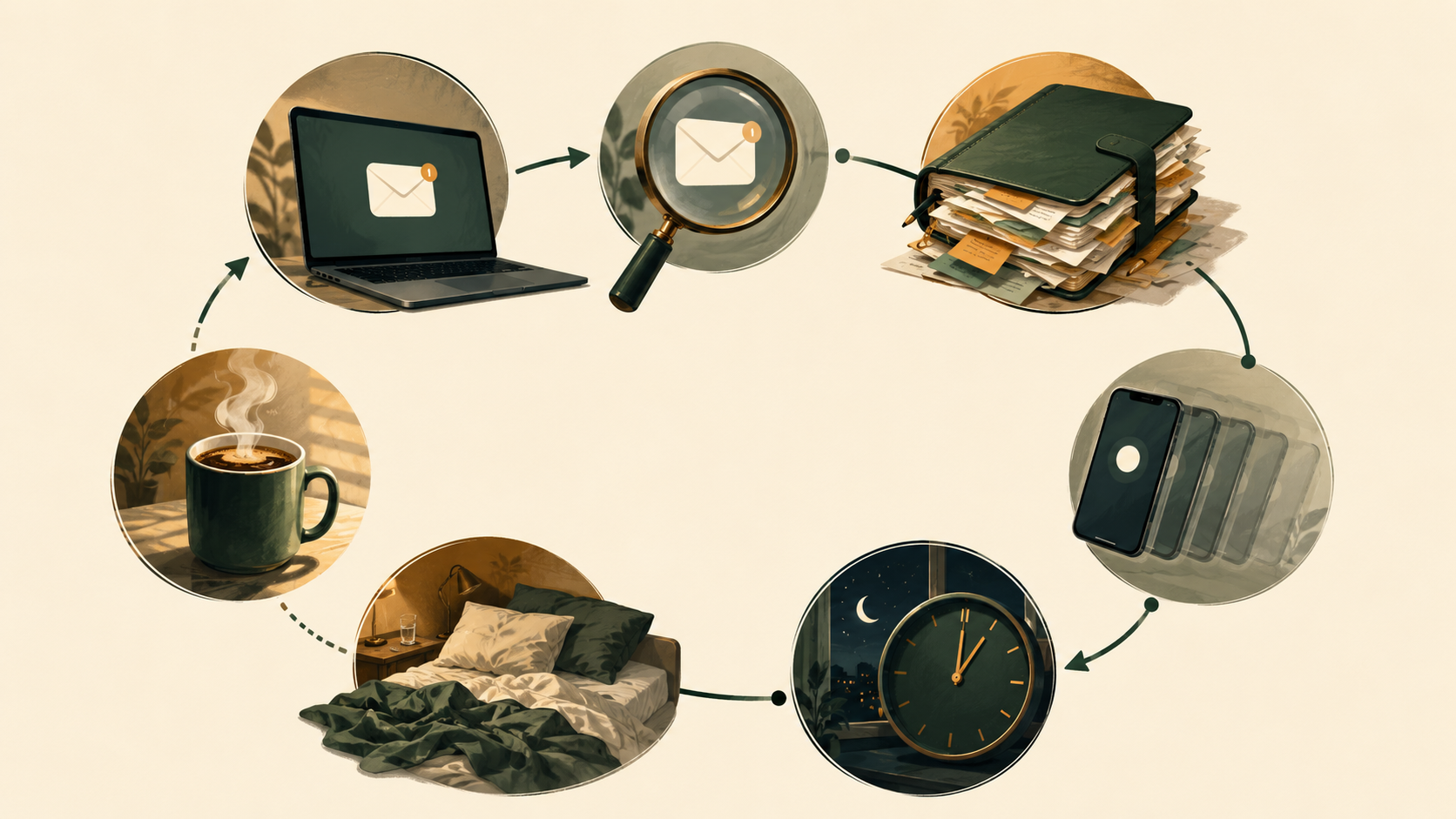
- An ambiguous signal appears: a short reply, a meeting with no agenda, a quiet manager.
- Your mind reads it as possible danger.
- You respond by overpreparing, monitoring or seeking certainty.
- The relief is real but temporary, which teaches your brain that checking worked.
- Recovery time disappears into rehearsal and vigilance.
- Fatigue reduces concentration and confidence, so performance feels shakier.
- More ordinary signals begin to register as threats, and the loop tightens.
Key point: The behaviours that briefly reduce anxiety, checking, rehearsing and overpreparing, can teach your brain that work is never safe enough to leave alone.
What Can Make Work Anxiety Worse?
Each of these begins as a reasonable attempt to feel safer, which is why they are hard to see.
- Checking messages repeatedly, turning every evening into an unpaid shift
- Replaying conversations, which feels like analysis but usually rehearses the fear
- Seeking constant reassurance, which works for an hour and slightly weakens your own judgement each time
- Overpreparing for ordinary tasks, which raises the internal standard for what counts as prepared
- Avoiding questions or feedback, which keeps you in uncertainty, the exact conditions anxiety needs
- Sacrificing sleep to feel ready, which reliably increases the mistakes you were trying to prevent
What Research Suggests About Work Anxiety and Rumination
Most of this research covers the general workforce rather than expats, so read it as context rather than a description of your situation.
A Eurofound-commissioned survey of employees in Belgium, France, Italy and Spain found that over 80 percent received work communications outside their contractual hours in a typical week, and almost nine in ten responded to at least some (Eurofound, 2023). Switching off is not purely a personal skill. For most people the workday no longer has a clear edge, and abroad that edge is blurrier still.
On what happens afterwards in your head, a study of 719 workers across diverse occupations found that affective rumination, the emotionally charged replaying of work, was associated with poorer sleep and greater fatigue, while problem-solving pondering was not (Querstret & Cropley, Journal of Occupational Health Psychology). Thinking about a problem is not the issue. Reliving the fear attached to it is.
On the underlying mechanism, a meta-analysis of 181 studies covering 52,402 participants found a moderate association between intolerance of uncertainty and anxiety-related symptoms (r = 0.51) (McEvoy et al., Journal of Anxiety Disorders). This may be especially relevant abroad, where life supplies a steady stream of unresolved uncertainty: contract renewals, permit timelines, unfamiliar norms and questions nobody around you can answer.
Second-language anxiety is also a recognised construct in its own right, distinct from general nervousness, though most of the research base sits in classrooms rather than workplaces (Annual Review of Applied Linguistics). If speaking up costs you more than it costs your colleagues, that is a documented phenomenon, not a character flaw.
Is It Work Anxiety, Stress, Burnout or General Anxiety?
These overlap. The rough distinction is what each one orients around: stress points at present demands, anxiety at future threat, burnout at depletion.
| Experience | What it may feel like | What may distinguish it | What may help |
|---|---|---|---|
| Stress | Pressure, urgency, tiredness after a demanding period | Attached to identifiable demands, and it eases when they end | Recovery time, workload adjustment, support during peaks |
| Anxiety | Anticipation, dread, replaying, difficulty switching off | Centred on threats that have not happened, often ahead of the evidence | Working with uncertainty, reducing checking, therapeutic approaches |
| Burnout | Depletion, cynicism about work, feeling ineffective | Centred on exhaustion, and rest alone stops restoring you | Reducing load, restoring control and genuine recovery |
| General anxiety | Worry across many areas, physical tension, poor sleep | Extends well beyond work into most of life | Professional assessment and treatment |
Anxiety and burnout often arrive together, since months of vigilance are themselves depleting. If exhaustion has become more prominent than fear, expat burnout covers that pattern in detail.
Work Anxiety Is Not Proof That Something Bad Is About to Happen
- Anxiety is not evidence. Feeling certain that dismissal is coming is a symptom, not information about your employer's plans.
- A short or delayed reply is not feedback. People are busy, in other meetings, or brief by habit.
- Feeling less fluent does not mean you are less competent. Those are two different things, and only one is visible to you.
- Asking a reasonable question does not expose you. In most workplaces it reads as engagement.
- Changing jobs may help, but the pattern can travel. If the anxiety runs on uncertainty and self-monitoring, a new employer may reset it for three months rather than resolve it.
Key point: Anxiety creates urgency, not certainty. The strength of the feeling tells you nothing about how likely the feared outcome is.
What Can Help With Work Anxiety Abroad?
Separate facts from interpretations

Anxiety presents predictions as observations. First step: take today's worry and write two lines, what was actually said or done, and what you concluded from it. Keep them visually separate.
Create a clear end-of-work ritual
Your brain needs a signal that the day has closed, and abroad that signal is often missing because home is also where the admin lives. First step: choose one repeatable five-minute action, a walk around the block, a specific playlist, changing clothes, and do it at the same point daily.
Reduce checking gradually
Abrupt digital shutdowns rarely survive contact with real responsibilities. First step: pick one window, for example after 21:00, and leave it unchecked this week. Expand only once that feels manageable.
Write down unresolved tasks
Much of the evening rehearsal is your mind trying not to forget something. First step: before closing your laptop, list tomorrow's three open items and the first action for each. Written down, they stop needing to be held.
Clarify expectations where you can
Workplace hypervigilance thrives on ambiguity, and abroad you may be reading unfamiliar signals with incomplete information. First step: ask for priorities in writing, or ask one clarifying question in your next check-in rather than inferring the answer.
Protect sleep from work preparation
Sacrificing sleep to feel prepared produces exactly the errors and slowed thinking you feared, and second-language processing degrades first. First step: move preparation earlier and set a fixed point after which work materials close.
Build confidence outside one workplace
When a single office holds your entire professional reputation abroad, every signal inside it carries too much weight. First step: have one professional conversation this month outside your company.
Verify practical risks with qualified sources
Immigration, employment and financial questions deserve real answers rather than anxious estimates, and the real answers are frequently less severe. First step: write down the specific thing you fear, then identify who is actually qualified to confirm or correct it.
What If the Workplace Really Is Unstable or Unsafe?
Not all work anxiety is a misreading. Restructuring happens. Contracts genuinely expire. Discrimination and bullying are real. Visa dependence creates real vulnerability, and chronically unclear expectations are an organisational failure rather than a personal one. Treating a real problem as an anxiety problem is its own kind of harm.
The useful move is to separate the responses, because they are not interchangeable:
- Emotional regulation helps you think clearly but does not change the situation.
- Evidence gathering means documenting what actually happens, with dates.
- Qualified legal or employment advice is where questions about rights, contracts and residency belong. Not an article, and not a therapist.
- Practical planning means knowing your options before you need them.
- Therapy helps with the fear, the rumination and the decision paralysis around all of the above.
Most people in a genuinely difficult workplace need several of these at once.
When Should You Seek Support for Work Anxiety Abroad?
Consider professional support when anxiety is persistent or worsening rather than passing, when sleep is repeatedly affected, when you cannot mentally disengage from work, when concentration is deteriorating, when avoidance is limiting your work or life, when panic symptoms appear, when relationships are suffering, or when alcohol or substance use is increasing. Feeling trapped, hopeless or unable to make ordinary decisions are also strong signals.
If you feel at risk of harming yourself, contact local emergency services or a crisis line in your country immediately. Expathy is not emergency care and does not replace urgent medical support.
How Expathy Can Help
Therapy can help you see the work-anxiety cycle from the outside, reduce rumination, work with the fear of making mistakes, build tolerance for the uncertainty international life keeps producing, separate your self-worth from your last performance signal, and set boundaries that fit your actual level of risk rather than someone else's.
It cannot guarantee job security, change a visa rule, fix discrimination or an unsafe employer, or replace legal, medical, immigration or employment advice.
Expathy matches people living abroad with licensed psychologists who work in their native language and understand the international context, so you are not explaining the background from scratch. If that sounds useful, you can explore online therapy for expats.
What to Read Next
- Working abroad and mental health, the broader guide to career stress and wellbeing abroad
- Expat burnout, if exhaustion has become more prominent than fear
- When your visa depends on your job, if residency is part of what makes work feel high-stakes
- Losing your job abroad, if the situation has already changed
Final thought
Constant anxiety about work does not mean you are failing, that dismissal is coming, that you are unqualified for international work or that you chose the wrong country. It usually means your job has come to carry more than a job normally carries, and your mind is trying to protect all of it at once.
The next step is not to try harder. It is to tell real risks apart from anxious predictions, loosen the habits that keep work mentally open, and get support when the cycle is too tight to interrupt alone.
Sources and further reading
- Right to disconnect: Implementation and impact at company level, Eurofound
- Querstret & Cropley, Exploring the relationship between work-related rumination, sleep quality, and work-related fatigue, Journal of Occupational Health Psychology
- McEvoy et al., Transdiagnostic associations with intolerance of uncertainty: a meta-analysis, Journal of Anxiety Disorders
- Second language anxiety: Construct, effects, and sources, Annual Review of Applied Linguistics
Frequently asked questions about work anxiety abroad
Why can I not switch off from work after moving abroad?
Because more depends on the job than it used to. Abroad, work may also carry your residency, finances, social contact and professional identity, so your mind treats it as something requiring continuous protection. Add unfamiliar norms and a second language, and there is simply more ambiguity to keep monitoring.
Why do I replay meetings and conversations after work?
Replaying feels like preparation and does briefly lower anxiety, which is why the habit sticks. Research distinguishes emotionally charged replaying from constructive problem-solving, and the first is linked to poorer sleep and greater fatigue. The problem is not thinking about work but reliving the fear attached to it.
Can working in a second language cause workplace anxiety?
It can contribute. Second-language anxiety is a recognised phenomenon, and workplaces add speed, hierarchy and consequences. The hardest part is usually uncertainty rather than vocabulary: not knowing whether your meaning landed, or whether a reaction was to your point or your phrasing, gives anxiety plenty to work with.
Is Sunday anxiety a sign that something is wrong with my job?
Not necessarily. Mild Sunday dread is common. It is worth attention when it starts earlier each week, takes over the whole day, or persists during calm periods at work. That pattern usually says more about anticipation than about any specific problem waiting on Monday.
How do I stop assuming every message from my manager is bad news?
Start by naming the assumption as an interpretation rather than a fact, then check how often past interpretations proved correct. For most people the answer is rarely. It also helps to learn the local pattern, since in some workplaces a three-word reply is normal efficiency rather than displeasure.
Is work anxiety the same as burnout?
No, though they often occur together. Anxiety centres on anticipated threat and makes you vigilant and overprepared. Burnout centres on depletion, cynicism and reduced effectiveness. Months of anxiety can produce burnout, which is why many people abroad end up experiencing both rather than one or the other.
Should I change jobs if work is making me anxious?
Sometimes, particularly if the workplace is genuinely unstable or unsafe. But if the anxiety runs on uncertainty, self-monitoring and fear of mistakes, a new job may reset it temporarily rather than resolve it. It is usually a clearer decision made after the acute anxiety has eased rather than during it.
Can therapy help with work anxiety abroad?
It can help with the parts that live inside you: rumination, fear of mistakes, tolerance of uncertainty and the link between performance and self-worth. It cannot guarantee your job, change immigration rules or fix an unsafe employer. Many people find the main benefit is thinking clearly enough to act deliberately.
Need support? We're here.
Book a free 15-min consultation with our expat-specialized therapists.