
Key takeaway
Working abroad can affect your mental health because your job often carries far more weight than your income. It may also hold your visa, your housing, your social circle, your professional identity and your family's stability. That concentration can turn ordinary work stress into something closer to fear. This guide explains why career pressure feels heavier abroad, how the pressure stack builds, what warning signs to look for, how stress, burnout, anxiety, depression and job loss grief differ, what research says about job insecurity, which practical steps actually help, and when professional support is worth considering .
When work stops being just work
It is 9:14 on a Tuesday morning. The email says "organisational update" and invites everyone to a company-wide call at 15:00.
Your colleague at the next desk groans and goes back to her coffee. She has been here eleven years. Her mortgage is fixed, her mother lives twenty minutes away, and if this goes badly she will be annoyed for six months and then fine.
You are doing different arithmetic. You are calculating notice periods against permit conditions. You are wondering how many days you would have to find something new. You are thinking about the lease you signed in March, the school your daughter finally settled into in January, the language course you paid for upfront, and the conversation you will have to have tonight with a partner who left their own career to come here.
By 9:20 you have read the email four times, looking for a clue that is not in it.
Nothing has happened yet. And yet something has, because the fear is already in your body.
Your job abroad may be more than your job. It may also be your visa, income, identity, social circle, family stability and proof that the move was worth it.
That is why generic career advice can feel so hollow when you are living abroad. It is also why losing your job abroad is rarely experienced as a single event. It tends to arrive as several losses stacked into one.
How Can Working Abroad Affect Your Mental Health?
Working abroad can strengthen your mental health by offering purpose, income, structure and a route into a new community. It can also increase pressure, because you are adapting, performing and often depending on one employer at the same time. The effect depends less on the job itself and more on how much of your life rests on it.
Most expats experience both sides. The work that stretches you is often the same work that gave you a reason to move. The difficulty is not that working abroad is harmful. It is that the safety net you had at home, the network, the language fluency, the family nearby, the familiar rules, may not have travelled with you.
The World Health Organization estimates that 12 billion working days are lost globally each year to depression and anxiety, at a cost of around one trillion US dollars in lost productivity, according to its mental health at work fact sheet. That research was not limited to expats. It matters here because it shows how routinely work and mental health are entangled, even for people with none of the additional pressures relocation adds.
Why Can Career Stress Feel More Intense Abroad?

Career stress can feel more intense abroad because the job is holding more than a role. It may be holding your legal right to remain, your only stable income, your main social contact and your evidence that a difficult decision was the right one. When one thing carries that much, any threat to it feels much larger.
Your job may be tied to your visa or residency
For many expats, employment is not just how you pay rent. It is the legal condition of being in the country at all. That changes the meaning of a bad performance review. If this describes your situation, the specific psychology of when your visa depends on your job is worth understanding on its own terms.
Work may carry your entire professional identity
At home your reputation lived in many places: former colleagues, clients, your university, your industry network. Abroad it may live entirely inside one building, in the opinions of people who met you eighteen months ago.
You may be operating in a second language
Even at a high level of fluency, working in a second language costs energy. Meetings require more concentration. Humour lands differently. Nuance is harder to read and harder to produce. By 17:00 you may be tired in a way that is difficult to explain to anyone who has never done it.
You may have lost your old professional network
The people who would have called you about an opening, vouched for you or told you what a company is really like are in a different time zone and a different labour market.
Your family may depend on the same job
One income, one permit, one employer, several people. That is a very different risk profile from two salaries in your home country.
A partner may have sacrificed their career
If your partner paused or gave up their own work to make the relocation possible, your job now carries their loss too. Many people describe a quiet, unspoken pressure to make the move "worth it" for someone else. This dynamic appears often in work and family pressure affecting women abroad, where career interruption and household responsibility frequently land unevenly.
You may feel pressure to prove the move was successful
Family back home ask how it is going. You say it is great. Admitting difficulty can feel like admitting you were wrong to leave.
Communication and cultural uncertainty can increase self-doubt
Feedback styles vary between workplaces. When you cannot yet read whether directness means concern or is simply normal here, ambiguity gets filled in by anxiety.
The Expat Career Pressure Stack
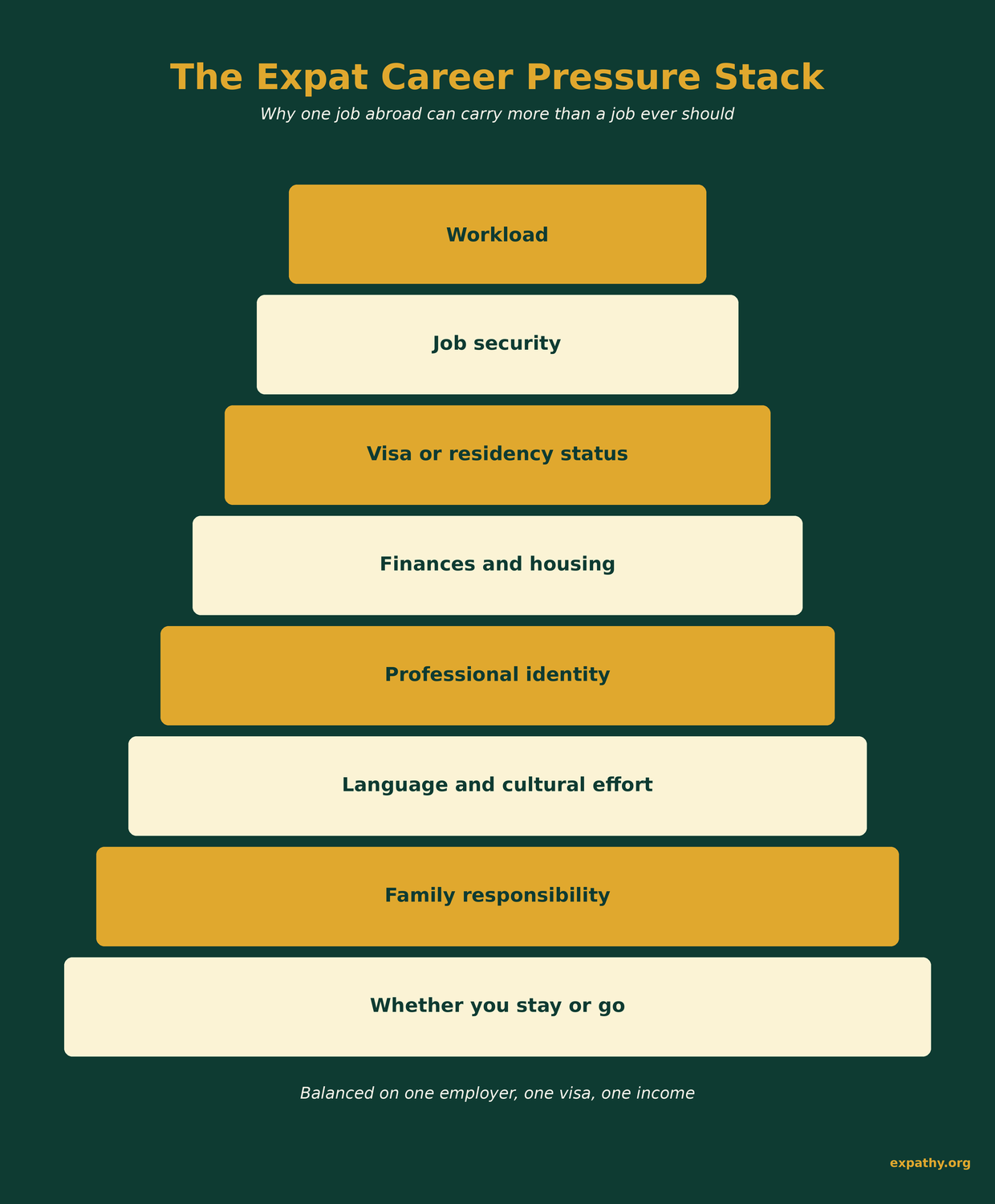
Picture eight layers resting on one point.
Workload sits on top. Beneath it, job security. Beneath that, visa or residency status. Then finances and housing, then professional identity, then language and cultural effort, then family responsibility, and at the bottom, the open question of whether you stay or go.
At home, these layers are usually spread across different supports. A rough month at work does not threaten your right to live in your own country.
Abroad, they can rest on a single employer.
This is why a colleague's offhand comment about "restructuring" can ruin your weekend, while your local coworker forgets it by lunchtime. You are not more fragile. You are carrying a taller stack on a narrower base.
Key point: Burnout abroad is rarely caused by workload alone. It usually grows from carrying work pressure, cultural adaptation, language effort and immigration uncertainty at the same time, with less recovery available between them.
Signs Work Abroad May Be Affecting Your Mental Health
Signs that work is affecting your wellbeing often appear before you would call it a crisis. They tend to show up as a nervous system that will not stand down, thinking that loops rather than resolves, and behaviour that quietly narrows. None of the following diagnoses anything. They are patterns worth noticing.
Emotional signs
- Constant low-level alertness, as though something is about to go wrong
- Dread on Sunday evening that starts earlier each week
- Irritability with people who did nothing
- Emotional numbness, or feeling flat about things you used to enjoy
Thought patterns
- Replaying meetings, rereading sent messages, searching for the mistake
- Interpreting neutral messages as warnings
- Believing a single error could end everything
- Losing confidence in judgement you once trusted
Behavioural signs
- Working longer to feel safer rather than to finish something
- Difficulty switching off, even when there is nothing to do
- Avoiding decisions, including small ones
- Withdrawing from social plans, then feeling more isolated
- Drinking more, sleeping less, moving less
Physical signs
- Exhaustion that does not improve with rest or a holiday
- Disrupted sleep, especially waking at 04:00 with work in your head
- Headaches, tension, stomach problems, frequent minor illness
Relationship and family signs
- Short temper at home and patience only at work
- Resentment, spoken or unspoken, about who sacrificed what
- A partner saying you are "not really here" in the evenings
- Children absorbing tension you thought you had hidden
Is It Stress, Burnout, Anxiety, Depression or Grief?
These experiences overlap. Many people live through two or three at once, which is exactly why self-diagnosis tends to fail. The table below is a rough map, not a test.
| Experience | What it may feel like | What may distinguish it | What may help |
|---|---|---|---|
| Ordinary work stress | Pressure, urgency, tiredness that lifts after a deadline | Tied to specific demands, and it recovers when the demand ends | Rest, workload adjustment, recovery time that is actually protected |
| Burnout | Depletion, cynicism about work, feeling ineffective | Centred on the occupational context, and rest alone stops restoring you | Reducing load where possible, restoring control, professional support |
| Anxiety | Racing thoughts, physical tension, anticipating disaster | Focused on future threat, often outrunning the available evidence | Working with the fear response, testing predictions, therapeutic approaches |
| Depression | Flatness, hopelessness, loss of interest, heavy fatigue | Spreads beyond work into most of life, and persists | Professional assessment, treatment, medical advice |
| Grief after job loss | Shock, anger, shame, disorientation, waves of sadness | A response to real loss rather than a disorder, but it can be severe | Time, structure, honest support, help if it does not begin to ease |
The WHO classifies burn-out in ICD-11 as an occupational phenomenon rather than a medical condition, defined by three dimensions: energy depletion, mental distance or cynicism about the job, and reduced professional efficacy. That distinction matters. It locates the problem in the relationship between you and the work, not in a personal defect.
When symptoms are persistent, severe or hard to tell apart, a qualified professional is better placed to make that distinction than an article.
What Research Says About Work, Job Insecurity and Mental Health
Three findings are worth knowing, with the caveat that none of this research was specific to expats.
A systematic review and meta-analysis of 20 cohort studies published in the International Archives of Occupational and Environmental Health found that perceived job insecurity carried an odds ratio of 1.29 for later depressive symptoms, slightly higher than unemployment itself at 1.19.
Read that again. Fearing the loss of your job was associated with at least as much risk as losing it. For expats, this may be especially relevant, because the fear phase can last months and is loaded with questions about permits, schools and whether the family has to leave.
The waiting is not nothing. Living for months inside "I might lose everything" is a genuine psychological load, not oversensitivity about an event that has not happened yet.
EU-OSHA's OSH Pulse survey reported that 29 percent of EU workers experience stress, depression or anxiety caused or made worse by work, with fear of job loss among the psychosocial risk factors measured (EU-OSHA, 2025). Nearly one in three, before you add relocation.
Current layoff cycles form the backdrop. The widely cited tracker Layoffs.fyi recorded more than 120,000 tech job cuts during 2026 by midyear. Numbers like these move constantly and will look different next year. The underlying experience does not change: restructuring puts a large number of internationally mobile employees into a period of uncertainty they cannot control.
Finally, on getting help: the WHO notes that language barriers, lack of awareness and confidentiality concerns often prevent migrants from accessing mental health care (WHO fact sheet). That evidence concerns migrants broadly rather than professional expats, but the access barrier it describes is one many expats recognise immediately.
The Career Challenges That Can Follow You Abroad
Expat burnout
Chronic depletion where recovery no longer works, intensified by adaptation load running in the background all day.
Work anxiety and the inability to switch off
The mind stays on duty because the stakes feel permanent. Evenings become surveillance rather than rest.
Imposter syndrome in international workplaces
Harder to shake abroad, because you cannot always tell whether a difficulty is your competence, the language, or an unfamiliar workplace culture.
When your visa depends on your job
The single largest amplifier of ordinary work stress. Explored fully in when your visa depends on your job.
Layoffs, restructuring and job insecurity
The uncertainty phase has its own cost, often underestimated because nothing has formally happened.
Losing your job abroad
Job loss abroad may also mean losing routine, daily conversation, community, professional identity and sometimes the legal ability to remain. The emotional aftermath is covered in depth in losing your job abroad.
Career identity after relocation
Many expats take a step sideways or down to make the move possible, then quietly grieve the seniority they left behind.
Toxic workplaces and cultural uncertainty
The hardest question abroad is often "is this abusive, or is this normal here?" Trusted local perspective helps more than solo analysis.
Career sacrifice in expat couples
One career advances, one pauses. Gratitude and resentment can live in the same household without either being spoken.
How work pressure affects relationships and families
Work stress rarely stays at work. It shows up as short evenings, cancelled plans and a partner who feels managed rather than met.
Teacher and school-staff burnout abroad
Relocated teachers often live inside the school community, work in it, socialise in it and sometimes house their children in it. Recovery space is scarce.
When therapy may help with work stress
Most usefully when fear has started making your decisions, or when the pattern repeats across jobs.
Why "Just Set Better Boundaries" May Not Be Enough Abroad
Boundaries are not useless. They are just incomplete advice when the risk is real.
Standard guidance assumes you can push back, be disliked for a week, and still be employed and housed next month. That assumption may not hold when your residency depends on your employer, when you do not yet know your rights under an unfamiliar labour system, when one income supports a whole household, when you are still rebuilding credibility in a new market, when your colleagues are also your only social circle, or when the entire family relocation rests on this contract.
Useful advice has to match your actual level of dependence and risk. Someone with permanent residency, savings and local job offers can afford to be blunt. Someone eight months into a sponsored permit is in a different position, and pretending otherwise is not empowerment.
The right question is not "why can't I set boundaries?" It is "what would I need in place before setting this one is safe?" That question has answers.
What Can Help When Work Abroad Is Affecting Your Mental Health
Separate facts from the feared future
Write two columns: what has actually been communicated, and what you are predicting. Abroad, the prediction column tends to be long and unverified. First step: put today's fear into the correct column and note what evidence would move it.
Map what actually depends on the job
Income, permit, insurance, housing, school place, partner's status. Not all of them are as tightly linked as they feel at 03:00. First step: write the list and mark which items you have confirmed rather than assumed.
Learn your practical options from qualified local sources
Immigration, employment, tax and financial questions require qualified local advice, and nothing in this article substitutes for it. First step: identify one appropriate professional or official body and book a single consultation, before you need it urgently.
Rebuild identity outside your role
When work is your only source of worth abroad, every performance signal becomes a verdict on you. First step: commit to one weekly activity where your job title is irrelevant.
Reduce unnecessary adaptation load
You cannot remove language and cultural effort, but you can stop stacking three demanding new things into the same month. First step: identify one optional adaptation task and postpone it.
Create a realistic Plan B
A vague plan increases anxiety. A specific one reduces it, even if you never use it. First step: write down what the first three days after a job loss would actually involve.
Protect recovery time
Recovery is not leftover time. It is the input that prevents depletion. First step: choose one evening this week that ends at a fixed hour and hold it.
Talk honestly with your partner or family
Protecting people from your worry usually creates distance, not safety, and they can already sense something. First step: name one specific worry out loud tonight rather than the whole situation.
Get support before reaching crisis point
Most people wait until they cannot function. Earlier is easier and takes less time to unwind.
Common Mistakes That Can Keep Career Stress Going
These are not failures of character. They are what tired, frightened people reasonably do.
- Waiting for total collapse before treating it as serious enough to address
- Reading every ambiguous message as confirmation of dismissal, which keeps the alarm permanently on
- Letting work become the only identity, so professional setbacks become personal verdicts
- Hiding the situation from a partner, which they usually notice anyway and experience as exclusion
- Making irreversible decisions during panic, such as resigning in a single afternoon
- Assuming moving home is the only alternative, when other options exist between staying miserable and leaving entirely
Should You Stay, Change Jobs, Take a Break or Leave the Country?

Nobody can answer this for you, and anyone who does after five minutes is guessing.
What helps is asking better questions before deciding.
- Is anything here unsafe, including your health?
- What are the verified immigration and employment facts, confirmed by a qualified local source rather than by a colleague's story?
- What is the financial picture across three months, six months and a year?
- Is the problem this workplace, this profession, or this country?
- What do the other people affected by this decision actually want?
- What alternatives exist that are not "endure it" or "go home"?
- What have you already tried, and what has not been tried yet?
- Does this decision feel like clarity, or does it feel like escape?
If the honest answer to the last question is escape, the useful next step is usually to reduce the panic first and decide second. Decisions made from clarity survive better.
When Should You Seek Support for Work Stress Abroad?
Consider professional support when distress is persistent or worsening rather than passing, when sleep and concentration are disrupted for weeks, when panic appears, when you feel emotionally numb, when relationships are being damaged, when alcohol or substance use is increasing, or when ordinary responsibilities have become difficult to manage.
Hopelessness and decision paralysis are also strong signals. So is the sense that you are no longer safe.
If you feel at risk of harming yourself, contact local emergency services or a crisis line in your country immediately. Expathy is not emergency care and is not a substitute for urgent medical support.
Can Therapy Help With Career Stress or Burnout Abroad?
Realistically, therapy can help with the parts of this that live inside you: anxiety and the fear response, burnout patterns that keep repeating, identity loss after relocation, grief following job loss, decision paralysis, perfectionism, imposter feelings, relationship strain, damaged confidence, and the habit of measuring your worth by your professional status.
It cannot stop a restructuring, change an immigration rule, guarantee you a new role, repair an unsafe workplace, or decide whether you stay or leave. It also does not replace legal, medical, immigration or financial advice.
Therapy cannot change a visa rule or stop a restructuring. It can help you manage fear, regain clarity and make decisions without panic controlling every step.
How Expathy Can Help
Expathy focuses specifically on international life. We match people living abroad with licensed psychologists who work in their native language and understand relocation, cultural adjustment and the particular weight a job can carry when you are far from home.
That matters here because career stress abroad is rarely only career stress. It is usually tangled with language, immigration, family decisions and identity, and explaining all of that from scratch to someone who has never lived it is exhausting when you are already depleted.
If you want to talk it through with someone who starts from that context, you can explore online therapy for expats. There is no pressure to commit to anything. A first conversation is often enough to see whether it helps.
A Brief Note for Employers
If you manage international employees, it is worth knowing that restructuring lands differently across your workforce. For relocated staff, a notice period may also be a countdown on residency. Uncertainty may affect a partner's status and a child's school place. Employees may hesitate to raise concerns for fear of appearing less committed than local colleagues.
Generic wellbeing provision often misses this entirely, particularly when it assumes local language, local systems and local support networks. Practical, culturally aware mental health support for international employees tends to be more useful during restructuring than after it.
A final thought
Struggling with work abroad does not mean the move failed, that you are not strong enough, that you must book a flight home, or that you made the wrong decision two years ago. It usually means your job has quietly taken on more roles than any job should hold, and that nobody warned you it would.
You can change that. Not by working harder, but by understanding what the job has come to represent, reducing the panic around it, and taking the next decision with better information and more support than you have now.
Start with one honest conversation. That is usually enough to begin.
Sources and further reading
- Mental health at work, World Health Organization
- Burn-out an occupational phenomenon: International Classification of Diseases, World Health Organization
- Kim & von dem Knesebeck, Perceived job insecurity, unemployment and depressive symptoms: a systematic review and meta-analysis, International Archives of Occupational and Environmental Health
- OSH Pulse survey findings on work-related stress, depression and anxiety, EU-OSHA
- Refugee and migrant mental health, World Health Organization
- Layoffs.fyi tech layoff tracker
Frequently Asked Questions About Working Abroad and Mental Health
Is expat burnout different from ordinary burnout?
The core pattern is the same: exhaustion, cynicism about work and reduced effectiveness, as described in WHO's ICD-11. What differs is the context. Abroad, you may be recovering from work while also adapting culturally, operating in a second language and managing immigration uncertainty, which leaves far less genuine recovery capacity in the day.
Why does job insecurity feel more frightening abroad?
Because more depends on the outcome. At home, losing a job usually threatens income and confidence. Abroad, it may also threaten your residency, your housing, your children's schooling and your partner's status. The fear is proportionate to what is actually at stake, which is a lot.
How do I know whether I am burned out or simply tired?
Tiredness generally improves with rest. Burnout typically does not. If you return from a two-week holiday and feel depleted again within days, if you have become cynical about work you once cared about, and if you feel ineffective regardless of effort, that pattern is worth discussing with a professional.
What can I do if my visa depends on my job?
Get accurate information from a qualified immigration professional or the relevant official authority in your country of residence, ideally before there is an emergency. Nothing online, including this article, can tell you your specific rights. Knowing the real rules usually reduces anxiety, because imagined rules are almost always harsher than actual ones.
Why do I feel trapped in a job I once wanted?
Because the job may now be holding things it was never meant to hold: your legal status, your social life, your family's stability. When leaving would put all of those at risk, staying can feel involuntary even in a role you chose freely. That feeling is about dependence, not ingratitude.
Can losing a job abroad cause grief?
Yes. Job loss abroad often removes several things at once: income, daily structure, professional identity, a large part of your social contact and sometimes the right to remain in the country. Grief is a reasonable response to multiple simultaneous losses, and it is not a sign of weakness or overreaction.
How can career stress affect my relationship?
Work stress often arrives home as irritability, absence or silence. Abroad this compounds, because your partner may have fewer independent supports and may also have sacrificed their own career for the move. Resentment can build quietly on both sides, usually because neither person is saying what they actually feel.
Should I quit my job or move home?
That depends on facts nobody online has access to: your immigration situation, your finances, your family's needs and whether the problem is this workplace or something wider. What helps is confirming the real constraints with qualified local advisors and reducing panic before deciding, rather than making a permanent choice during your worst week.
Can therapy help with work stress abroad?
It can help with the internal parts: anxiety, burnout patterns, confidence, grief, perfectionism and decision paralysis. It cannot change immigration rules, prevent layoffs or fix an unsafe workplace. Many people find its main value is regaining enough clarity to make decisions deliberately rather than reactively.
Is working abroad bad for mental health?
No. Work abroad can provide purpose, income, structure and community, and many expats thrive. The risk comes from concentration rather than from relocation itself. When one job carries your residency, finances, identity and social life at once, the ordinary ups and downs of employment carry far more weight than they should.
Need support? We're here.
Book a free 15-min consultation with our expat-specialized therapists.