
Key takeaway
Anxiety produces real physical symptoms : chest tightness, headaches, nausea, dizziness, muscle tension, palpitations and a breath that never quite completes. Abroad they feel more frightening, because you lose the doctors, the language and the family who used to reassure you . This article explains what physical anxiety feels like , why the body does it , when a doctor must check you first , how the symptoms quietly shrink your routines and relationships, and how therapy breaks the cycle . Physical anxiety while living abroad responds well to treatment, and the earlier you start, the smaller the pattern is to undo .
She has been to three doctors in eight months. Blood tests, an ECG, a thyroid panel, and once, at two in the morning, an emergency room in a language she can only half follow. Everything came back normal. On paper she is fine.
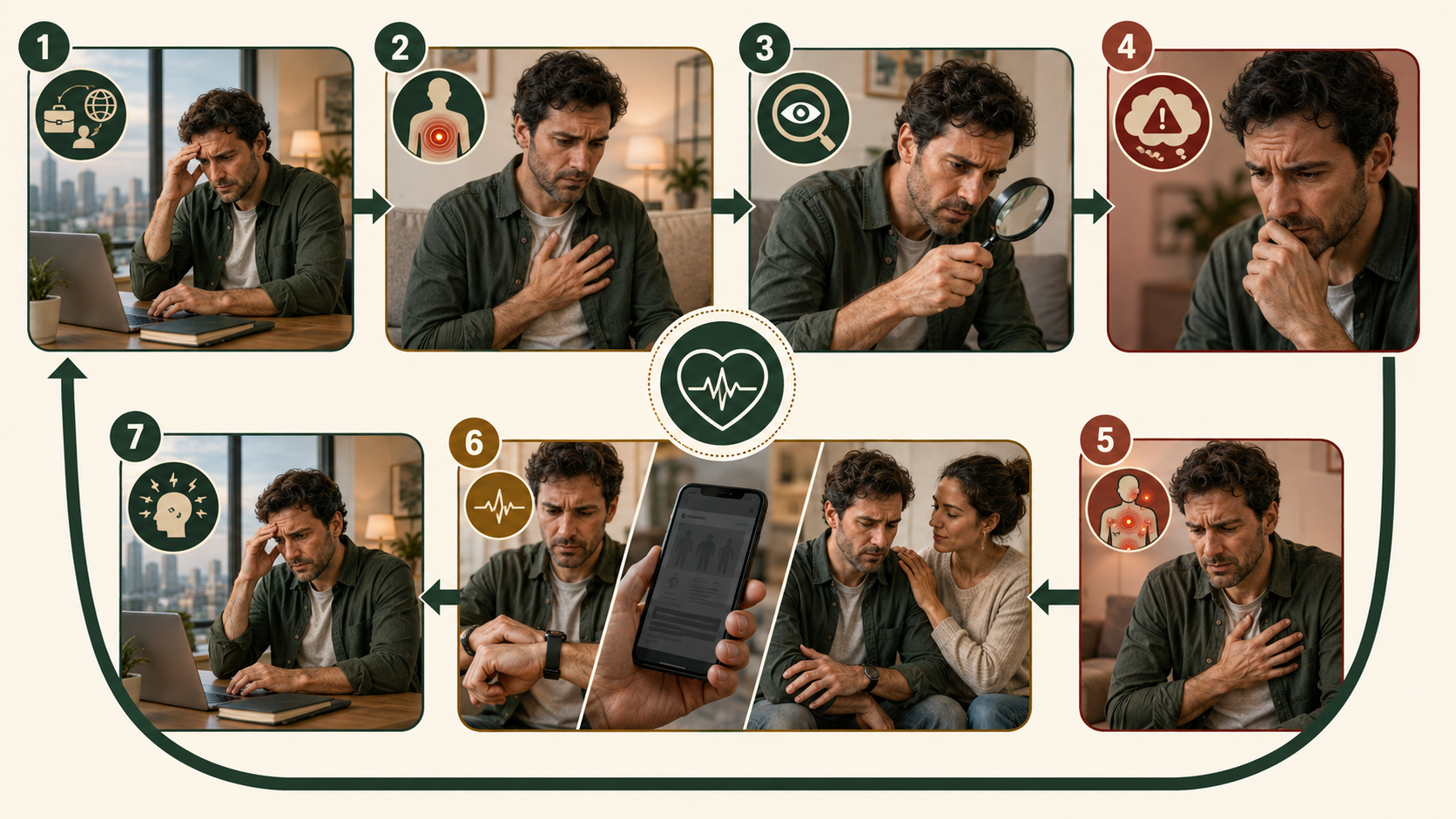
What nobody sees is the hand she presses against her sternum on the tram, checking. The searches at 1am about heart symptoms in your thirties. The quiet suspicion that a foreign doctor missed something a doctor back home would have caught.
The most exhausting part is not the symptom. It is the not knowing.
Physical anxiety is one of the least recognised parts of expat life, and one of the most misread. It does not announce itself as an emotional problem. It announces itself as a body problem, which is exactly why so many people spend a year in waiting rooms before anyone mentions the word anxiety.
What Physical Anxiety Actually Feels Like
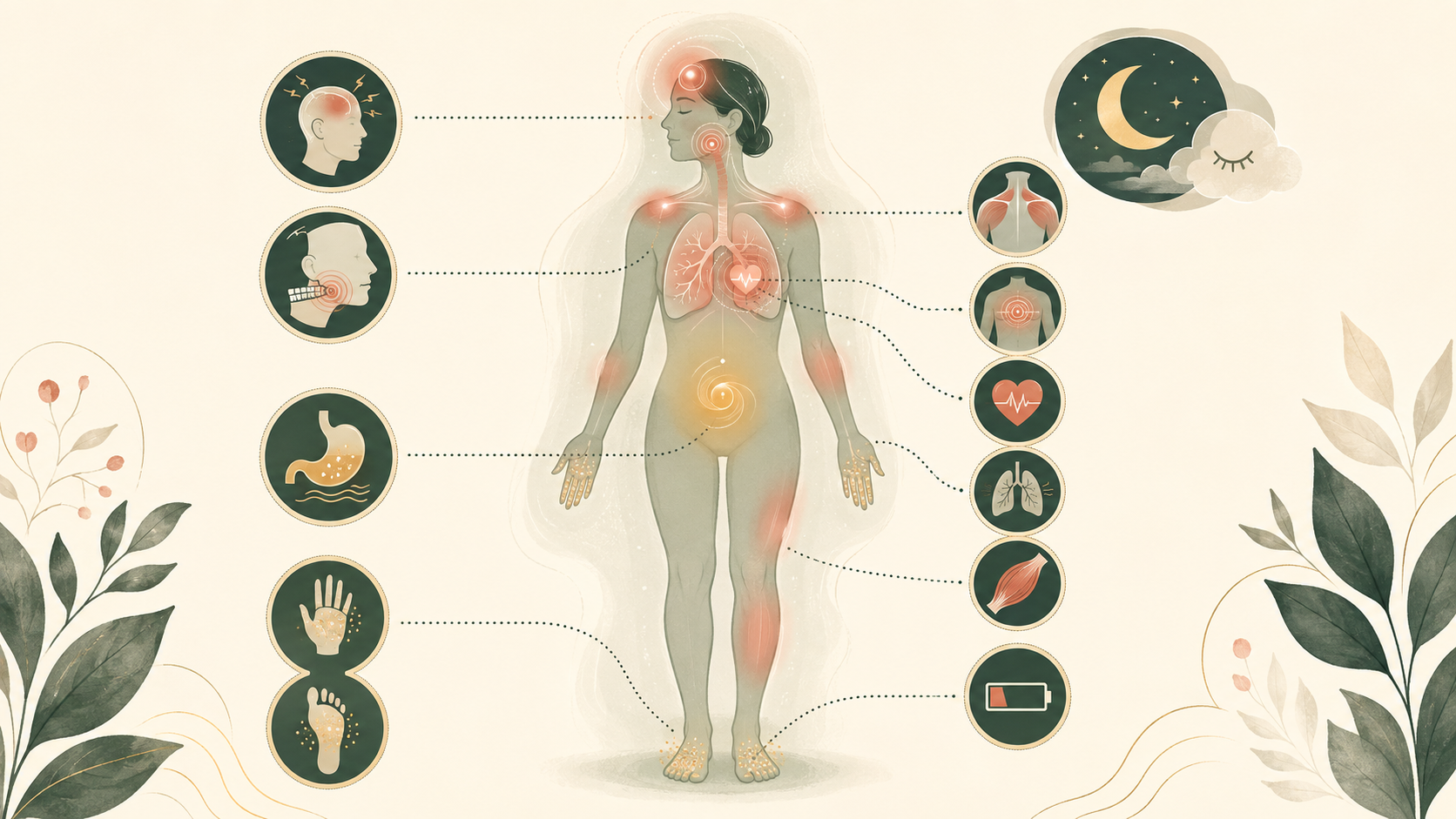
Physical anxiety is a set of real bodily sensations produced by a stress response that stays switched on. It usually appears in the heart and chest, the digestive system, the muscles, the balance and sensory systems, and in sleep. The symptoms are persistent or recurring rather than dramatic, and they often arrive when nothing stressful is obviously happening.
Heart and breathing. Palpitations, or a heart that seems to skip. A tight or heavy chest. The frustrating sense that you cannot take one satisfying, complete breath no matter how deeply you inhale, like breathing through a straw.
Digestion. Nausea, especially in the morning. Loss of appetite, or the opposite. Cramping, urgency, bloating, a stomach that reacts to Monday mornings and airport departures more reliably than to food.
Muscles and pain. Shoulders permanently near your ears. Tension headaches that build through the afternoon. Jaw clenching and grinding at night, often discovered by a dentist first. Neck and back pain with no injury behind it.
Dizziness and sensory changes. Lightheadedness. A floaty, slightly unreal feeling in supermarkets or open squares. Tingling in the hands or face. Shaking hands that only appear in meetings.
Sleep and exhaustion. Waking at 4am with your heart already racing. Falling asleep fine but surfacing repeatedly. And the fatigue that follows, a bone-level tiredness sleep does not repair, because a body in low-grade alert mode never fully rests.
Physical anxiety is rarely one big symptom. It is usually four or five small ones that never fully leave, and that keep changing shape just enough to stay frightening.
One distinction matters. These ongoing symptoms are not panic attacks, which are short, intense surges that usually peak within about ten minutes and then subside. Physical anxiety is the low, continuous hum. Panic is the spike. Many people get both, and we cover the spike separately in our guide to panic attacks abroad.
Why Anxiety Creates Real Physical Symptoms
Anxiety produces physical symptoms because the body's threat response is a physical system, not a mental one. When the brain registers uncertainty, it releases adrenaline and cortisol, speeds up the heart, tenses the muscles, changes breathing and diverts blood away from digestion. These are measurable physiological changes. The symptoms are not imagined, and they are not weakness.
This system evolved for short bursts. Run, fight, survive, recover. It was never designed to stay switched on through an eighteen-month permit process, a new job in a second language, and family six flight hours away. Sustained uncertainty is the fuel, which is why the pattern is so common in people whose visa depends on their job.
The trouble starts when the sensations themselves become the threat. You feel your heart, you check it, checking makes you tense, tension makes the sensation stronger, and the loop closes.
Stress or uncertainty
        ↓
The body becomes more alert
        ↓
Physical sensations appear
        ↓
The sensations feel dangerous
        ↓
More fear and body monitoring
        ↓
Symptoms become stronger
This is the part nobody explains at the doctor's office. You are told your tests are normal, which is true and important, but it answers a different question than the one you asked. You wanted to know what is happening. You were told what is not happening.
Neither anxiety nor this pattern is rare. According to the World Health Organization, 359 million people were living with an anxiety disorder in 2021, making it the most common mental health condition in the world, and only around 1 in 4 people who need treatment actually receive it.
Why the Same Symptoms Feel Worse Abroad
The symptoms are identical everywhere, but the fear around them intensifies abroad because the reassurance systems you grew up with are gone. Unfamiliar medical pathways, a second language, no family doctor who knows your history, and no relative nearby to say "you look fine, sit down". Uncertainty amplifies every sensation.
Consider what actually changes when you move:
- You do not know whether the local system takes your symptom seriously or tells you to wait.
- You are describing chest tightness in a language where you lack the precise word, watching a doctor's face for a reaction you cannot read.
- Nobody around you knew you before, so no one can say "you always got headaches during exams too".
- And underneath it all: if something serious happens here, who is with me?
That last question turns a symptom into a permanent background fear. It is also why so many expats end up over-investigating and under-treating: repeated tests for the sensation, no attention at all to the alarm system producing it. Someone can be thriving professionally while their nervous system is still working through a full culture shock curve underneath, or carrying the low-grade loneliness of life abroad that keeps the body braced.
Being competent abroad and feeling safe abroad are two different things. Your CV can be doing brilliantly while your nervous system still files you as unsettled.
When a Doctor Needs to Look First
Anxiety is what remains after physical causes have been reasonably considered, never an assumption made in advance. New, severe, unusual, worsening or persistent physical symptoms should be assessed by a qualified medical professional. Thyroid problems, anaemia, vitamin deficiencies, cardiac issues, hormonal changes and medication side effects can all produce sensations that closely resemble anxiety.
Seek prompt medical attention for chest pain with radiating pain, breathlessness at rest, fainting, sudden severe headache, neurological changes, unexplained weight loss, or any symptom that is clearly escalating. This article does not replace medical assessment, and no online explanation should.
In a study of 1,000 patients published in the American Journal of Medicine, Kroenke and Mangelsdorff found that after evaluating fourteen common physical symptoms, an organic cause was identified in only 16 percent of cases. The point is not that the rest were imaginary. It is that medicine has long known physical symptoms are frequently real and frequently not explained by organ disease.
So the sequence matters. Get properly checked. Then, if results come back clear and symptoms continue, stop repeating the same test and start treating the system producing the sensation. If you are unsure who that even is, our guide to the difference between a psychologist and a psychiatrist explains which professional does what.
How Physical Anxiety Quietly Shrinks Your Life
Physical anxiety rarely stops someone all at once. It narrows life gradually, through small, sensible-seeming adjustments that accumulate into a much smaller world. Most people do not notice until they realise how many things they now avoid, delay or need company for.
It often looks like this:
- Declining the work trip because you would rather not be far from a hospital you know.
- Sitting near the aisle, near the exit, near the door, always.
- Asking your partner to stay home again, then feeling guilty, then resenting the guilt.
- Skipping the gym, because raising your heart rate on purpose feels like tempting fate.
- Turning down the promotion that involves travel, and telling yourself it was about salary.
No single decision is irrational. Together they build a life organised around avoiding a sensation, and every avoidance quietly teaches the brain that the sensation really was dangerous.
There is a relationship cost too. Reassurance works for about twenty minutes and then needs repeating. Partners start out patient and end up exhausted, which produces shame on both sides. This lands hardest on couples where one person already carries the weight of the move, something we cover in our article on the trailing spouse and expat partner. The pattern is far easier to interrupt at month three than at year three.
You do not need to be in crisis to deserve help. If your body is already editing your calendar, that is reason enough.
How Therapy Breaks the Cycle

Therapy reduces physical anxiety by targeting the loop rather than the sensation. Instead of trying to make the tight chest disappear directly, treatment works on the alarm response, the interpretation of the sensation, and the checking behaviours keeping it alive. When those change, the physical symptoms reduce as a consequence rather than as a goal.
In practice, several things work together. Understanding what your body is actually doing, so the sensation stops reading as danger. Reducing the checking, reassurance-seeking and late-night searching that maintain the cycle. Breathing retraining, since chronic over-breathing directly produces tingling, dizziness and that unsatisfying-breath feeling. And gradually returning to what you have been avoiding, at a pace that is challenging rather than overwhelming. Cognitive behavioural therapy is recommended by NICE as a first-line psychological treatment for generalised anxiety disorder.
Doing this work in your native language matters more here than in almost any other area of therapy. Body sensations live in metaphor: the pressure, the fullness, the fluttering, the floor moving slightly. In a second language most people flatten all of it to "I feel strange", and the description is where treatment starts. Saying exactly what your body does, to someone who also knows what a residence permit renewal does to a person, removes two layers of translation at once.
Book a free 20 minute session with a psychologist who speaks your native language and has lived abroad themselves. No commitment, no diagnosis, just a conversation about what your body has been trying to tell you.
If the symptoms have been running for months, anxiety therapy for expats is usually more effective than another round of tests. If you are unsure where to begin, online therapy for expats lets you start from home, in your own language, without navigating a foreign referral system first. Daily habits support the work rather than replace it, and our guide to self-care abroad covers that practical side.
Final Thought
There is a specific loneliness in having a body that frightens you in a country where you cannot easily explain it. The tests come back clear, you are relieved for an hour, and then the tightness returns and you wonder whether the relief was premature.
It was not premature. It was incomplete. Clear results tell you your body is safe. They do not tell your body it is safe, and that second message is the one you have been missing. It can be delivered, not by another scan, but by treating the alarm instead of the alarm bell.
Your body has been trying to tell you something for months. It is not that you are ill. It is that you have been carrying too much, alone, in an unfamiliar place, for too long.
Sources and Further Reading
- World Health Organization, Mental disorders fact sheet: 359 million people living with an anxiety disorder in 2021
- World Health Organization, Anxiety disorders fact sheet: treatment coverage of approximately 27.6 percent
- Kroenke K, Mangelsdorff AD, "Common symptoms in ambulatory care", American Journal of Medicine, 1989
- NICE CG113, Generalised anxiety disorder and panic disorder in adults: management
- NHS, Generalised anxiety disorder (GAD) in adults
Frequently Asked Questions
Can anxiety really cause chest tightness and heart palpitations?
Yes. Adrenaline raises heart rate and contraction force, and sustained tension in the chest wall and diaphragm produces a squeezing or heavy sensation. These are genuine physiological effects. Chest symptoms should still always be medically assessed first, particularly if they are new, occur during exertion, or come with radiating pain or breathlessness at rest.
Why do my test results keep coming back normal when I clearly feel unwell?
Because standard tests look for organ disease, and anxiety symptoms come from a functioning body running an overactive alarm system. Nothing is damaged, which is why nothing shows. Normal results are good news, but they answer only half your question. The other half, what is actually causing the sensation, is where psychological support becomes useful.
Why did these symptoms only start after I moved abroad?
Relocation stacks sustained stressors at once: visa uncertainty, a new job, a second language, lost social support and unfamiliar systems. None is dramatic alone, but together they keep the stress response active for months rather than hours. Symptoms often appear six to twelve months after arrival, once the excitement of the move has faded.
Can therapy really reduce physical symptoms, or only the worry?
Both, usually in that order. When the alarm response settles and checking decreases, muscle tension, breathing patterns and digestive symptoms typically improve as a result. Many people notice sleep and morning nausea shifting first, with chest and muscular symptoms easing more gradually over several weeks.
What if a doctor already told me it is "just stress"?
That phrase sounds dismissive even though the underlying point is accurate. Stress-driven symptoms are real symptoms that respond to real treatment. If you have been assessed and told your results are clear, the next step is a psychologist, not another opinion on the same test.
When should I seek urgent medical help rather than therapy?
Seek immediate medical attention for chest pain with radiating pain, breathlessness at rest, fainting, sudden severe headache, neurological changes such as weakness or slurred speech, or any symptom that is rapidly worsening. Therapy is the right route for persistent symptoms after medical assessment, never a substitute for assessment itself.
Need support? We're here.
Book a free 15-min consultation with our expat-specialized therapists.