
Key takeaway
Loneliness abroad is not about how many people are around you. You can have colleagues, a full calendar, a partner beside you, and still feel that nobody truly knows you. Loneliness is the gap between the connection you have and the connection you need , and moving abroad widens that gap by removing your relationships, your routines, and your sense of effortless belonging all at once. It is real, it is common, and it is not the same thing as homesickness, social anxiety, or depression, though it can lead toward them. This article separates the different groups who live abroad rather than treating them as one, because a student, a labour migrant, an accompanying partner, and a refugee do not experience this the same way.
You come home from an evening with perfectly nice people, close the door, and feel further from everyone than you did before you went out. That feeling has a name, and it is worth understanding.
What does loneliness abroad actually feel like?
Loneliness abroad is the perceived gap between the connection you have and the connection you want, which is why it can persist even when you are surrounded by people. It is less about being physically alone and more about feeling unseen, unmatched, or unknown in the place you now live. The people are there. The recognition is not.
It often shows up as a set of specific, quiet experiences:
- Feeling unseen even when you are socially active
- Having people to meet for coffee but nobody to call at 2am
- Constantly explaining your references, your humour, your background
- Feeling like a temporary guest in both your host country and your home country
- Missing effortless conversation more than you miss any particular person
- Coming back from social events feeling emptier, not fuller
Loneliness is not always the absence of people. Sometimes it is the absence of being known.
Being alone and feeling lonely are not the same thing
Solitude and loneliness are opposites in everything except appearance. Solitude is chosen and restorative. Loneliness is unwanted disconnection. You can be completely alone and content, or surrounded by people and aching, because what matters is not the headcount but whether your need for connection is being met.
| Experience | Chosen or unwanted | Emotional effect | What it points to |
|---|---|---|---|
| Solitude | Usually chosen | Rest, reflection, recovery | Energy returns on its own |
| Social isolation | Objective lack of contact | Varies by person | A need for more contact |
| Loneliness | Unwanted gap in connection | Sadness, emptiness | A need for meaningful connection |
| Homesicknes | Separation from home | Longing, grief, nostalgia | A need for familiarity |
The distinction matters because the fixes are different. More contact solves isolation. It does not always solve loneliness.
The three kinds of loneliness you can feel abroad
Loneliness is not one experience, and researchers have identified distinct types that call for different responses. The psychologist Robert Weiss drew the foundational distinction between two forms, and later research on internationally mobile people added a third that is specific to life abroad.
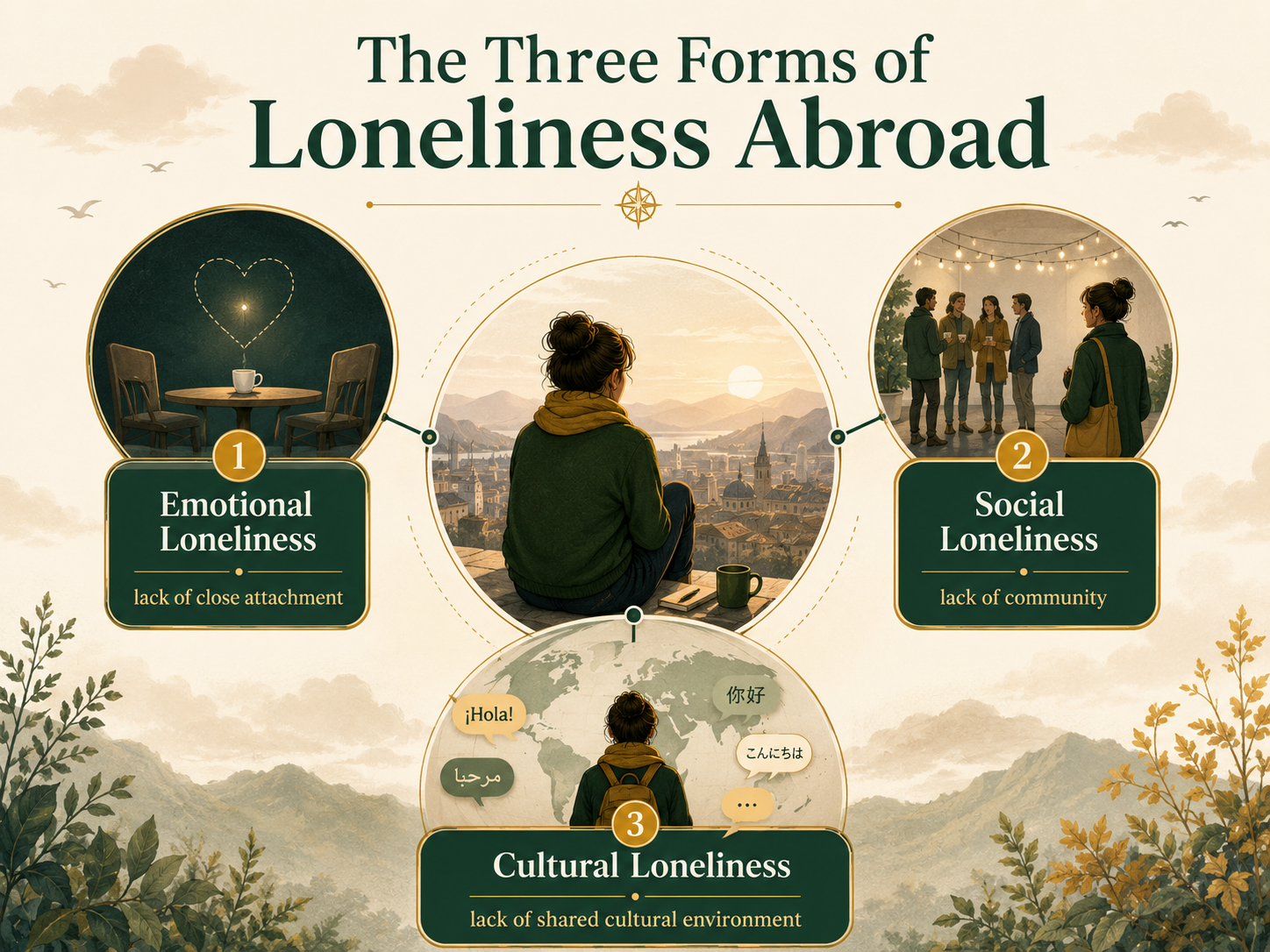
Emotional loneliness is the absence of a close, trusted attachment: one or two people with whom you feel fully safe and understood. Weiss linked this form more closely to anxiety. You can have a wide social circle and still feel emotionally lonely if none of those relationships are deep.
Social loneliness is the absence of a wider network or community, the sense of not belonging to a group. Research has associated this form more with depression. This is the loneliness of having nobody to invite you to things, no crowd that expects you.
Cultural loneliness is more specific to living abroad. In a study of international students, researchers Sawir and colleagues identified it as loneliness triggered by the absence of your preferred cultural and linguistic environment, and crucially, they found it can affect even people who have adequate personal and social support. You can have good friends and a partner and still feel culturally lonely when nobody around you shares your humour, your traditions, or your instinctive way of reading a situation.
Recognising which kind you feel changes what will help. Emotional loneliness needs depth, not more acquaintances. Social loneliness needs a group. Cultural loneliness needs someone who shares your world.
Why living abroad makes meaningful connection so much harder
Relocation removes the invisible infrastructure that relationships normally grow through, which is why connection abroad takes far more deliberate effort than it did at home. At home, friendships formed through repeated accidental contact, shared history, and mutual friends. Abroad, almost none of that is automatic, and several forces work against you at once.

You lose people and places at the same time. The move removes both your relationships and the settings where connection happened without planning. You have to rebuild both.
Language creates emotional distance. You can be fluent enough to function and still lose precision when it comes to humour, vulnerability, affection, or conflict. Communicating is not the same as connecting.
Cultural rules are harder to read. How quickly people open up, how invitations work, how often friends are expected to be in touch, all of this differs between cultures, and getting it slightly wrong is exhausting.
Expat communities are temporary. People leave when contracts end, which creates a quiet friendship fatigue: after a few goodbyes, you become reluctant to invest deeply in someone you expect to lose.
Work provides contact without closeness. Colleagues give you people to talk to, but shared shifts rarely become emotional intimacy, especially in a competitive or unfamiliar workplace.
Digital contact preserves relationships without replacing presence. Calls and messages keep old friendships alive, but time zones and the inability to share ordinary daily moments slowly thin the closeness.
This is also why loneliness often persists long after you have technically settled in. Practical adjustment and emotional integration are not the same process. You can know how the buses work, have a job and a routine, and still not feel that anyone here truly knows you. Time creates competence. It does not automatically create belonging.
Why you can feel lonely even after making friends abroad
Having friends does not guarantee your emotional needs are met, which is the single most confusing part of loneliness abroad for people who have clearly "done the work" socially. You went out, you joined things, you made friends, and the feeling did not lift. That is not a failure. It usually means the connections you built meet some needs but not others.
Some common reasons the gap stays open:
- The friendships are activity-based but never became emotionally close
- You present a simplified version of yourself in a second language, so people know that version, not you
- New friends do not share your personal history, so there is no shorthand
- You hold back vulnerability because the relationships feel temporary
- You spend time with people who share your nationality but not your values
- You belong to several communities without feeling fully part of any of them
This is the difference between making friends and feeling known. The practical side of building a social life is covered in depth in our guide to making friends abroad. This page is about the feeling underneath it, which sometimes needs something different.
How common is loneliness among people living abroad?
Loneliness is well documented among some internationally mobile groups and barely studied in others, so the honest answer depends heavily on which population you mean. The strongest data is on international students. For corporate expats and accompanying partners, reliable population-level figures are largely missing, and anyone claiming a precise "expat loneliness rate" is likely borrowing from a different group.
| Population | Loneliness finding | Source |
|---|---|---|
| International students (Australia) | Around two-thirds reported loneliness or isolation, especially in early months | Sawir et al., 2008, N=200 interviews |
| International students (mainly UK-based) | Loneliness prevalence higher than a prior three-quarters estimate for a smaller UK sample | BBC Loneliness Experiment, 521 students |
| Migrants generally | International migration experience identified as a key individual risk factor for loneliness | EU report, Barjaková & Garnero, 2022 |
| Migrants, students, expats, refugees | Adaptation most strongly tied to connectedness and not feeling lonely | Meta-analysis, 571,260 people |
| Corporate expats and accompanying partners | No reliable pooled prevalence estimate | Evidence gap |
The honest position: loneliness is heavily documented among international students and recognised as a migration risk factor across the board. For expats and accompanying partners specifically, we have strong evidence that it happens and matters, but not a clean number for how many are affected.
A note on the numbers above: much of the student data comes from interviews and single surveys rather than large pooled prevalence studies, so treat "two-thirds" as a strong signal from a specific sample, not a universal rate.
Is loneliness the same as homesickness, anxiety, or depression?
Loneliness overlaps with these experiences but is distinct from each, and telling them apart helps you know what you are actually dealing with. They frequently occur together and feed one another, which is exactly why they get confused.
| Experience | Central feeling | Main focus | Typical signs |
|---|---|---|---|
| Loneliness | Lack of meaningful connection | Your current relationships | Feeling unseen, disconnected |
| Homesickness | Longing for home | People and places you left | Nostalgia, grief, wanting to return |
| Social anxiety | Fear of judgement | Social performance | Avoidance, worry, physical tension |
| Depression | Persistent low mood | Broadly across life | Hopelessness, loss of pleasure |
If your feeling centres on a place and people you left behind, that is closer to homesickness abroad. If it centres on fear of being judged in social situations, our guide to anxiety while living abroad covers that. If low mood and loss of pleasure dominate most of your life, read homesickness and depression abroad. Loneliness can lead toward any of these, which is why it is worth taking seriously early.
What persistent loneliness can affect
Persistent loneliness is associated with a range of mental and physical health risks, though it is important to read these as risks and correlations rather than guaranteed outcomes. The research consistently links chronic loneliness with depressive symptoms, anxiety, alcohol misuse, cognitive decline, and increased mortality risk across the general population, and there is no reason to think people abroad are exempt.
Beyond the clinical associations, loneliness tends to erode the very things that would help you escape it: confidence, energy for social effort, and a baseline sense that people are glad to see you.
Persistent loneliness is not a personal failure. It is a signal that a real human need is going unmet.
The loneliness loop, and how it keeps itself going
Loneliness tends to become self-reinforcing, which is why it can feel impossible to break out of through effort alone. The cycle runs in a predictable order, and understanding it is the first step to interrupting it:
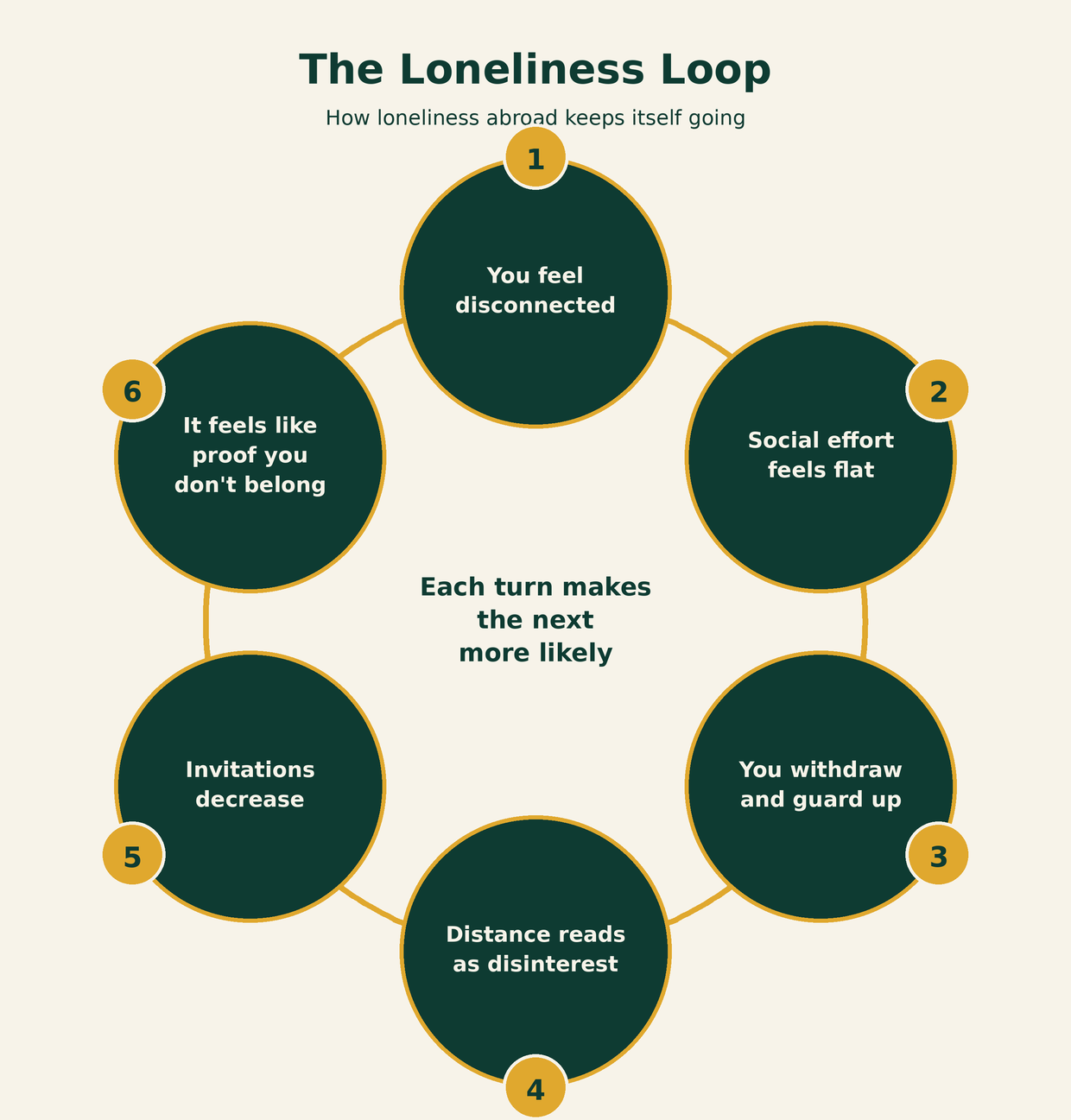
- You feel disconnected.
- Social situations start to feel effortful or disappointing.
- You withdraw a little, or become more guarded.
- Other people read your distance as disinterest.
- Invitations and opportunities quietly decrease.
- The reduced connection feels like proof that you do not belong.
Each turn of the loop makes the next one more likely. Breaking it usually takes two things at once: repeated contact, and enough emotional safety to let people actually see you. Effort alone is not enough if you stay guarded, and openness alone is not enough without regular exposure to the same people.
What actually helps with loneliness abroad
The most effective responses target meaningful connection and belonging rather than simply increasing the number of social events you attend. This section stays at the level of principle. For the step-by-step tactics of building a social life, our making friends abroad guide has the full playbook.
Prioritise repeated contact over one-off events. Relationships grow through regular exposure to the same people, not through a packed but scattered social calendar. Pick one recurring setting, a class, a volunteering role, a weekly meetup, and show up consistently.
Let yourself be slightly more visible. Connection deepens when interaction moves past biography and small talk. Share one honest, proportionate detail rather than waiting for the other person to go first.
Seek belonging through contribution. People often feel more connected when they have a role, not just attendance. Help organise, welcome newcomers, take responsibility for one small part of a group.
Protect contact in your strongest language. Conversations in your native language reduce the performance pressure of a second language and allow fuller emotional expression. If that matters to you in a support setting, our native language therapy page explains how that matching works.
Consider professional support when the pattern runs deep. Therapy helps when loneliness is tangled up with shame, avoidance, grief, identity loss, or a repeating relational pattern that friend-making alone will not shift.
Struggling to feel connected abroad does not mean you are bad at relationships. It often means you are carrying more change than any one person should carry alone. Explore loneliness therapy for expats.
When persistent loneliness needs professional support
Loneliness becomes a reason to seek help when it stops lifting and starts pulling other things down with it. Reach out for professional support when loneliness comes alongside:
- Persistent low mood or loss of interest in things you used to enjoy
- Severe anxiety, or avoidance of most social contact
- Major changes in sleep or appetite
- Declining performance at work or in study
- Rising alcohol or substance use
- Withdrawal from nearly all contact
- Feeling worthless, hopeless, or trapped
If you are having thoughts of harming yourself or feeling that you would rather not be here, please treat that as urgent and contact local emergency services or a crisis line in your country now. You do not have to be certain it is serious enough to justify reaching out.
Loneliness responds to support. Connection can be rebuilt, often more fully than the version you left behind, and needing help to do it is ordinary, not shameful.
Frequently asked questions
Is it normal to feel lonely after moving abroad?
Yes. Loneliness is one of the most commonly reported difficulties of moving abroad, because relocation removes your relationships, routines, and cultural familiarity at the same time. Studies of international students have found the majority experience loneliness or isolation, particularly in the early months, so if you feel it, you are in the large majority, not the exception.
How long does loneliness after moving abroad usually last?
It varies, and it depends more on whether you rebuild meaningful connection than on time passing. Loneliness often eases as you develop repeated contact and a few genuine relationships, but it can persist for months or longer if your daily life becomes functional while your relationships stay shallow. If it is deepening rather than easing, that is a reason to seek support rather than wait it out.
Why do I feel lonely even though I have friends abroad?
Because having friends does not automatically meet every kind of connection need. Your friendships may be activity-based rather than emotionally close, or built with a simplified version of yourself in a second language, or held at a distance because they feel temporary. This is emotional or cultural loneliness rather than a lack of people, and it calls for depth and being known, not just more socialising.
What is the difference between loneliness and homesickness?
Loneliness is a gap in your current connections, while homesickness is longing for the specific people and places you left behind. You can be homesick while surrounded by good new friends, and you can be lonely in a place you have no wish to leave. They often occur together abroad but they point to different needs: familiarity for homesickness, meaningful connection for loneliness.
Can loneliness abroad lead to anxiety or depression?
Persistent loneliness is associated with a higher risk of both, though it does not cause them in everyone. Research consistently links chronic loneliness with depressive symptoms and anxiety, and Weiss's work suggests emotional loneliness leans toward anxiety while social loneliness leans toward depression. The practical takeaway is that addressing loneliness early can protect your wider mental health.
Does learning the local language reduce loneliness?
It helps, but it does not fully resolve loneliness on its own. Language fluency reduces friction and opens more social doors, yet cultural loneliness can persist even with strong language skills, because it is about shared references and belonging rather than vocabulary. Language is one important piece, not the whole answer.
Is moving abroad alone a bad idea?
No, but it does raise your risk of loneliness, so it is worth planning for. People who move without a partner or existing network lack an immediate household connection and often have no nearby emergency contact at first. That is manageable with deliberate effort to build repeated contact early, but it helps to expect the loneliness rather than be blindsided by it.
When should I consider therapy for loneliness abroad?
Consider therapy when loneliness is persistent, tied to shame or avoidance, or accompanied by low mood, rising substance use, or withdrawal from most contact. Therapy is especially useful when friend-making alone has not shifted the feeling, because that often points to grief, identity loss, or a relational pattern worth working through with a professional who understands life abroad.
You do not need to wait until loneliness becomes unbearable to ask for help. Expathy can match you with a licensed psychologist who speaks your native language, understands life abroad, and will not judge how long it has taken you to reach out. Matched in 30 seconds, with a free first session. Find support for loneliness abroad.
Need support? We're here.
Book a free 15-min consultation with our expat-specialized therapists.