
Key takeaway
Anxiety while living abroad is common, treatable, and badly understood, mostly because "people living abroad" is not one population. A corporate assignee, a labour migrant, an international student, and a refugee face genuinely different pressures, and the research covering them is uneven: solid for refugees and migrant workers, close to absent for expats and accompanying partners. Published anxiety figures range from 11% to 42% depending on who was studied and how it was measured. What connects these groups is narrower than the headlines suggest: lost support networks, sustained uncertainty, and the work of rebuilding ordinary life from nothing.
This article does something most content on this topic avoids. It separates the groups, names which study covers which population, and says clearly where the evidence runs out.
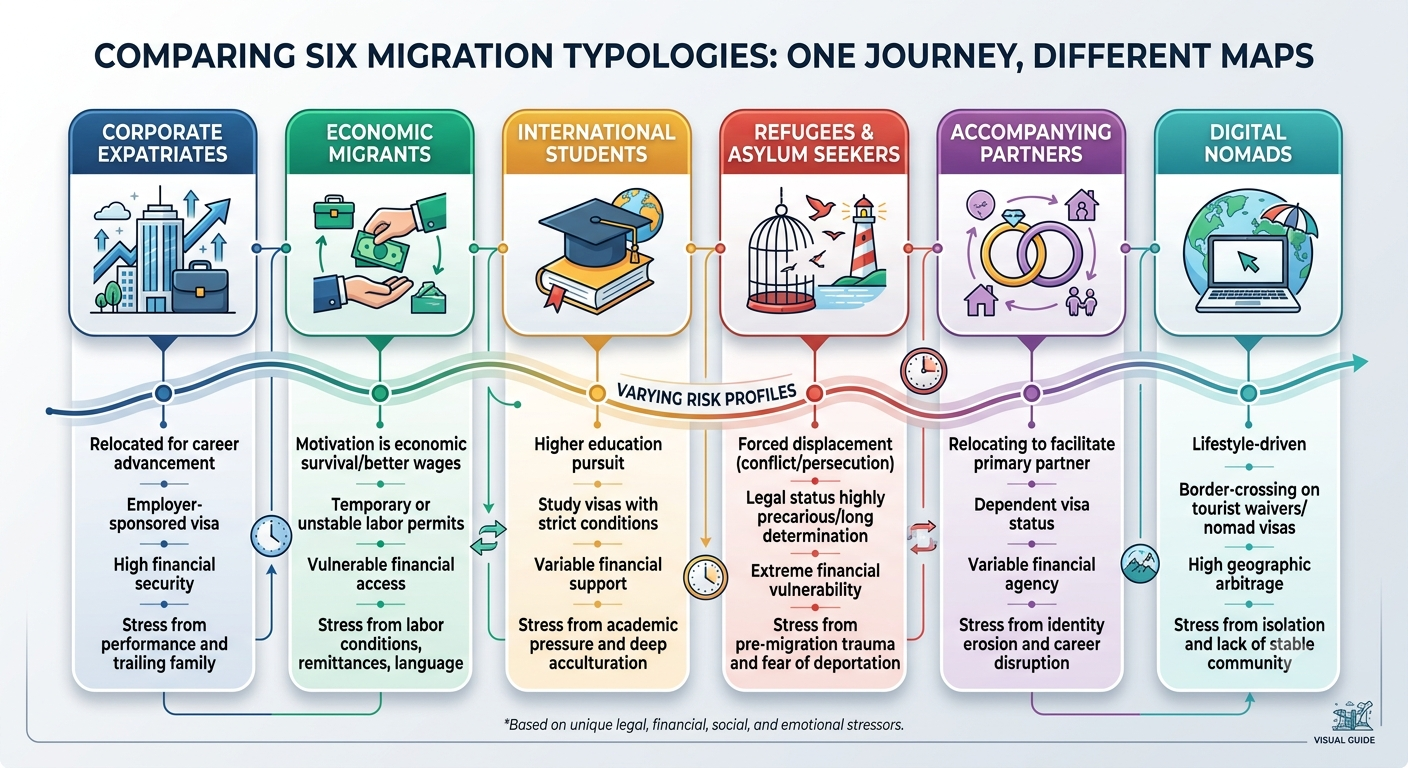
Different journeys, overlapping anxiety risks
People move across borders for reasons that are not remotely comparable, and those reasons shape both the risk and the recovery. The legal, financial, and trauma differences between these groups are real and should not be flattened into one story about "life abroad." What connects them is narrower and more specific: the loss of an established support network, sustained uncertainty, and the need to rebuild ordinary daily life from nothing.
The definitions below are not our own. The International Organization for Migration defines a migrant worker as a person engaged in a remunerated activity in a state of which they are not a national. UNHCR defines a refugee as someone forced to flee because their life, freedom, or physical safety is seriously threatened, and an asylum seeker as someone whose claim for that status has not yet been decided. The OECD defines international students as those who completed prior education in another country and are not permanent residents where they study.
| Group | Legal position | Financial agency | Dominant stressor |
|---|---|---|---|
| Corporate expats | Stable, employer-sponsored | High, with relocation support | Performance pressure, family adjustment |
| Economic migrants | Conditional, tied to employer | Low to moderate | Working conditions, wages, marginalisation |
| International students | Temporary study visa | Moderate, often restricted | Academic pressure, belonging, finances |
| Refugees and asylum seekers | Highly unstable | Severely limited | Trauma, status uncertainty, safety |
| Accompanying partners | Dependent visa, often barred from work | Tied to partner | Identity loss, isolation, career erosion |
| Lifestyle migrants and digital nomads | Short-term or nomad permits | Variable | Rootlessness, shallow local ties |
The move that looks easiest from the outside can still take something out of you that nobody sees.
What the evidence covers, and what it does not
The research on anxiety among internationally mobile people is strong in some places and genuinely thin in others, and it matters that you know which is which. Meta-analytic data is solid for refugees, asylum seekers, and migrant workers, because those populations have been studied extensively. For corporate expats and accompanying partners, no reliable pooled prevalence estimate exists.
That gap is not a footnote. It means anyone quoting a confident percentage for "expat anxiety" is either borrowing a figure from a different population or inventing one. A 2018 Belgian study of expats seeking psychotherapy had a completed sample of 97 people, of whom 69% had moved for a work assignment and 28% were accompanying partners. A 2025 study of 207 internationally mobile partners found perceived stress and isolation were the strongest predictors of reduced wellbeing. Both are useful. Neither gives a prevalence rate.
One more caution. Much of the strongest data on international students comes from pandemic years, when conditions were unusual. Those figures describe a moment, not a permanent baseline.
The honest position: anxiety is well documented among refugees, asylum seekers, and migrant workers. For corporate expats and accompanying partners, we have evidence about mechanisms and risk factors, but not about how many people are affected.
How common is anxiety among people living abroad?
Anxiety prevalence varies enormously depending on which population was studied and how it was measured, with figures ranging from 11% to 42% across different groups and methods. The table below keeps each figure attached to the population it actually describes. These numbers should not be read as a ranking, because they are not measuring the same thing in the same way.
| Population | Anxiety finding | Sample | Source |
|---|---|---|---|
| Refugees and asylum seekers | 11% anxiety disorder | Global systematic review | Blackmore et al., 2020, diagnostic criteria |
| Refugees in high-income countries | 13% diagnosed, 42% self-reported | 66 publications, N=14,882 | Henkelmann et al., 2020 |
| Migrant workers | 27.31% | 7 studies, 44,365 workers, 17 countries | Hasan et al., 2021 |
| International migrant workers | 17.8% anxiety symptoms | 57 studies, N=29,481 | Yema et al., 2025 |
| African-origin migrants | 34.60% | 46 studies, N=28,367 | James et al., 2022 |
| Chinese international students in the US | 20.7% | 1,881 students, GAD-7 score of 10 or above | Lin et al., 2022 |
| Corporate expats and accompanying partners | No reliable pooled estimate | Not available | Evidence gap |
The World Health Organization stated in 2025 that mental health conditions, including anxiety, depression, and PTSD, are more prevalent among refugees and migrants than among host populations. That directional finding is well supported even where the precise numbers vary.
Why the same population produces different numbers
The gap between 13% and 42% in the same study population comes down to measurement method, not disagreement about the facts. Diagnostic assessment uses a clinical interview against formal criteria and produces conservative figures. Self-report screening asks people to rate their own symptoms on a questionnaire and captures a much wider group, including people with meaningful distress who would not meet a diagnostic threshold.
Neither number is wrong. They answer different questions. The 13% figure answers "how many people have a diagnosable anxiety disorder." The 42% figure answers "how many people are experiencing anxiety symptoms significant enough to report." If you are struggling and you would not meet a clinical threshold, your experience sits inside that second number and it is still real.
Understanding this one distinction will make you a better reader of every mental health statistic you encounter from here on.
Anxiety or depression: how to tell them apart
Anxiety centres on threat and the future, while depression centres on loss and the present. The clearest practical difference is in energy and anticipation: anxiety feels wired and forward-looking, depression feels slowed and flattened. They frequently occur together, which is part of why they get confused.
| Anxiety | Depression | |
|---|---|---|
| Core feeling | Threat, dread, worry | Loss, emptiness, flatness |
| Time orientation | Future focused, "what if" | Present or past focused |
| Energy | Wired, restless, on edge | Slowed, heavy, exhausted |
| Motivation | Wants to act, fear intervenes | Interest and drive fall away |
| Concentration | Usually intact between episodes | Persistently difficult |
| Pleasure | Still possible when calm | Reduced or absent |
If you recognise more of the right-hand column, our guide to homesickness and depression abroad covers that territory in more depth.
Normal relocation stress, adjustment disorder, or an anxiety disorder?
Not every difficult feeling after a move is a disorder, and the difference lies in duration, intensity, and whether daily functioning holds. The distinctions below run from ordinary to clinical, and each one is separated from the last by a specific threshold rather than by severity of feeling alone.
Normal relocation stress produces headaches, stomach complaints, muscle tension, poor sleep, difficulty deciding, and irritability. The NHS describes these as ordinary stress responses to major change. Function stays broadly intact and symptoms ease as you gain competence in the new environment.
Adjustment disorder develops after an identifiable stressor, typically within three months. What distinguishes it is that the reaction is disproportionate to the trigger and function is visibly impaired at work, in study, or socially. A relocation, a visa crisis, or a partner's job loss can all set it off.
Generalized anxiety disorder is persistent, uncontrollable worry spread across many areas of life, lasting at least six months on most days. The key difference from relocation stress is scope. Relocation stress clusters around the move. GAD spreads everywhere.
Panic disorder involves sudden episodes of intense fear with physical symptoms such as palpitations, chest pain, breathlessness, and dizziness, plus fear of further attacks. Abroad, this is often first experienced as fear of a medical emergency in a health system you do not understand.
Social anxiety disorder is intense fear of judgement in social situations, with avoidance of things like phone calls, shops, or group meals. Abroad it hides easily behind "my language is not good enough."
Trauma-related presentations involve flashbacks, nightmares, hypervigilance, and avoidance, and require separate assessment. These are particularly relevant for refugees, asylum seekers, and anyone exposed to violence before or during migration.
What triggers anxiety abroad
The triggers cluster differently depending on your situation, but almost all of them share one feature: they are invisible to the people watching your life from home. Your friends see the photographs. They do not see the residence permit appointment you have rescheduled twice, or the way you rehearse phone calls.
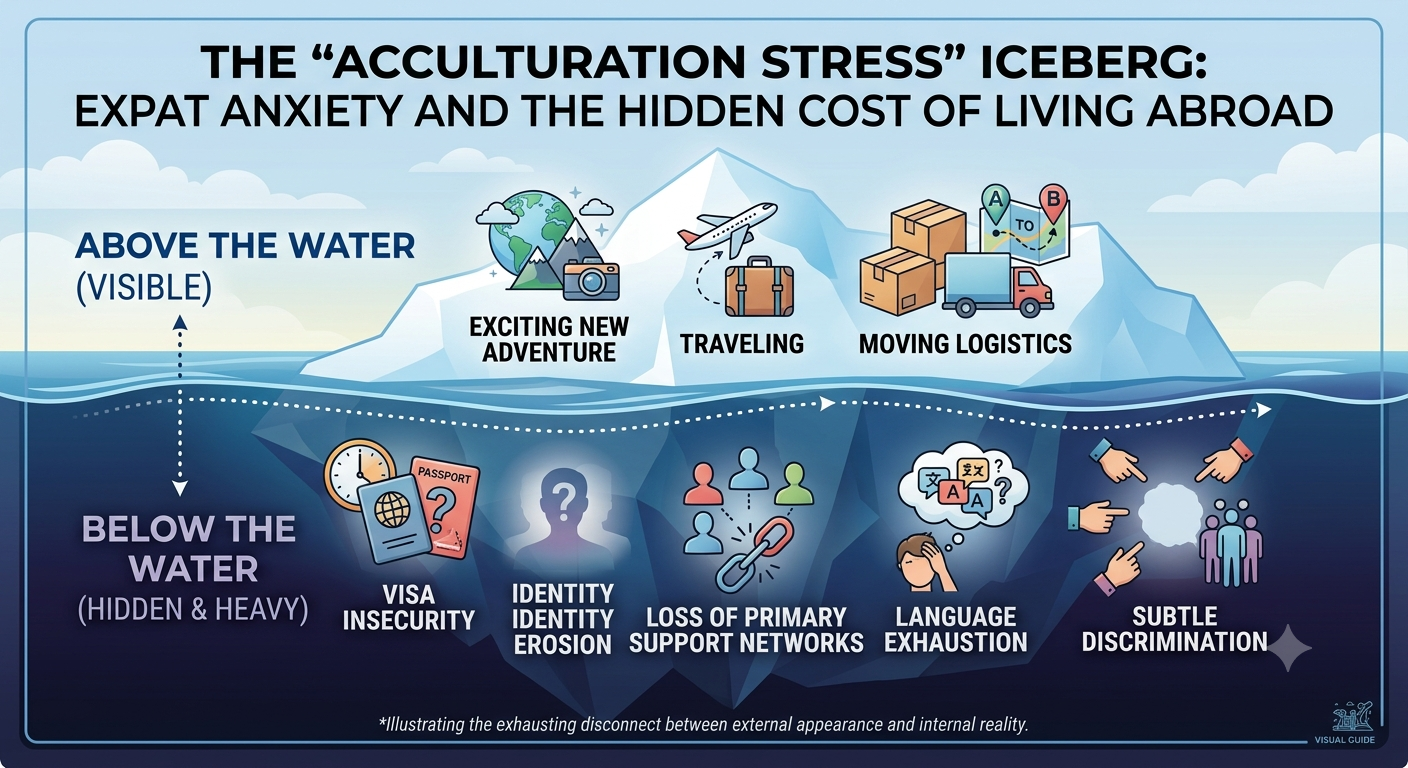
Language and cultural friction
Operating in a second language is a continuous cognitive load. It is not only vocabulary, it is decoding ambiguous social signals, judging formality, and reading a room whose rules you learned late. That load runs all day, and it does not announce itself as effort.
What helps: protect one part of the day where you are not performing in a second language, whether that is a call home, a book, or a podcast.
Legal and status insecurity
Uncertainty about whether you can stay is one of the most consistently documented anxiety drivers across migration research. It affects asylum seekers most severely, but it also reaches temporary visa holders and, in a different way, dependent visa holders whose right to remain rests on someone else's employment.
Work, money, and status
The specific stressor differs sharply by group. Systematic reviews of migrant workers point to workplace psychosocial conditions, wage and benefits problems, abuse, housing, and limited healthcare access. Corporate expats report performance pressure and the strain of family adjustment. Accompanying partners face something else again: professional identity erased by a visa that does not permit work.
If that last one is familiar, our guide for trailing spouses and accompanying partners goes deeper.
Isolation and lost networks
You did not just lose proximity to people, you lost the version of yourself that existed in relation to them. Building new connections takes years, not months, and expat communities have unusually high turnover, so the friendships you do build often end when someone's contract does.
What helps: prioritise repeated, low-stakes contact over occasional big social events. Proximity and repetition build friendships more reliably than intensity.
Discrimination and exclusion
Perceived or structural exclusion based on nationality, accent, or race correlates with higher anxiety and, importantly, with lower help-seeking. People who expect to be misunderstood ask for help less often.
Family separation and distance
Handling a crisis at home through a phone screen is its own category of strain, and it comes with guilt attached: guilt at being far away, and sometimes guilt at being safe. For migrant workers supporting family financially, remittance pressure compounds it.
Why anxiety abroad often does not look like anxiety
Anxiety frequently presents physically rather than emotionally, which is why it goes unrecognised for months in people living abroad. According to NIMH and NHS descriptions, anxiety commonly involves sleep disturbance, irritability, difficulty concentrating, fatigue, palpitations, dizziness, gastrointestinal symptoms, muscle tension, breathlessness, and sweating. None of those announce themselves as a mental health problem.
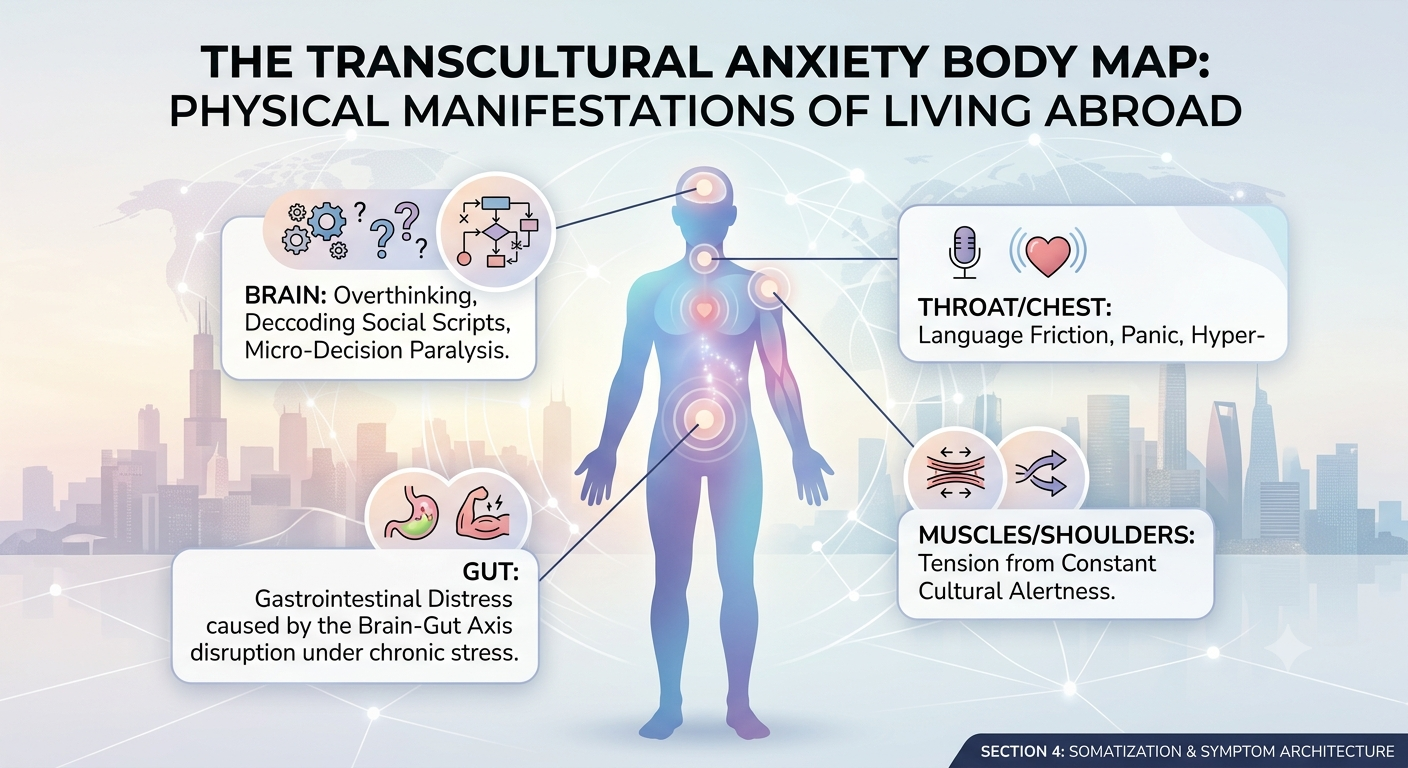
Abroad, there is always another explanation available. The insomnia is jet lag. The stomach trouble is the food. The exhaustion is the commute. The irritability is the bureaucracy. The reluctance to answer an unknown number is just sensible. Every symptom has a plausible local cause, so the pattern never gets assembled.
Two misreadings are especially common. Social anxiety gets attributed to language ability, so people conclude they need more vocabulary when what they actually have is a fear of judgement that more vocabulary will not fix. And panic gets experienced as a medical emergency, which is significantly more frightening when you do not know how the local health system works or who to call.
If you have been telling yourself you are still adjusting for longer than a year, it may be worth asking what you are adjusting to.
What makes it worse, and what protects you
Certain factors recur across every population studied, which makes them a reasonable guide even where population-specific data is missing. The risk factors are consistent: low social support, trauma exposure, sleep disruption, discrimination, financial pressure, status insecurity, and precarious working conditions.
The protective factors are more consistent still, and social support is the strongest of them. Higher social support correlated with lower anxiety among Chinese international students. Lower social support tracked with worse mental health in a German multi-university analysis. Among internationally mobile partners, stress and isolation were the dominant negative predictors of wellbeing. Among expatriates in one international construction study, prior overseas assignment experience and psychological resilience both acted as buffers.
Practically, that means four things worth acting on:
- Build repeated contact, not occasional contact. Regularity matters more than depth at the start.
- Protect sleep before anything else. Sleep disruption and anxiety reinforce each other in both directions.
- Move your body regularly. Physical activity and offline engagement were both associated with reduced anxiety in student research.
- Anchor the day with routine. Predictable structure gives your nervous system something stable to hold when the environment does not.
What actually helps
The most defensible answer is that culturally and linguistically accessible care works better than generic care, though the evidence is stronger for some interventions than others. Here is what the research supports, with the strength of that support stated honestly.
Culturally adapted care has good support. A 2020 realist systematic review found that symptom improvement in community-based psychotherapy for refugees was helped by culturally adapted care, migrant-sensitive settings, involvement of other clinical staff, and sufficient intervention intensity. Standardised Western approaches see higher dropout rates among non-Western clients.
Language access matters, but the evidence is more nuanced than usually claimed. Direct modern comparative evidence for native-language matching specifically is limited. An influential earlier meta-analysis in the cultural adaptation literature found effectiveness roughly doubled when interventions were delivered in the client's native language. At the same time, interpreter-mediated therapy produces meaningful clinical outcomes: a 2019 retrospective cohort study delivered 16 sessions of CBT to 825 trauma-affected refugee patients specifically to test interpreter-mediated outcomes, and earlier meta-analytic PTSD literature found no outcome difference between studies that used interpreters and those that did not. The practical reading: working in your own language removes real cognitive and emotional friction, and if that is not available, therapy through a qualified interpreter remains a genuine option rather than a compromise not worth making.
Online therapy has promising but uneven evidence. A 2024 systematic review of digital psychological interventions for migrants and refugees found signals for reducing depressive symptoms, with weaker evidence for PTSD and anxiety. The 2025 RESPOND randomised controlled trial provided solid evidence for WHO's stepped-care model, using Doing What Matters and Problem Management Plus, among distressed migrants in Italy. Low-threshold, scalable, multilingual models are where the strongest recent evidence sits.
Sleep, routine, and physical activity have support, though partly from general anxiety research. Physical exercise and offline activity reduced anxiety in international student studies, and the link between insomnia and higher anxiety is well established. Some of this evidence comes from general anxiety literature rather than migration-specific research, which is worth knowing.
One thing the research makes clear: priorities differ by group. For refugees, safety and legal status come before anything else. For students, belonging and academic pressure. For accompanying partners, isolation and identity. For migrant workers, wages, conditions, and housing. For corporate expats, the balance between work, family, and adjustment. Advice that ignores those differences is advice for nobody in particular.
If working in your own language matters to you, our native language therapy page explains how that matching works.
Why people abroad do not get help even when they need it
Access barriers, not willingness, explain most of the gap between need and treatment among internationally mobile people. Large reviews of immigrant populations consistently identify lack of insurance, high cost, and language as the primary structural obstacles.
The softer barriers matter just as much. Systematic reviews of refugee and asylum-seeker populations repeatedly find stigma, not knowing services exist, confidentiality concerns, distrust of authorities, unstable housing and finances, communication difficulties, cultural beliefs about mental health, fragmented service provision, and immigration status itself. For international students, language, unfamiliarity with the health system, and stigma dominate.
Then there is the fear that surfaces most often among people on employer-sponsored or study visas: that seeking help will show up somewhere it should not. That a diagnosis could affect a visa renewal, a sponsorship, or a professional reputation. That fear is not irrational given how much rests on status, but it keeps people who could be helped quickly from asking at all.
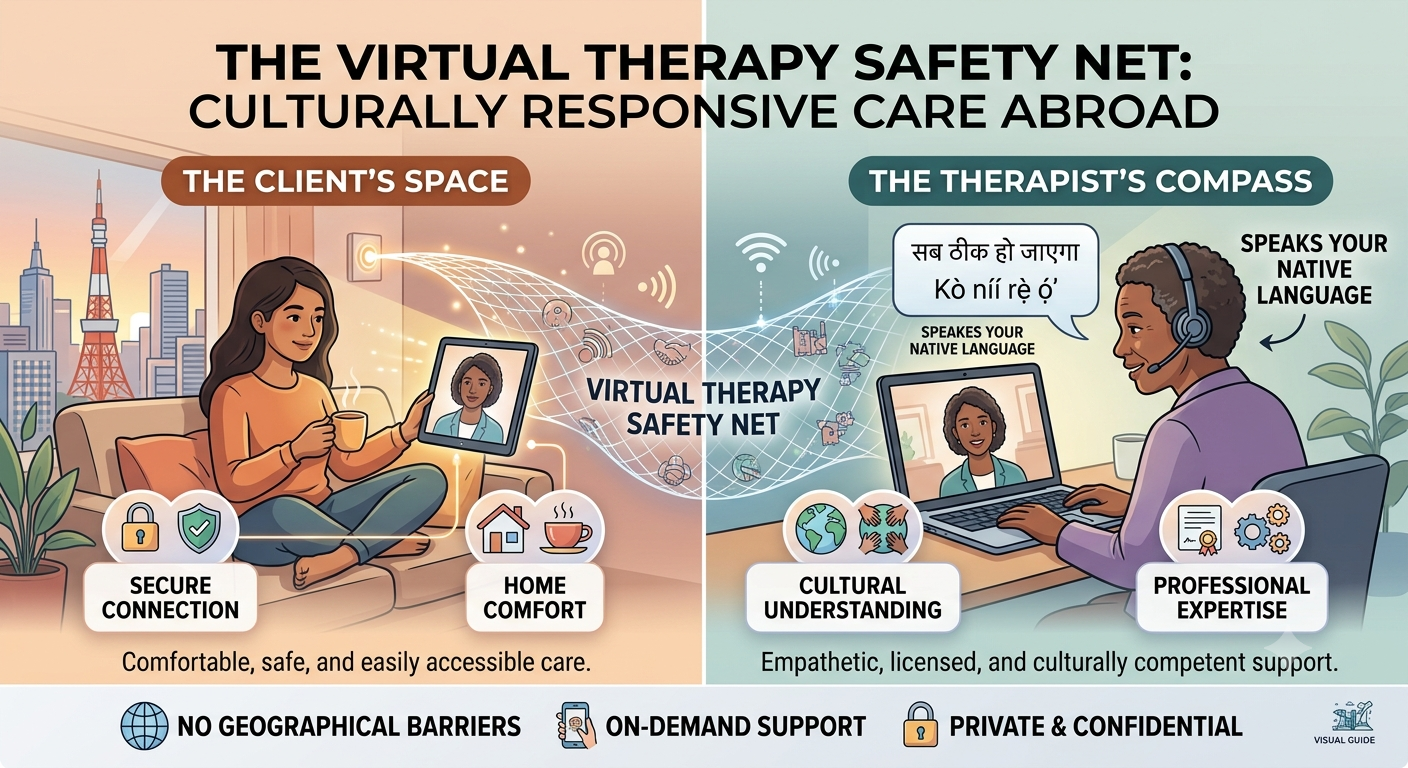
Every barrier in this section is a reason people wait. Expathy exists to remove most of them: licensed psychologists who have lived abroad themselves, matched by your native language and cultural background in 30 seconds, with a free 20-minute first session and no waiting list. Find a therapist who understands anxiety abroad.
When to seek professional support
Seek professional support when anxiety measurably interferes with your ability to work, study, parent, maintain relationships, sleep, eat, leave the house, or make ordinary decisions. That functional test matters more than how severe the feeling is, because people are poor judges of their own distress and much better judges of what they have stopped being able to do.
Specific signs that warrant assessment sooner rather than later:
- Symptoms persisting beyond four to six weeks with no improvement despite active coping
- Panic attacks, particularly if you have started avoiding places where one occurred
- Prolonged insomnia, significant unintended weight change, or persistent gastrointestinal symptoms
- Increasing reliance on alcohol or other substances to manage the feeling
- Flashbacks, nightmares, or persistent hypervigilance
- Withdrawal to the point of near-total isolation
If you are having thoughts of harming yourself, or feeling that you would rather not wake up, please treat that as urgent and contact local emergency services or a crisis line in your country now. You do not need to be certain it is serious enough to deserve help.
Anxiety disorders are among the most treatable mental health conditions there are. Most people improve, often substantially, and often faster than they expected once they start.
Frequently asked questions
Is expat anxiety a real condition?
"Expat anxiety" is not a formal diagnosis, but the anxiety that people experience while living abroad is entirely real and can meet clinical criteria for recognised conditions such as generalized anxiety disorder, panic disorder, social anxiety disorder, or adjustment disorder. The label describes a context, not a separate illness.
How common is anxiety among people living abroad?
It depends heavily on which population you mean and how it was measured, with published figures ranging from 11% to 42%. Refugees show 11% for diagnosed anxiety disorder in global meta-analysis, migrant workers around 27%, and Chinese international students in the US around 21%. For corporate expats and accompanying partners, no reliable pooled figure exists.
How long should adjustment anxiety last?
Ordinary relocation stress generally eases as you gain competence in the new environment, often over weeks to a few months. If significant symptoms persist beyond four to six weeks with no improvement, or if they are getting worse rather than better, that is a reasonable point to seek assessment rather than waiting longer.
Can moving abroad cause anxiety if I never had it before?
Yes. Relocation stacks multiple major stressors simultaneously: new job, new country, changed finances, disrupted routine, lost support network, and often a partner and children adjusting at the same time. A first anxiety episode in this context is common, and prior mental health history is a risk factor rather than a requirement.
Why do I feel anxious when the move went well?
Anxiety does not require anything to have gone wrong. The cognitive load of operating in an unfamiliar environment continues even when the move was successful and chosen, and the mismatch between how good it looks and how hard it feels often makes people less likely to seek help, not more.
Is it anxiety or culture shock?
Culture shock describes a normal adaptation process with recognisable phases, while anxiety is a clinical presentation defined by persistent worry, physical symptoms, and avoidance that impairs functioning. They overlap and can occur together. The practical test is function: culture shock is uncomfortable, anxiety stops you doing things. Our guide to culture shock covers the adaptation side in detail.
Does therapy work if I am not fluent in the local language?
Yes. Therapy in your native language removes the cognitive work of translating emotional experience and is generally preferable where available. Where it is not, therapy through a qualified interpreter still produces meaningful clinical outcomes, with meta-analytic PTSD literature finding no outcome difference between interpreter-mediated and non-interpreter studies.
Does online therapy work as well as in person?
For many people, yes, though the evidence varies by condition. A 2024 systematic review of digital interventions for migrants and refugees found clearer signals for depressive symptoms than for anxiety and PTSD, while the 2025 RESPOND trial supported low-threshold stepped-care models among distressed migrants. For people abroad, online access often makes the difference between getting care in your own language and getting none at all.
Will seeking mental health support affect my visa or job?
In most countries and most employment situations, private therapy is confidential and separate from immigration or employment records, but rules vary by country, visa type, and employer, so this is worth checking for your specific situation rather than assuming. If confidentiality is a concern, ask directly about record-keeping and disclosure before your first session. A provider that cannot answer that clearly is not the right provider.
You do not have to work out which category you fall into before asking for help. Expathy matches you with a licensed psychologist who has lived abroad, speaks your native language, and understands what displacement does to a nervous system. Free 20-minute first session, matched in 30 seconds. Start with anxiety therapy for expats.
Need support? We're here.
Book a free 15-min consultation with our expat-specialized therapists.