
Key takeaway
Homesickness is a normal, common response to living abroad, and feeling it doesn't mean you made the wrong decision. It usually comes from losing your routines, your language comfort, and your sense of belonging all at once. Small daily routines and gradual social steps genuinely help, and if homesickness starts affecting your sleep, work, or relationships, speaking to a psychologist who understands expat life can make a real difference.
You're not just "missing home"
You finally made the move. New city, new job, maybe a new language. From the outside it looks like an adventure, and in many ways it is. But some evenings the apartment feels too quiet, your phone is full of messages from a life happening without you, and a small, heavy feeling settles in. You miss home, and you're not sure you're allowed to.
If that sounds familiar, you're in good company, and there's nothing wrong with you. Homesickness is one of the most common experiences expats go through. Feeling it doesn't mean you've failed or chosen badly. It means you left behind people and places that mattered, which is exactly what makes you human. If you are struggling with this at work, it is worth knowing that some employers now offer ongoing mental health support for their international staff, often in your own native language.
This guide walks through what expat homesickness actually is, why it tends to hit people living abroad especially hard, how to recognise it, what genuinely helps, and how to tell when it's worth reaching out for support.
What is expat homesickness?
Homesickness is the distress that comes from being separated from the people, places, and routines that used to make life feel familiar. It's not only about missing a physical house. It's about missing the whole web of small, automatic comforts that told you "you belong here."
For expats, that web gets pulled apart all at once. You lose your social circle, your daily rhythms, and your cultural shorthand, the food, the language, the unspoken rules you never had to think about, in a single move. For many people this overlaps with culture shock, which can deepen the sense of not belonging.
That's why expat homesickness can feel so heavy. You're not only missing a place. You may be missing the version of yourself who knew exactly how life worked.
It can start the week you arrive, or months later. Some expats feel excited at first, then homesick once the novelty fades. Others feel it strongly from the very first day. Both are completely normal.
Why it hits harder when you live abroad
Living abroad quietly removes the small emotional anchors that usually keep you steady. At home, you know where to buy groceries, how people greet each other, and who to call when something goes wrong. You probably never noticed those things until they were gone.
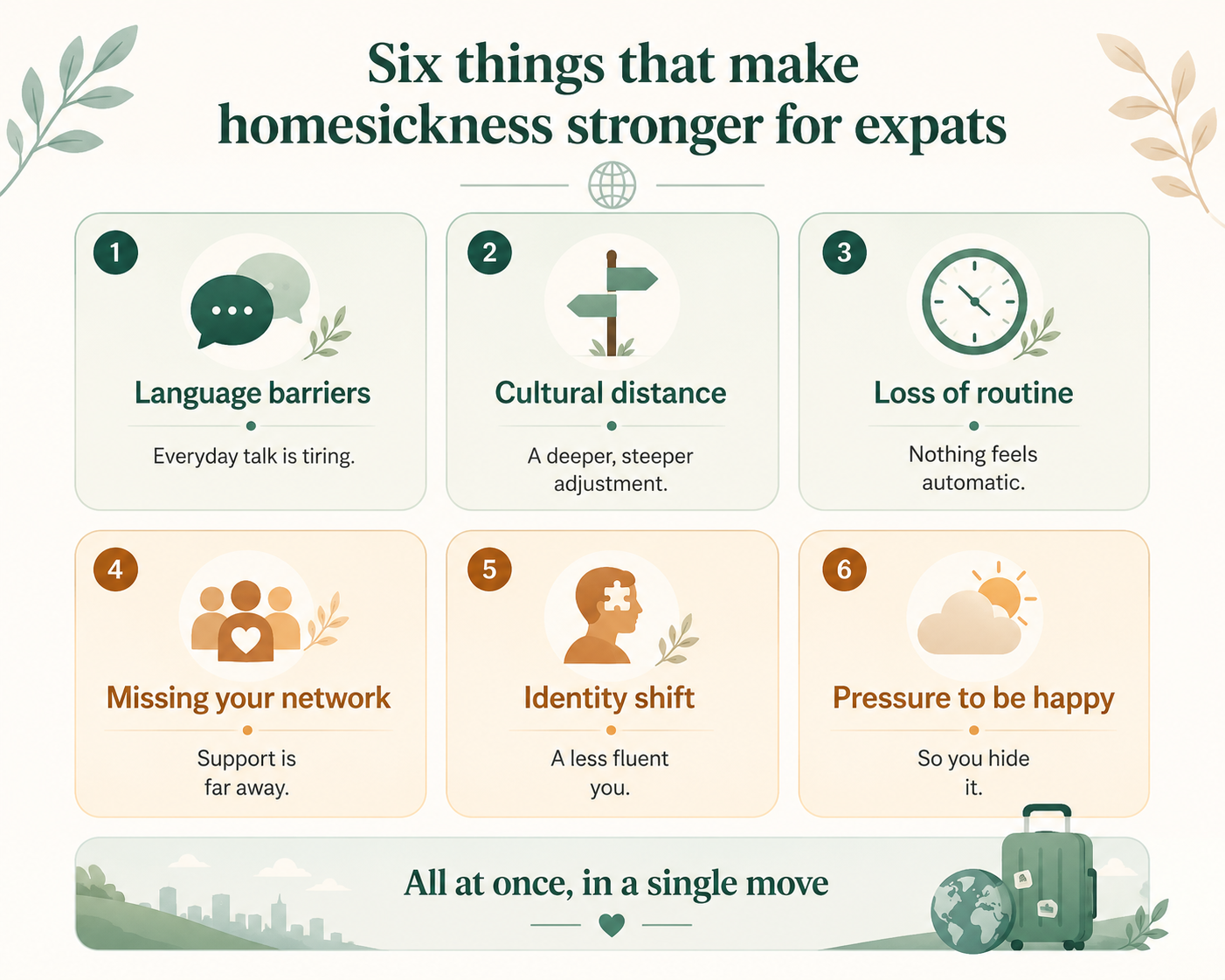
Abroad, your brain has to work harder at all of it. You're constantly translating, interpreting, comparing, and trying not to make mistakes. Homesickness can feel stronger simply because your nervous system is already worn out by the end of the day.
For expats, homesickness is usually tangled up with a few specific things:
- language barriers and the daily effort of being understood
- cultural adjustment and missing your old social rules
- loneliness and not having close friendships yet
- missing family and familiar routines
- guilt about the people you left behind
- uncertainty about the future
- a shifting sense of who you are
So homesickness isn't only about the past. It's also about the present. You miss home partly because your new environment hasn't become emotionally safe yet.
Common homesickness symptoms
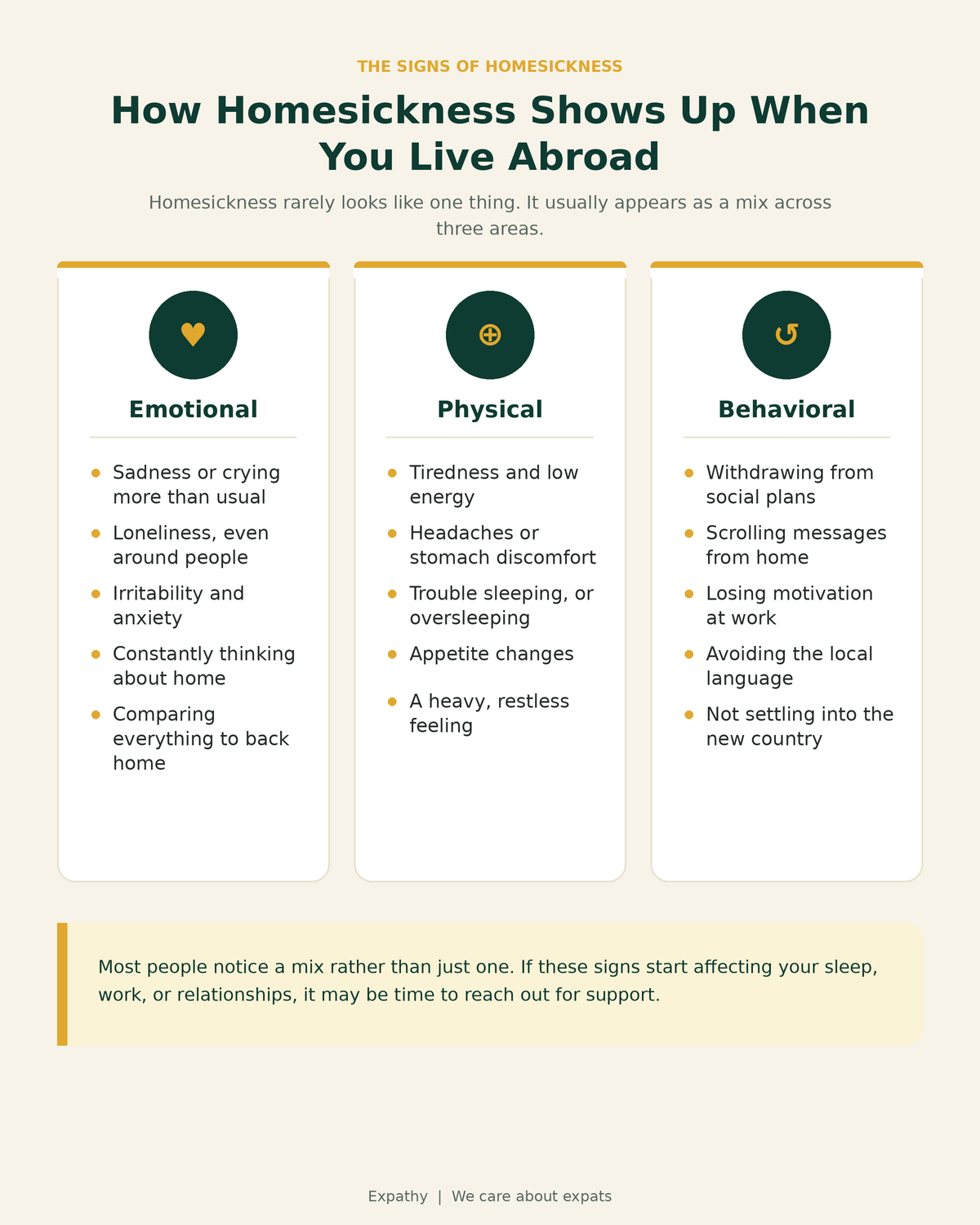
Homesickness looks different for everyone. Some people cry often. Others feel numb. Some get anxious or physically run-down, while others look completely fine from the outside but feel disconnected inside. The symptoms usually fall into three groups.
Emotional symptoms
- sadness, or crying more than usual
- loneliness, even in a room full of people
- missing family, friends, food, places, or your language
- comparing everything to home
- regret or guilt about moving abroad
- irritability and frustration
- anxiety about simple daily tasks
- feeling like you don't belong
- feeling disconnected from your own identity
Many expats also feel ashamed of being homesick. They think, "I chose this life, so why am I struggling?" But choosing to move abroad doesn't switch off your need for comfort, familiarity, and belonging.
Physical symptoms
Homesickness shows up in the body too. This is why people often ask whether homesickness can actually make you sick. It can. Physical symptoms may include:
- tiredness or low energy
- headaches
- stomach discomfort or nausea
- tightness in the chest
- trouble sleeping, or sleeping too much
- appetite changes
- muscle tension and restlessness
- difficulty concentrating
These symptoms don't mean homesickness is "all in your head." Emotional stress genuinely affects the body, especially when you're adjusting to a new country, a new language, and a different support system all at once.
Behavioral symptoms
Homesickness can also change how you act. You might notice that you:
- avoid going out or turn down invitations
- spend hours scrolling photos and messages from home
- call family constantly but still feel empty afterward
- stop trying to meet new people
- lose motivation at work or university
- avoid learning the local language
- feel stuck between your old life and your new one
Sometimes people cope by staying emotionally attached only to home. It's understandable, but over time it can make the new country feel even more distant.
Homesickness as an adult
Homesickness gets talked about like it's only for children or students, but adult homesickness is extremely common. Adults move abroad for work, study, love, family, or safety, and then often feel they're not "allowed" to struggle. There's a job, maybe a partner or children, maybe financial pressure, and a quiet expectation to look like you've got it together.
Adult homesickness can be especially painful because it hits your identity. You may have been confident, social, and independent back home. Abroad, you can suddenly feel dependent, uncertain, or invisible. The thoughts often sound like this:
"I used to know who I was. I was independent before I moved here. Now I feel like a beginner at everything, and I miss being understood without having to explain myself."
None of that means you made the wrong call. It usually means your emotional system is working hard to absorb a major life change.
Severe homesickness: when it gets harder to manage
Not all homesickness is mild. Severe homesickness can affect your sleep, appetite, work, relationships, and ability to function day to day. You might be dealing with it if:
- you cry frequently or feel overwhelmed most days
- you can't focus on work, study, or basic responsibilities
- you feel intense panic or dread about being abroad
- you think about going home almost constantly
- you feel disconnected from your body or surroundings
- you feel hopeless about ever settling in
- you feel trapped between staying and leaving
Severe homesickness deserves real care. It's not something you have to grit your teeth and push through alone. The right support can help you untangle whether you're dealing with homesickness, culture shock, anxiety, loneliness, depression, or several of them at once.
Chronic homesickness: what if it doesn't go away?
For many people, homesickness softens naturally as routines, friendships, and language confidence build. But for some expats it turns chronic, meaning the feeling never really lifts. You might function fine on the surface while privately feeling sad, unsettled, or split between two countries, even years after the move.
Chronic homesickness tends to take hold when:
- you haven't built a support system abroad
- you feel isolated, or face exclusion or discrimination
- you're still struggling with the local language
- you feel stuck because of work, visa, family, or relationship reasons
- your identity is still firmly rooted in the place you left
- you never had space to grieve the move
If homesickness has become chronic, it can help to stop asking "Why am I not over this yet?" and start asking "What support, structure, or safety is still missing from my life here?"
Can homesickness cause depression?
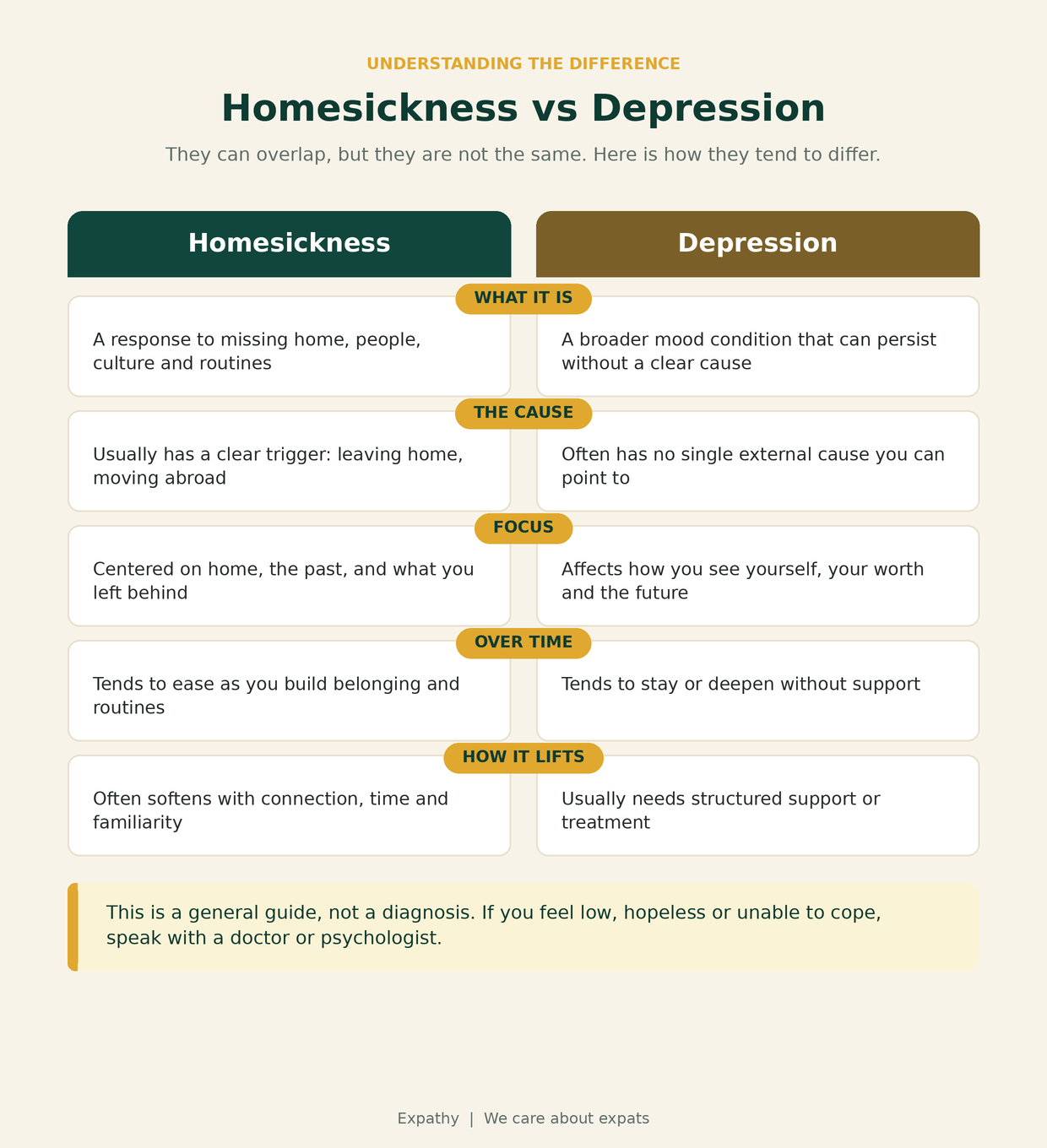
Homesickness and depression aren't the same thing, but they can overlap. Homesickness has a clear link to missing home, familiar people, your culture, or your old life. Depression is broader. It affects mood, energy, sleep, self-worth, and hope, often without a single obvious cause.
Long-running homesickness can feed into depression, though, especially when it's mixed with loneliness, isolation, and that trapped feeling. It's worth taking more seriously if homesickness comes with:
- persistent hopelessness
- loss of interest in things you normally enjoy
- feeling worthless or like a burden
- major changes in sleep or appetite
- constant exhaustion and trouble functioning
- thoughts of giving up or not wanting to continue
If that sounds familiar, it can help to read more about homesickness and depression in expats, or to talk to a mental health professional. You don't need to wait until things feel unbearable before reaching out.
Homesickness and loneliness
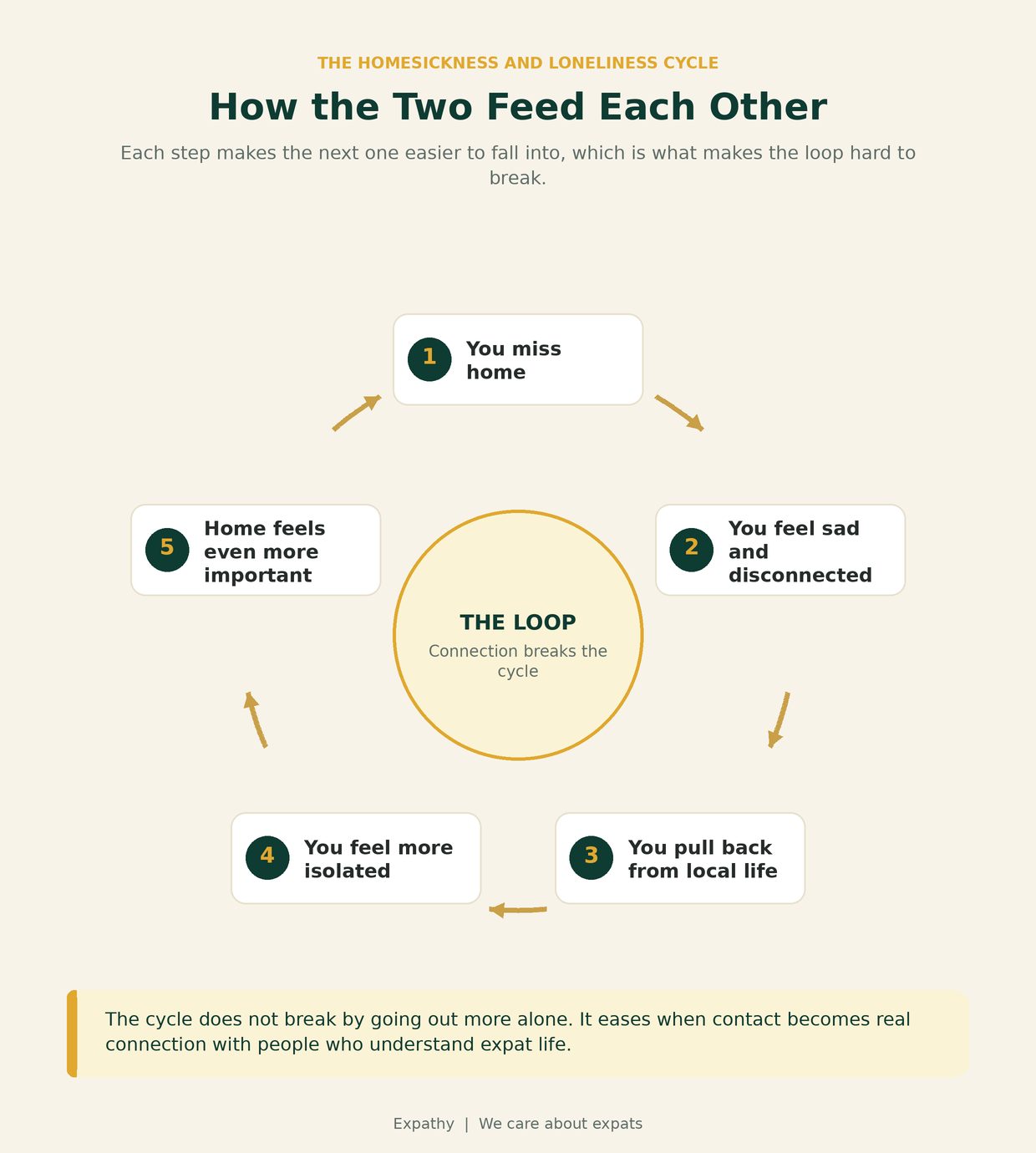
Homesickness and loneliness feed each other. When you feel lonely abroad, home starts to feel like the only place you were ever truly known. And when you miss home intensely, you pull back from your new surroundings, which makes the loneliness worse.
The cycle usually runs like this: you miss home, you feel disconnected, you avoid local life, you feel more isolated, and home starts to feel even more important. Each step makes the next one easier to fall into.
For a lot of expats, the hardest part isn't being physically alone. It's feeling emotionally unknown. You can have colleagues and acquaintances and still have nobody who understands your background, your humor, or your family world. That's why homesickness isn't fixed just by "going out more." Contact helps, but real connection matters more.
How long does homesickness last?
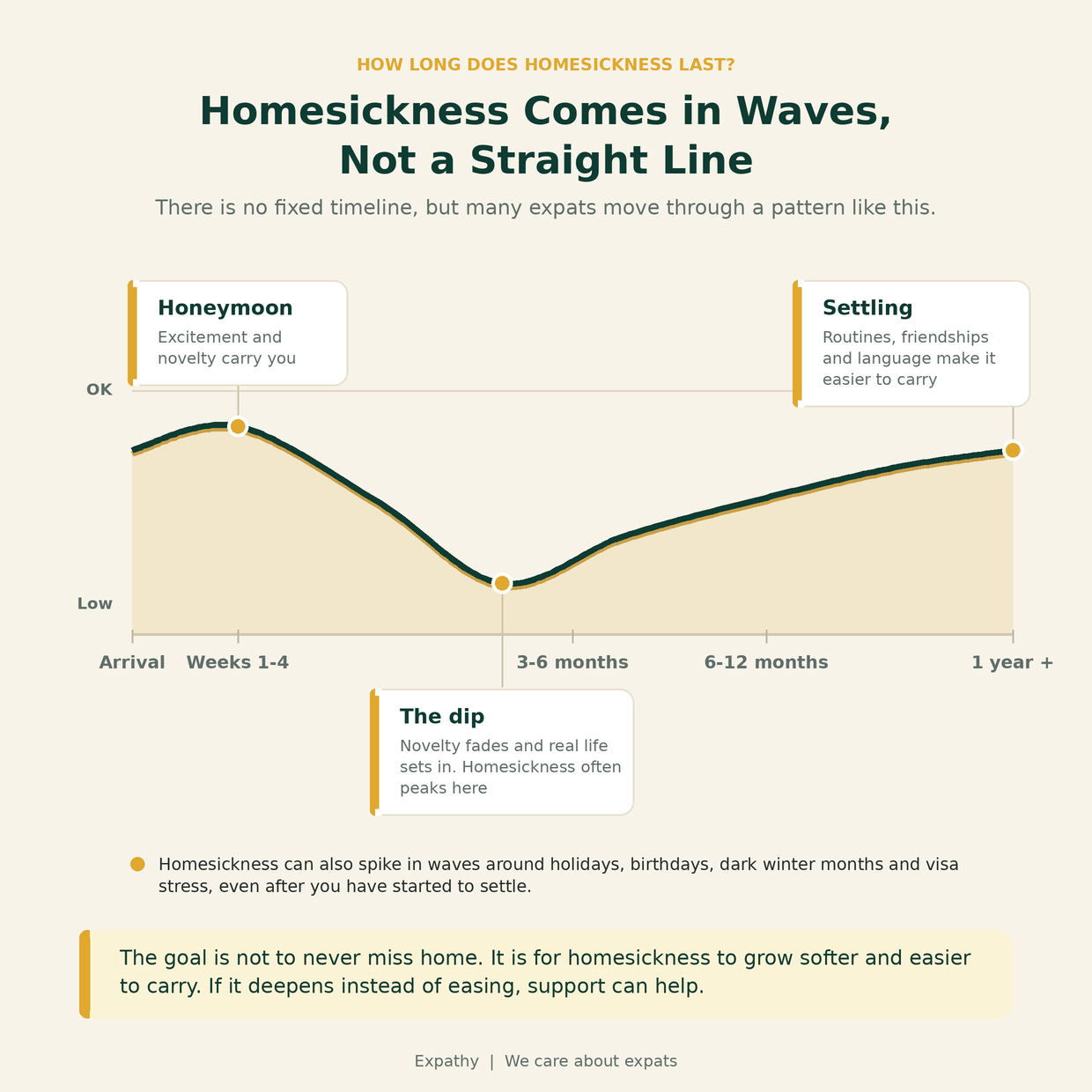
There's no fixed timeline. For some people it's strongest in the first few weeks. For others it shows up after three to six months, once the excitement fades and ordinary life sets in. Plenty of expats feel it come in waves around birthdays, holidays, winter, or visa stress.
Homesickness tends to linger longer when:
- you don't have close relationships abroad yet
- you're under heavy stress, or can't visit home easily
- you feel unsafe or unwelcome
- you're struggling with the local language
- you moved for someone else's job or dream
- you have grief about leaving that you never processed
The aim isn't to never miss home. Missing home may always be part of expat life. The healthier goal is for homesickness to become softer, less controlling, and easier to carry.
How to deal with homesickness abroad
Coping with homesickness isn't about forcing yourself to feel happy. It's about building emotional stability where you are now, while staying connected to the people and places you love. Here are ten practical places to start.
Create a daily routine. Homesickness gets louder when days feel empty or chaotic. Small anchors help your nervous system feel safer: wake around the same time, eat regular meals, take a daily walk, keep a bedtime routine. Routine doesn't erase homesickness, but it cuts down uncertainty, and abroad that matters a lot.
Stay connected to home, but not constantly. Calling home is comforting, but if every free minute goes to scrolling and messaging, it keeps the wound open. Schedule proper calls instead of checking nonstop, share your new life too, and let yourself miss people without disappearing into the past.
Build small local anchors. You don't have to feel fully at home right away. Start with one café where you're comfortable, one walking route, one shop where you know what to buy, one weekly class. Belonging almost always starts small.
Make your space feel familiar. Your home abroad doesn't need to look perfect, it needs to feel safe. Familiar food, photos, music, a favorite mug, or a scent from home can help your body settle while your mind catches up.
Name what you're grieving. Homesickness is often grief. Instead of "I should be happy," try asking what exactly you're missing, and what home gave you that you don't have here yet. Naming the loss makes it easier to tend to.
Stop comparing every detail to home. Constant comparison turns your new country into a worse copy of the old one. Catch the "back home this was easier" thoughts. Some may be true, but if comparison becomes your only lens, nothing new gets a fair chance.
Find people who understand expat life. Not everyone will get it. Some will say "but you should be grateful," which only deepens the loneliness. Look for other expats, immigrants, international students, or therapists who understand transition. Sometimes the most healing sentence is "I know exactly what you mean."
Learn enough local language for daily confidence. You don't need fluency overnight, but practical phrases for shopping, transport, and appointments cut down the daily helplessness. Every small language win gives a bit of confidence back.
Take care of your body. Homesickness is emotional, but the body carries it. Regular sleep, movement, sunlight, real meals, and less doom-scrolling are part of looking after your mind when you're overwhelmed abroad.
Ask for help before you hit a wall. A lot of expats wait too long, telling themselves it's "not serious enough." Therapy isn't only for crisis. It can help you understand what your homesickness is pointing to and rebuild some stability. You deserve support before you're completely drained.
How to cope with homesickness at night
Homesickness often feels worse at night. During the day you're busy enough to outrun it. At night, the quiet gives your mind room to miss everything. To soften night-time homesickness, try:
- a calming evening routine with regular sleep hours
- keeping off emotional scrolling right before bed
- writing down what you miss instead of replaying it on a loop
- familiar music or a comforting podcast
- lining up one small thing to look forward to tomorrow
- texting someone earlier in the evening rather than late at night
Night-time homesickness doesn't mean you're failing. Usually it just means your body finally has space to feel what you carried around all day.
When therapy can help with homesickness
Therapy helps when homesickness becomes more than the occasional wave of sadness. It may be worth it if:
- homesickness is affecting your sleep, work, study, or relationships
- you feel stuck between staying and leaving
- you feel guilty for struggling abroad
- you keep comparing everything to home
- your sense of identity feels shaken
- you're worried it's tipping into depression
- you don't know how to start building a life in the new country
A good therapist can help you separate the layers, grief, loneliness, culture shock, anxiety, identity change, depression, so the whole thing feels less confusing and far more workable.
How Expathy supports expats feeling homesick
At Expathy, we understand that homesickness isn't only about missing home. It touches your identity, your confidence, your relationships, your body, and your sense of belonging. Our platform connects you with psychologists who are expats themselves, who understand cultural transition and the strange experience of living between two countries. You can talk to someone in your own language who already knows what it's like to miss home while trying to build a new life.
If you feel homesick, isolated, or unsure how to settle in, homesickness therapy for expats can help you explore what you're feeling and build practical tools for your life abroad. You don't have to wait until it becomes severe. Getting support early can help you feel less alone and more grounded.
Frequently asked questions about homesickness
What are the signs of homesickness?
The signs of homesickness usually show up in three ways: emotionally, physically, and in your behavior. Emotionally, you might feel sad, lonely, irritable, or anxious, and find yourself constantly thinking about home or comparing everything to it. Physically, the signs can include tiredness, headaches, trouble sleeping, appetite changes, or a heavy, restless feeling. Behaviorally, you may withdraw from social plans, scroll through messages and photos from home for hours, lose motivation, or avoid settling into your new country. Most people notice a mix rather than just one. If these signs start interfering with your sleep, work, or relationships, it's a good moment to reach out for support.
What are the symptoms of homesickness?
Common symptoms include sadness, loneliness, anxiety, crying, irritability, low motivation, trouble sleeping, appetite changes, headaches, stomach discomfort, and constantly thinking about home. Some people also withdraw socially or struggle to focus on daily life.
Can homesickness make you physically sick?
Yes. Emotional stress can contribute to headaches, nausea, stomach discomfort, fatigue, sleep problems, and tension. If physical symptoms are strong or persistent, it's also worth checking in with a medical professional.
Is homesickness a mental illness?
Homesickness on its own isn't usually considered a mental illness. It's a normal reaction to separation, change, and lost familiarity. That said, severe or chronic homesickness can overlap with anxiety, depression, or adjustment difficulties.
How long does homesickness last?
It can last days, weeks, months, or longer depending on the person and the situation. It often eases as you build routines, relationships, language confidence, and a sense of safety. If it doesn't improve, or it gets worse, support can help.
How do I stop feeling homesick?
The goal isn't to stop missing home completely. It's to build stability where you are: keep routines, stay connected to home in a healthy way, meet people, create familiar rituals, look after your body, and ask for support when you need it.
Why do I feel homesick as an adult?
Moving away from home affects identity, belonging, independence, and emotional safety at any age. Being an adult doesn't remove the need for familiarity, connection, and support.
Can homesickness cause depression?
They're different, but long-lasting homesickness can feed depressive feelings, especially alongside loneliness, isolation, and feeling trapped abroad. If you feel hopeless, numb, or unable to function, professional support matters.
Final thoughts
Homesickness doesn't mean you're weak. It doesn't mean you failed at living abroad, and it doesn't always mean you made the wrong choice. It means you're human. You left behind people, places, routines, and a version of life that helped you feel safe. Of course part of you misses that.
But homesickness can change. With time, structure, connection, and support, your new country can stop feeling so foreign. You can miss home and still build a meaningful life abroad. You can grieve what you left and still create something new.
If homesickness is getting too heavy to carry alone, homesickness therapy for expats can help you take the first step toward feeling more supported, grounded, and understood.
Scientific references
- Fisher, S. (1989). Homesickness, Cognition and Health. Lawrence Erlbaum Associates.
- Stroebe, M., Schut, H., & Nauta, M. (2015). Homesickness: A systematic review of the scientific literature. Review of General Psychology.
- Thurber, C. A., & Walton, E. A. (2012). Homesickness and adjustment in university students. Journal of American College Health.
- Hendrickson, B., Rosen, D., & Aune, R. K. (2011). An analysis of friendship networks, social connectedness, homesickness, and satisfaction levels of international students. International Journal of Intercultural Relations.
- Ward, C., Bochner, S., & Furnham, A. (2001). The Psychology of Culture Shock. Routledge.
Need support? We're here.
Book a free 15-min consultation with our expat-specialized therapists.