
Key takeaway
Self-care abroad is not scented candles and a good morning routine. It is the deliberate work of protecting your body and mind after you lose the things that used to hold you steady: your doctor, your language, your family, your food, and your daily routine. At home, self-care tops up a system that mostly works. Abroad, the system itself is gone, so self-care becomes rebuilding rather than maintaining , and how you do it depends on how much time, money, and freedom you actually have.
You wake up genuinely ill in your new country, and your first clear thought is not "where does it hurt" but "who do I even call?" You do not know which doctor, which number, whether your insurance covers it, or how to explain your symptoms in a language you are still learning. That small moment of helplessness is what self-care abroad is really about.
Why self-care abroad is different from self-care at home
Self-care abroad is harder because relocation removes the invisible infrastructure that used to keep you well without any effort on your part. At home, your health was propped up by things you never had to think about: a doctor who knew your history, family within reach, familiar food, and routines built over years. Abroad, most of that support disappears at once, and looking after yourself stops being maintenance and becomes reconstruction.
That is the shift almost nobody warns you about. You are not failing at self-care because you lack discipline. You are doing it on hard mode, without the scaffolding you had before, often in a second language, and frequently while exhausted.
Self-care is not one thing, and access to it is unequal
The honest starting point is that self-care advice is usually written for people with time, money, and stable status, which describes only a fraction of the people living abroad. A relocated professional and an undocumented labour migrant both need to protect their health, but one can book private therapy this afternoon and the other cannot leave a work shift. Any guide that ignores that difference is a guide for the comfortable.
| Situation | Main constraint on self-care | What is realistically available |
|---|---|---|
| Moved by choice (expats, students, nomads) | Isolation, overwork, guilt about struggling | May have more flexibility, but isolation, overwork, or money pressure can still block it |
| Labour migrants | Long hours, low income, poor housing, limited healthcare access | Small, free, time-light practices |
| Refugees and asylum seekers | Trauma, legal precarity, survival needs first | Safety and stability before anything else |
| Accompanying partners | Identity built around someone else's life, lost routine | Rebuilding a self separate from the partner's role |
Self-care is not a luxury for people who already have everything handled. It matters most for the people with the least room to practise it.
The World Health Organization's 2023 review of refugee and migrant mental health identifies basic needs and security, insecure income, housing, food, and legal status, as a foundational risk factor. In plain terms: you cannot self-care your way out of an unmet basic need, and pretending otherwise is its own kind of harm. The rest of this article assumes that, and offers something for every level of resource.
Five things you lose access to abroad, and how to rebuild each
Moving abroad quietly strips away five supports you probably never noticed you relied on, and rebuilding them deliberately is the core of self-care in a new country. None of these come back on their own. Each has to be reconstructed on purpose.
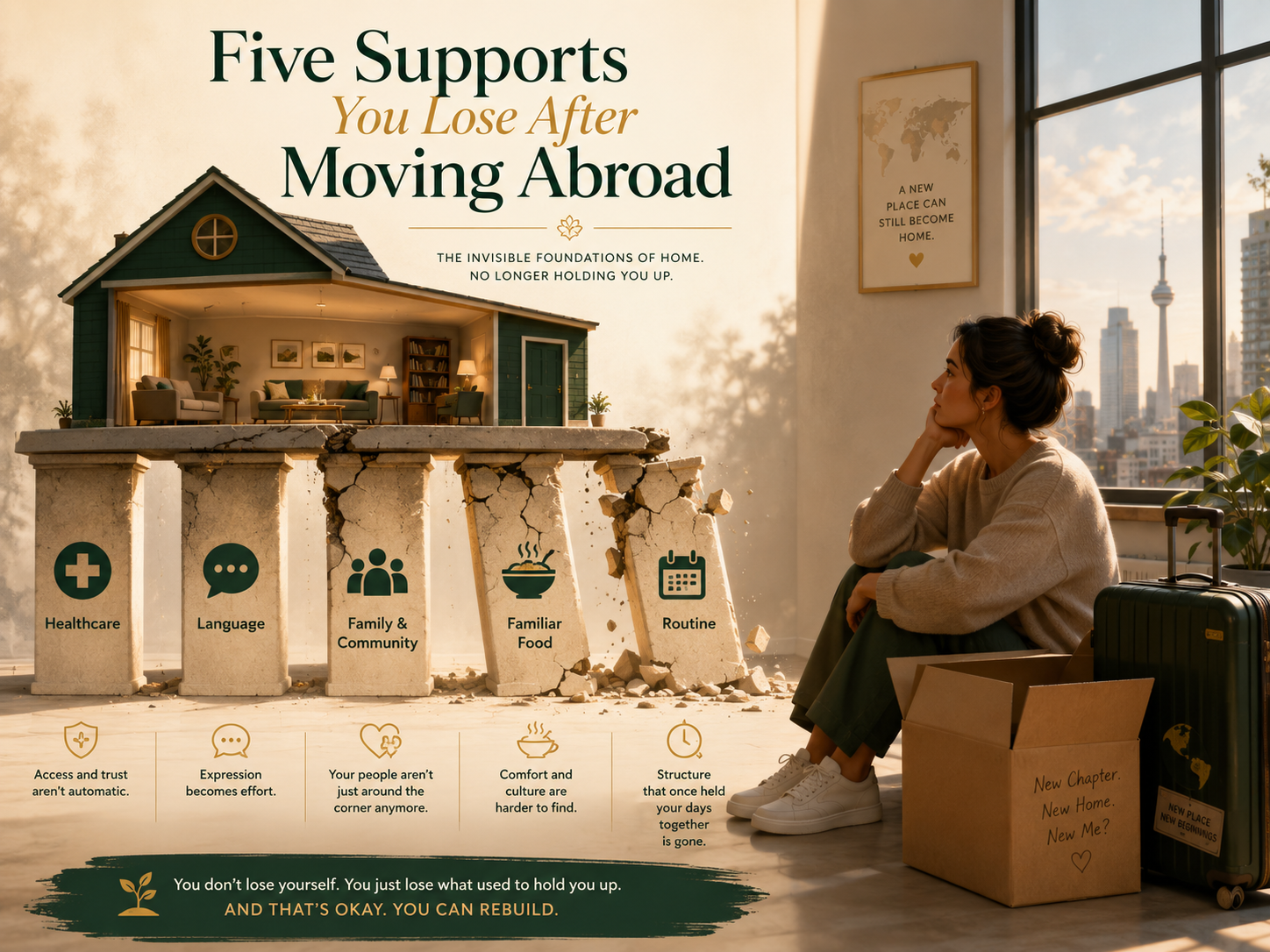
Familiar healthcare. You lose the doctor who knew you and the system you knew how to use. Rebuilding it means learning how care works here before you are sick, not during an emergency in a language you are still learning.
Today: find out how to register with a local doctor, and save the local emergency number in your phone.
Your own language as a place to rest. Operating in a second language all day is genuinely tiring, because your brain is doing constant background work that a native speaker does for free. Research on the "foreign language effect" even shows that emotions register less intensely in a second language, which is useful for staying calm but costly when you need to feel fully understood.
Today: protect one pocket of the day in your own language, a call home, a book, a podcast, or a show.
Family and community. You lose the people who would have noticed you were struggling before you said a word. Rebuilding this is slow and deliberate, and it is covered properly in our guide to loneliness abroad.
Today: message one person who knows the old you, and treat it as a health task, not a social nicety.
Familiar food. Food is comfort and continuity, not only fuel, and losing the tastes of home removes a quiet source of steadiness.
Today: find where to buy one ingredient from home, or cook one familiar dish this week.
Routine and rhythm. You lose the automatic structure of a familiar life, and structure is exactly what a stressed nervous system needs to feel safe.
Today: fix one anchor, a consistent wake time or a standing weekly commitment, and hold it even when everything else is in flux.
Looking after your physical health abroad
Physical health is the most neglected part of self-care abroad, because a new country disrupts sleep, movement, diet, and medical continuity all at once, often without you noticing. The mental strain of adjusting is visible. The physical toll is quieter and easier to ignore until it forces itself on you.
Five practical priorities that get overlooked:
- Sleep. Time-zone shifts and stress fracture sleep, and poor sleep worsens almost everything else. Protect it first, because it is the foundation the rest of your health sits on.
- Movement. Routines that included walking or exercise often collapse in the chaos of a move. Rebuild some daily movement early, before inactivity becomes the new normal.
- Medication continuity. If you take regular medication, do not assume it is available or named the same way here. Sort out supply and local equivalents before you run out.
- Preventive care. In an unfamiliar system, it is easy to skip check-ups and screenings entirely. Find out what preventive care you are entitled to and use it.
- Delayed treatment. A common physical-health mistake abroad is putting off care because the system feels confusing. Learn the route to a doctor before you need it urgently, so a small problem does not become a large one.
Your health setup checklist for the first weeks:
- Register with a local doctor, or find out how the system lets you access one
- Confirm your medication supply and local equivalents before you run low
- Save the local emergency number in your phone now
- Check what your insurance actually covers, including mental health
- Find out what preventive care and screenings you are entitled to
Keeping hold of who you are while you adapt
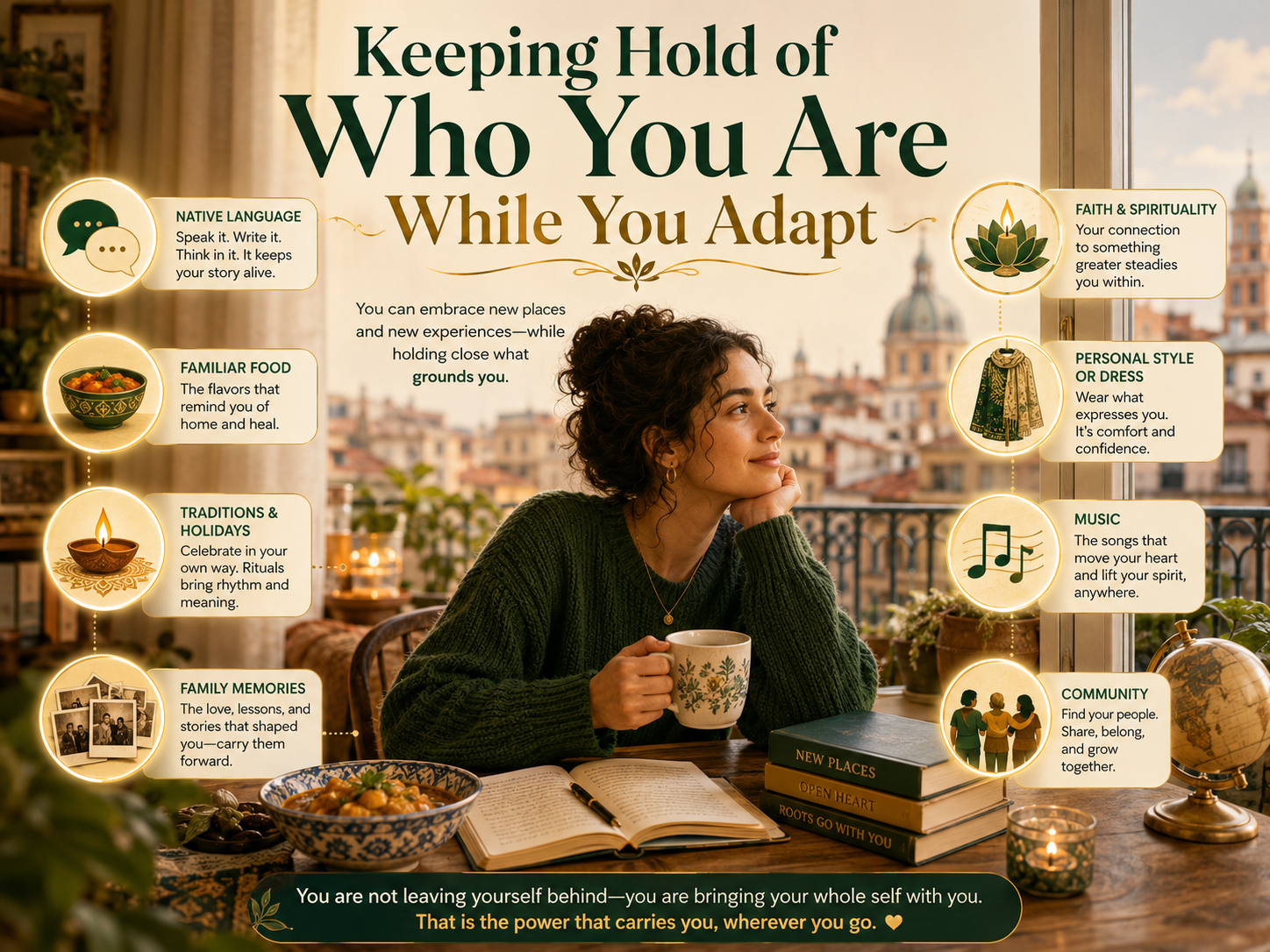
Holding on to parts of your own culture is not resistance to fitting in, it is a way of staying steady while everything else changes. Adaptation asks a lot of you, and doing all of it at once, language, customs, food, social rules, can leave you feeling like you are disappearing into the new place. Keeping chosen pieces of your identity gives you something solid to stand on while the rest shifts.
The WHO's review names self-identity and community support as a protective factor, and found that staying connected to a community with a shared background is associated with better mental health. That is the evidence behind something people feel instinctively: keeping your language, your holidays, your food, your traditions, or your faith is not clinging to the past, it is protecting your sense of self.
The key word is chosen. This is not an obligation to perform your culture, and not a rule that you must resist local ways. It is permission to keep the parts of yourself that matter to you, at your own pace, while you adapt to the parts of the new place you want to take on. Both can happen at once.
Connection is self-care, and so is asking for help
One of the most protective things you can do for your mental health abroad is build and keep genuine connection, because social support is the most consistent protective factor across migration research. Study after study of migrants and immigrants finds the same thing: perceived social support buffers against anxiety and depression, and its absence sharpens both. Connection is not separate from self-care. It is the centre of it.
That includes knowing when self-care is not enough on its own. Looking after yourself well can carry you a long way, but it cannot treat clinical depression or an anxiety disorder, and reaching for professional help is itself an act of self-care, not a failure of it.
If self-care has stopped being enough, talking to someone who understands life abroad can be the most useful next step. Expathy matches you with a psychologist in your own language in 30 seconds, with a free first session. See how it works.
If any of that is where you are, our guides to anxiety while living abroad and therapy in your native language are the right next step.
Self-care when you have almost no time or money
Real self-care has to work for people with no spare time and no spare money, so here it is stripped down to what is free, fast, and available to almost anyone. Forget the gym membership and the spa day. The practices below are built around the constraint most people abroad actually face, and they are organised by how much you have to give on a given day.
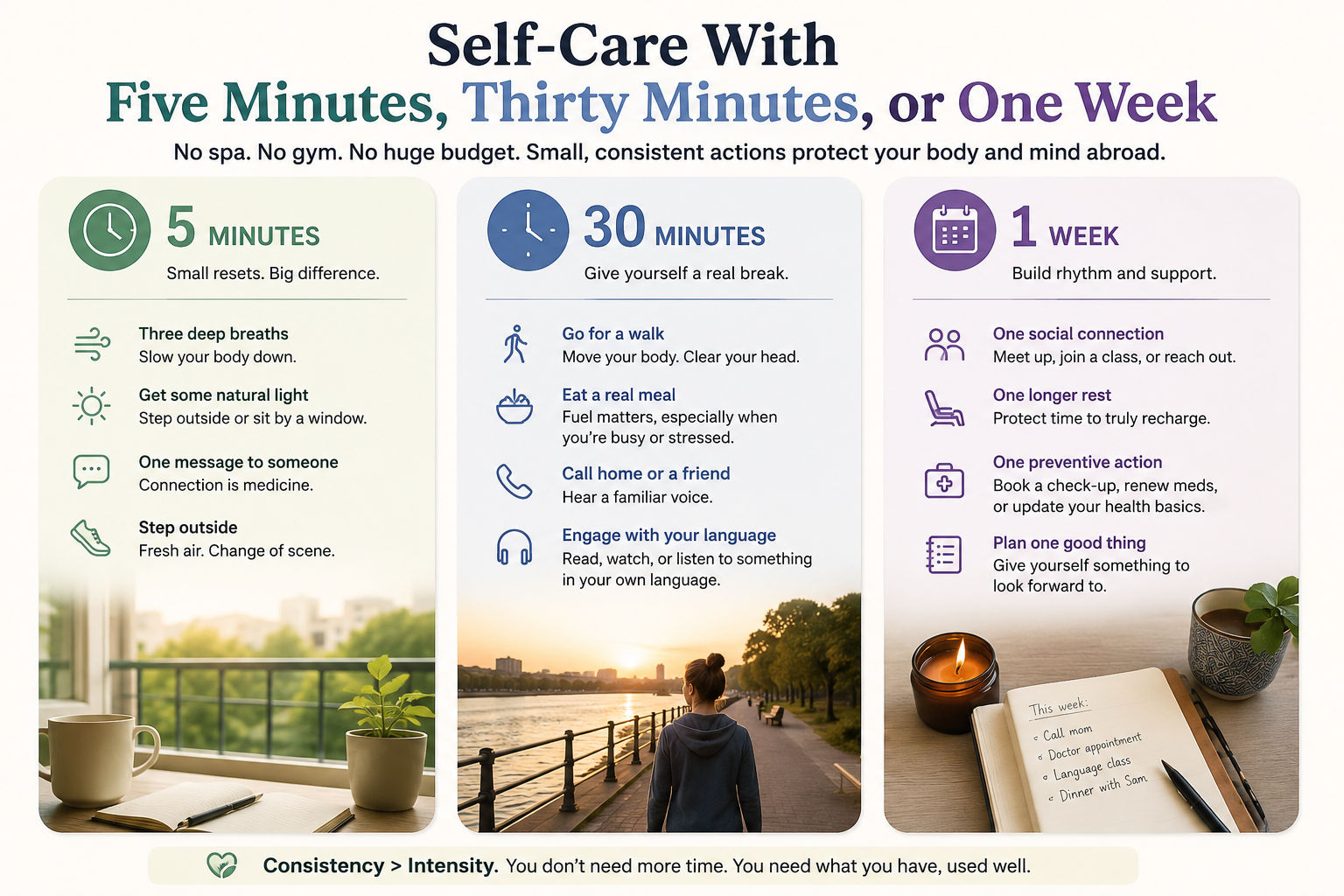
Five-minute self-care (for the hardest days):
- Step outside and get daylight on your face
- Send one message to one person who knows you
- Slow your breathing for two minutes, longer out-breath than in
- Eat or drink something familiar from home
- Put on music or a voice in your own language
Thirty-minute self-care (when you have a little more):
- Take a walk, ideally somewhere with a bit of nature
- Cook and eat one proper meal rather than grabbing something fast
- Call someone at home and actually talk, not just message
- Watch or read something in your native language, fully, without multitasking
Weekly self-care (the anchors worth protecting):
- One real social contact, in person if you possibly can
- One longer stretch of genuine rest that you plan and defend
- One preventive-health action: an appointment, a refill, a check you have been putting off
You do not need money or a free afternoon to look after yourself abroad. You need a few small things done regularly, especially on the days you least feel like it. Start with the five-minute list today.
When self-care is not enough
Self-care has limits, and pushing past them alone is not strength, it is risk. Reach for professional support when low mood, anxiety, or exhaustion has lasted for weeks without lifting, when it is interfering with your work, sleep, relationships, or ability to function, or when you are relying on alcohol or other substances to cope. Those are signals that the load has moved beyond what any routine can hold.
If you are having thoughts of harming yourself, or feeling that you would rather not be here, please treat that as urgent and contact local emergency services or a crisis line in your country now. You do not have to be sure it is serious enough to reach out.
None of this means you have failed at looking after yourself. It means you are human, you are carrying a lot, and some weights are meant to be shared. Support exists, it works, and needing it is ordinary.
When self-care is not enough on its own, Expathy can match you with a licensed psychologist who speaks your native language and understands life abroad, in 30 seconds, with a free first session. Talk to someone who gets it.
Frequently asked questions
What does self-care actually mean when you live abroad?
Self-care abroad means deliberately protecting your physical and mental health after losing the support systems you had at home, such as familiar healthcare, family, food, language, and routine. It is less about relaxation and more about rebuilding the everyday supports that used to keep you well without any effort, which is why it takes more conscious work in a new country than it did before.
Why is it harder to look after yourself in a new country?
Because relocation removes several forms of support at once: your doctor, your family, your community, your routines, and the ease of living in your own language. You are rebuilding all of that while also adjusting to a new environment, often in a second language and while tired, so self-care that was automatic at home now takes deliberate effort.
What should I arrange for my health soon after moving abroad?
Sort out how to access healthcare before you urgently need it: register with a local doctor if the system allows, understand what your insurance covers, and learn where to go for urgent care. If you take regular medication, confirm supply and local equivalents early. Doing this while you are well means a health problem later does not also become a logistical crisis.
Is it healthy to keep my own culture's habits instead of adapting?
Yes. Keeping chosen parts of your culture, your language, food, traditions, or faith, is associated with better mental health, and the World Health Organization identifies self-identity and community support as a protective factor. This is not the opposite of adapting. You can hold on to what anchors you and take on parts of the new culture at the same time, at your own pace.
How do I practise self-care with no time or money?
Focus on small, free, repeatable actions rather than anything that costs money or a free afternoon. Daylight, two minutes of slow breathing, one message to someone who knows you, a familiar food, or a few minutes in your own language all count, and they matter most on the days you least feel like doing them. Consistency matters more than scale.
Can moving abroad affect my physical health?
Yes. Relocation commonly disrupts sleep, diet, movement, and medical continuity at the same time, and people often delay treatment because an unfamiliar health system feels intimidating. The mental strain of adjusting is easier to notice than the physical toll, so physical health is worth protecting deliberately: sleep first, then movement, medication continuity, and preventive care.
What is the difference between self-care and needing therapy?
Self-care is what you do to protect and maintain your wellbeing, while therapy is professional treatment for something self-care cannot resolve on its own, such as clinical depression or an anxiety disorder. If low mood or anxiety persists for weeks, interferes with daily functioning, or you are using substances to cope, that is beyond the reach of self-care, and seeking therapy is itself a form of looking after yourself.
How do I look after my mental health as a migrant or refugee?
Start with stability and safety, because basic needs like secure housing, income, and status are foundational, and self-care cannot substitute for them. Beyond that, staying connected to a community with a shared background is protective, as is keeping parts of your own culture and identity. If you have experienced trauma or persistent distress, seek professional support in your own language where possible, since that removes a real barrier to being understood.
References
- World Health Organization (2023), Mental health of refugees and migrants: risk and protective factors and access to care. Identifies self-identity and community support, and basic needs and security, as key themes for migrant mental health.
- Perceived social support and immigrant mental health, PLOS One (2026): lower perceived social support was associated with higher anxiety and depression scores among immigrants.
- Social support effectiveness for immigrant mental health, British Journal of Social Work (2022): family social support acts as a predictor of good mental health and resilience for immigrants.
Looking after yourself abroad is harder than anyone tells you, and doing it alone is harder still. Expathy matches you with a psychologist who speaks your language, understands what you have left behind, and can help you rebuild. Matched in 30 seconds, free first session. Start with online therapy for expats, or learn how native-language therapy works.
Need support? We're here.
Book a free 15-min consultation with our expat-specialized therapists.