
Key takeaway
A panic attack abroad can feel like a medical emergency happening in the worst possible place. Your heart races, breathing changes, the room feels unreal and one thought takes over: What if something is seriously wrong and nobody here can help me? Panic attacks are treatable, and getting support early can stop fear from shrinking the life you moved abroad to build.
When Panic Hits Somewhere That Still Does Not Feel Like Home
You are on a train, in a supermarket queue or alone in your apartment when your body suddenly changes.
Your chest tightens. Your heart pounds. Your hands tingle. You feel dizzy or detached. Within seconds, the fear becomes bigger than the situation.
You may think:
- I am having a heart attack.
- I am going to faint.
- I am losing control.
- Who would I call here?
- How would I explain this in another language?
The unfamiliar setting adds another layer. Your family may be in another time zone. You may not understand the local healthcare system. Even asking a stranger for help can feel difficult.
A panic attack can feel more dangerous abroad because your body is frightened and the environment does not yet feel fully safe.
If anxiety has become a wider part of daily life, our guide to anxiety while living abroad explains the broader pattern. This article focuses on sudden panic attacks and fear of the next one.
What Does a Panic Attack Feel Like?
A panic attack is a sudden wave of intense fear accompanied by strong physical sensations.
Common symptoms include:
- a racing heart;
- chest pressure;
- shortness of breath;
- dizziness;
- shaking or sweating;
- nausea;
- numbness or tingling;
- feeling detached from yourself;
- fear of losing control;
- fear of dying.
According to the NHS, most panic attacks last between 5 and 20 minutes, although some can last longer.
One panic attack does not automatically mean panic disorder. Panic disorder involves repeated unexpected attacks and ongoing fear or behavioural changes related to another attack. Only a qualified professional can assess that.
Why Does Panic Feel So Convincing?
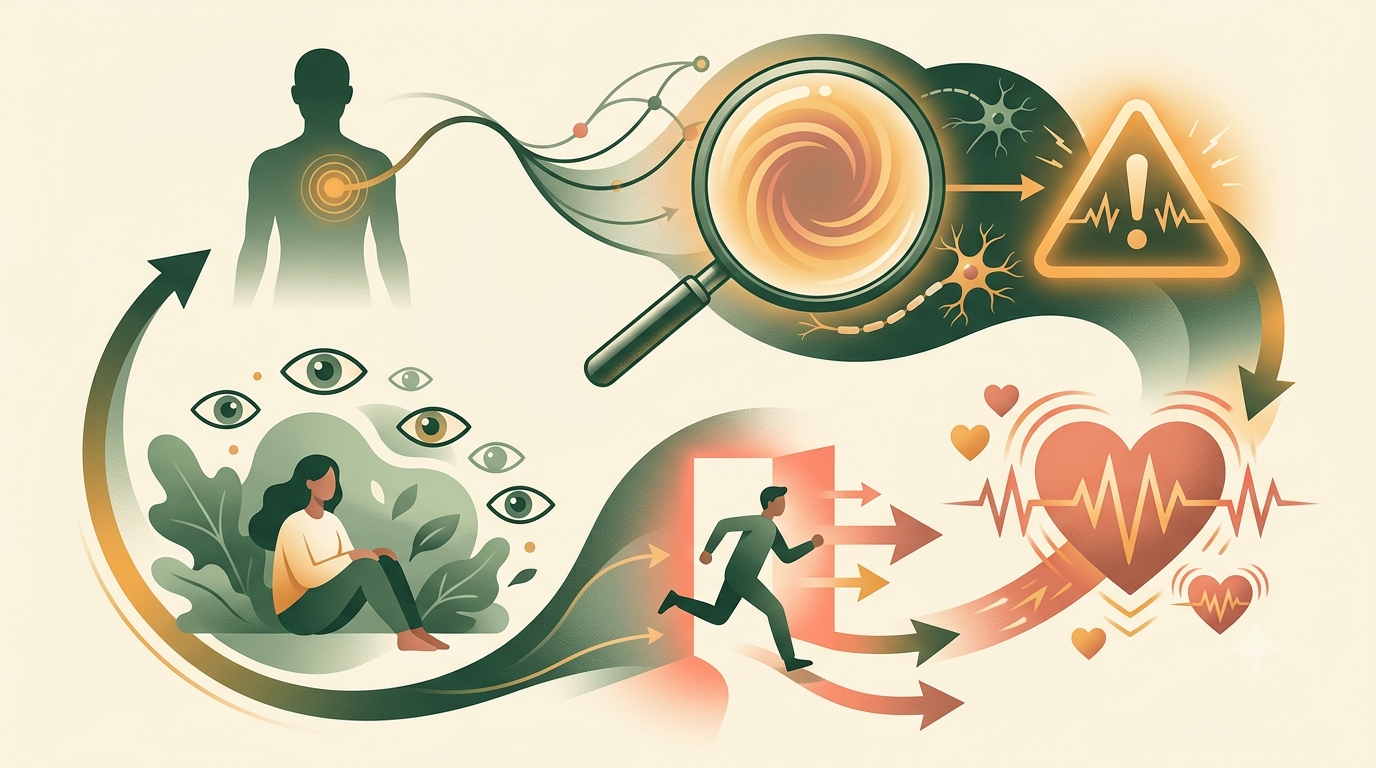
Your body has an alarm system designed to protect you from danger. During panic, that alarm can activate when there is no immediate external threat.
Professor David Barlow, one of the world's leading anxiety researchers, has described fear as a response focused on a sudden present threat. During panic, the body reacts as though that threat is real, even when the danger may be a sensation or interpretation.
A body sensation
       ↓
"This is dangerous"
       ↓
More fear and adrenaline
       ↓
Stronger physical sensations
       ↓
Checking or escaping
       ↓
Temporary relief
       ↓
More fear of the next attack
The attack is frightening, but fear of the sensations often becomes the fuel that keeps the cycle moving.
The heartbeat, dizziness and breathlessness are real. Therapy helps change how those sensations are understood and what you do next.
Is It Panic or a Medical Emergency?
Panic symptoms can overlap with physical health problems. Do not use an article to diagnose severe chest pain, breathing difficulty, fainting or other serious symptoms.
| Experience | What it may look like | What to do |
|---|---|---|
| Possible panic attack | Sudden fear, racing heart, shaking, dizziness or feeling unreal, often peaking within minutes | Move somewhere safe, use grounding and arrange support if attacks repeat |
| Ongoing anxiety | Worry builds over hours or days rather than one sudden peak | Review the wider anxiety pattern and consider professional support |
| New or unusual symptoms | Symptoms are different, severe or persistent | Seek prompt medical assessment |
| Possible emergency | Severe chest pain, collapse, major breathing difficulty or new neurological symptoms | Contact local emergency services immediately |
When symptoms are new, severe, unusual or uncertain, let a medical professional make the distinction.
Why Can Panic Feel Worse Abroad?
Living abroad does not automatically cause panic attacks. It can make the first attack more frightening and the next one harder to stop fearing.
You do not know where help is
At home, you may know the emergency number, nearest hospital and person who would come immediately. Abroad, uncertainty can turn fear into helplessness.
You may need another language
Even fluent speakers struggle when frightened. Searching for words while your heart is racing can intensify the belief that you are losing control.
Familiar support is far away
A trusted person may be asleep or unable to reach you. That can make being alone feel dangerous after the first attack.
Your stress level may already be high
Housing, work, loneliness, paperwork and culture shock can reduce your capacity to recover. The attack may seem to come from nowhere, even though your system has carried pressure for months.
You fear the attack means you cannot live abroad
One attack on a train can become: I cannot use public transport. Then: I cannot travel alone. Eventually: Maybe I cannot stay here.
The danger is not only the attack. It is how much life you may surrender to prevent another one.
What Should You Do During a Panic Attack?
The goal is not to force the attack away instantly. Fighting every sensation can tell your body that something truly dangerous is happening.
Try this sequence:
- Move somewhere safer. Sit down or step away from traffic, stairs or other hazards.
- Name the possibility. Tell yourself: “This may be panic. The feeling is not proof that I am in danger.”
- Slow the exhale. Avoid repeated huge breaths. Breathe gently and let the exhale become a little longer.
- Look outside your body. Name objects, colours, sounds and surfaces around you.
- Stop testing every sensation. Repeated pulse and breathing checks keep attention trapped inside the alarm.
- Contact someone when helpful.
- Seek medical help when needed.
You do not need to win a battle against panic. You need to stay safe long enough for the wave to rise, peak and pass.
What Usually Makes Panic Worse?
After a frightening attack, protective behaviour feels reasonable. The problem is that short-term relief can teach your brain that the situation really was dangerous.
Common examples include:
- checking your pulse repeatedly;
- searching every symptom online;
- leaving the moment anxiety appears;
- avoiding exercise because a faster heartbeat feels threatening;
- refusing to travel without another person;
- avoiding trains, shops or meetings;
- using alcohol or substances to prevent sensations;
- asking for reassurance again and again.
These behaviours are attempts to feel safe. But when avoidance grows, your mind may learn: I survived only because I escaped.
The Fear of the Next Attack Can Become the Bigger Problem
The attack may last minutes. Fear of the next one can occupy months.
You monitor your breathing in meetings. You sit near exits. You stop travelling alone. Gradually, life becomes organised around preventing panic.
In older but still widely cited U.S. survey data published by the National Institute of Mental Health, 44.8% of adults with panic disorder reported serious impairment. This was not expat-specific and does not predict one person's outcome. It shows why repeated panic deserves attention before avoidance takes over work, relationships and independence.
Panic becomes most expensive when it starts choosing where you go, who you depend on and how small your life must become.
How Panic Can Affect Your Life Abroad

Fear of panic may lead you to:
- stop using public transport;
- avoid travelling alone;
- decline work opportunities;
- skip language classes;
- cancel social plans;
- depend heavily on your partner;
- consider moving home mainly to escape fear.
Your partner may become your driver, reassurance source and emergency plan. Over time, that can exhaust both of you. Our guide to expat couples and relationship challenges abroad explains why relocation pressure can make this strain harder to manage.
Love can support recovery, but it cannot replace professional help. You deserve more than a life built around keeping one trusted person constantly nearby.
What Can Help Between Attacks?
The period between attacks is where you can begin changing the pattern.
Useful steps include:
- getting medical assessment for new or unexplained symptoms;
- noting what happened before, during and after an attack;
- reducing constant body monitoring;
- protecting sleep and regular meals;
- reviewing caffeine, alcohol or substance use;
- learning the local emergency number and healthcare route;
- telling one trusted person what helps;
- returning gradually to avoided situations;
- speaking with a psychologist before avoidance spreads.
Create a simple local plan:
- Emergency number
- Medical contact
- Trusted person
- Translated sentence explaining panic symptoms
- Professional support contact
Planning is not surrendering to panic. It removes some of the uncertainty that makes an attack abroad feel so dangerous.
Why Therapy Can Make a Real Difference
Panic often responds well to psychological treatment because therapy works directly with the cycle keeping it alive.
A psychologist may help you:
- understand what your body is doing;
- identify catastrophic interpretations;
- reduce fear of physical sensations;
- stop relying on reassurance and escape;
- return gradually to avoided places;
- rebuild independence;
- manage wider relocation stress;
- prepare for future sensations without treating them as emergencies.
A Cochrane review examined 60 studies involving 3,021 participants. Talking therapies were generally more effective than no treatment, although evidence quality varied.
The NICE guideline for panic disorder recommends psychological interventions, including cognitive behavioural therapy, for people with panic disorder.
Statistics cannot promise what therapy will do for you. They can challenge the belief that panic is something you must simply endure.
The biggest change is not always having zero sensations. It is learning that the sensations no longer control your decisions.
Do Not Wait Until Avoidance Becomes Your Lifestyle
Consider professional support when:
- attacks are repeating;
- fear of another attack dominates your day;
- avoidance is increasing;
- you rely heavily on a partner to feel safe;
- sleep, work or relationships are affected;
- you use alcohol or substances to cope;
- you are considering leaving the country mainly because of panic.
Therapy does not replace medical assessment or emergency care. It can help you stop living as though the next attack is always one heartbeat away.
How Expathy Makes the First Step Easier
Expathy quickly matches expats with licensed psychologists who speak their native language.
Many Expathy psychologists are expats themselves. They understand both your cultural background and the uncertainty of building a life in another country.
You can talk about the panic, healthcare confusion, loneliness and fear that your new life is falling apart without translating the emotional context first.
Final Thought
A panic attack can feel catastrophic. It does not mean you are losing your mind, becoming incapable or failing at life abroad.
But repeated avoidance can quietly take away the freedom you moved abroad to find.
Get medical help when symptoms require it. Get psychological support before fear becomes your daily organiser. The goal is not to guarantee that you will never feel anxious again. It is to make sure panic no longer decides where you can go, what you can do or whether you get to keep the life you built.
Sources and Further Reading
- Panic disorder statistics, National Institute of Mental Health
- Panic disorder, NHS
- Panic disorder treatment guidance, NICE
- Psychological therapies for panic disorder, Cochrane
- Anxiety and related disorders, Professor David H. Barlow and Kristen K. Ellard
Frequently Asked Questions About Panic Attacks Abroad
What does a panic attack feel like?
A panic attack can cause a racing heart, chest tightness, shortness of breath, dizziness, shaking, nausea, tingling, feeling unreal and fear of losing control or dying. Symptoms often rise quickly and feel physically dangerous.
How long does a panic attack usually last?
The NHS states that most panic attacks last between 5 and 20 minutes, although some can last longer. Fear may continue after the physical peak because you worry about another wave.
Can moving abroad trigger panic attacks?
Moving abroad does not automatically cause panic attacks. Relocation can increase stress through isolation, unfamiliar systems, language pressure and reduced support, making the nervous system more reactive or an attack more frightening.
How do I know whether it is panic or an emergency?
You cannot always know by yourself. Seek urgent medical help for new, severe, unusual or persistent symptoms, especially serious chest pain, collapse, major breathing difficulty or neurological changes.
What should I do during a panic attack abroad?
Move somewhere safe, name what may be happening, let your breathing become gentler, focus on your surroundings and contact someone you trust. Seek medical help when symptoms are new, severe or uncertain.
Should I avoid places where I had a panic attack?
Avoidance can strengthen the belief that the place is dangerous. A psychologist can help you return gradually and safely rather than forcing yourself or allowing avoidance to expand.
When should I seek therapy for panic attacks?
Consider therapy when attacks repeat, fear occupies your day, avoidance grows or panic affects work, travel, relationships or independence. You do not need to wait until you can no longer function.
Can online therapy help with panic attacks abroad?
Online therapy can make licensed, native-language support easier to access abroad. A psychologist can help you understand the panic cycle, reduce avoidance and rebuild confidence. Medical emergencies still require local care.
Need support? We're here.
Book a free 15-min consultation with our expat-specialized therapists.