
Key takeaway
You say something in a meeting and it passes without comment. Ten minutes later a colleague rephrases the same point in a flatter, more local-sounding voice, and the room nods like it just heard something new. Nobody was rude. Nobody said anything about how you sound. And yet your accent, not your argument, seems to have decided how the idea landed. This article covers what research actually shows about accent bias: whether an accent really changes how competent, hireable or credible someone is judged to be, why being perfectly understood does not fully protect against it, and where the line sits between a legitimate communication requirement and a bias dressed up as one.
You've rehearsed the phrase in your head before saying it out loud. You know exactly what you mean. Then you watch the listener's face do the small, almost invisible thing faces do when they've decided, before you finished the sentence, that this is going to take more effort than it should.
An accent tells you where someone's speech was shaped. It does not tell you how intelligent, experienced or capable they are.
What is accent discrimination?
Accent discrimination is when someone is judged as less competent, less hireable, less credible or less senior specifically because of how they sound when speaking, independent of whether their meaning was actually understood. It is distinct from a genuine communication barrier. A genuine barrier means the listener could not follow what was said. Accent discrimination happens even when they could.
This distinction is the entire subject of this article, and it is better established in research than most people assume.
Can a foreign accent really affect hiring?
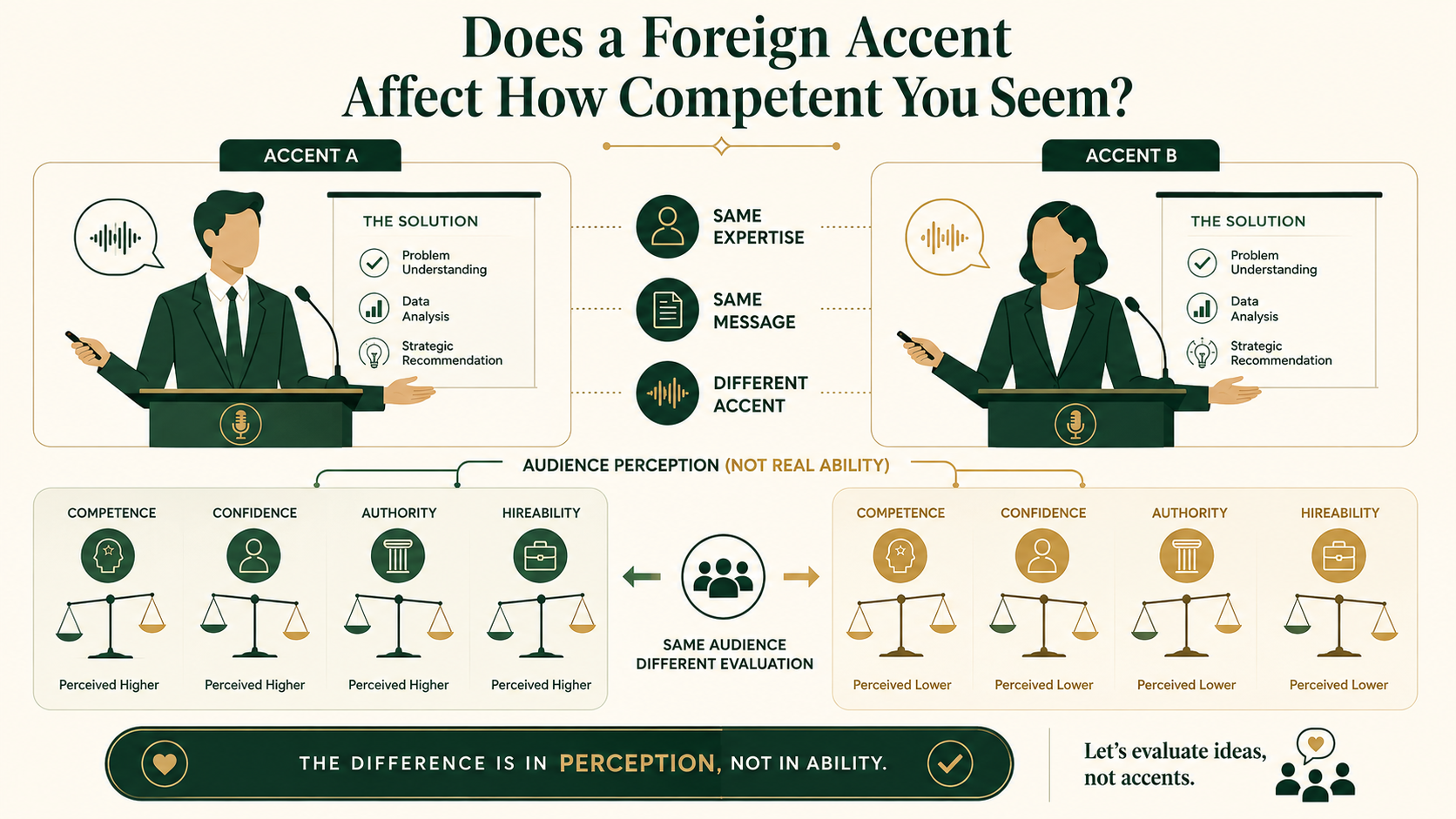
Yes, and the effect has been demonstrated experimentally, not just reported anecdotally. In a German telephone field experiment, researchers tested otherwise identical job applications that varied only the applicant's spoken accent. Applicants speaking standard German received positive responses roughly 80% of the time. The same applicant profile, this time with a Turkish name but still speaking standard German, received almost the same response rate. The name alone did not move the number much. The Turkish-accented version of the same application, however, dropped to roughly 73%, a real penalty attributable specifically to how the applicant sounded.
That detail matters more than it might first appear. It isolates accent as its own variable, separate from name, separate from nationality signaled on paper. The accent itself was doing the work.
A 2024 meta-analysis pooling 139 effects across 4,576 participants found the same pattern at scale: applicants with standard accents were consistently rated as more hireable than those with non-standard accents, with the disadvantage largest in communication-intensive roles. A separate 2025 multilevel meta-analysis covering 120 effects and over 20,000 evaluators found a comparable hiring penalty. Both studies checked whether comprehension difficulty explained the gap. It did not.
Are people with foreign accents actually judged as less competent?
Yes. A 2024 meta-analysis synthesizing 22 studies and 3,615 raters found non-standard speakers were judged meaningfully less competent, less hireable and, to a smaller degree, less warm than standard speakers, even when raters could understand them without difficulty. The competence gap in that research was substantially larger than the warmth gap, suggesting listeners weren't simply reacting to unfamiliarity or discomfort. They were making a judgment specifically about capability.
This shows up outside recruitment too. A university study involving 189 Dutch listeners, 175 international non-native listeners and 158 native-English listeners found that lecturers with a moderate accent were evaluated less positively than lecturers with a slight or native accent, even though both were rated equally easy to understand. Notably, this was not a purely native-speaker bias. Non-native listeners rated accented lecturers less favorably too. The bias was not simply "locals prefer their own sound." It ran through evaluators regardless of their own linguistic background.
Why doesn't intelligibility explain accent bias?
Because accent bias operates through a stereotype about the speaker, not purely through how much effort it takes to understand them, and multiple studies have tested and ruled out comprehension difficulty as the main explanation. If the effect were only about listening effort, removing the effort should remove the penalty. It usually doesn't.
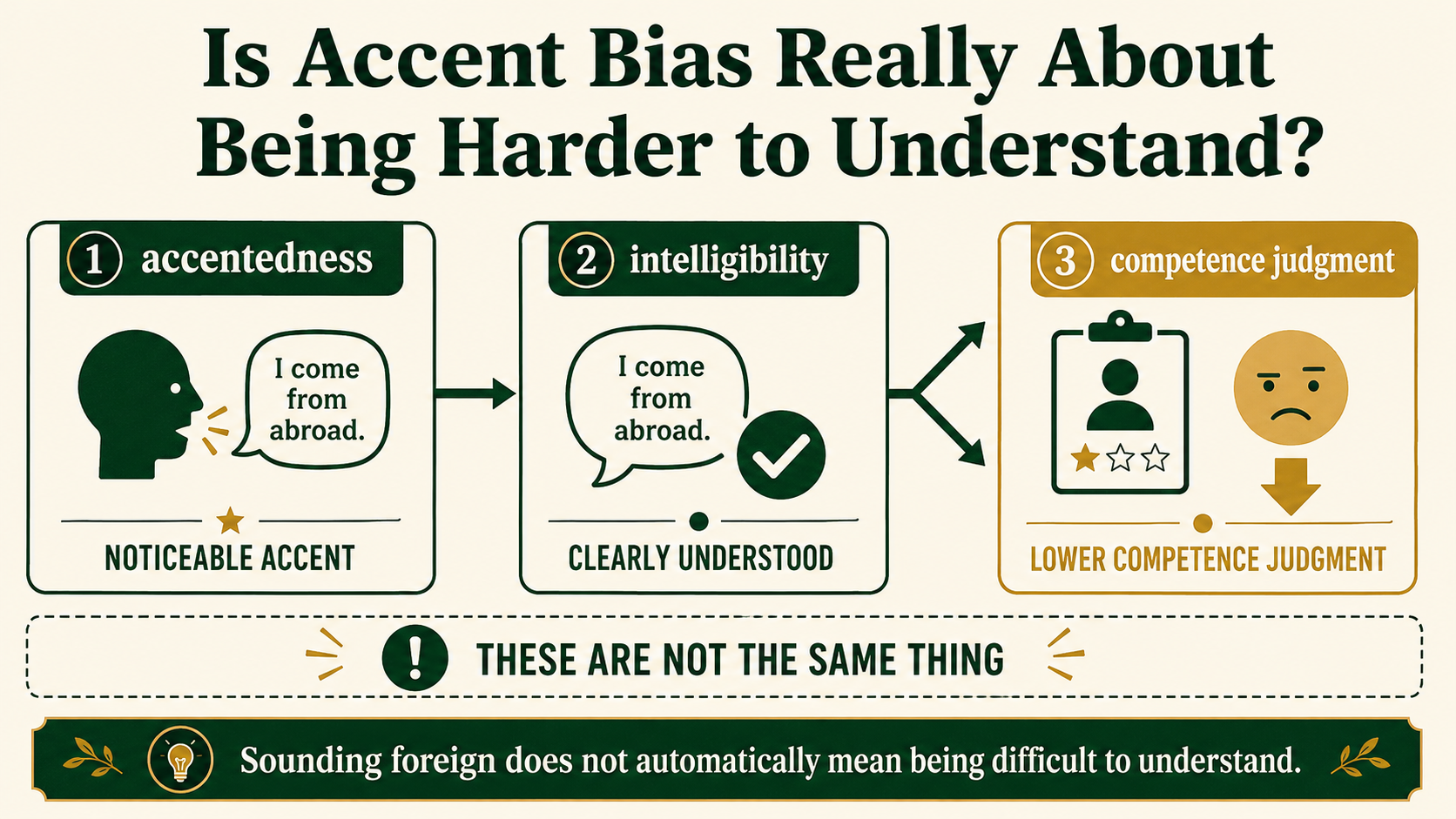
It helps to separate four things that get collapsed into one:
Accentedness is how noticeably non-standard someone's speech sounds.
Intelligibility is whether the listener actually understood the words correctly.
Comprehensibility is how much effort the listener felt they had to put in to understand.
Social evaluation is the separate judgment the listener makes about the speaker, their competence, status, credibility, authority.
These are four different variables, and research keeps finding that social evaluation moves independently of the other three. You can be fully intelligible, easy to follow, and still be marked down on competence and hireability, purely because of how you sound.
Understanding someone perfectly and judging them as less capable are not contradictory. Research shows both can happen in the same interaction.
The strongest accent-bias research suggests that being understood does not fully protect someone from being judged differently.
Is accent discrimination the same as language discrimination?
No. Language discrimination is broader and can include penalizing someone for limited proficiency, restricting opportunities based on which languages they speak, or excluding them from processes conducted only in one language. Accent discrimination is narrower: it is specifically about how someone's speech sounds, regardless of their actual proficiency or fluency.
Someone can be entirely fluent, precise and articulate, and still carry an accent that triggers a lower competence judgment. Fluency and accent are not the same axis. This is why "communication concerns" raised about a highly fluent employee are worth examining carefully rather than accepting at face value. For the broader picture of language pressure and anxiety abroad, see language anxiety abroad and language barriers for international employees.
Can an employer legitimately require a certain level of spoken communication?
Yes, absolutely, and this is not what accent discrimination research is arguing against. A role that requires clear communication with clients, patients or colleagues can reasonably require a functional standard of spoken proficiency. That is a legitimate operational need, not bias.
The distinction lies in what's actually being required. A proficiency standard asks: can this person be understood and communicate effectively? That is legitimate. A native-likeness standard asks: does this person sound like they're from here? That is a different, much harder standard to justify, and it is the one accent-bias research repeatedly finds evidence of. A fluent, fully intelligible employee being marked down because their vowels or rhythm signal a different first language has crossed from proficiency into accent bias.
Clear communication can be a legitimate job requirement. Sounding native is a different standard.
How does accent bias show up at work?
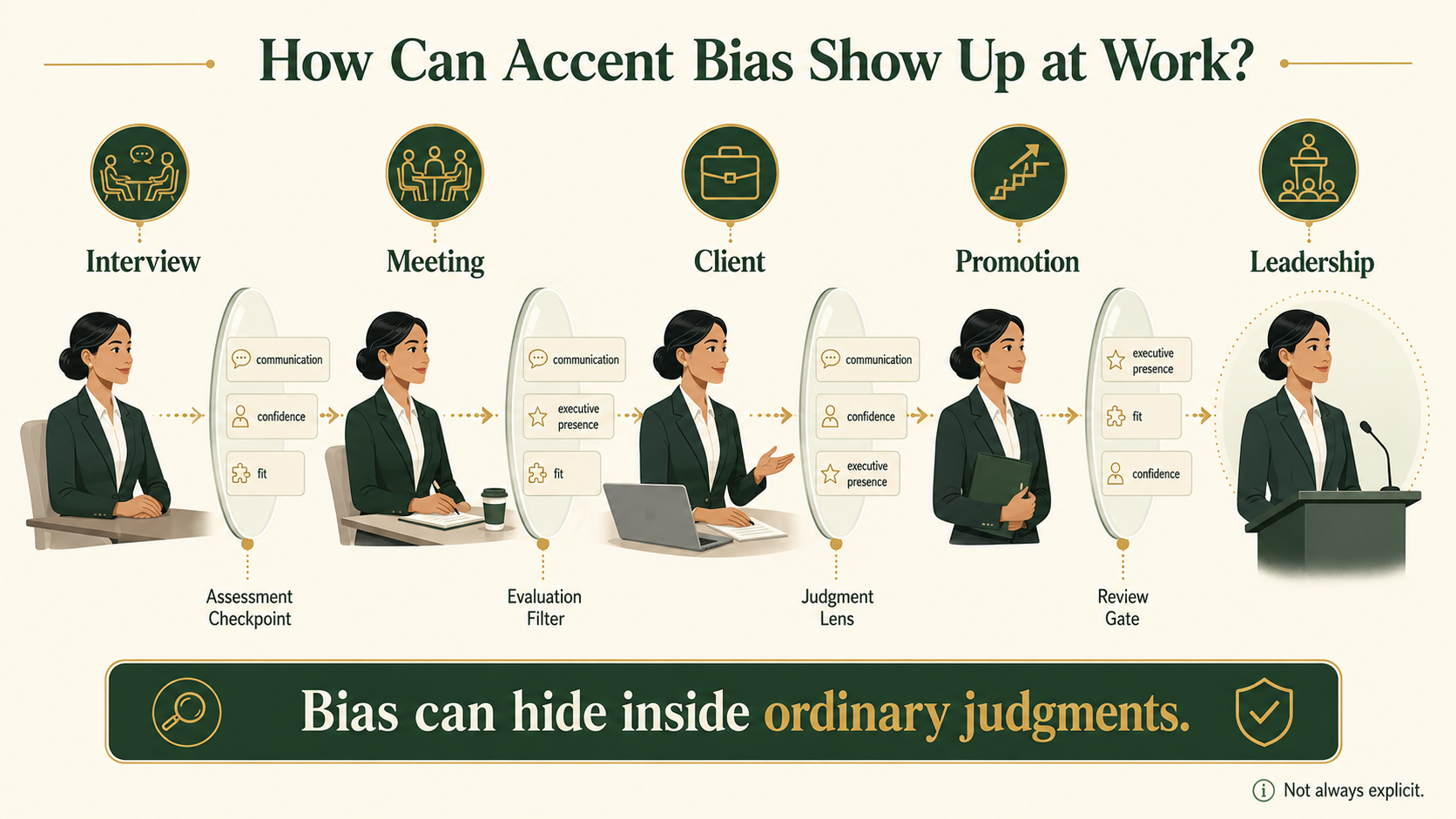
Accent bias at work typically shows up as vague "communication style" feedback despite no actual comprehension problems, ideas gaining more traction when repeated by a colleague with a local accent, and being passed over for client-facing or leadership roles despite strong fluency. None of these require anyone to say anything explicit about how you sound.
Research on multinational teams adds an important layer here: fluency has been linked not just to how understandable someone is, but to the informal status and influence they're granted by peers, separate from their actual expertise. Expertise and voice are not the same thing. A brilliant idea delivered in an accented voice can simply get less airtime than a mediocre one delivered fluently, and evaluators rarely notice this is happening in the moment.
The person who says something first and the person who gets credit for it are not always the same person. Fluency has a way of deciding which.
This connects closely to broader patterns of subtle and workplace discrimination. If what you're noticing extends beyond how you sound, into how you're evaluated, promoted or included more generally, workplace discrimination abroad and subtle discrimination abroad cover that wider terrain. Accent bias also frequently travels alongside name-based hiring discrimination, covered separately at foreign name discrimination in hiring, and alongside skepticism about foreign credentials, covered at foreign qualifications and local experience discrimination.
What does repeatedly having your competence questioned do to you?
Being repeatedly evaluated on how you sound rather than what you say can lead to self-monitoring, increased anxiety before speaking, and a tendency to contribute less in group settings, none of which reflect a real drop in ability. When someone reduces their participation in meetings, at least four different things could be happening: the real cognitive demand of processing and speaking in a second language, anxiety about being judged for mistakes or accent, a realistic assessment of status and evaluation risk, or a workplace that doesn't feel psychologically safe to speak up in. All four look identical from the outside. They are not the same problem, and they don't have the same solution.
Over time, some people respond by over-preparing every sentence, speaking less than they otherwise would, or deferring to colleagues who sound more locally fluent even when they know more about the topic. This is a rational adaptation to a biased environment, not a personal weakness, though it can be mistaken for one, including by the person experiencing it. If speaking up itself has started to feel unsafe, not just effortful, psychological safety for international employees covers that dynamic directly. If the accumulated weight of this has been affecting your mood or confidence more broadly, discrimination and mental health abroad covers what tends to help.
Should you try to lose your accent?
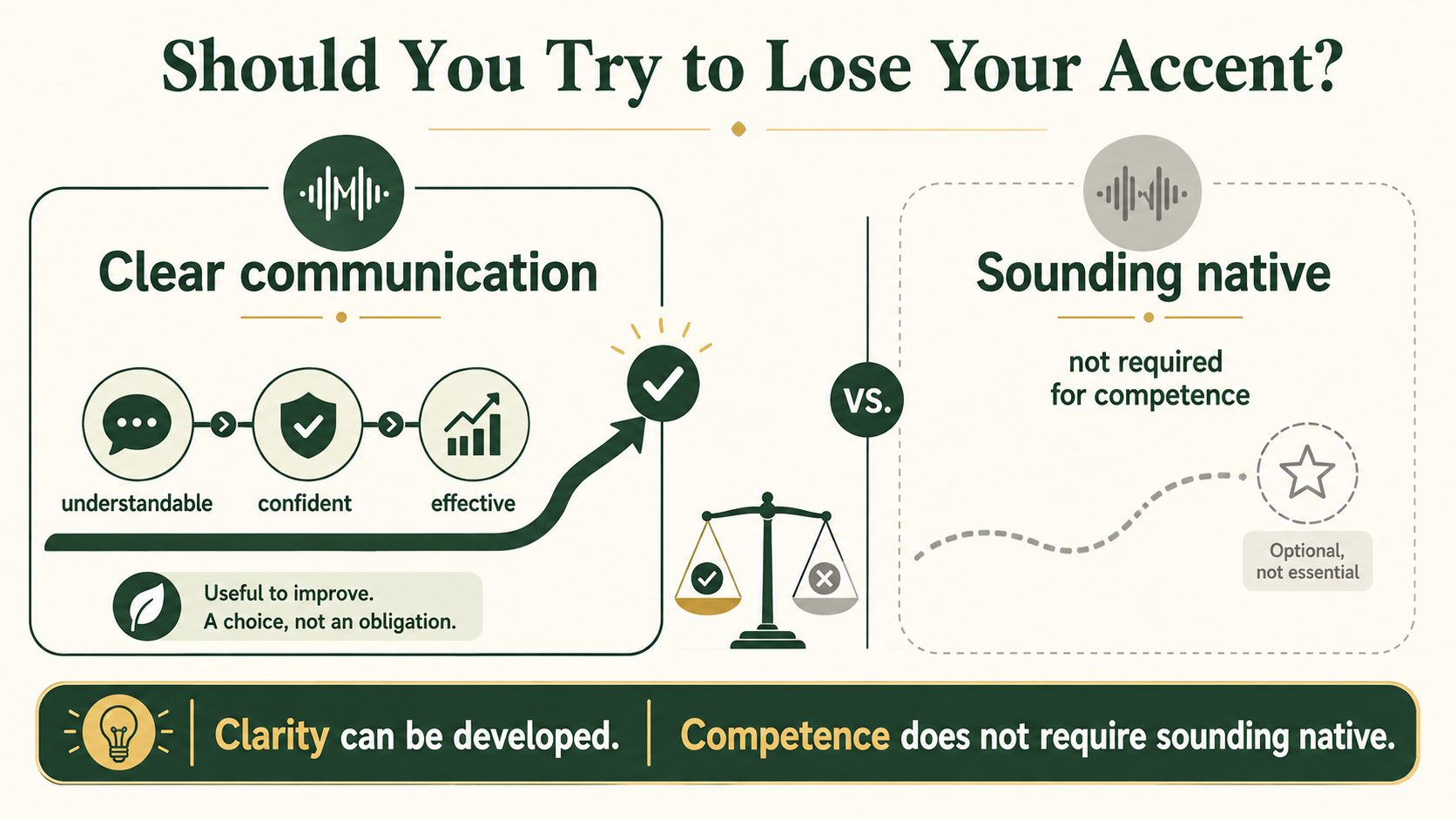
That is a personal decision, not a requirement, and research does not support the idea that accent reduction is necessary for competence or success. Some people choose accent coaching for specific professional reasons and find it genuinely useful. Others reasonably decide that changing how they sound to accommodate other people's bias is not a trade they want to make, and that is an entirely defensible position given what the evidence shows about where the actual problem sits.
The research points toward the bias being the more accurate target for change, not the accent. That said, understanding how accent bias operates can still be useful practically: knowing that your idea might land better on a second mention, or that a colleague repeating your point isn't stealing it so much as benefiting from an unfair acoustic advantage, can at least remove some of the self-doubt from the equation.
What should employers do differently?
Employers should separate genuine communication requirements from native-likeness expectations, and should pay attention to whether ideas are being credited to the person who first said them rather than the person who said them most fluently. Practical steps include checking whether "communication feedback" given to accented employees would also be given to a native speaker making the identical point in the identical way, and noticing patterns in whose contributions get built on versus repeated back to the room as if new.
None of this requires lowering genuine standards. It requires being honest about which standard is actually being applied.
Frequently asked questions
What is accent discrimination?
Accent discrimination is being judged as less competent, hireable or credible because of how you sound when speaking, separate from whether you were actually understood. It is distinguishable from a genuine communication barrier, which involves an actual failure to understand.
Can a foreign accent affect hiring?
Yes. Field experiments and meta-analyses covering thousands of hiring evaluations consistently find that accented applicants receive fewer positive responses and are rated as less hireable than otherwise identical applicants with standard accents, even when their message was fully understood.
Are people with foreign accents judged as less competent?
Research indicates yes. A meta-analysis of 22 studies and over 3,600 raters found non-standard speakers were rated meaningfully lower on competence and hireability, with the competence gap larger than any gap in perceived warmth, suggesting a specific judgment about capability rather than general discomfort.
Is accent discrimination the same as language discrimination?
No. Language discrimination is broader and can involve proficiency or which languages someone speaks. Accent discrimination is specifically about how speech sounds, and can affect someone who is fully fluent and easily understood.
Can an employer require a certain level of spoken language?
Yes, when the requirement is genuinely about being understood and communicating effectively for the role. It becomes accent bias rather than a legitimate requirement when the actual standard being applied is sounding native rather than being clearly understood.
Does having an accent mean someone is harder to understand?
Not necessarily. Research distinguishes accentedness, how noticeable an accent is, from intelligibility, whether the listener actually understood correctly. Studies repeatedly find people can be fully intelligible while still being judged more harshly because of how they sound.
Can accent bias affect confidence at work?
Yes. Repeatedly having competence questioned based on accent rather than content can lead to increased self-monitoring, anxiety before speaking, and reduced participation in meetings, a response to a biased environment rather than a reflection of actual ability.
Should you try to lose your accent?
That is a personal choice, not a requirement. Research does not support the idea that accent reduction is necessary for competence, and the evidence more strongly points toward addressing the bias itself rather than the accent as the more accurate response to the problem.
Need support? We're here.
Book a free 15-min consultation with our expat-specialized therapists.