
Key takeaway
An international employee sits through a meeting, understands everything, has something genuinely useful to add, and says nothing. A colleague repeats a version of the same point twenty minutes later and the room treats it as insight. Nobody in that room discriminated against anyone. The team may still not be psychologically safe. This article explains what psychological safety actually means for international employees specifically, why they often speak less even when fully capable, how quietness gets mistaken for lower competence, and which organizational practices have real evidence behind them versus which ones mostly just feel like progress.
The idea is good. It stays unsaid. Three people later, someone with a more familiar accent says something adjacent to it, and that's the version that makes it into the meeting notes.
A team is not psychologically safe simply because nobody openly discriminates.
What is psychological safety at work?
Psychological safety is a team member's belief that they can ask questions, admit mistakes, disagree or raise concerns without disproportionate interpersonal or status cost. It is not the same as a friendly atmosphere, and it is not the same as an absence of open conflict. A team can be polite and welcoming on the surface while still being a place where certain people have learned, correctly, that speaking up carries a real cost.
For international employees specifically, that cost can be layered: language processing, accent judgment, unfamiliar hierarchy norms and cultural expectations about when it's appropriate to disagree all sit on top of whatever baseline psychological safety exists for everyone else on the team.
Why do international employees often speak less in meetings?
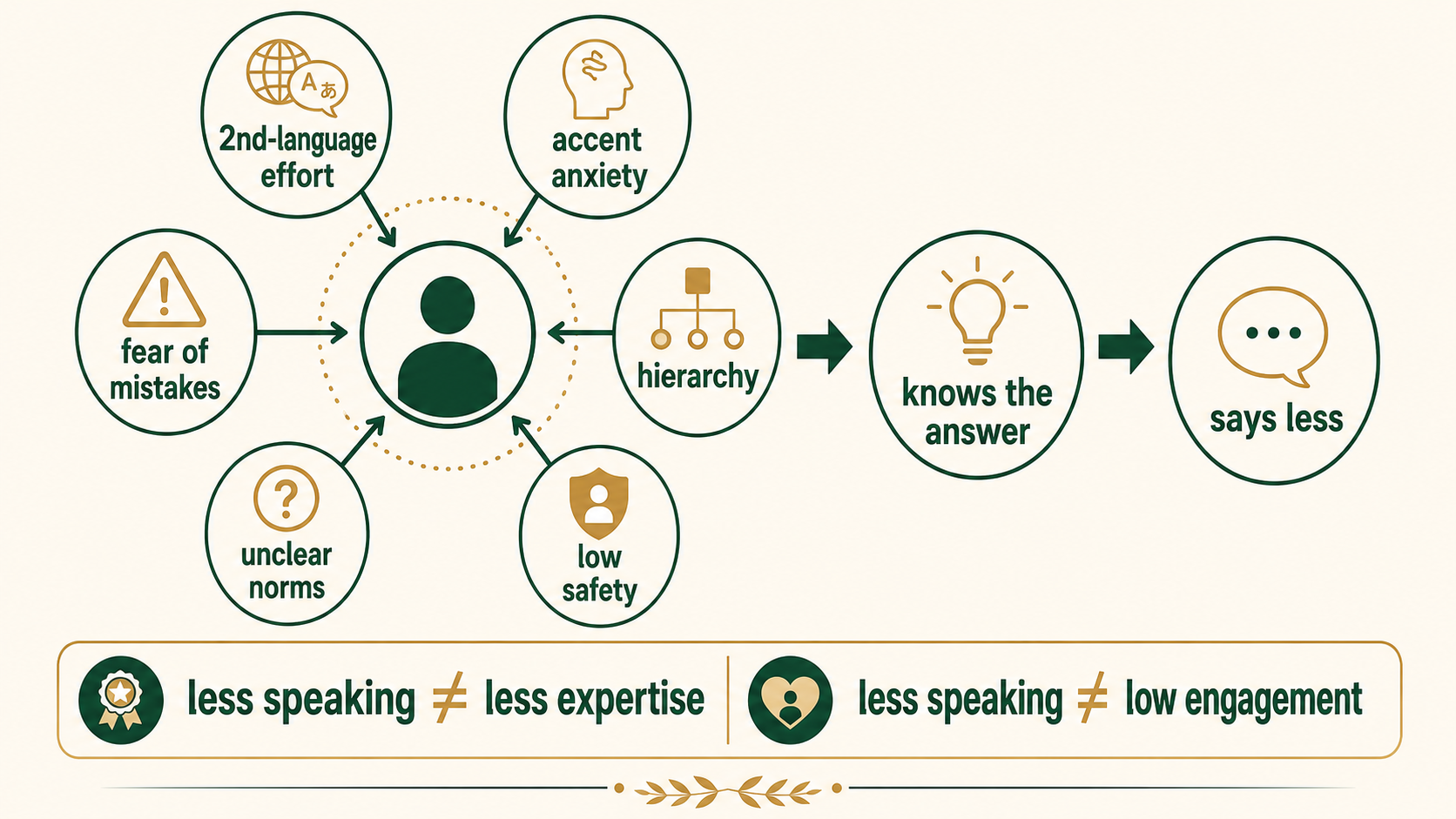
International employees may speak less because of a combination of factors, real cognitive load from processing and producing a second language, anxiety about being judged for accent or mistakes, a realistic assessment of status and evaluation risk, and lower psychological safety, and these four mechanisms are genuinely different from each other despite looking identical from the outside. Treating reduced participation as a single, simple thing, whether that's assumed shyness, lower confidence or lower expertise, misses what's actually happening.
This distinction matters practically. A manager who assumes quietness reflects modesty will respond differently than one who recognizes it might reflect a real, justified fear of being judged more harshly for an accented mistake than a colleague would be. The intervention that helps depends entirely on which mechanism is actually driving the silence, and most workplaces never stop to ask.
Four different problems can produce the exact same silence in a meeting. Only one of them is about confidence.
Direct evidence on this comes from a study of 519 members across 101 newly formed multinational teams in the UK. International team members showed lower initial psychological safety and slower development of it over time compared with host-country nationals. The study connected these dynamics directly to verbal participation and, in turn, to how competent members were subsequently perceived to be by their peers.
When international employees speak less, organizations can mistake reduced participation for reduced expertise.
Does speaking less mean an employee is less competent?
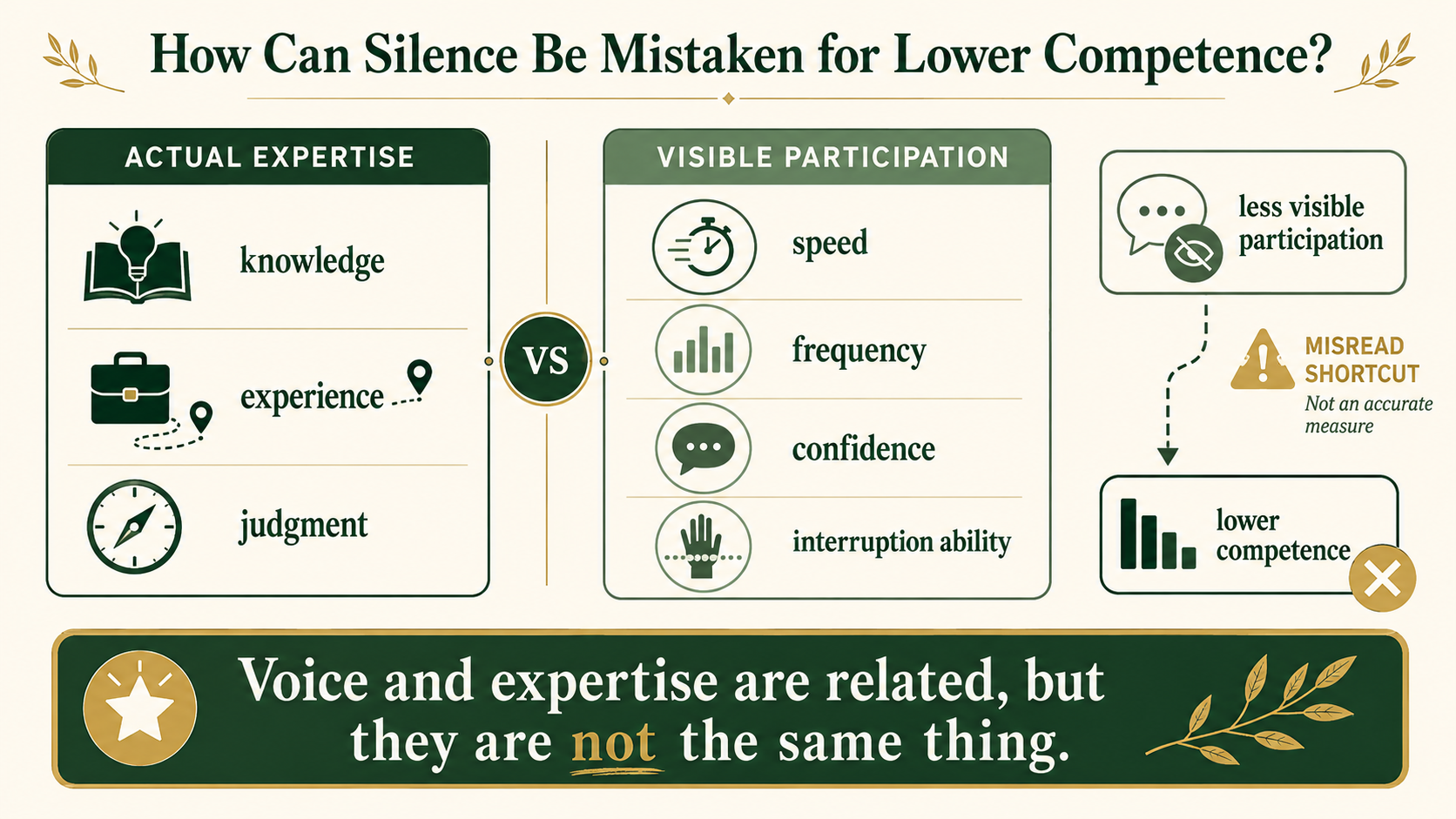
No, and this is precisely the trap the multinational-team research identifies: reduced verbal participation can itself shape how competent someone is perceived to be, creating a loop where the original cause of the silence becomes invisible and only the silence itself gets judged. Lower psychological safety leads to less speaking, less speaking leads to weaker competence perceptions, and those competence perceptions then become the "evidence" used to justify treating that person as less capable, when the loop started somewhere else entirely.
This should not be read the other direction either. Not every quiet international employee is anxious or unsafe. Some people are naturally less verbal, some prefer to contribute in writing, some are processing carefully before speaking. The point is not that silence always signals a problem. It's that silence should never be treated as reliable evidence of low competence, because too many things other than competence can produce it.
How does accent factor into psychological safety?
Accent adds a specific, well-documented layer of risk on top of general participation anxiety, because research shows accented speech can be judged as less competent and less hireable even when it is perfectly understood, which gives international employees a realistic, not paranoid, reason to calculate the cost of speaking up. This isn't a hypothetical fear. It's backed by controlled research on how accented speech gets evaluated, covered in full at accent discrimination abroad.
A separate line of research adds an important nuance here: fluency has been linked not just to comprehension, but to informal status and influence granted by peers, independent of actual expertise. Expertise and voice are not the same thing. An employee can know exactly what they're talking about and still receive less credit for it than a more fluent colleague saying something less substantial. For the wider language picture beyond accent specifically, language barriers for international employees and cross-cultural communication in international teams cover related ground.
How can managers unintentionally reduce psychological safety?
Managers can unintentionally reduce psychological safety by responding to raised concerns with defensiveness or dismissal, by consistently building on fluent colleagues' contributions while letting accented or hesitant ones pass without acknowledgment, and by treating confident, fast delivery as a proxy for good ideas. None of this requires any conscious bias. It's often simply the path of least resistance in a fast-moving meeting.
Research on supervisor response offers a useful, transferable finding here: in a Dutch study of 3,159 workers, how supervisors responded when an employee raised their own interests or concerns was linked to that employee's later willingness to speak up constructively about broader organizational matters. How a manager handles the first, smaller instance of someone speaking up shapes whether that person tries again later. A dismissive or impatient response to an accented, hesitant question doesn't just cost that one moment. It teaches the employee something about the cost of trying next time.
The second time someone speaks up depends heavily on what happened the first time. That first response is doing more work than most managers realize.
A larger 2026 meta-analysis, covering 49 independent studies and 50,856 participants, reinforced the same pattern at scale: employees spoke up more often in environments where leaders, peers and the broader workplace were genuinely supportive of that kind of voice. Psychological safety isn't a personality trait employees either have or lack. It's substantially shaped by what happens the first few times someone tries.
Do anonymous reporting channels solve the problem?
No, not on their own. Research shows anonymous communication channels can genuinely increase willingness to speak up, but an anonymous channel that leads nowhere, where concerns are unaddressed, retaliation still happens through other means, or patterns are never actually investigated, does not create lasting psychological safety. Anonymity lowers the immediate cost of speaking. It doesn't guarantee that speaking up actually changes anything, and employees tend to figure that out fairly quickly.
Anonymous channels work as one part of a system, not as a substitute for the rest of it. If concerns raised anonymously are visibly acted on, that builds trust in the system generally, including for concerns people are willing to raise openly. If they disappear into silence, the anonymous channel itself becomes evidence that speaking up doesn't matter.
Does unconscious bias training actually work?
The strongest available evidence, a meta-review of 37 reviews on organizational diversity interventions, found that training reliably improves awareness and knowledge but has considerably weaker and more mixed evidence for changing actual behavior or organizational outcomes. This doesn't mean training is worthless. It means a single workshop, treated as a complete solution, is not well supported by the evidence.
What the same body of research points toward instead is structural change that reduces discretion: consistent, criteria-based decision processes, clearer paths for how concerns get handled, and systems that don't rely entirely on individual managers remembering to be inclusive in the moment. Training can build awareness. Structure is what tends to change what actually happens.
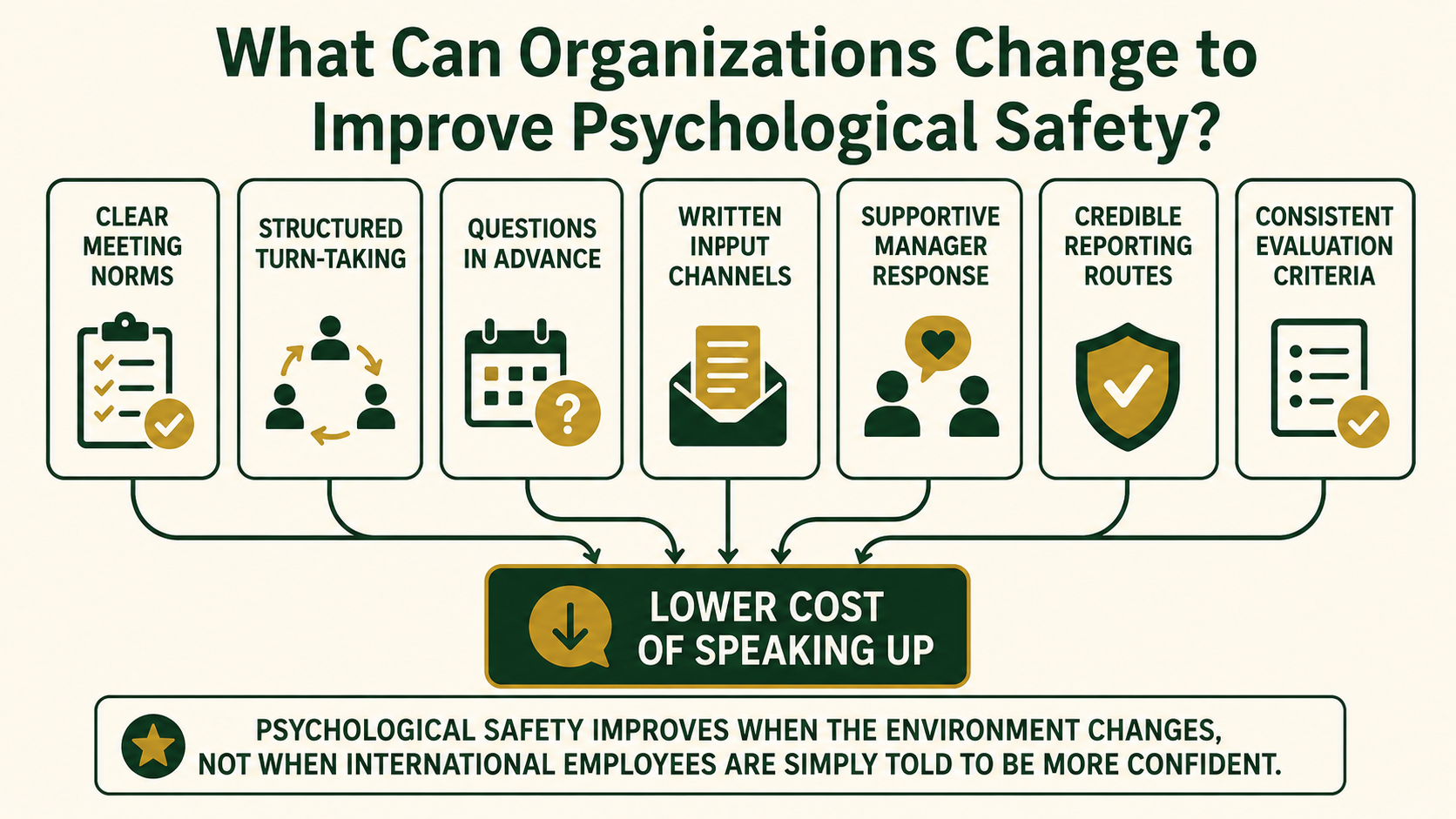
Psychological safety improves when systems reduce the cost of speaking, not when employees are simply told to be more confident.
What can HR and leaders actually do?
HR and leaders can build psychological safety for international employees by responding constructively to early, small instances of speaking up, actively crediting ideas to the person who first raised them regardless of how fluently they said it, building structured rather than purely discretionary decision processes, and treating an anonymous channel as the start of accountability rather than the end of it. None of this requires lowering standards. It requires being honest about which standard is actually being applied and to whom.
A few concrete, evidence-aligned starting points:
Notice who gets credited. In meeting notes and follow-ups, check whether ideas are attributed to whoever said them first, not whoever repeated them most fluently.
Watch the first response, not just the policy. The way a manager reacts to someone's first hesitant question sets the tone for whether that person tries again. This is worth actively coaching, not just assuming will happen naturally.
Build structure into evaluation and decision processes, since research consistently finds this does more than training alone to change actual outcomes.
Treat anonymous channels as infrastructure, not a finish line. Track what happens after a concern is raised anonymously, and make sure that track record is visible enough to build trust over time.
If discrimination itself, rather than psychological safety more broadly, is the concern being raised, workplace discrimination abroad and how to report discrimination abroad cover that territory directly. For the wider landscape of discrimination and exclusion abroad, discrimination abroad is the place to start.
Expathy works with organizations to build psychologically safer international teams through both workshops and webinars grounded in this kind of evidence rather than generic inclusion content.
Frequently asked questions
What is psychological safety at work?
Psychological safety is the belief that team members can ask questions, admit mistakes, disagree or raise concerns without disproportionate interpersonal or status cost. It's distinct from general friendliness and can be absent even in teams with no visible conflict.
Why do international employees speak less in meetings?
Several distinct mechanisms can contribute: the real cognitive demand of working in a second language, anxiety about being judged for accent or mistakes, a realistic assessment of status risk, and lower psychological safety. Research on multinational teams found international members had lower initial safety and it developed more slowly than for host-country colleagues.
Does speaking less mean lower competence?
No. Research shows reduced participation can itself shape competence perceptions, creating a loop where lower psychological safety leads to less speaking, which then gets misread as evidence of lower ability. Silence has many possible causes and should not be treated as a reliable signal of competence either way.
How does accent affect psychological safety?
Accent adds a documented layer of risk, since research shows accented speech can be judged as less competent and hireable even when fully understood. This gives international employees a realistic basis for calculating the cost of speaking up, separate from general language-processing demands.
How can managers create psychological safety in international teams?
By responding constructively to early instances of employees raising concerns or questions, since research links how supervisors handle that first response to whether employees speak up again later. Actively crediting ideas to whoever raised them first, regardless of fluency, also helps prevent voice from being conflated with expertise.
Do anonymous reporting channels help?
They can increase willingness to speak up, but research indicates they are not sufficient on their own. An anonymous channel only builds lasting psychological safety if concerns raised through it are visibly investigated and addressed, rather than disappearing without any follow-through.
Does unconscious-bias training work?
Evidence suggests training reliably improves awareness and knowledge but has weaker, more mixed evidence for changing actual behavior or organizational outcomes. Structural changes that reduce individual discretion in decision-making appear to have stronger evidence behind them than training alone.
What should HR do when international employees are afraid to speak up?
Focus on the underlying mechanism rather than assuming a single cause, and build structural changes, consistent decision processes, visible follow-through on concerns raised, and manager coaching on early responses, rather than relying solely on one-off training or anonymous channels as a complete solution.
Need support? We're here.
Book a free 15-min consultation with our expat-specialized therapists.