
Key takeaway
A senior engineer on your team has said almost nothing in the last four sprint reviews. Her written work is among the strongest in the department. Her manager has written "needs more confidence in meetings" on two consecutive reviews. Nothing about that assessment is deliberately unfair, and almost none of it is accurate. This article looks at what language barriers actually do inside international teams, why fluent employees still lose access to voice and influence, and which parts of the problem sit in your organisation's design rather than in your employees.
Most companies treat language as a hiring filter. It clears at interview, and after that it is assumed to be solved.
It is not solved. It changes shape.
The employee who passed the language bar can do the technical work, write clear documentation, and hold a productive one-to-one. What may still be out of reach is interrupting a senior colleague, disagreeing in real time, landing a joke, negotiating under pressure, or getting a half-formed idea into a fast-moving discussion before someone else takes the floor.
That gap is where organisations quietly lose access to expertise they already employ.
What Counts as a Language Barrier When the Employee Already Speaks the Language
A language barrier at work is rarely about comprehension. It is about unequal access to voice, speed and informal participation. An employee can perform complex work in the company language while still being disadvantaged in fast discussion, spontaneous debate, humour, networking and any situation where the fluent response wins the moment.
It helps to separate two things HR often treats as one.
Job proficiency is whether someone can do the work in the language. Most international hires clear this comfortably.
Participation parity is whether they can compete for airtime, be read as confident, build informal relationships and get credit for their thinking at the same rate as colleagues. This is frequently not equal, and it is not measured anywhere.
A useful distinction comes from a 2025 meta-analysis by Ng and colleagues covering 355 field samples and 128,358 participants, which found that language proficiency and cultural intelligence were separate resources, each independently linked to job performance and adaptation.
The practical implication for People teams is direct. Fixing language does not automatically fix communication, and strong cultural understanding does not remove the processing demand of working in a second language. They are two different problems and they need two different responses.
The question is not whether your international employees speak the company language. It is whether your communication systems let their expertise arrive at all.
Understanding a Meeting Is Not the Same as Finding It Effortless
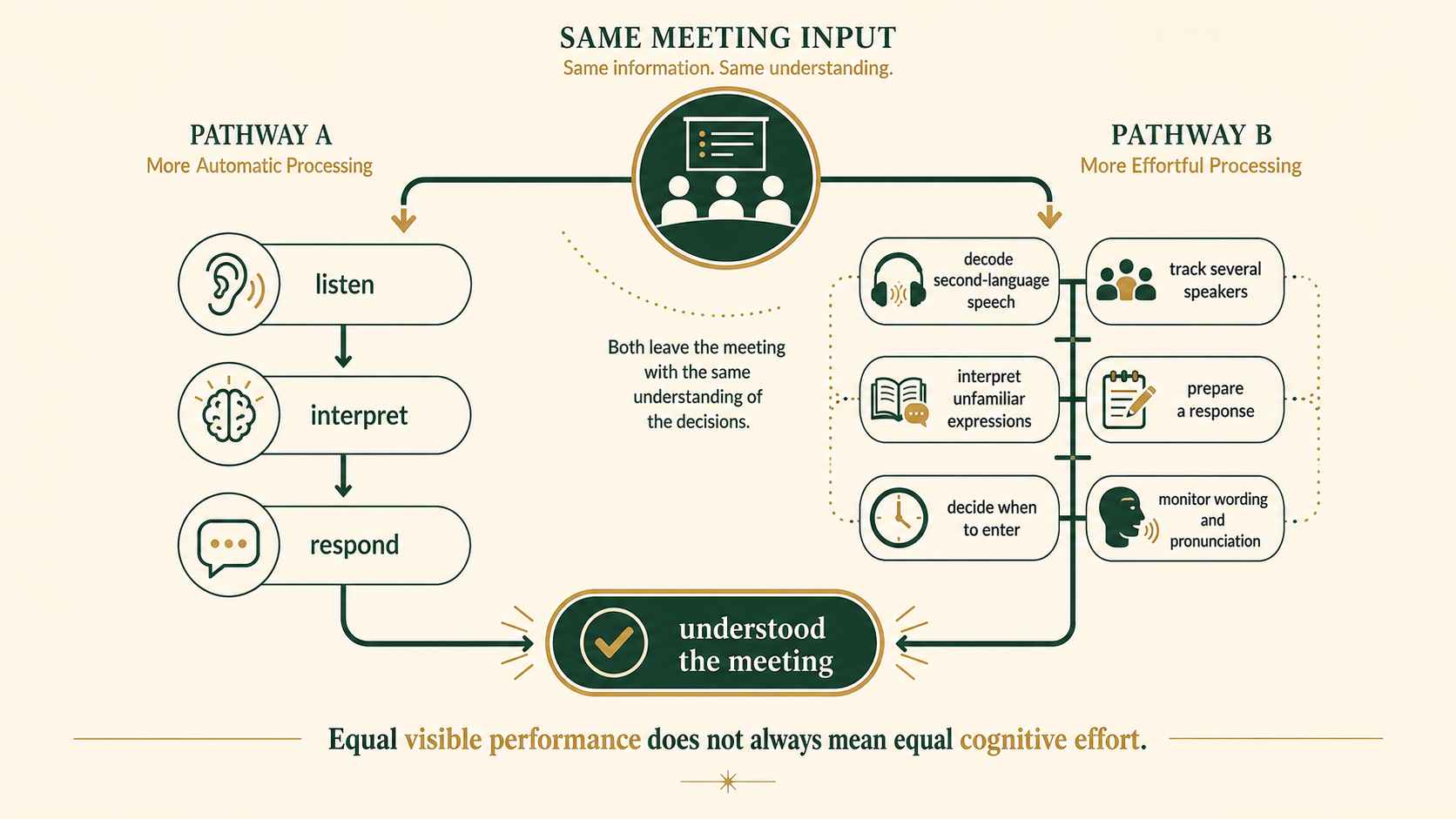
Two employees leave the same hour-long meeting having understood the same decisions. For one, following it was largely automatic. For the other, the same hour involved decoding speech, tracking multiple speakers, interpreting unfamiliar expressions and preparing their own contribution simultaneously. Equal output, unequal cost.
The research synthesis by Bsharat-Maalouf, Degani and Karawani is clear on this point: second language listeners can require substantially more mental effort even when their comprehension is completely accurate.
Nothing about that shows up in a performance system. From the outside, both employees participated in a meeting.
Environment makes the gap wider or narrower. A review of 29 studies by Mealings found that non native listeners are disproportionately affected by poor acoustics. That describes a large share of where modern work happens: open plan offices, glass meeting rooms, all hands sessions, team lunches, networking events and video calls where two people talk over each other and the audio compresses.
A person who communicates well one to one may become noticeably quieter in a fast, noisy group of eight. That change is environmental. Managers routinely read it as disengagement.
Why Capable People Speak Less in Meetings
Because meetings reward speed, and speed is the single thing a second language reliably costs. The employee is not deciding whether to contribute. They are formulating, checking and waiting for an entry point that never opens. By the time the sentence is ready, two faster colleagues have spoken and the topic has moved.
Watch the sequence in a real brainstorm.
Five people speak rapidly, interrupt each other, complete each other's sentences and use three idioms nobody would find in a dictionary. The international employee contributes twice. The next morning they send a written follow up containing three of the strongest ideas in the project.
That is not an engagement problem. That is a format problem, and the format is entirely within your control.
The same pattern appears socially. Everyone laughs at lunch. The employee understood every word but not the reference, which was a television programme from a country they did not grow up in. Nobody excluded anyone. Repeat that a few hundred times across two years and informal belonging develops unevenly, which matters because informal networks are how much of an organisation's real information moves.
When Accent Changes How Competence Is Judged
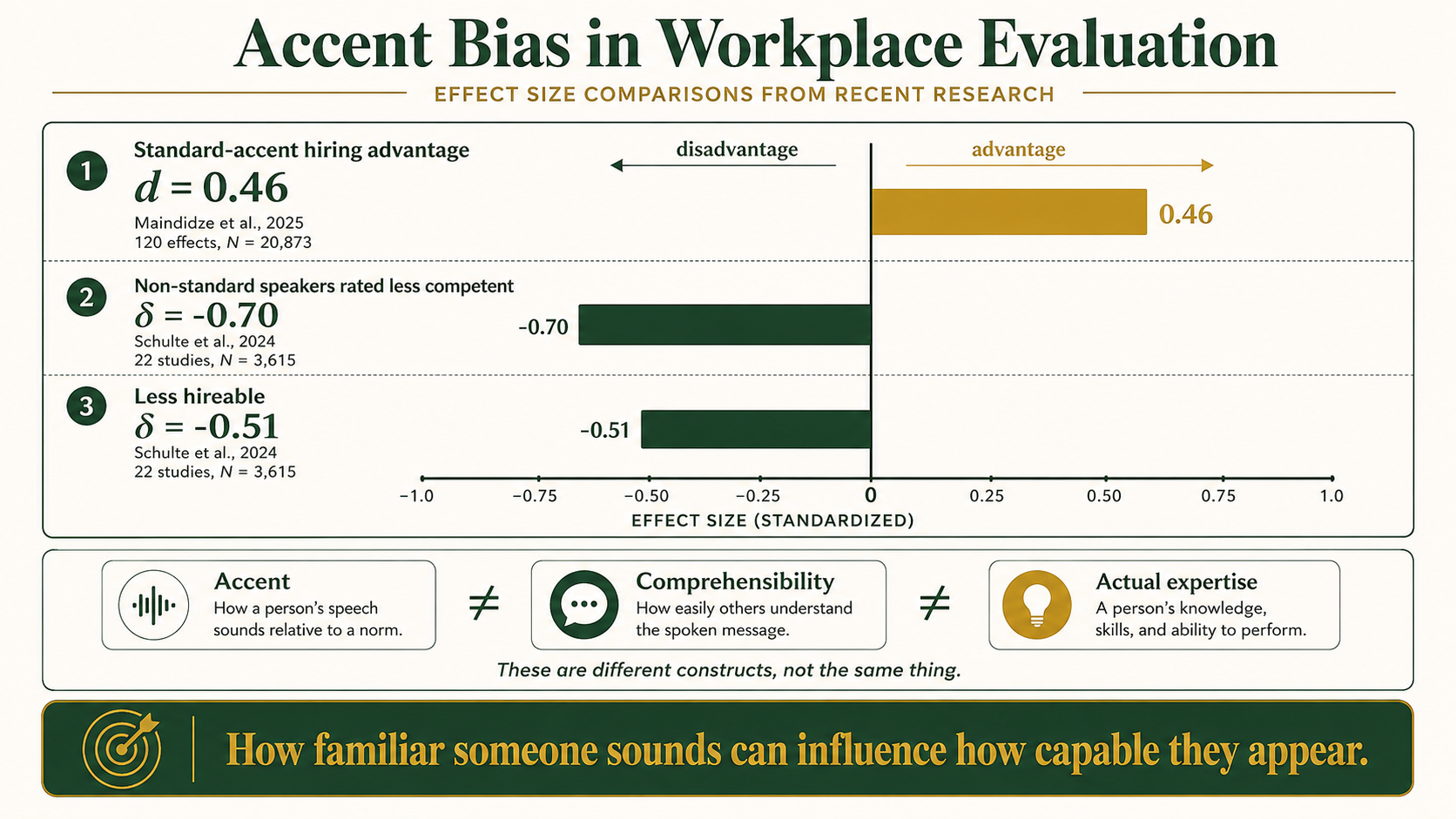
This is the finding most HR leaders should sit with. In a 2025 meta-analysis of hiring evaluations by Maindidze and colleagues, candidates with standard accents were consistently rated more favourably than comparable candidates with non standard ones. The critical detail: how easily the candidate was understood did not explain the effect.
So it is not a clarity problem. It is a perception problem.
A separate 2024 meta-analysis by Schulte and colleagues, covering 22 studies and 3,615 participants, found non standard speakers were rated meaningfully less competent and less hireable.
Here is why that matters more in performance reviews than in recruitment. A manager assessing "executive presence," "communication skills," "gravitas" or "leadership potential" believes they are evaluating capability. Part of that impression may be responding to how familiar the speech sounds. The manager is not lying. They cannot see the input.
This does not mean every accented employee experiences discrimination, and accent is not the same as intelligibility. It does mean that any evaluation criterion phrased as vaguely as "communication skills" is a place where this can enter your talent decisions unnoticed.
If your promotion process depends heavily on how someone sounds in unscripted conversation, you have built accent into your succession planning without deciding to.
How Fluency Quietly Becomes Status
In multinational teams, corporate language fluency does not stay a technical skill. It converts into influence. Employees who speak the company language quickly take more turns, contribute more visible ideas, enter discussions earlier and are more likely to emerge as informal leaders, independent of what they actually know.
Research on multinational teams by Guzman and Reiche traces exactly this route: fluency to peer granted status to influence.
That produces the most expensive shortcut in international workplaces.
Who speaks fastest becomes confused with who knows most.
Every organisation says it values expertise. Most measure the proxy: verbal fluency under time pressure, in one specific language, in real time, in front of an audience. Those are not the same thing, and one of them is far easier to observe.
The cost is not fairness alone. It is that your organisation stops hearing from the people whose knowledge does not travel at conversational speed.
Before You Call It a Performance Problem, Identify the Barrier
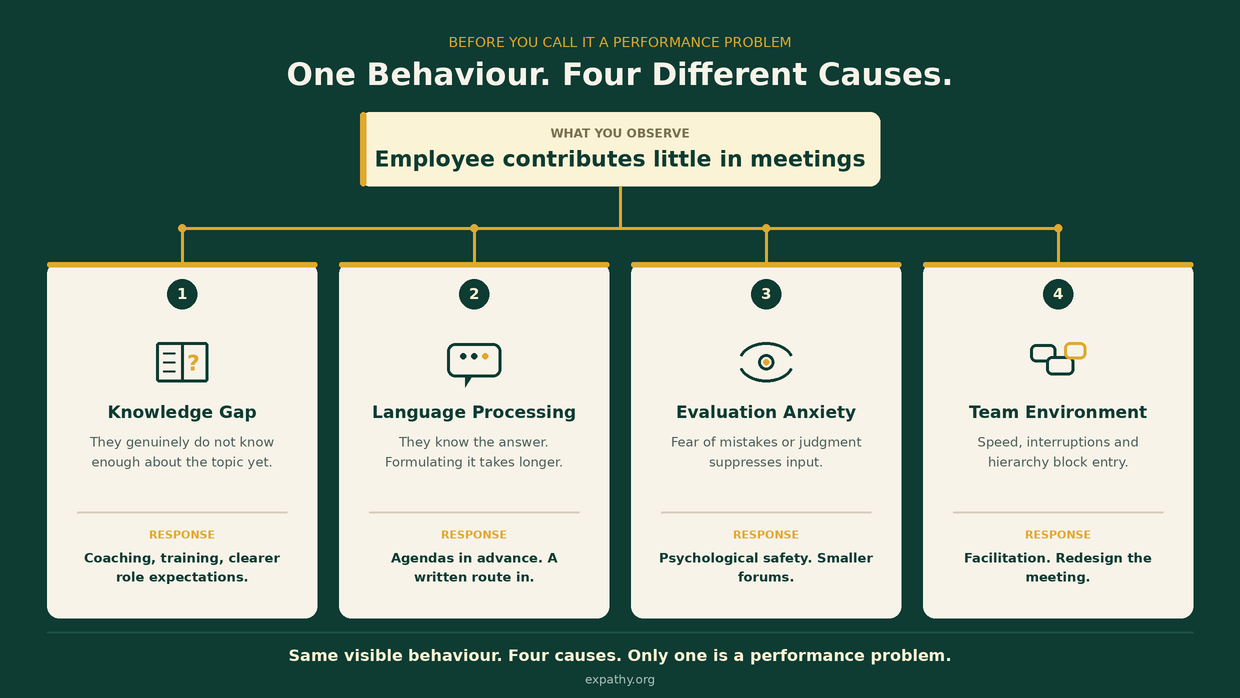
When an international employee seems quiet, under-contributing or less confident than their record suggests, at least four different causes produce identical behaviour. They require completely different responses, and only one of them is a genuine performance issue. Diagnosing wrongly is how organisations lose good people.
| What you observe | Possible cause | What it actually looks like | The right response |
|---|---|---|---|
| Says little in discussion | Knowledge gap | Contributions are also thin in writing and in one to ones | Coaching, training, clearer role expectations |
| Says little in discussion | Language processing demand | Strong in writing and one to one, quiet in fast group settings | Agendas in advance, written channels, managed pacing |
| Says little in discussion | Evaluation anxiety | Hesitates before speaking, self corrects, avoids senior audiences | Psychological safety, smaller forums, manager signalling |
| Says little in discussion | Team environment | Multiple people are quiet, interruptions dominate, hierarchy is steep | Facilitation, meeting redesign, leadership behaviour |
The value of this table is that it stops the default assumption. Silence is the least informative signal in a multilingual team, because it is produced by four unrelated mechanisms, three of which are the organisation's responsibility.
Managers can test this cheaply. Ask the same employee for input in writing after the meeting. If the written contribution is strong, you have ruled out the knowledge gap in one step.
Why This Shows Up in Belonging, Adjustment and Retention
Language barriers rarely appear in exit interviews. They appear earlier, as thinner local networks, weaker informal information access and slower adjustment. A study of 281 expatriates by Bayraktar and colleagues found that local language proficiency was linked to work and interaction adjustment largely through social support from local colleagues.
The same study found something more useful for employers: strong local networks partly buffered lower language proficiency.
Read that as an operational instruction. Language ability and workplace relationships reinforce each other, which means the standard advice, learn the language first and integrate later, has the sequence backwards.
Practically, this means language support that sits in a separate box from onboarding, buddy systems, mentoring and everyday contact with local colleagues is working at half strength. Pairing an international hire with a local peer does more for their language than a course they attend alone on Thursday evenings, and it does considerably more for their adjustment.
For organisations already investing in relocation support, this is the piece that most often gets funded last and matters most, a pattern we cover in more depth in our guidance on manager training for international employees.
What Managers Can Change This Month
Most of the fix is meeting design, not language training, and almost none of it requires budget. The aim is to stop making real time verbal speed the only route into decisions. These changes help everyone in the room, which is why they rarely meet resistance.
Send agendas and the actual questions in advance. Prediction is most of what makes listening cheap. An employee who knows the topic can prepare a precise contribution instead of assembling it live.
Open a written channel during and after meetings. Chat, a shared document, a follow up thread. Ideas that arrive twenty minutes late are not worth less.
Manage interruptions deliberately. If only the fastest speakers can enter, the meeting is not equally accessible. Naming it once, "let's let people finish," changes the pattern more than any policy.
Cut idioms and internal jargon. Not simplified language. Just removing phrases that add cultural decoding without adding meaning.
Confirm complex decisions in writing. This removes the pressure to catch everything in real time and improves accuracy for the whole team.
Separate accent from competence, consciously. The question to ask yourself is specific: did I fail to understand this person's idea, or did their speech simply sound less familiar?
Make clarification normal. If asking someone to repeat themselves carries a status cost, people will nod instead. Senior people asking for repetition is the fastest way to fix this.
Do not treat silence as a verdict. Ask for the contribution in another format before drawing a conclusion about capability.
What HR Should Examine Structurally
Manager behaviour matters, but the durable problems sit in systems: how performance is defined, how promotions are decided, and where information actually travels. These are design choices that were never consciously made, which is exactly why they persist. Reviewing them is cheaper than replacing the people they push out.
Worth auditing:
- Whether "communication skills" in your review framework has a written definition, or functions as an impression
- Whether promotion depends disproportionately on spontaneous performance in live meetings
- Whether business critical information moves through informal conversations in the local language
- Whether language support exists after month three, or ends with onboarding
- Whether corporate language expectations are explicit or assumed
- Whether managers of multilingual teams have had any guidance on multilingual communication
- Whether quieter employees are being read as lacking leadership potential
A quick diagnostic for your own teams
Run this on one team, honestly, in a single meeting:
- Who speaks most, and who has not spoken in twenty minutes?
- Who gets interrupted, and by whom?
- Who contributes far more in writing than aloud?
- Do colleagues regularly switch out of the official working language mid discussion?
- Was an agenda circulated in advance?
- Can anyone in the room ask for repetition without visible cost?
- Is there any route into the decision other than speaking quickly?
- Are international employees socially connected to local colleagues, or only to each other?
- Does anyone on this team confuse silence with absence of expertise?
If several answers are uncomfortable, the finding is not that your managers are biased. It is that your communication design has been rewarding one specific skill and calling it performance.
When Language Barriers Become a Wellbeing Issue
For some international employees this stops being a communication problem and becomes a psychological one. Sustained monitoring of a second language, combined with feeling less capable than you know you are, can produce real anxiety, withdrawal, loss of confidence and eventually burnout. By that stage, meeting design alone will not resolve it.
The pattern is recognisable to People teams who have seen it: a strong performer who becomes progressively quieter, declines visible opportunities, socialises only within their own language group, and eventually resigns for reasons that sound like career development.
This is where employer provided support matters, and where generic provision usually underdelivers. An employee who spends eight hours a day translating, adapting and self monitoring does not want to spend a support session explaining what it is like to be an international hire in a country they moved to eighteen months ago.
Expathy provides mental health support built for internationally mobile employees, with psychologists matched by native language and cultural background who have lived abroad themselves. The context does not need explaining, so the session is spent on the problem.
That is not a claim that support in someone's first language is universally more effective. It is a claim about efficiency and trust: fewer barriers between the employee and the help, and a provider who understands why a fluent, capable person can still be struggling.
If you are assessing what this looks like for your workforce, therapy packages for international employees covers headcount based access with native language matching and aggregate only reporting. For teams where the need is broader awareness rather than individual support, our workshops for international teams and wellbeing webinars address multilingual communication and belonging directly with managers and employees.
Final Thought
The question most organisations ask about international employees is why they do not speak up more.
It is the wrong question, and it puts the entire burden on the person with the least control over the conditions.
A better one: have we built a workplace where expertise gets heard even when it does not arrive fast, fluent and native sounding?
Most companies have not, and they have no idea, because the cost is invisible. Nobody files a complaint about an idea they never managed to say out loud. It simply does not enter the meeting, does not appear in the review, and eventually leaves with the person who had it.
You already hired the expertise. The remaining work is making sure your systems can hear it.
Sources and Further Reading
- Ng and colleagues (2025), meta-analysis of 355 field samples and 128,358 participants on language proficiency, cultural intelligence and job performance: https://doi.org/10.1111/apps.12603
- Bsharat-Maalouf, Degani and Karawani (2023), research synthesis on listening effort in a second language: https://doi.org/10.1177/23312165231205107
- Mealings (2023), review of 29 studies on acoustics and non native listeners: https://doi.org/10.1044/2023_JSLHR-23-00154
- Maindidze and colleagues (2025), multilevel meta-analysis on accent and hiring evaluations: https://doi.org/10.1111/ijsa.12519
- Schulte and colleagues (2024), meta-analysis of 22 studies on non standard speech, perceived competence and hirability: https://doi.org/10.1111/apps.12528
- Guzman and Reiche (2024), research on corporate language fluency, status and influence in multinational teams: https://doi.org/10.1016/j.obhdp.2024.104334
- Bayraktar and colleagues (2026), study of 281 expatriates on local language proficiency, social support and adjustment: https://doi.org/10.1007/s11575-025-00605-4
Frequently Asked Questions
What are language barriers in the workplace?
Language barriers at work are anything that limits an employee's ability to contribute, influence and belong because of the language a workplace runs in. They extend well beyond comprehension to include speed of response, access to informal conversation, humour, negotiation and how confident someone sounds under pressure.
Can language barriers affect employee performance?
They can affect measured performance more than actual performance. An employee may deliver excellent work while appearing less engaged in meetings, contributing less to visible discussions and receiving weaker subjective ratings on communication and leadership potential. The output is strong. The signals your systems collect are weak.
Why do non-native speakers speak less in meetings?
Usually because meetings reward speed. Formulating a precise contribution in a second language takes longer, and fast discussions rarely leave an entry point. Research also shows second language listeners expend more mental effort even when comprehension is accurate, and that noisy or multi-speaker settings widen the gap.
Does accent affect hiring and promotion decisions?
Evidence suggests it can. A 2025 meta-analysis found candidates with standard accents were rated more favourably in hiring evaluations, and how easily they were understood did not explain the effect. A separate analysis of 22 studies found non standard speakers rated less competent and less hireable. This is perception, not capability.
Is speaking less in meetings a sign of low confidence?
Not reliably. The same silence can come from a knowledge gap, language processing demand, evaluation anxiety or a team environment that rewards interruption. Three of those four are organisational rather than individual. Asking for the same contribution in writing usually distinguishes them within a day.
How can managers support employees who work in a second language?
Circulate agendas and questions in advance, open a written channel for contributions, actively manage interruptions, reduce idioms and internal jargon, confirm complex decisions in writing, and make asking for repetition socially normal. None of this requires budget, and all of it improves meeting quality for the whole team.
Should companies provide language training to international employees?
Language support helps, but it works considerably better alongside social integration than on its own. Research on 281 expatriates found local language proficiency supported adjustment largely through social support from local colleagues, and that strong local networks partly compensated for lower proficiency. Pair training with mentoring and genuine local contact.
What is the difference between language proficiency and communication ability?
Proficiency is whether someone can operate in the language. Communication ability includes cultural norms, turn taking, humour, hierarchy and knowing when and how to disagree. A large 2025 meta-analysis found language proficiency and cultural intelligence function as separate resources, so strength in one does not guarantee the other.
How can HR make multilingual workplaces more inclusive?
Start structurally rather than with training. Define what "communication skills" means in your review framework, check whether promotion depends on live verbal performance, ensure important information does not travel only through informal local language conversation, and provide contribution routes that do not require speaking fastest.
Need support? We're here.
Book a free 15-min consultation with our expat-specialized therapists.