
Key takeaway
Manager training helps leaders support people who are working across languages, cultures, relocation stress, and distance from home. The goal is not to turn managers into therapists. It is to help them notice strain earlier, communicate with cultural awareness, build a team where people feel safe speaking up, and point employees toward the right support before a quiet problem becomes an expensive one. This guide covers what that training should teach, what it usually gets wrong, and where a manager's job ends.
Consider a situation most people leaders will recognise. A manager notices that a relocated employee has gone quieter in meetings. The work is still fine, nothing you could put in a review, but the person has stopped joining the informal chat before calls, has started replying to messages at odd hours, and seems oddly short-tempered about small things. An untrained manager files this under disengagement, maybe starts watching the person a little more critically. A trained manager asks a better question first: is this someone struggling under the hidden load of working abroad? The difference between those two reactions is often the difference between keeping that employee and losing them.
This is why some companies put their team leads through manager training for international teams before problems reach HR.
Why managers of international employees need different training
Most management training assumes a settled, local team. It teaches delegation, feedback, one-to-ones, the usual toolkit, and it quietly assumes everyone in the room shares a rough baseline of language, culture, and life outside work. For a manager of international employees, that assumption does not hold, and the gaps it leaves are exactly where people fall through.
A manager of an international team is not only managing the work. They are managing across cultural expectations about authority and directness, across varying confidence in the working language, across the ongoing weight of relocation, across time zones that stretch the day out of shape, and across genuinely different norms about whether you are even supposed to admit you are struggling. None of that is intuitive, and very little of it is covered by standard leadership training.
International employees may hide strain differently
In some cultures, talking openly about stress, mental health, family difficulty, or feeling unsupported is simply not done, especially not with a manager, and especially not by someone worried about their standing as a foreign hire. A manager used to reading distress through complaints or visible frustration can completely miss an employee who has been taught, all their life, to keep that private. The lesson trained managers internalise is a simple one: silence is not the same as fine.
Relocation changes the manager-employee relationship
When someone moves to a new country for a job, that job often becomes far more than a job. It is their main daily structure, one of their only sources of social contact, and a large part of whatever sense of belonging they have managed to build so far. That raises the stakes on ordinary managerial behaviour. A curt message, an overlooked contribution, a change of plan handled carelessly lands harder on someone for whom work is currently the whole scaffolding of their life.
Language affects trust and participation
An employee can be fluent enough to do the job well and still hold back. Expressing uncertainty, disagreement, or emotion in a second language is harder and riskier than handling routine work in it, and people who fear looking less competent will often just stay quiet rather than risk it. Managers need to learn how to open space for that person without putting them on the spot, which is a skill, not an instinct.
Cross-cultural misunderstanding can look like performance trouble
Directness, eye contact, how feedback is given and received, how conflict is handled, what a silence means, how hierarchy is treated, all of these vary enormously across cultures, and all of them are easy to misread. A manager who has never thought about this can interpret a culturally normal way of behaving as a bad attitude, low engagement, or a lack of initiative. The performance problem they think they are seeing is sometimes just difference they have not been trained to recognise.
What manager training for international employees should teach
This is the practical core, and it needs to be specific to international teams rather than generic leadership content. A good programme builds a handful of real competencies.
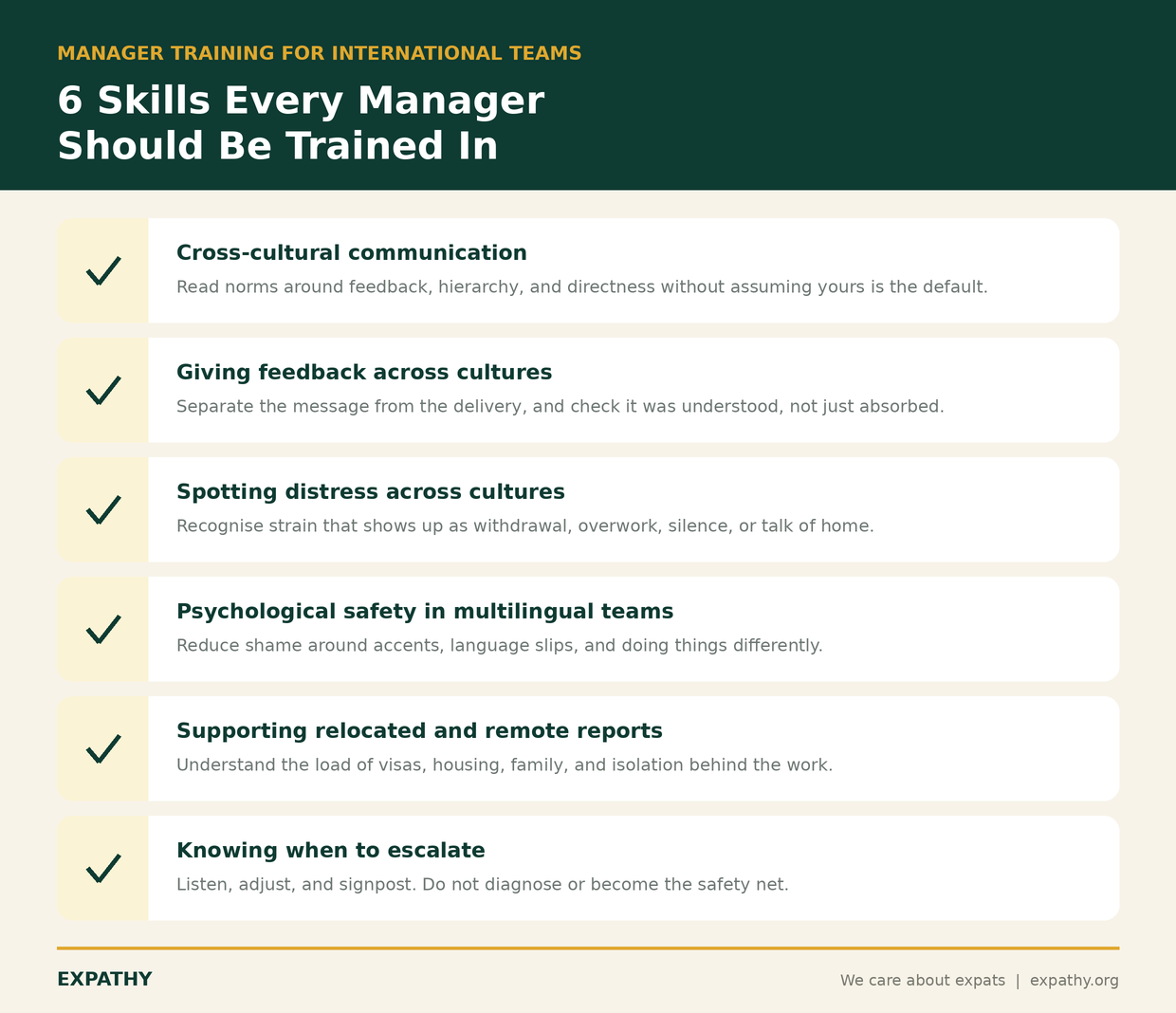
Cross-cultural communication
Managers should learn how communication norms shift across cultures, particularly around feedback, disagreement, hierarchy, directness, and how uncertainty is expressed. The aim is emphatically not to hand managers a list of national stereotypes to apply. It is to make them curious rather than presumptuous, to help them ask better questions, and to stop them treating their own cultural style as the neutral professional default that everyone else is failing to meet.
Giving feedback across cultures
The same piece of feedback can land as helpful, humiliating, or baffling depending on who is receiving it and how. Training should help managers separate the substance of a message from its delivery, check that it was actually understood rather than just politely absorbed, and avoid the kinds of feedback that leave someone ashamed or confused about what is even being asked of them.
Spotting distress across cultures
Distress does not announce itself the same way in everyone. It can look like withdrawal, irritability, overwork, perfectionism, going silent, growing cynical about the host country, or suddenly talking a lot about home. Managers do not need to become clinicians, but they do need to recognise the range of ways strain surfaces. For a fuller picture of what this looks like specifically, our guide to expat employee burnout goes into the signs in depth, and it is worth a manager's time.
Building psychological safety in multilingual teams
People do their best work, and ask for help soonest, when they feel safe admitting confusion or saying that something is not working. In an international team, psychological safety carries an extra dimension: it means actively reducing the shame around accents, language slips, cultural uncertainty, and simply doing things differently. A manager who lets a small correction of someone's English become a moment of embarrassment has just taught the whole team to stay quiet.
Supporting relocated and remote reports
A relocated employee is often juggling housing, visas, schools, a partner's adjustment, an unfamiliar healthcare system, loneliness, and culture shock, all while trying to look capable at work. Managers should understand that this load is real and that it bleeds directly into focus and energy. They do not need to become relocation experts, and this is not the place to try, but the early window matters enormously, which is why we treat it separately in relocation mental health support and why the first 90 days matter.
Knowing when to escalate to professional support
This is the competency that protects everyone, the manager included. Managers need a clear line they can hold: they can listen, they can normalise, they can adjust workload or deadlines where that is reasonable, and they can point someone toward proper support. What they cannot and should not do is diagnose, counsel, or quietly become the person's emotional safety net. A manager without that line either does too little or takes on far too much.
What managers should and should not do
Clarity here is what makes managers confident rather than anxious, and it is what keeps the support appropriate.
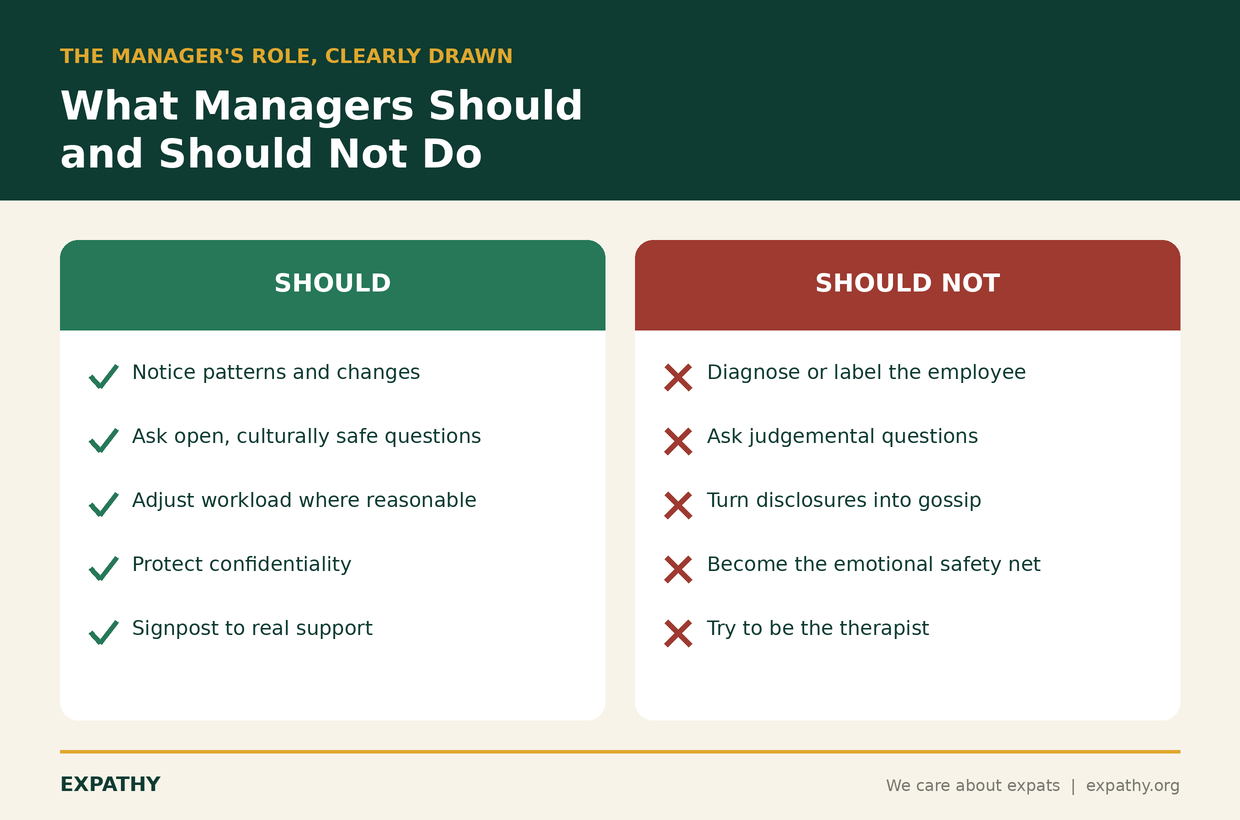
Notice patterns, do not diagnose people
A manager can reasonably notice that someone has been withdrawing, missing deadlines they used to hit, working strange hours across time zones, or mentioning home more and more. That is observation, and it is useful. Deciding that the person is depressed, burnt out, or fundamentally unable to adapt is not the manager's call to make, and reaching for those labels usually does more harm than the silence it replaces.
Ask open, culturally safe questions
The wording matters more than managers expect. Questions that open a door tend to sound like:
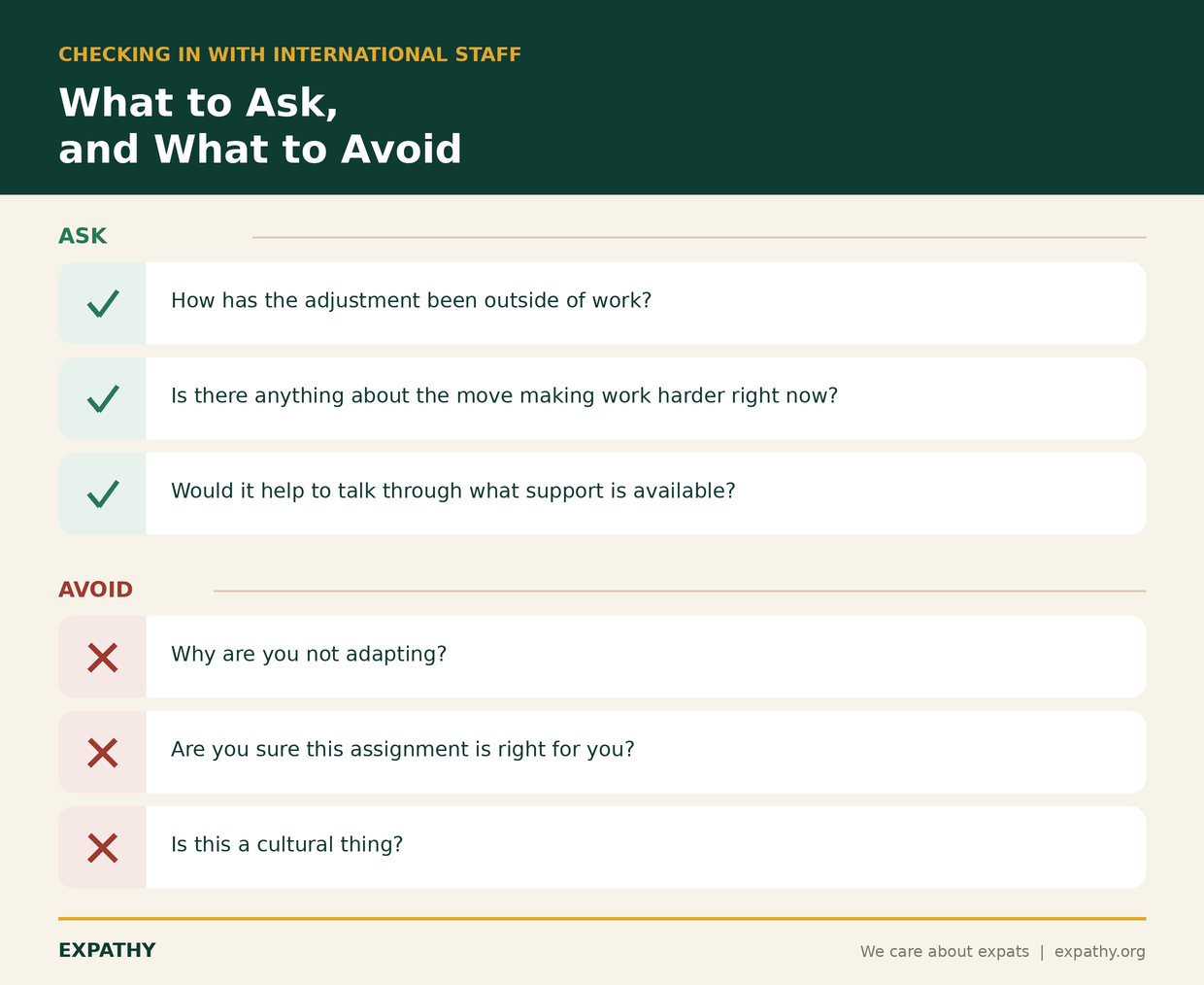
- How has the adjustment been outside of work?
- Is there anything about the move that is making work harder right now?
- Would it help to talk through what support is available?
Questions that quietly close it, and should be avoided, sound like:
- Why are you not adapting?
- Are you sure this assignment is right for you?
- Is this a cultural thing?
The first set signals care without judgement. The second set, even when well meant, tells the employee they are being assessed, and the honest answer promptly disappears.
Protect confidentiality
If an employee does share something personal, what happens next decides whether anyone ever trusts the manager again. That disclosure is not material for team speculation, corridor conversation, or an automatic escalation the employee did not ask for. The person should have a clear sense of what will stay between them and what, if anything, needs to go further, and why.
Signpost, do not become the therapist
The manager's job is to keep the working environment supportive and to guide the person toward appropriate help. It is not to provide that help themselves. Asking for intimate detail, trying to untangle trauma or a family crisis, attempting to treat symptoms, all of that oversteps the role and usually leaves both people worse off. Good managers hold the boundary warmly, not coldly, but they hold it.
What manager training often gets wrong
Plenty of manager training exists. A lot of it fails international teams for predictable reasons, and naming them is the fastest way to avoid them.
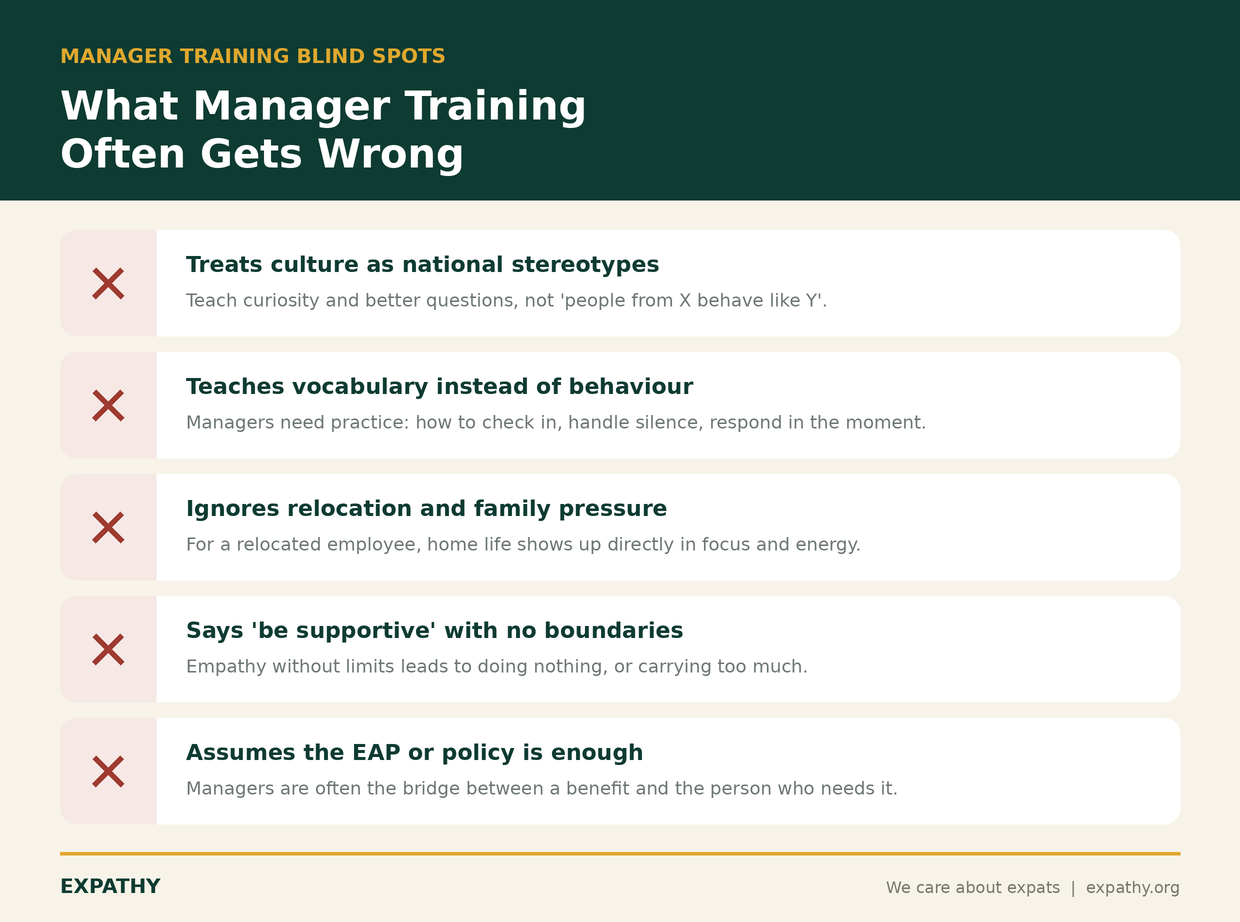
It treats culture as a list of national stereotypes
Weak training tells managers that people from a given country behave in a given way, which is both inaccurate and actively harmful. It replaces one lazy assumption with another. Strong training does the opposite: it teaches managers to hold their assumptions loosely, stay curious, and communicate across difference without deciding in advance what that difference means.
It teaches vocabulary instead of behaviour
Managers can learn all the right inclusive language and still have no idea what to actually do when someone goes quiet. Real training is practice, not glossary: how to run a check-in, how to deliver hard feedback kindly across cultures, how to sit with a silence, how to respond in the moment when someone finally says they are not coping.
It ignores relocation and family pressure
Some training draws a clean line between work and personal life and stays firmly on the work side. For a relocated employee that line does not exist in any useful sense. A partner who cannot settle, a child who is miserable at a new school, a visa that will not come through, all of it shows up in the employee's focus, energy, and quiet calculations about whether to stay.
It says "be supportive" without giving boundaries
Telling a manager to be supportive, with no limits attached, sets them up to either do nothing or take on responsibility that was never theirs to carry. Good training offers both halves: genuine empathy, and a clear edge around what a manager is and is not responsible for.
It assumes the EAP or an HR policy is enough
A support service only helps if managers know it exists, can explain it in plain terms, and know when to point someone toward it. Assuming the benefit will find the employee on its own is a common and costly mistake, and it is one of the reasons generic EAPs often go unused by international staff. Managers are frequently the bridge between a benefit and the person who needs it.
What good manager enablement looks like
Training does not need to be elaborate to work. It needs to be practical, specific, and actually usable on a Tuesday afternoon.
A short, focused session
For managers of international or relocated employees, a well-designed session of sixty to ninety minutes can cover a great deal. The constraint is a feature: it forces the training toward the few things managers will genuinely use rather than an exhausting survey of everything.
Scenario-based practice
Managers remember what they rehearse, not what they are told. Good training walks them through realistic situations, a relocated employee pulling back, a fluent colleague who keeps avoiding meetings, a team conflict caused entirely by clashing feedback styles, someone who is clearly afraid to ask for help, and lets them practise responding.
Clear escalation pathways
Managers should leave knowing exactly what to do when a concern is mild, when it is moderate, and when it is urgent, including when HR should be involved and when the right move is to point the person toward confidential professional support. Ambiguity here is what makes managers freeze.
Scripts and check-in questions they can actually use
Most managers want the words. Giving them five to seven ready check-in questions, phrased to be culturally safe, removes the single biggest reason good intentions never turn into an actual conversation.
A simple reference sheet
The most useful thing a manager keeps after training is a one-page reference: signs to watch for, questions to ask, phrases to avoid, the confidentiality rules, and where to point someone for real help. It turns a training session into something that still works months later.
Trained managers are the first layer, not the whole support system
Managers are usually the first to notice when an international employee is struggling, which makes their training genuinely valuable. But being first to notice is not the same as being equipped to carry it, and no amount of training should turn a manager into someone's mental health provider. The point of enablement is to help managers respond earlier and more safely, and then to hand off well.
That hand-off needs somewhere to go. A trained manager who spots strain early, and behind them a confidential, culturally aligned support option the employee will actually use, is a far stronger system than either piece alone.
Looking for company-wide support for your international employees? Explore Expathy's mental health support for international employees.
Frequently asked questions
What is manager training for international employees?
It is training that teaches leaders how to support staff who are working across cultures, languages, relocation stress, and distance from home. It focuses on cross-cultural communication, psychological safety, early recognition of strain, and knowing when to guide an employee toward professional support. Importantly, it is about enabling managers to notice and signpost, not turning them into therapists.
Why do managers of international employees need different training?
Because international employees often face pressures local staff do not experience the same way: cultural adjustment, language fatigue, homesickness, family relocation stress, and uncertainty about unfamiliar systems. Without training, managers tend to misread these pressures as attitude or performance problems, which makes things worse for an employee who is already stretched.
Should managers talk about mental health with international employees?
They can talk about wellbeing in a careful, respectful way, but they should not diagnose or act as a therapist. The manager's role is to notice changes, ask open and non-judgemental questions, protect confidentiality, adjust work factors where reasonable, and guide the employee toward appropriate professional support when it is needed.
What skills should manager training include?
The core skills are cross-cultural communication, giving feedback across cultures, building psychological safety in multilingual teams, recognising distress in its different cultural forms, supporting relocated and remote reports, and knowing when and how to escalate a concern to HR or to professional support. Practice matters more than vocabulary.
What mistakes do managers often make with international employees?
The common ones are assuming silence means everything is fine, reading cultural difference as a poor attitude, ignoring the effect of family and relocation pressure, giving feedback in a way that feels culturally unsafe, and trying to personally solve problems that really need professional support. Most of these come from missing training rather than from bad intent.
How can HR measure whether manager training worked?
Useful signals include manager confidence before and after training, employee feedback, whether people are actually using support pathways, team-level psychological safety, retention among international employees specifically, and whether managers are raising concerns earlier and more appropriately than they did before.
Need support? We're here.
Book a free 15-min consultation with our expat-specialized therapists.