
Key takeaway
Poor mental health shows up on a company's balance sheet in three ways: absenteeism, presenteeism, and turnover. Most of that cost is invisible, because the largest part is not people staying home, but people showing up while unwell and quietly working below their capacity. For international employees, the risk can become harder to see and more expensive to ignore when the available support does not fit their language, culture, or relocation reality. This article breaks down where the cost comes from and how to measure it in your own team.
The real cost of poor mental health at work
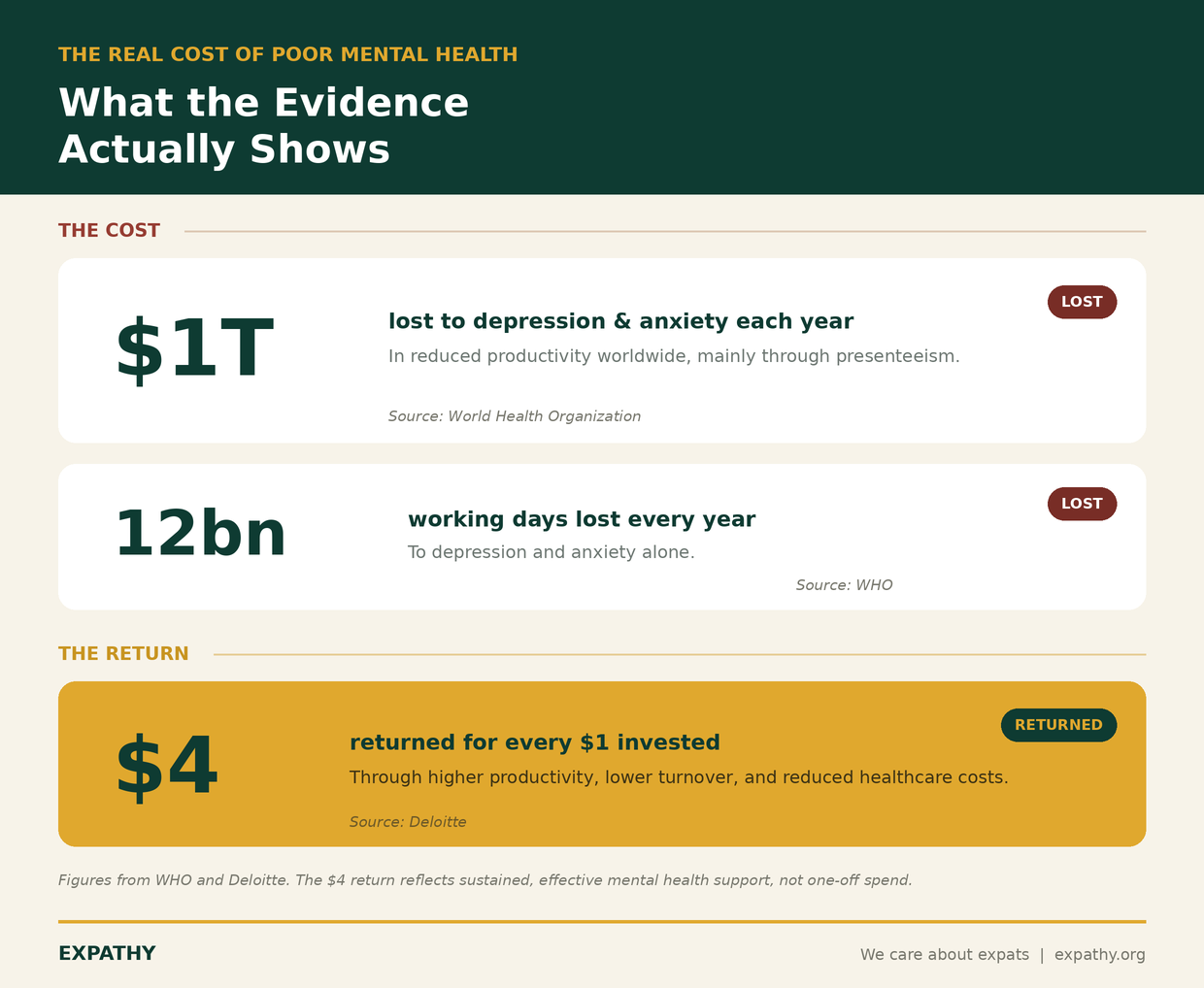
The headline numbers are large, and they are well sourced. The World Health Organization estimates that depression and anxiety cost the global economy around US$1 trillion per year in lost output, attributed primarily to presenteeism rather than absence. Depression and anxiety alone account for an estimated 12 billion working days lost every year. The most direct way to reduce that hidden cost is ongoing therapy access your international employees will actually use.
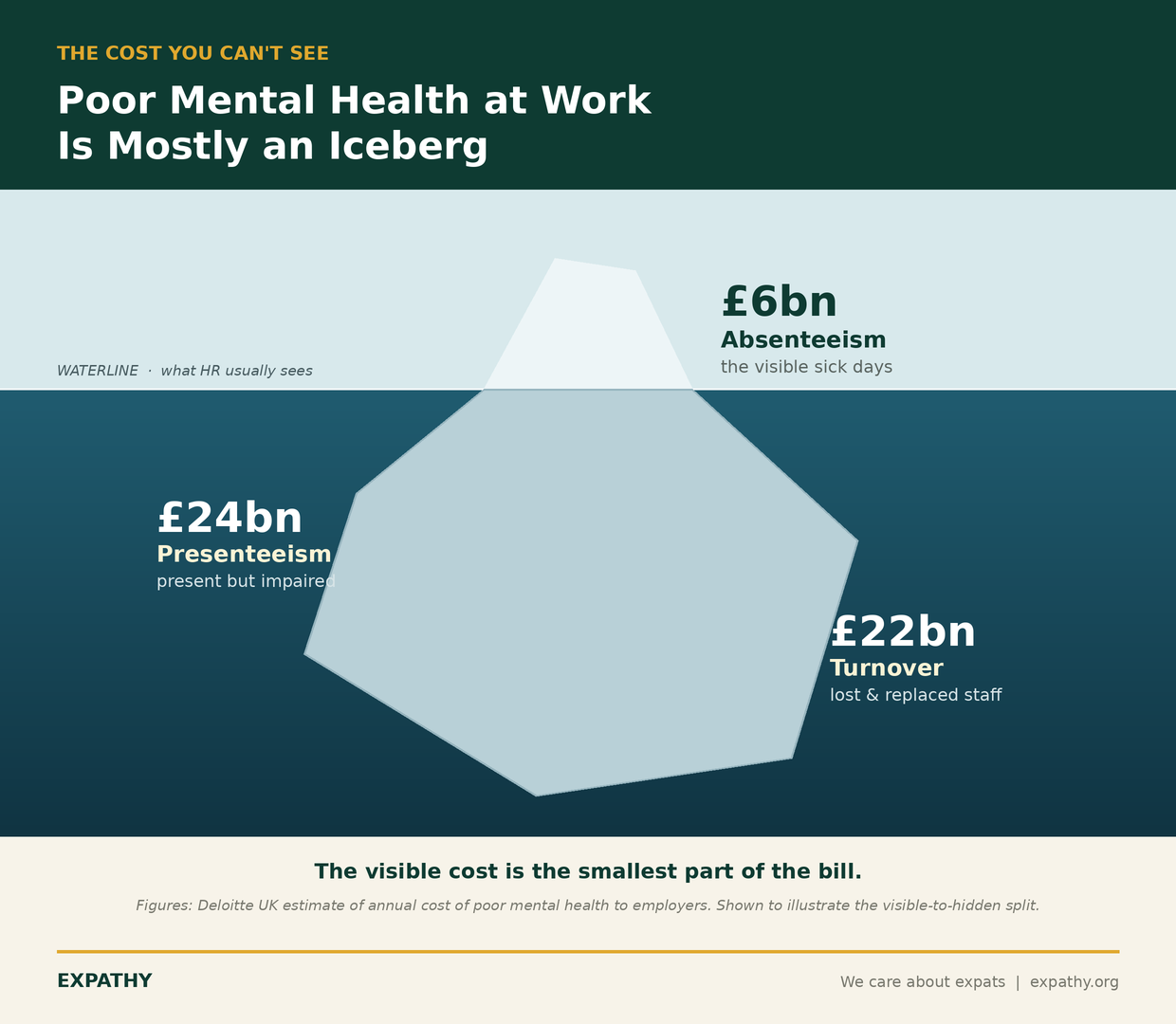
At a national level the picture is just as stark. Deloitte's research puts the cost of poor mental health to UK employers at around £51 billion per year, with presenteeism the single largest contributor. The exact figures vary by country and study, but the pattern is remarkably consistent everywhere it is measured.
It helps to hold the whole cost in one simple frame:
Total cost of poor mental health = absenteeism + presenteeism + turnover / assignment failure
Most companies see only the first term. The real bill is the sum of all three, and the two you cannot easily see are usually the largest.
Absenteeism: the visible cost
Absenteeism is the part HR already tracks: sick days, mental-health leave, unplanned absence. It is real and it is measurable. Gallup estimates each missed workday costs employers roughly US$340 for a full-time employee. Across a workforce, mental-health-related absence adds up quickly.
But absenteeism is the visible tip of the iceberg. It is the cost that shows up on a timesheet, which is exactly why it gets most of the attention, and why it misleads companies into thinking they can see the whole problem. They cannot.
Presenteeism: the hidden cost
Presenteeism is being present but impaired: at your desk, logged in, and working well below your normal capacity because you are unwell. It does not show up on any attendance record, which is precisely what makes it so expensive.
Across multiple studies, presenteeism costs employers far more than absenteeism, often several times more. In Deloitte's UK analysis, presenteeism accounts for the largest share of the total, at roughly £24 billion a year.
The reason is simple and a little counterintuitive. When someone takes sick leave, a manager can plan around it and redistribute the work. When someone shows up impaired, the loss hides in plain sight: tasks take longer, errors creep in, quality slips, and no one logs any of it. The sick day you can see is cheaper than the bad week you cannot.
Why the bill runs higher for international employees
Here the honest caveat matters: most of the hard cost data above is drawn from general workforces, not expat-specific studies. What we can say, directionally and from the evidence, is that international employees are a more exposed group carrying a support gap.
The exposure is documented. Around 1 in 3 employees experience moderate to severe anxiety or depression symptoms, and separate research on expatriates has found them at meaningfully higher risk than domestic staff. When you combine higher underlying risk with support that often does not fit an international employee's language or situation, the predictable result is lower usage and more unaddressed strain, which is exactly the fuel for presenteeism.
We cover why international employees are more at risk, and what the warning signs look like, in a separate piece on expat employee burnout. The point here is narrower: the cost mechanics that apply to any workforce tend to hit harder, and stay hidden longer, when support does not reach the people who need it.
Turnover and assignment failure: the cost nobody budgets for
The third term in the framework is the one that rarely appears in a wellbeing line item, and it is often the largest. When an international hire disengages and leaves, or returns early from an assignment, the company loses not just a role but the entire relocation investment: the move, the setup, the ramp-up time, and the cost of doing it all again for a replacement.
A domestic resignation is expensive. An international one, where the company may have spent months and significant money placing someone abroad, is far more so. This is the cost that does not show up in a spreadsheet cell labelled "wellbeing," and it dwarfs the ones that do.
What the numbers mean for wellbeing investment
The case for investment is well established. Deloitte and others put the return at roughly US$4 for every US$1 spent on employee mental health, through higher productivity, reduced turnover, and lower healthcare costs.
One honest qualification: that return comes from sustained, effective support that people actually use, not from a one-off purchase. And this is the specific trap for international teams. If you buy generic support that expat employees do not use, because it is not in their language or does not understand their situation, you capture almost none of that return. The ROI does not come from offering support. It comes from support that gets used.
What to measure in your own company
Company-level averages hide the problem. To see the real cost, and whether it is concentrated among your international staff, track these by segment rather than as a single company total:
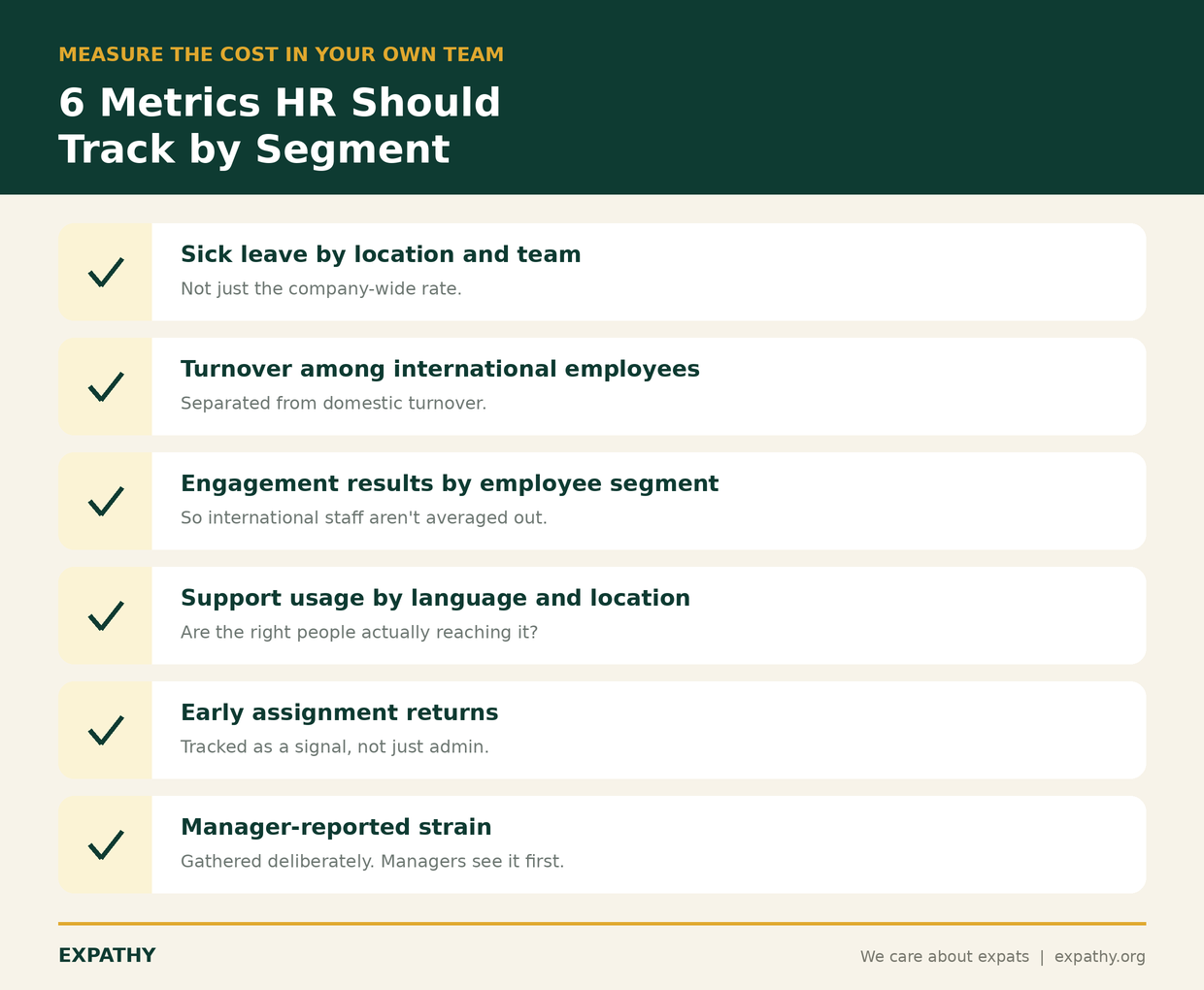
- Sick leave by location and team, not just the company-wide rate.
- Turnover among international employees specifically, separated from domestic turnover.
- Engagement survey results broken down by employee segment, so international staff are not averaged into invisibility.
- Support usage by language and location, to see whether the people you bought support for are actually reaching it.
- Early assignment returns, tracked as a signal, not just an HR administrative event.
- Manager-reported strain, gathered deliberately, since managers often see it first.
If the international slices look worse than the company average, or if you cannot produce them at all, that gap is itself the finding.
Support that fits is support that pays back
The numbers all point the same way. The cost of poor mental health is real, mostly hidden, and heaviest exactly where support fits worst. For international employees, the return on wellbeing spend depends entirely on whether the support is used, and people use support that speaks their language and understands their life.
If you want your wellbeing investment to actually reach your international employees, Expathy provides the culturally aligned, native-language support layer that turns spend into usage. Explore mental health support for international employees.
Frequently asked questions
How much does poor mental health cost employers?
Estimates are large and consistent. The WHO puts the global cost of depression and anxiety at around US$1 trillion a year in lost productivity, and Deloitte estimates poor mental health costs UK employers roughly £51 billion annually. The exact number varies by country and method, but across studies the majority of the cost comes from presenteeism rather than visible sick leave.
What's the difference between absenteeism and presenteeism?
Absenteeism is being absent from work, sick days and unplanned leave, which is visible and easy to measure. Presenteeism is being present but impaired: at work, but performing well below capacity because of poor mental health. Absenteeism shows up on a timesheet. Presenteeism does not, which is what makes it harder to see and more expensive.
Why does presenteeism cost more than absenteeism?
Because it is both larger and hidden. When someone is absent, a manager can plan around it. When someone is present but unwell, the lost output is invisible: work takes longer, quality drops, and errors appear, with none of it logged. Multiple analyses, including Deloitte's, find presenteeism to be the single largest component of the total cost of poor mental health.
Is mental health support actually worth the investment?
The commonly cited return is around US$4 for every US$1 invested, through improved productivity, reduced turnover, and lower healthcare costs. The important caveat is that this return depends on sustained support that employees actually use. Support that is bought but not used, a common outcome for international staff offered generic services, captures little of that return.
Why does poor mental health cost more for international employees?
The cost mechanics are the same as for any workforce, but they tend to hit harder and stay hidden longer. International employees carry higher underlying risk and often face support that does not fit their language, culture, or relocation situation. That mismatch lowers usage and leaves strain unaddressed, feeding presenteeism, and it adds the large, often overlooked cost of losing an expensive international hire.
How do we measure the cost of poor mental health in our own team?
Track by segment, not company average: sick leave by location and team, turnover among international employees, engagement results by segment, support usage by language and location, early assignment returns, and manager-reported strain. If the international figures look worse than the overall average, or you cannot produce them, that absence of visibility is itself a sign worth acting on.
Need support? We're here.
Book a free 15-min consultation with our expat-specialized therapists.