
Key takeaway
Expat employee burnout is ordinary burnout with a second layer underneath it, one that comes from living and working in a country that is not your own. Alongside the normal pressures of the job, an international employee is carrying relocation stress, cultural fatigue, language load, and distance from home, and that second layer never clocks off. HR often reads the result as slow adjustment or a performance dip, right up until someone disengages or asks to go home. This article covers what makes expat burnout different, the signs to watch for, and how to reduce the risk before people hit the wall.
Picture an employee who looks fine on paper. Targets met, showing up, no complaints. Then look at the hours the company does not see. After work they are still translating official documents they half understand, helping a partner who gave up their own career adjust to a place they did not choose, calling home across an awkward time difference, and spending all day quietly decoding a culture they did not grow up in. The job is one shift. Everything else is the second one. That second shift is where expat burnout is built.
Where burnout is already showing up across a team, a burnout prevention workshop for international staff helps managers spot it before it turns into sick leave.
What makes expat burnout different from ordinary burnout
Ordinary workplace burnout is well understood: it grows out of workload, lack of control, insufficient reward, weak community, unfairness, and mismatched values. All of that still applies to an expat employee. The difference is what sits on top of it.
An international employee runs a constant background process of adaptation, every waking hour, whether they are at their desk or not. Reading unfamiliar social norms, operating in a second language, managing the logistics of a life rebuilt from scratch, holding the low-grade grief of missing home. It is a second shift of adaptation layered onto the normal working day, and unlike the job, it has no end time and no weekend. Two full loads, one person, no clocking off from either.
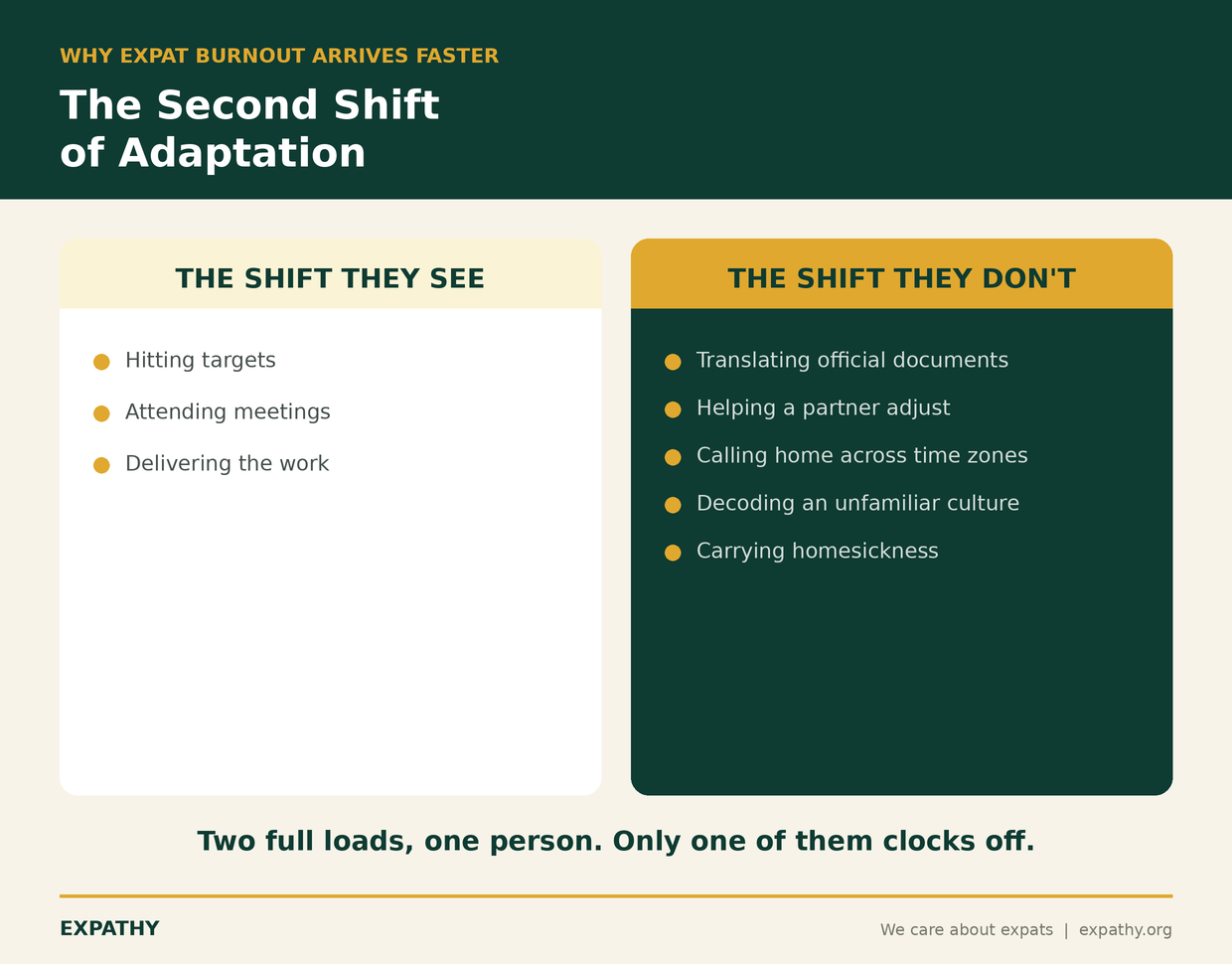
That is why expat burnout arrives faster and reads differently. The employee is not just tired from work. They are tired from everything the work sits inside of, and that exhaustion is the part HR usually cannot see.
The expat-specific drivers of burnout
These are the pressures that stack on top of ordinary work stress. Each one is specific to living abroad, and together they are the second shift.
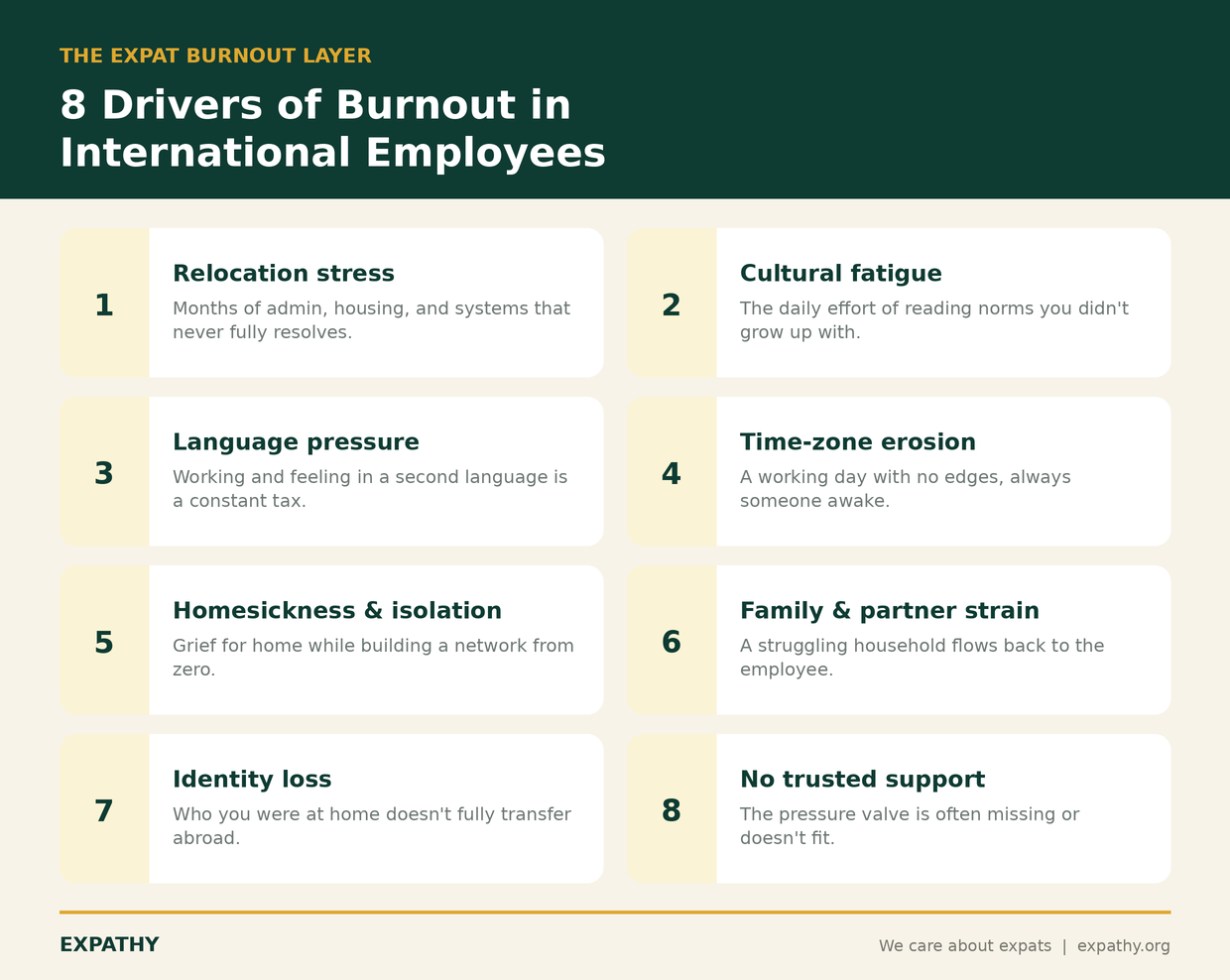
Relocation stress that never fully resolves
The move is treated as a one-time event. It is not. For months afterward the admin grinds on: residency paperwork, housing, banking, healthcare systems, a hundred small tasks that would be automatic at home and are now effortful and uncertain. The stress does not end when the boxes are unpacked.
Cultural fatigue
Every interaction in an unfamiliar culture takes a little more effort: reading the humour, the hierarchy, the unwritten rules of how things are actually done. One conversation is fine. A thousand of them, every day, quietly drains a battery the employee does not know is draining.
Language pressure
Working and, harder still, feeling in a second language is a constant tax. Even fluent speakers spend energy that native speakers never notice, and the gap widens exactly when they are stressed, tired, or upset, which is when they can least afford it.
Time-zone work and boundary erosion
When a team is spread across the world, the working day loses its edges. Someone is always awake, always waiting on a reply. For international employees already short on downtime, the erosion of any real boundary between work and rest removes the last place they might recover.
Homesickness and isolation
Building a life from zero socially, while carrying grief for the one left behind, is its own slow exhaustion. There is no established network to fall back on, no old friend a short drive away. The support that would normally absorb hard weeks simply is not there yet.
Family and partner strain
Relocation rarely lands on one person. When the accompanying partner is struggling to rebuild their own life, or the children are having a hard time settling, that strain flows straight back to the employee. A struggling household is a struggling employee, however well they perform at work.
Identity loss
At home they were someone: competent, connected, known. Abroad, much of that does not transfer. The status, the easy social role, the sense of being good at your own life, all of it gets scrambled, and the disorientation of not quite recognising your own days is heavier than it sounds.
No trusted support to offload to
Every pressure above is more bearable with somewhere to put it down. For many expats that outlet is missing, or the support on offer does not fit their language or situation, so the load has nowhere to go but inward.
Signs of expat burnout HR can watch for
The hard part is that these signs look like a performance problem or a bad attitude, which is exactly why they get missed. Reading them as burnout is the intervention.
Behavioural signs: pulling back from the local team and the expat community, turning down social invitations they used to accept, visibly counting down to their next trip home.
Performance signs: output slipping in someone previously reliable, handoffs missed across time zones, a once-motivated international hire going quiet and disengaged.
Emotional and physical signs: growing cynicism about the assignment or the host country, talking about "just going home," an exhaustion that a weekend or a holiday does not fix, and a creeping rise in sick days.
Any one of these can be read charitably in isolation. Together, in an international employee, they are a pattern worth taking seriously.
What HR often misreads
This is where good intentions go wrong. The same signals that point to burnout are routinely filed under something else, and the misread costs you the employee.
- Disengagement mistaken for low motivation. The quiet, checked-out employee is often not lazy or uncommitted. They are depleted, and treating it as a motivation problem adds pressure to someone already over capacity.
- Withdrawal mistaken for poor team fit. Pulling back from colleagues can look like someone who "just isn't gelling." More often it is exhaustion or isolation, not a personality mismatch.
- Frustration with the host country mistaken for negativity. Complaints about the bureaucracy, the weather, the way things work are easy to label as a bad attitude. They are frequently the sound of someone worn down by cultural fatigue.
- Asking to go home mistaken for failure rather than distress. When an employee raises leaving, it gets read as the assignment failing or the person not being up to it. Usually it is a distress signal, and treating it as failure guarantees the outcome you were trying to avoid.
The risks of leaving it unaddressed
Left unread, expat burnout does not stay quiet. It surfaces as assignment failure, early return, and the loss of an international hire the company spent months and significant money relocating. Research on international assignments has long linked poor adjustment to elevated failure rates, and the strain does not stay contained to one person; a burnt-out team member affects the wider team's morale and workload too.
The full business-cost picture, absenteeism, sick leave, and productivity leakage among international employees, deserves its own treatment, which we give it in a separate piece on mental health, sick leave, and productivity among international employees. Here it is enough to say the cost of missing it is real, and most of it is avoidable.
How HR can reduce the risk of expat burnout
You cannot promise to prevent burnout entirely. You can meaningfully reduce the risk, catch it earlier, and build support before someone hits the wall. It works best at three levels.
Early and before the move: set realistic expectations about how hard the first year can be, so people do not read normal difficulty as personal failure. Build structured support into the first 90 days, and help new movers connect to community fast rather than leaving them to manage isolation alone.
Ongoing and structural: protect boundaries across time zones so the working day has an edge again. Normalise the adaptation load openly, so employees stop blaming themselves for finding a genuinely hard thing hard. And check in on the whole household, not only the employee, because the family's adjustment is part of theirs.
A support layer that fits: give international staff access to culturally aligned, native-language support before they reach crisis, not after. Support that understands the expat experience, and speaks the employee's own language, is far more likely to be used while it can still make a difference.
Reducing the risk works better than repairing the damage
Burnout is far cheaper, and far kinder, to catch early than to recover from once someone has already broken down or booked their flight home. For expat employees, the support has to match the specific load they carry, not generic wellness advice that never touches the second shift.
If your international employees are carrying more than their job, Expathy provides the culturally aligned, native-language support layer that helps you catch strain early. Explore mental health support for international employees.
Frequently asked questions
What is expat employee burnout?
It is workplace burnout combined with a second layer of pressure unique to living and working abroad: relocation stress, cultural fatigue, language load, isolation, and family strain. Because that second layer runs constantly outside work hours, expat employees can burn out faster than their domestic colleagues, and the causes are easy for HR to miss.
How is expat burnout different from regular burnout?
Regular burnout comes mainly from the job: workload, control, reward, and so on. Expat burnout stacks a full second shift of adaptation on top of that, the ongoing effort of operating in an unfamiliar culture and language, far from home. The employee is not only tired from work, but from everything the work sits inside of, which never clocks off.
What are the early signs of burnout in international employees?
Watch for withdrawal from the team and expat community, declining social invitations, counting down to home leave, slipping performance in someone previously reliable, cynicism about the host country, and exhaustion that rest does not fix. In an international employee, several of these together are a pattern worth taking seriously rather than reading as a performance or attitude problem.
Why are expat employees more at risk of burnout?
Because they carry the ordinary pressures of work plus a constant second load: adapting to a new culture, working in a second language, managing relocation logistics, and coping with isolation and family strain, often without a trusted support network. That combination arrives faster and is harder to recover from, especially when the available support does not fit their language or situation.
How can HR reduce the risk of burnout in international teams?
Set realistic expectations before the move, build structured support into the first 90 days, protect boundaries across time zones, normalise the adaptation load so people do not self-blame, check in on the family as well as the employee, and provide culturally aligned, native-language support before someone reaches crisis. The aim is to reduce risk and catch strain early, not to promise it will never happen.
Can burnout cause an international assignment to fail?
Yes. Unaddressed burnout is a common thread in early returns and failed assignments, which are costly given the investment in relocating someone. When an employee starts talking about going home, it is often a distress signal rather than a verdict on their ability, and reading it that way early is what gives you a chance to change the outcome.
Need support? We're here.
Book a free 15-min consultation with our expat-specialized therapists.