
Key takeaway
The first 90 days of an international assignment are one of the most vulnerable windows an employee will go through, and one of the most decisive. It is the stretch where the adaptation load is heaviest and the support around them is thinnest, and it quietly sets whether the assignment thrives or slowly falls apart. Relocation mental health support works best when it starts here, and even before arrival, rather than after someone is already struggling. This article walks through what those early weeks actually feel like, what HR tends to miss, and how to support people through them.
Picture an employee in week three. The excitement of arriving has worn off. Their days are a blur of admin they half understand, a home that does not feel like one yet, and a city where they know no one. They are performing at work because they are professional, so on paper everything looks fine. No one has asked how they are adjusting. They have only been asked whether they have started delivering. That gap, between looking fine and being fine, is where the first 90 days quietly go wrong.
Employers who want to protect the first ninety days often run a relocation adaptation workshop so a new posting starts as a success rather than a risk.
Why the first 90 days are a critical window
The early window is hard for a specific, structural reason: the load peaks exactly when the support is thinnest. Everything is new at once, the language, the systems, the social codes, the daily logistics, so the effort of simply functioning is at its highest. And at that same moment the employee has no network, no routine, and no local knowledge to lean on.
Maximum load, minimum support, precisely when it matters most. That mismatch is why the first 90 days carry more weight than any later stretch of an assignment, and why support offered in this window does more than support offered later.
The first 90 days start before the move
Relocation mental health support that begins on day one has already started late. The window really opens weeks earlier, and the preparation matters as much as anything that happens after arrival.
Before someone gets on the plane, three things shape how the early weeks will go: realistic expectations about how hard adjustment can be, family readiness for their own upheaval, and an anxiety about the language and culture that often goes unspoken. Setting expectations honestly, and making sure a support pathway is already in place before it is needed, changes the trajectory before the assignment has even begun. You cannot prepare someone for everything, but you can stop them from thinking the difficulty means they have failed.
What the first 90 days actually feel like
The early window is not one uniform experience. It moves through rough phases, and knowing them helps HR see where an employee actually is.
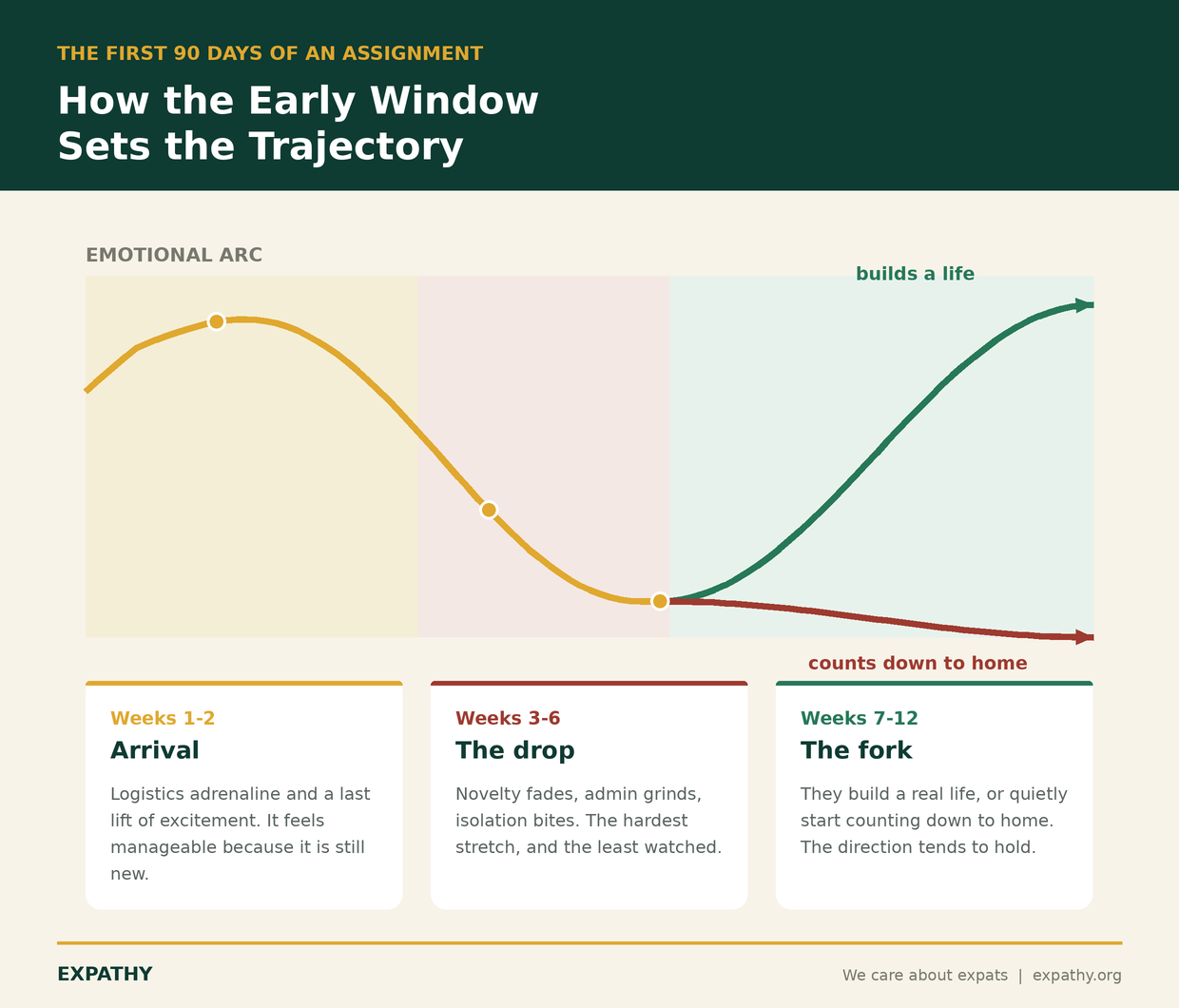
Weeks 1 to 2, arrival. Logistics adrenaline carries people. There is a lot to do, and often still a sense of excitement. Things feel manageable because the newness is still novel.
Weeks 3 to 6, the drop. The novelty fades and the admin grinds on. Isolation starts to bite, the honeymoon tips into a crash, and this is often the hardest stretch. This is where people quietly start to struggle, and where almost no one is watching for it.
Weeks 7 to 12, the fork. The employee goes one of two ways. They begin building a real life, friends, routine, a sense of belonging, or they start privately counting down to going home. The direction set here tends to hold.
The whole assignment often takes its shape inside these twelve weeks.
The pressures stacking up in the early window
Several pressures land at once in the first 90 days, and it is the pile-up, not any single one, that overwhelms people.
There is relocation admin overload, the endless practical tasks of building a life from scratch. There is no social base yet, so hard days have nowhere to land. The cultural and language load is at its most exhausting, because nothing is automatic yet. The family is adjusting in parallel, and their strain feeds back to the employee. And through all of it runs the pressure to perform at work before they have found their feet. Any one of these is manageable. All of them together, in the same few weeks, is not.
What HR usually misses in the first 90 days
This is where good intentions slip. The early window has predictable blind spots, and each one costs you.
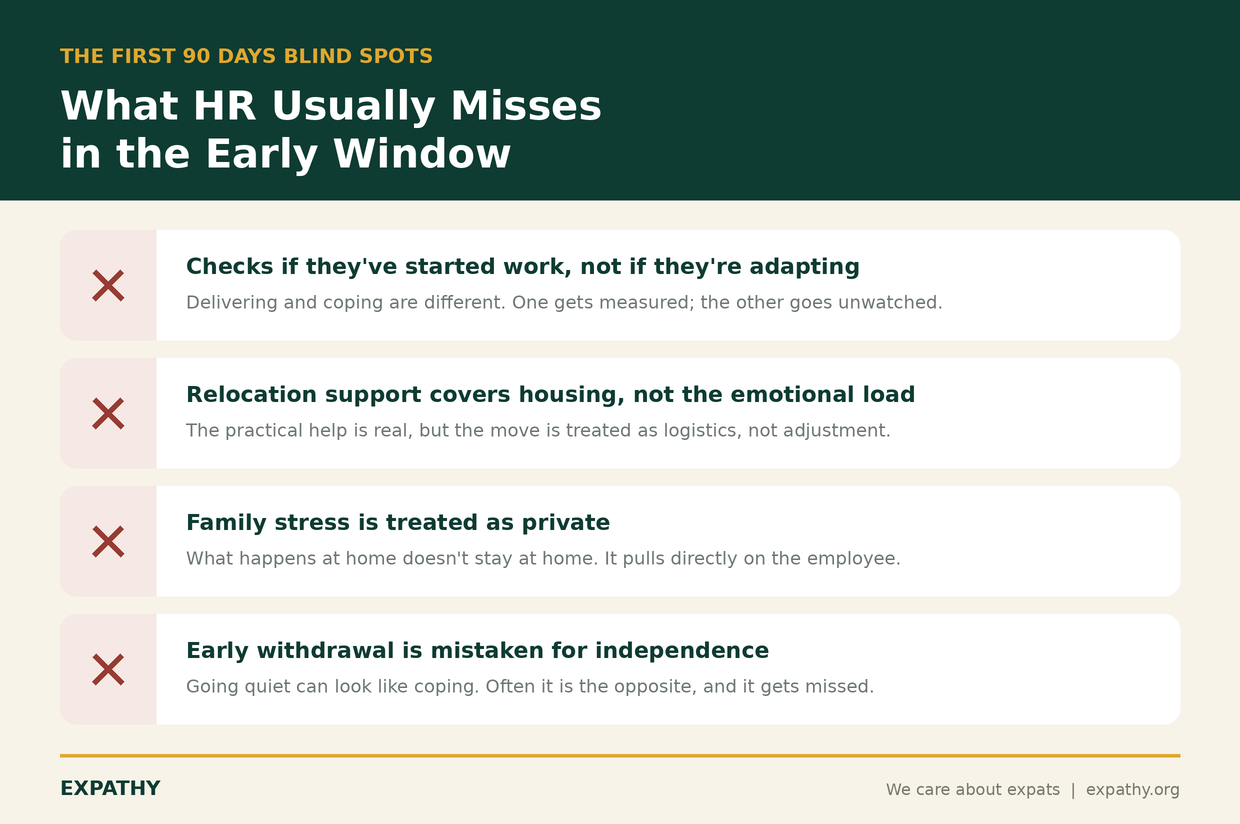
- HR checks whether the employee has started work, not whether they are adapting. Delivering and coping are different things, and the first is easy to measure while the second goes unwatched.
- Relocation support focuses on housing and documents, not the emotional load. The practical help is real and necessary, but it treats the move as a logistics problem when the harder part is emotional.
- Family stress is treated as private, even though it affects performance. What happens at home does not stay at home. A partner or child struggling to settle pulls directly on the employee.
- Early withdrawal is mistaken for independence. An employee going quiet and self-contained can look like someone handling it well. Often it is the opposite, and reading isolation as competence is how early strain gets missed entirely.
Why early support beats late support
Support offered after someone is already struggling is damage control. Support offered in the first 90 days is trajectory-setting. It is cheaper, it is kinder, and it is far more likely to keep the assignment on track rather than salvage it.
The stakes are real. Research on international assignments has long linked poor early adjustment to elevated assignment failure, with failed placements estimated to cost multiples of an employee's salary once relocation and replacement are counted. When early strain is left unaddressed, it does not stay an early-window problem; it hardens into the kind of chronic exhaustion we cover in our piece on expat employee burnout. Catching it in the first 90 days is what stops that slide.
What good first-90-days support looks like
The aim is not to pretend the early window is easy. It is to make it survivable, and to set the right trajectory while it can still be set.
Before arrival: set realistic expectations rather than only handling logistics, and put a support pathway in place before it is needed.
Weeks 1 to 4: structured check-ins that ask how someone is adjusting, not just whether they have started. Fast connection to community, and practical help with the adjustment load.
Weeks 4 to 12: access to culturally aligned, native-language support before a crisis, not after, and genuine attention to how the family is doing, because their adjustment is part of the employee's.
Support that fits the early window, in the employee's own language and shaped around the expat experience, is far more likely to be used while it can still change the outcome.
The first 90 days set the trajectory
Get the early window right and the assignment has a real chance. Miss it, and you are often managing an exit that started weeks before anyone noticed. For relocated employees, the support has to reach them early, and it has to fit, generic help offered too late rarely changes anything.
If you want your relocated employees supported from the start, Expathy provides the culturally aligned, native-language support layer built for the expat experience. Explore mental health support for international employees.
Frequently asked questions
What is relocation mental health support?
It is support designed to help employees through the psychological load of an international move: the adjustment, isolation, cultural and language pressure, and family strain that come with relocating. Unlike generic wellbeing support, it is shaped around the relocation journey specifically, and it is most effective when it begins before arrival and continues through the critical early months.
Why do the first 90 days of an assignment matter so much?
Because the adaptation load peaks exactly when support is thinnest. Everything is new and effortful at once, while the employee has no network, routine, or local knowledge to lean on. The trajectory of the whole assignment is often set inside this window, which makes early support far more valuable than support offered once someone is already struggling.
What are the signs a relocated employee is struggling early?
Watch for withdrawal from colleagues and social opportunities, a drop in energy or engagement after the first few weeks, talk of missing home, and signs the initial excitement has tipped into low mood. These often appear around weeks three to six, and they are easy to misread as independence or a simple performance issue rather than early adjustment strain.
How can HR support employees in the first 90 days?
Start before the move with realistic expectations and a support pathway already in place. In the early weeks, run structured check-ins that ask how someone is adjusting, not just whether they have started work, and help them connect to community quickly. From roughly week four, provide access to culturally aligned, native-language support before a crisis, and pay attention to how the family is settling too.
Does early support really reduce assignment failure?
The evidence consistently links poor early adjustment to higher assignment failure, and failed assignments are expensive once relocation and replacement costs are counted. While exact figures vary, the direction is clear: supporting adjustment in the early window is far more effective, and far cheaper, than trying to rescue an assignment after an employee has already decided to leave.
Should relocation support include the employee's family?
Yes. The accompanying partner and children go through their own upheaval, and when they struggle to settle, that strain flows straight back to the employee and their work. Treating family adjustment as part of relocation support, rather than a private matter, is one of the clearest ways to protect both the employee's wellbeing and the assignment.
Need support? We're here.
Book a free 15-min consultation with our expat-specialized therapists.