
Key takeaway
Native-language therapy means employees can receive mental health support in their native or preferred language, from clinicians who understand their language and cultural context. For global teams, this is often the difference between a benefit that exists on paper and one that people actually use. When support fits the language someone feels most themselves in, it tends to feel safer, more precise, and easier to reach for. This article explains why that is, and what it means to offer it well.
Picture an employee who runs meetings in English all day without a second thought. Fluent, confident, effective. Then they sit down for a therapy session, and something shifts. The feeling they came to talk about, the grief, the shame, the memory that lives somewhere in their childhood, does not come in English. It exists in their first language, and in the session they find themselves translating it, smoothing it, reaching for words that are close but not quite it. They can describe the feeling in English. They cannot quite feel it there.
This is exactly why some employers now offer therapy in an employee's native language as an ongoing benefit rather than a one-off session.
Why language matters more in therapy than almost anywhere else
Therapy is not a business meeting. A meeting runs on information, and information survives translation reasonably well. Therapy runs on something more fragile: emotional precision, spontaneity, the exact word for a feeling, the memory attached to a phrase from childhood. Those things are bound tightly to the language they were first formed in.
There is a growing body of work in psychology on how emotion and language are linked, and it points consistently in one direction: people tend to experience and express emotion most fully in their first language. A second language, even a fluent one, often carries a small but real emotional distance, useful sometimes, but a barrier when the whole point is to get close to what you feel. On top of that, working in a second language takes ongoing mental effort, and it demands that effort exactly when someone is stressed, tired, or upset and least able to spare it.
Fluent isn't the same as at home in a language
Here is the objection most HR teams raise, and it deserves a real answer: our people speak excellent English, so why would this matter?
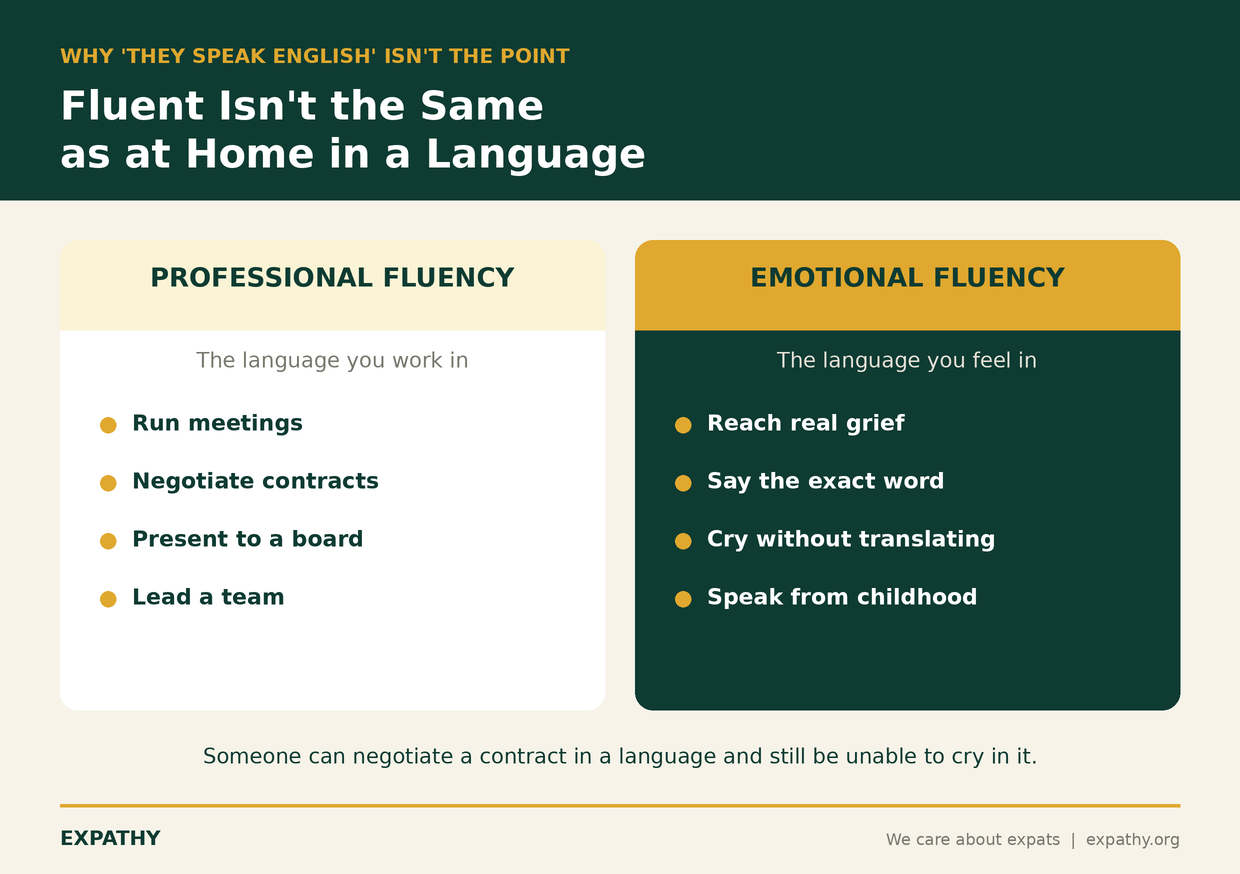
Because professional fluency and emotional fluency are two different things. Someone can negotiate a contract, lead a team, and present to a board in their second language, and still be unable to cry in it. The language you work in and the language you break down in are not always the same one. Fluent is not the same as at home in a language, and therapy needs the one you are at home in.
What gets lost when therapy happens in a second language
The therapy still happens. It just tends to work at reduced power. A few specific things slip:
Emotional precision flattens. The client reaches for the nearest available word instead of the exact one, and nuance is where a lot of therapeutic work lives.
People self-edit. Consciously or not, someone working in a second language stays inside the vocabulary they are confident in, which quietly narrows what they are willing to say.
Cultural references need explaining. A phrase, a family expectation, a norm from home has to be unpacked for the therapist, and every explanation interrupts the flow of actually feeling something.
The effort itself tires them. Translating yourself in real time is work, layered on top of whatever brought them to therapy in the first place.
Native-language therapy is not the same as translation
This is the distinction that matters most, and the one most easily blurred on a benefits brochure. A therapist who works directly in the client's language is a fundamentally different thing from a workaround that routes around the language gap.
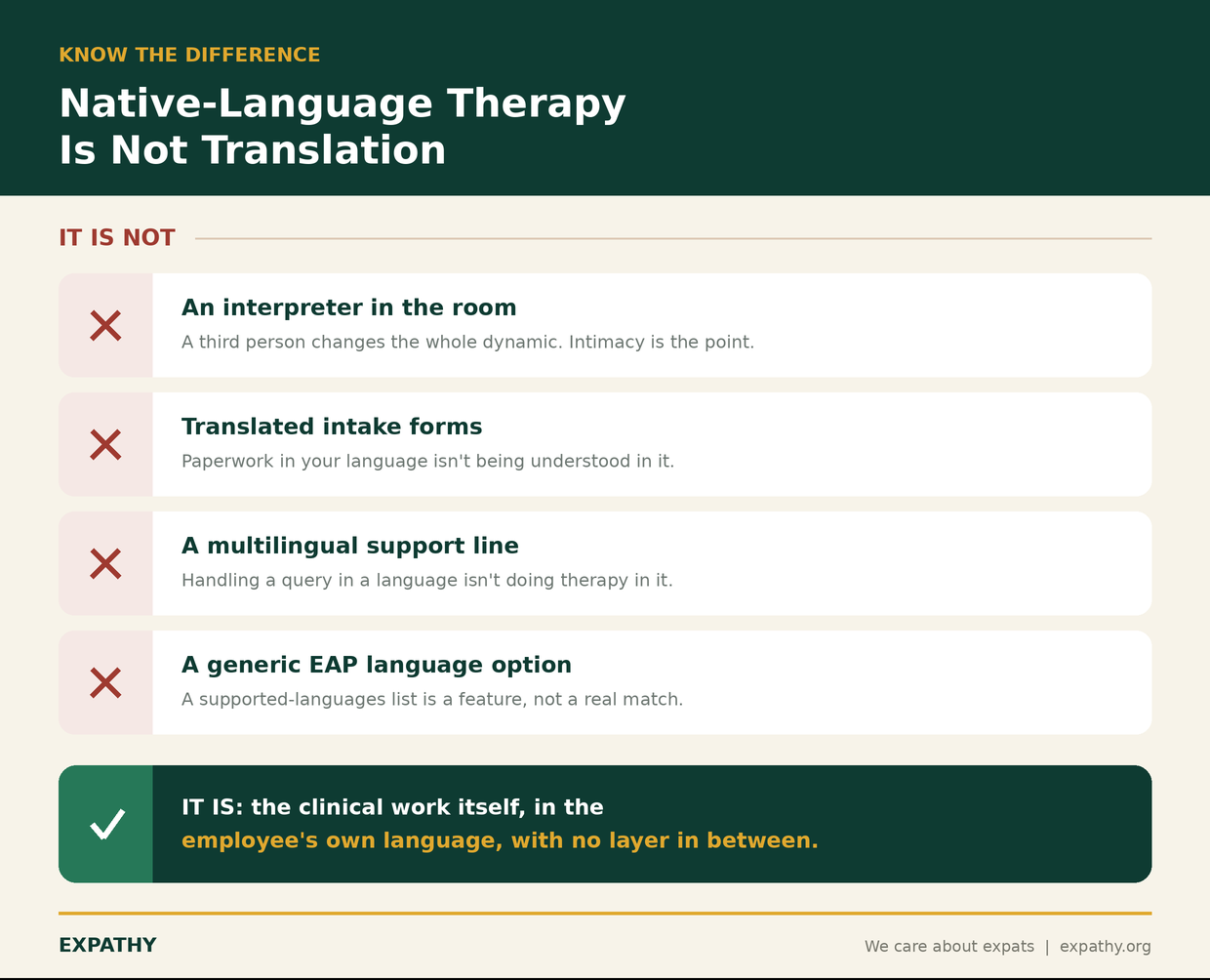
It is not:
- An interpreter in the room. A third person changes the entire dynamic of a session, and intimacy is exactly what therapy depends on.
- Translated intake forms. Paperwork in someone's language is not the same as being understood in it.
- A multilingual customer-support line. Handling a query in a language is not conducting therapy in it.
- A generic EAP language option. A supported-languages list is a feature, not a guarantee that an employee can actually be matched with a therapist who works in their language. This is one of the reasons generic EAPs often underperform for international staff.
Real native-language therapy means the clinical work itself happens in the employee's own language, directly, with no layer in between.
Cultural context is the other half
Language alone is not the whole story. A clinician who understands the employee's cultural context, as well as their language, can grasp what is going on without it all having to be explained: the family dynamics, the specific weight of building a life abroad, the different norms around showing distress and asking for help.
That combination, working in the employee's language and understanding the context they come from, is what makes support feel genuinely safe rather than merely accessible. It is also why matching matters: the goal is not just a shared language, but a clinician equipped to understand the person in front of them.
What HR should not assume
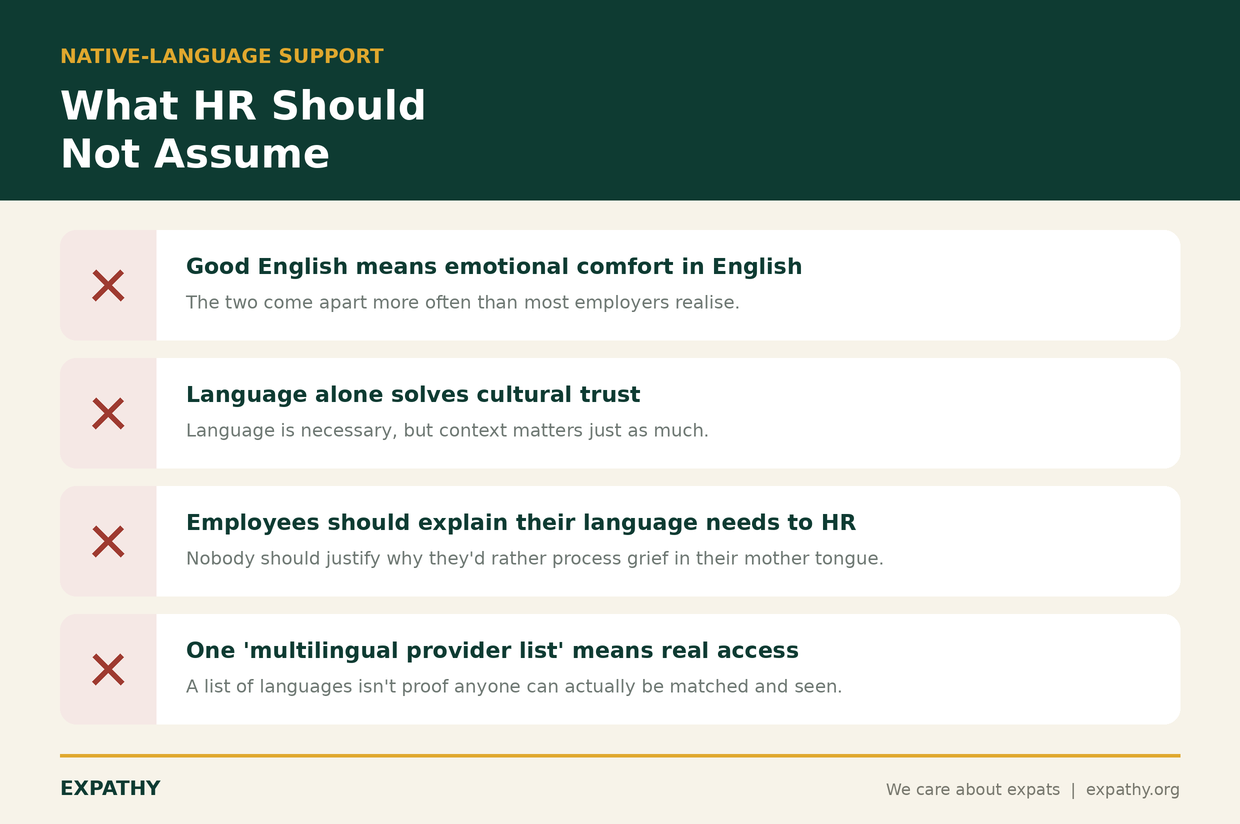
This is where good intentions quietly go wrong. A few assumptions are worth naming and setting aside:
- Do not assume good English means emotional comfort in English. The two come apart more often than most employers realise.
- Do not assume language alone solves cultural trust. Language is necessary but not sufficient; context matters too.
- Do not make employees explain their private language needs to HR. Nobody should have to justify to their employer why they would rather process grief in their mother tongue. The benefit should simply make it available.
- Do not treat one "multilingual provider list" as real access. A list of supported languages is not proof that any given employee can actually be matched and seen in theirs.
Why it works as an employee benefit
Step back to the business logic. A mental health benefit only returns value if people use it, and international employees use support far more when it fits their language and their situation. Offering therapy in an employee's native or preferred language is not a luxury add-on for a global team; it is often what turns a benefit from decorative into real.
This is the same usage logic that drives the cost of poor mental health among international employees: support that does not fit does not get used, and support that does not get used returns nothing. Native-language access is one of the clearest ways to close that gap.
A brief but important note on privacy: offering this as a benefit does not mean HR sees inside it. The company should see usage and access patterns, whether the benefit is reaching people, in which languages, in which locations, and never the content of anyone's therapy. Confidentiality is part of what makes employees willing to use it at all.
What to look for when offering it
If you are considering it as a benefit, this is what real native-language support looks like, as opposed to a language line with good marketing:
- Direct therapist matching in the employee's language, not interpreters or translation.
- Genuine cultural understanding, not just a language ticked on a list.
- A language range that matches your actual workforce, not a short default set.
- Clinicians who understand the expat experience, so the context does not have to be taught.
- Clear confidentiality, so employees trust the benefit enough to use it.
The benefit that gets used
The entire point of a mental health benefit is that people reach for it when they need it. For a global team, native or preferred language and cultural understanding are often what make that happen, the difference between support that sits unused and support that actually holds someone up on a hard night.
This is exactly what Expathy is built for. We match international employees with licensed psychologists who work in their native language and understand the expat experience first-hand. Explore mental health support for international employees.
Frequently asked questions
What is native-language therapy?
It is mental health support delivered in a client's native or preferred language, by a therapist who works directly in that language and understands their cultural context. It differs from translated materials or interpreter-assisted sessions, because the clinical work itself happens in the employee's own language, with no intermediary layer.
Why does therapy work better in a person's native or preferred language?
Because emotion and language are closely linked. People tend to experience and express feelings most fully in the language those feelings were formed in, usually their first. Working in a second language can add emotional distance and mental effort exactly when someone is least able to spare it, so therapy in a native or preferred language often feels safer, more precise, and easier to engage with.
Our employees speak good English, do we still need this?
Quite possibly, yes. Professional fluency and emotional fluency are different. Someone can lead meetings confidently in English and still struggle to reach or express difficult feelings in it. The language a person works in is not always the language they process grief, shame, or fear in, and therapy depends on the latter.
Is native-language therapy the same as having an interpreter?
No. An interpreter introduces a third person into what is meant to be a private, intimate conversation, which changes the dynamic entirely. Native-language therapy means the therapist works directly in the client's language, so nothing has to pass through a translator, and nothing of the relationship is lost in between.
Why does cultural understanding matter alongside language?
Because language carries context. A clinician who understands the employee's cultural background can grasp family dynamics, social expectations, and the specific pressures of living abroad without needing them spelled out. Shared language makes the conversation possible; cultural understanding makes it land. Together they make support feel genuinely safe rather than merely available.
Is it worth offering native-language therapy as a company benefit?
For a genuinely international workforce, often yes. A mental health benefit only delivers value when people use it, and usage rises sharply when support fits an employee's language and situation. Native-language access is one of the most direct ways to make sure the benefit you are paying for actually reaches the people it is meant for, while confidentiality keeps therapy content private from the employer.
Need support? We're here.
Book a free 15-min consultation with our expat-specialized therapists.