
Key takeaway
A standard employee assistance program can look like full mental health coverage on paper and still barely be used by your international staff. The reason is not that expats need help less. It is that a generic EAP was built for a domestic workforce, and it quietly misses the language, cultural, and relocation realities of working abroad. This article explains why that gap opens, what it costs, and how to tell if it is happening to your own team.
Picture how it usually goes. An expat employee, six months into a hard adjustment, finally calls the EAP line about the homesickness that has been flattening them for weeks. They reach a kind, competent counsellor who does not speak their first language and has never lived through what they are describing. The employee spends the call translating their own grief into a second language, feels politely misunderstood, thanks them, and hangs up. They never call again. On the company's dashboard, that shows up as one contact. In reality, it is one person deciding the support is not for them.
The problem hiding in your usage numbers
Generic EAPs are underused to begin with. SHRM reports that EAP utilisation averages under 10% of employees, and for traditional providers the figure commonly sits closer to 5%. Most of the workforce you are paying to cover never touches the service. The fix is not more reminders about the EAP, but an EAP alternative built for international employees from the start.
For international staff, it is usually worse, and the reason it stays invisible is that most companies measure access, not use by segment. If your provider only shows total company engagement, you cannot see that your expat population is barely represented in it. The number looks fine. The people it was meant for are missing from it.
Why generic EAPs fall short for expat employees
The failure is rarely about the quality of the counsellors. It is about a service designed around assumptions that do not hold for someone living and working far from home.
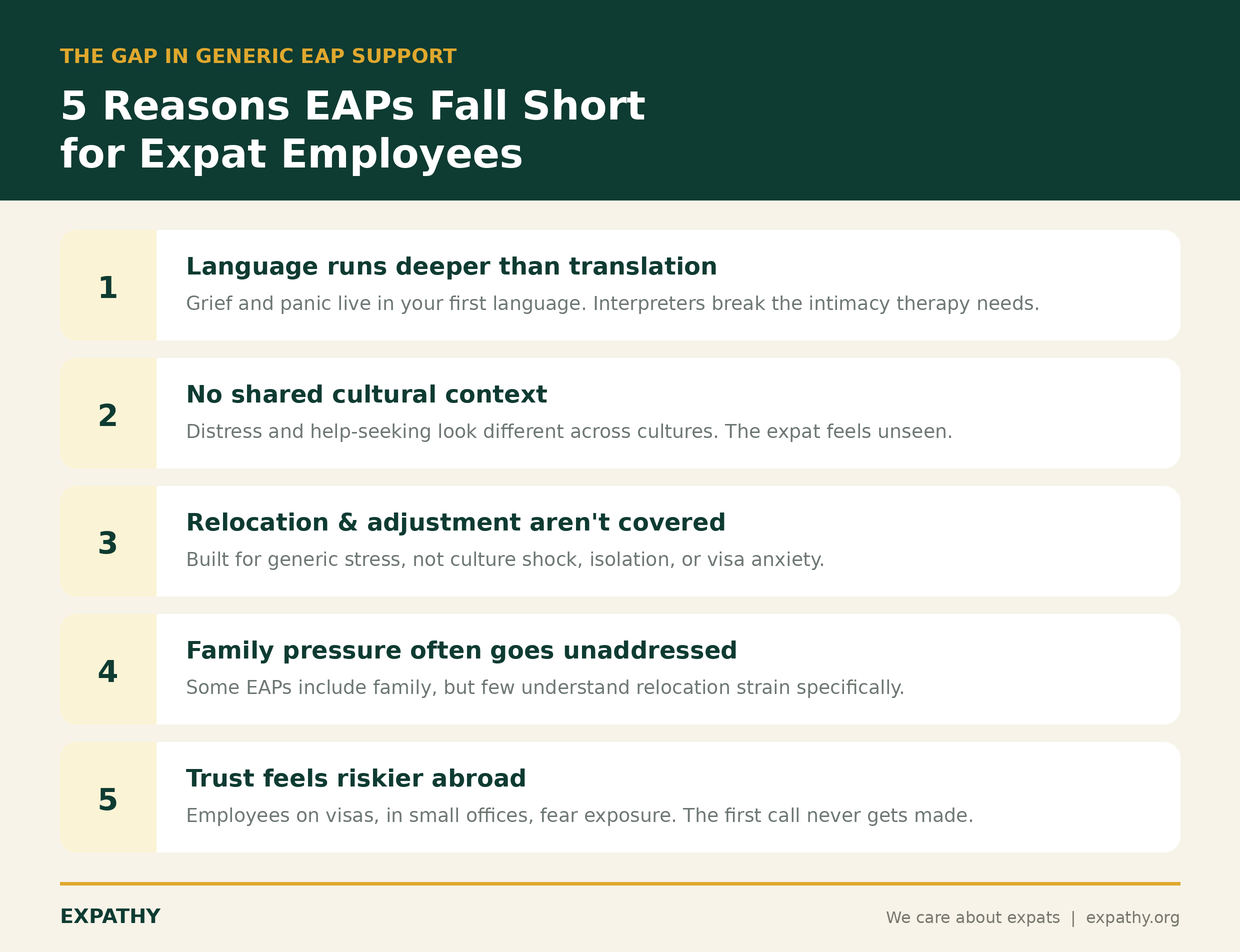
The language barrier goes deeper than translation
Processing panic, grief, or shame is not the same as ordering coffee. People do it in the language those feelings were formed in. Ask someone to do it in their second language and something flattens. The words arrive, but the weight behind them does not. Offering an interpreter does not fix this either, because a third person in the room breaks exactly the intimacy that therapy depends on. Faced with that, most people simply stop.
There is no shared cultural context
Distress does not look the same everywhere, and neither does asking for help. A counsellor working from one cultural frame can miss what a caller from another is actually signalling, or read ordinary cultural difference as a symptom. The expat on the other end feels subtly unseen, and feeling unseen by the person meant to help you is worse than not calling at all.
Relocation and adjustment are not on the menu
A generic EAP is built for generic stress: workload, conflict, general anxiety. It is not built for culture shock, for the specific isolation of a city where you know no one, for visa precarity, or for the strange grief of missing a home you chose to leave. These are the exact pressures driving an expat to call, and they are the ones a standard script is least equipped to meet.
Family and partner pressure often goes unaddressed
Relocation rarely lands on one person. The accompanying partner, often the one who gave up a job and a network, and the children adjusting to new schools, carry a large share of the strain, and when the household is struggling the employee is too. Many EAPs do offer some family access, so this is not a blanket gap. But general family counselling is a different thing from support that understands relocation pressure specifically, and that is the piece most often missing.
Trust and confidentiality feel riskier abroad
An employee on a visa, in a small local office, weighing whether to disclose that they are struggling, is doing a different risk calculation than a settled domestic worker. The fear of exposure is higher and the safety net is thinner. A distant, unfamiliar help line does not easily earn the trust that first call requires, so the call never gets made.
What it costs when expat support quietly fails
An unused benefit is not a neutral line item. It is a problem you are paying to not solve.
The people it fails are already the more exposed group. A joint study by Chestnut Global Partners and the Truman Group found expats at roughly 2.5 times the risk of anxiety and depression compared with domestic workers, and the same body of research links that strain to assignment failure rates that have been estimated as high as 40%. When support does not reach them, that risk does not disappear. It surfaces as disengagement, early returns from assignment, and the loss of expensive international hires you spent months relocating.
The World Health Organization estimates depression and anxiety cost the global economy US$1 trillion a year in lost productivity, and that every US$1 invested in effective treatment returns about US$4. A benefit no one uses captures none of that return.
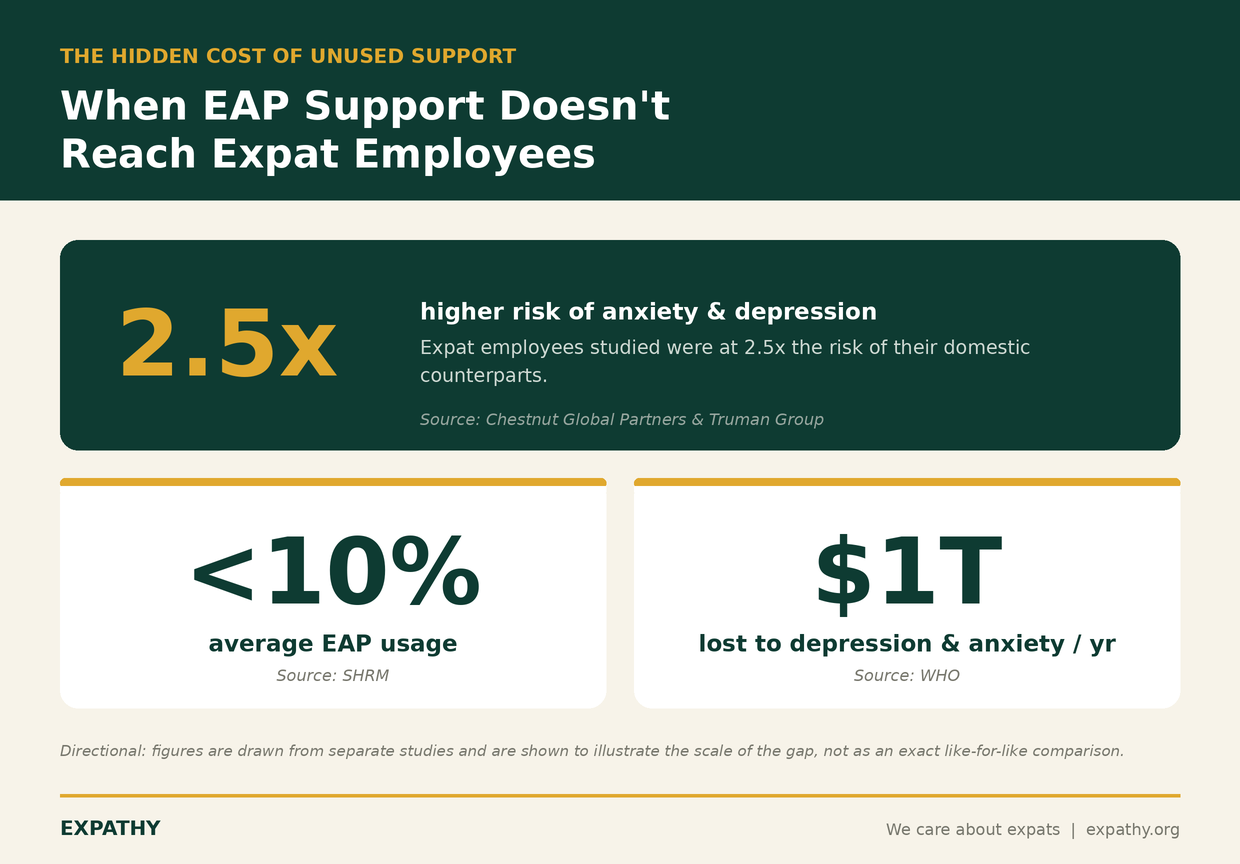
Read these as the stakes, not a sales pitch. The point is simple: the cost of support that quietly fails is not zero. It is just hidden.
What this means for how you support international staff
Understanding why a generic EAP falls short is the first step. The second is a separate decision: whether to supplement your existing EAP or replace it, and what to look for in a specialist provider. We cover that decision in full in what companies should know about EAP alternatives for international employees, so this piece can stay focused on the diagnosis.
The short version is that the fix is not usually to tear out your EAP. It is to add support that speaks your employees' language, understands the expat experience, and reaches the people the general service is missing.
If your EAP is not reaching your international employees, Expathy can act as the culturally aligned support layer around native language, relocation, and expat-specific care. Explore mental health support for international employees.
Frequently asked questions
Do expat employees actually use standard EAPs?
Often far less than the company assumes. General EAP utilisation already averages under 10% per SHRM, and international staff tend to use it even less, for reasons of language, cultural fit, and relevance. The usage frequently stays hidden because companies track total access rather than engagement broken down by international employees.
Why don't international employees use their EAP?
The most common reasons are that support is not available in their native language, the counsellor does not share or understand their cultural context, and the service does not address relocation, culture shock, or isolation. Add the higher confidentiality fears of employees on visas or in small offices, and many simply never make the call, or never make a second one.
Isn't an EAP with multiple languages enough?
Not necessarily. There is a real difference between being matched directly with a therapist who speaks your native language and being offered an interpreter or a phrasebook of supported languages. Emotional work depends on speaking freely and being understood without a middle layer. Language access on a feature list is not the same as native-language therapy in practice.
Does this mean we should cancel our EAP?
No, and for most companies that would be the wrong move. A generic EAP still does useful work for the general workforce. The question is usually whether to add a specialist layer for international staff rather than remove the EAP, which is a decision we walk through separately in our guide to EAP alternatives.
How do we know if our EAP is failing our international staff?
Ask your provider for usage broken down by international employees, language group, and location, not just total company access. If the international slice is thin or unavailable, that absence is itself the answer. Low engagement from the group most at risk is the clearest signal that the support is not reaching the people who need it.
Need support? We're here.
Book a free 15-min consultation with our expat-specialized therapists.