
Key takeaway
An EAP alternative for international employees is not necessarily a replacement for your existing provider. For most companies it means adding a specialist layer on top of a general EAP, so international and expat staff get support that matches their language, culture, and relocation reality, while the EAP keeps covering everything else. This guide walks through the real options, where a generic EAP still wins, and the exact questions to ask before you choose.
What is an EAP alternative, and why do international teams need one?
An EAP alternative is any support model a company adds or switches to when a standard employee assistance program is not meeting a group of employees' needs. It can mean replacing the EAP, but far more often it means supplementing it with something specialised for a specific population. Companies seeking a specialist alternative to a generic EAP are usually looking for support their international employees can truly trust, access, and use.
International and expat employees are one of the clearest cases. A standard EAP is built for a domestic workforce: help lines and short-term counselling, usually in the country's main language, delivered by clinicians who assume the caller shares their cultural context. That assumption breaks down for someone processing distress in a second language, adjusting to a new country, and far from any support network they trust. The support technically exists. It just does not fit.
We cover the reasons this gap runs deeper than language in a separate piece on why generic EAPs may not work for expat employees. Here, the focus is the decision: what your options are, and how to choose between them.
The main types of EAP alternative
There are four broad routes, and they are not mutually exclusive. They run roughly from most disruptive to least.
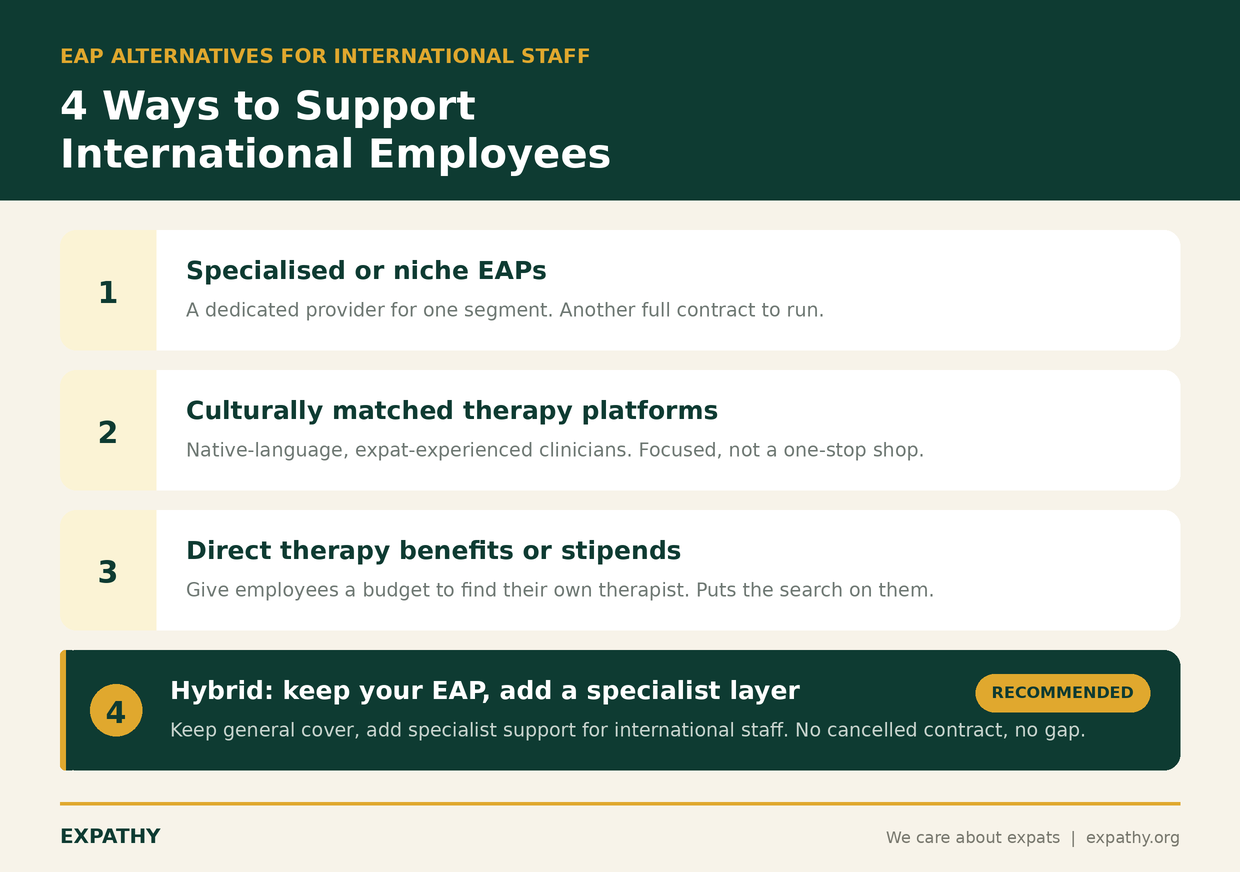
Specialised or niche EAPs
Providers built around a particular segment or need rather than the whole workforce. Who it suits: companies whose EAP is failing a defined group badly enough to justify a dedicated provider. Trade-off: another full contract to manage, and you may still need general cover for everyone else.
Culturally matched therapy platforms
Providers that match employees with licensed psychologists who share their native language and cultural background, and often have lived the expat experience themselves. This is the category Expathy sits in. Who it suits: companies with genuinely international staff where language and cultural fit are the core problem. Trade-off: focused on the international population, not a one-stop shop for every HR need.
Direct therapy benefits or stipends
Give employees a budget and let them find their own therapist. Who it suits: smaller or highly distributed teams where no single provider fits everyone. Trade-off: puts the search burden on the employee, which is exactly the barrier many international staff struggle with in the first place.
Hybrid: keep your EAP, add a specialist layer
Keep the general EAP for what it does well, and add a specialist provider for your international and expat staff. Who it suits: most companies, honestly. Trade-off: two providers instead of one, but no cancelled contract, no gap in coverage, and no forcing a whole workforce onto a service built for a subset of it.
For most organisations with a functioning EAP, the hybrid route is the sensible default. It treats the specialist support as an addition rather than a rip-and-replace, which is both lower risk internally and closer to what the situation actually calls for.
Generic EAP vs specialist international support: a comparison
Neither model wins outright. A generic EAP is broad and cheap per head; a specialist provider goes deep on a population the EAP was never designed for. An honest comparison looks like this:
| Generic EAP | Specialist international support | |
|---|---|---|
| Language access | Usually the country's main language | Native-language, matched to the employee |
| Cultural fit | Assumes shared context | Clinicians share cultural background |
| Relocation & adjustment | Rarely addressed | Core focus |
| Family & partner support | Sometimes included | Often included by design |
| Breadth of services | Broad: legal, financial, general counselling | Focused on mental health for international staff |
| Cost per head | Low | Higher per user, narrower population |
| Best for | General workforce support | International and expat employees |
The rows where the generic EAP wins are real. If you need legal and financial support, domestic counselling, and low cost across a whole workforce, a standard EAP does that well, and a specialist provider does not try to. That is the whole argument for keeping both.
When to supplement vs when to replace
Start from a bias toward supplementing. If your EAP is working for most of your people and simply failing your international staff, the answer is almost never to tear it out. Add the specialist layer for the group that needs it and leave the rest in place.
Replacing only makes sense in a few situations: the EAP is barely used across the board, the contract is up for renewal anyway, or your workforce is so international that the general provider is the wrong fit for nearly everyone. Outside those cases, replacement adds internal risk and disruption for little gain. Knowing when not to switch is worth as much as knowing when to.
Questions to ask before choosing a provider
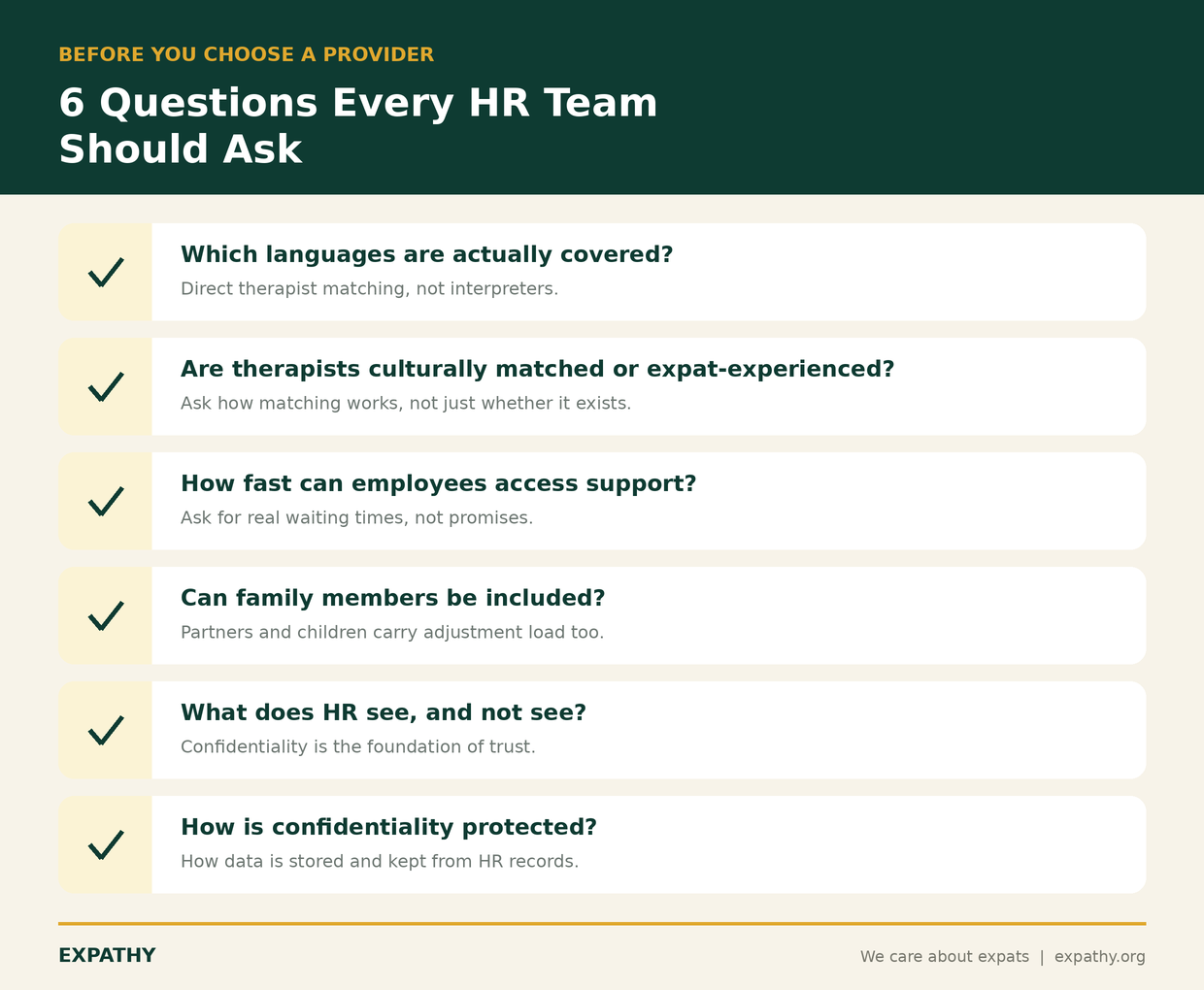
Whichever route you lean toward, these are the questions that separate a real specialist from a generic service with international branding. Weak answers here are a warning sign.
- Which languages are actually covered? Not "we support many languages" via interpreters, but which languages employees can be matched with a therapist in directly. Interpreters change the nature of therapy, and rarely for the better.
- Are therapists culturally matched or expat-experienced? A clinician who has lived abroad understands acculturation stress differently from one reading about it. Ask how matching works, not just whether it exists.
- How fast can employees access support? Ask for real waiting times. A benefit with a three-week queue is not there in the moment someone actually needs it.
- Can family members be included? The accompanying partner and children often carry heavy adjustment load. Ask whether cover extends to them, or stops at the employee.
- What does HR see, and not see? Confidentiality is the foundation of trust, especially for employees on visas. Ask exactly what is reported back to the company and at what level of aggregation.
- How is confidentiality protected? Beyond what HR sees, ask how data is handled, stored, and separated from employment records.
One more, on measurement: ask providers for usage broken down by international employees, language group, and location, not just total company access. Aggregate access numbers hide whether the people you bought the service for are actually reaching it. Industry data already shows how low general engagement runs. SHRM reports that EAP utilisation averages under 10% of employees, and traditional providers commonly see figures around 5%. If a provider cannot show you the international slice of their usage, assume it is lower still.
What good international mental health support looks like
Put the criteria together and a picture emerges: support in the employee's own language, from clinicians who understand the expat experience first-hand, accessible fast, extending to family, and protected by confidentiality employees actually trust. That is the standard worth holding any provider to, including us.
Expathy was built to be the specialist layer in exactly this picture. We match expat employees with licensed psychologists who share their native language and have lived the expat life themselves, alongside, not instead of, whatever general support you already offer.
Weighing up how to support your international staff without tearing out what already works? Explore Expathy's mental health support for international employees.
Frequently asked questions
What is an EAP alternative for international employees?
It is any support model a company adds to, or switches to from, a standard employee assistance program to better serve international and expat staff. In practice it usually means supplementing the existing EAP with a specialist provider offering native-language, culturally matched therapy, rather than replacing the EAP entirely.
Do we have to replace our EAP completely?
No, and most companies should not. If your EAP works for the general workforce and only falls short for international staff, the better move is to keep it and add a specialist layer for that group. Replacing outright makes sense mainly when the EAP is barely used or the contract is already up for renewal.
Why do international employees underuse standard EAPs?
General EAP utilisation is low to begin with, under 10% on average per SHRM, and often lower for international staff. The usual reasons compound for people working abroad: support is not in their native language, clinicians do not share their cultural context, and the service does not address relocation or adjustment. When the help does not fit, people simply do not use it.
What should we look for in a specialist provider?
Direct native-language matching rather than interpreters, therapists who are culturally matched or have lived the expat experience, fast access with short waiting times, cover that can extend to family members, and clear confidentiality. Ask each of these as a specific question and listen for specific answers.
Is specialist international support more expensive than an EAP?
Per user it usually costs more, because it goes deeper and serves a narrower population. But the comparison that matters is not cost per head, it is cost per person actually helped. A cheap benefit that international staff never use is not saving money, it is spending it on nothing.
Can we run a specialist provider alongside our existing EAP?
Yes, and for most companies this is the recommended approach. Keep the EAP for general, legal, and financial support across the whole workforce, and add a specialist provider for the international and expat staff who need language and cultural fit. You get full coverage without cancelling anything.
Need support? We're here.
Book a free 15-min consultation with our expat-specialized therapists.