
Key takeaway
International relocation can remove professional status without touching professional ability, and that gap is what turns a career downgrade abroad into an identity problem rather than a career problem. This article covers what status loss actually involves, why qualifications and reputation travel more slowly than you do, what the data show about occupational downgrading, why underemployment abroad costs more than salary, how to separate status loss from discrimination and from a genuine skill gap, and how to rebuild professional identity abroad. Across the EU in 2025, 41.4% of employed non-EU citizens with a degree were working below their qualification level. Start by separating what you actually need to learn from what is simply not being recognised yet.
Back home, people called you when they needed an answer.
You ran projects. You knew which rules could bend. Your qualifications meant something the moment you said them out loud. You walked into meetings knowing exactly what you were there to contribute.
Then you moved countries.
Now your degree needs assessing. Your references are from a market nobody here has heard of. Your network is three time zones away. You hesitate for half a second before speaking because you are doing it in your second language, and half a second is enough for someone else to take the floor.
Maybe the only work available is well below your previous level. Maybe someone introduces you at a dinner as "this is Alex, their partner works at..."
And a thought arrives that feels humiliating to admit:
Who am I here, if nobody can see the person I used to be?
What loss of status after international relocation actually means
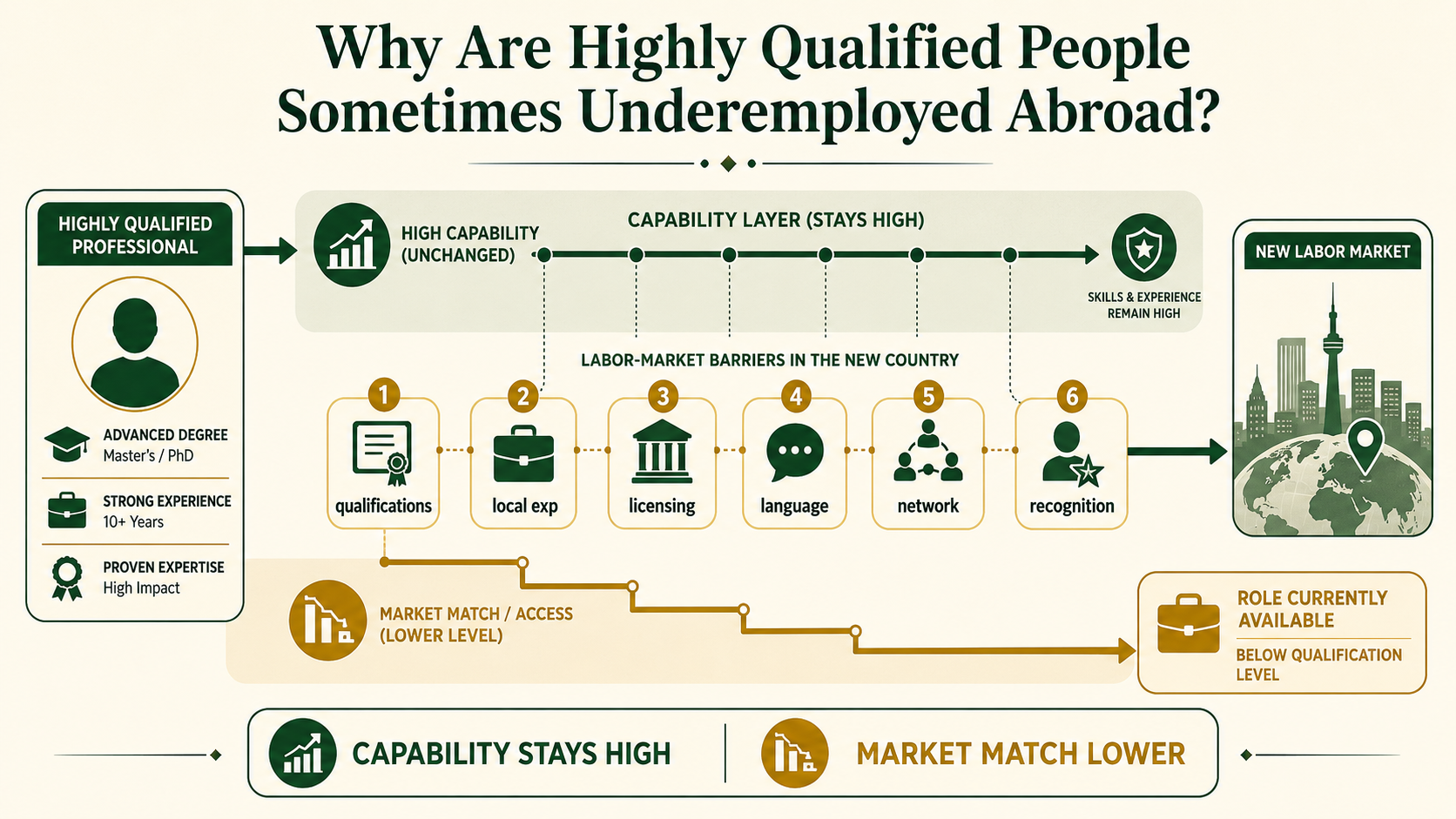
Loss of status after international relocation is the reduction of professional recognition, authority, income, autonomy or perceived competence that can follow a move abroad, even when the person's actual skills and experience are unchanged. It can involve a formal career downgrade, or simply an environment that no longer reflects back who you know yourself to be.
It rarely arrives as one clean event. It is usually several things at once: a lower-level role, less decision-making power, qualifications that need reassessing, a reputation that did not cross the border, a salary that no longer signals seniority, a network reduced to a contacts list.
Status loss is structural and subjective at the same time. There may be a measurable occupational downgrade. There is also the internal version, which is harder to name and often harder to bear.
Your expertise may not have disappeared. The environment's ability to recognise it may have changed.
This is a specific piece of the wider picture. If your questions are more about who you are becoming abroad in general, the broader territory is covered in Expathy's work on expat identity crisis and belonging abroad.
Why a career downgrade abroad can feel like losing part of yourself
Because professional status is rarely just a title. For most working adults it bundles together competence, autonomy, income, social recognition, daily structure, a professional community and a sense of forward direction. Relocation can remove several of those at once, which is why a career setback abroad often feels disproportionate to the job itself.
Think about what "what do you do?" has actually meant for you. Usually not an occupation. It stands in for years of training, a body of knowledge, a reputation you built slowly, and a place in a professional world where people knew what you were good at.
Remove the answer, and the question gets uncomfortable.
Understanding why status matters is not the same as saying status should determine human worth. Those are different claims, and collapsing them is how most advice on this topic goes wrong.
A career downgrade can feel like an identity downgrade even when your actual abilities have not changed at all.
Why relocation erases recognition faster than it erases expertise
Because recognition is built from local signals, and almost none of those signals cross a border intact. Qualifications need reassessing, reputation does not transfer, references come from an unfamiliar market, and the seniority encoded in your old job title may have no equivalent here. Your capability is portable. The evidence for it is not.
Foreign qualifications do not transfer cleanly
In regulated professions especially, a doctor, lawyer, psychologist, teacher or engineer may face credential assessment, licensing exams, supervised local practice or additional training before they can work at their previous level. Sometimes those requirements are legitimate. Sometimes they are slow, expensive, and function as a wall.
The OECD's Settling In 2023 report puts it bluntly: foreign degrees are devalued in virtually every labour market in the OECD.
Your reputation does not travel at the speed of your CV
At home, your standing accumulated over a decade through work people saw. Abroad, you arrive as a document. Your CV travels faster than your reputation, and reputation is what actually gets you taken seriously.
"You need local experience"
The phrase that makes internationally experienced professionals want to put their head through a wall. It is not always illegitimate. Local regulation, market knowledge and institutional norms are real. But hearing it repeatedly, from people who have not asked what you have actually done, has an effect on how you start to see yourself.
Titles and hierarchies do not map one to one
A "senior manager" in one market may carry the scope of a team lead in another, or the reverse. Nothing dishonest is happening. Two systems are simply not translating, and you are the one standing between them.
What the research shows about occupational downgrading
Working below your qualification level after an international move is not a personal failure, it is one of the most consistently documented patterns in migration research. Across the EU in 2025, according to Eurostat, 41.4% of employed non-EU citizens with a tertiary degree were working in low or medium-skilled occupations, against 20.0% of nationals.
Here is the part that tends to land hardest. Experience does not protect you. Among 35 to 64 year olds, the over-qualification rate for non-EU citizens rose to 44.1%, while for nationals in the same age group it fell to 19.3%. Mid-career is not a shield. In these figures it is a liability.
And the strongest predictor is not who you are. It is where your diploma was issued. OECD analysis of third-country nationals in the EU found that among people holding host-country degrees, over-qualification ran at 30% for non-EU nationals and 20% for nationals. Among the foreign-educated, it was 45% for both groups.
Read that again. Same country, same degree level, and the gap between citizens and non-citizens nearly vanishes once you hold the qualification constant. The labour market is discounting the passport of your diploma more than the passport in your pocket.
The broader OECD picture is that 47% of tertiary-educated immigrants in the EU are either over-qualified or not in employment, compared with 30% of the native-born. A host-country degree closes about three quarters of that over-qualification gap EU-wide.
One important limitation. These datasets track immigrants, foreign-born workers and non-EU citizens. They are not studies of self-described expats, and the two populations are not identical in income, legal security or choice. The mechanisms, though, are the same ones: credential recognition, local experience requirements, network loss and language. That is why the numbers are useful here, and why they should not be relabelled.
When nearly half the foreign-educated graduates in a labour market are working below their level, the explanation stops being individual.
Why working below your qualifications hurts more than the pay cut
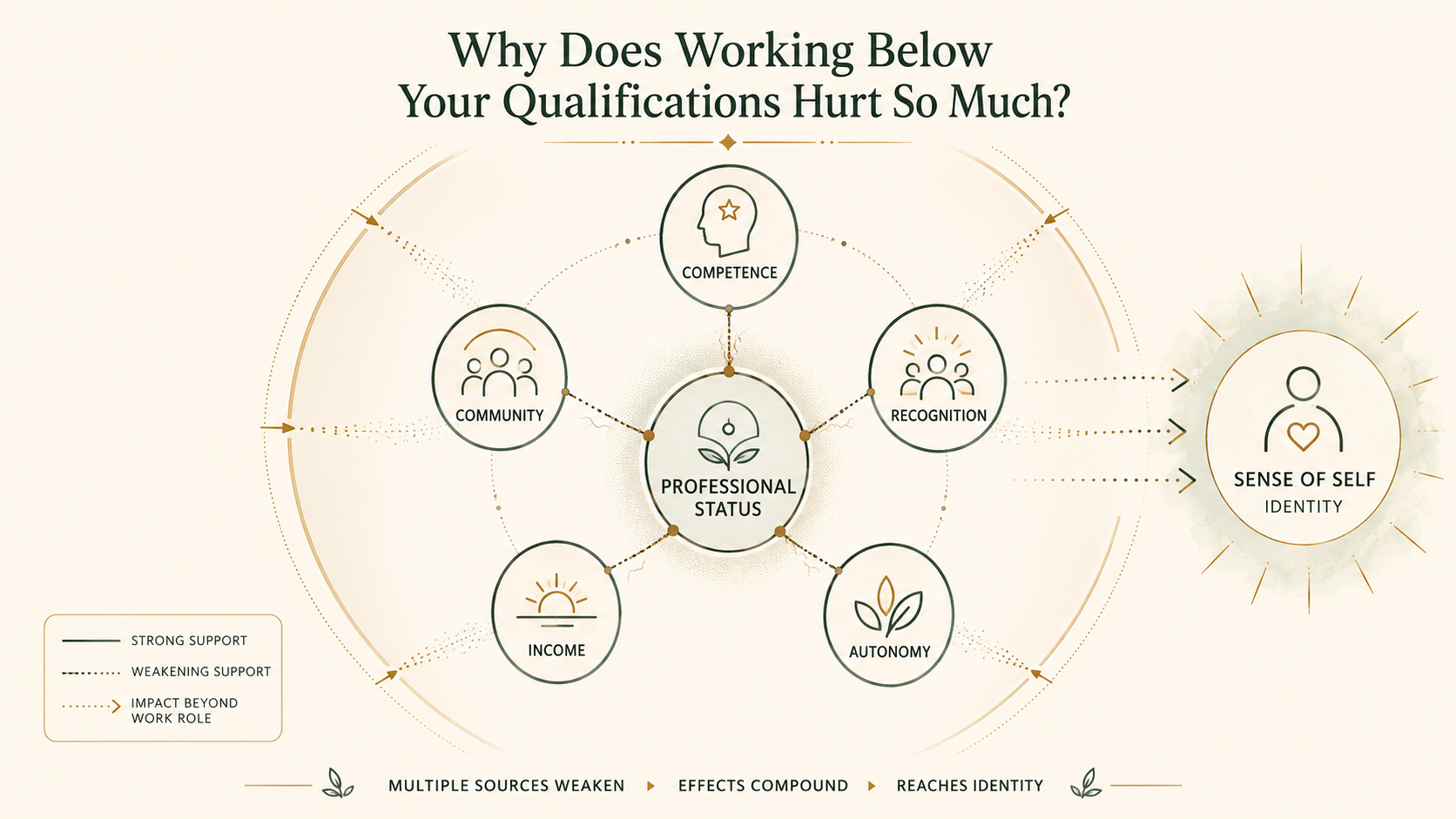
Because underemployment removes the daily experience of being good at something. A job that uses a fraction of what you know gives you fewer chances to feel competent, fewer problems worth your judgment, and fewer moments where someone turns to you as the person who knows. Salary is the visible loss. Skill underuse is the one that erodes identity.
The evidence base here is substantial. A 2025 meta-analysis in the Journal of Management, published under the excellent title Capable Fish or Deficient Ponds?, pooled 704 effect sizes from 251 independent samples covering 87,229 people. Its conclusion is more nuanced than the usual story: feeling overqualified is not uniformly damaging, and outcomes depend heavily on context, culture and the conditions of the job itself.
That nuance matters for you. It means being overqualified abroad is not a sentence. It also means the conditions around the role, whether you have any autonomy, whether anyone uses your expertise, whether the situation looks temporary, do a lot of the work in determining how much damage it does.
Broader syntheses of the field, including the Annual Review of Organizational Psychology, link overqualification to job attitudes, wellbeing and turnover across many studies. Most of this research is correlational, so it shows patterns rather than proving one thing causes another.
Being overqualified for your current job does not erase the years in which you became qualified.
Why "you should be grateful to be here" makes it harder
Because gratitude and grief are not mutually exclusive, and being told otherwise removes your permission to name a real loss. Many internationally relocated professionals feel unable to say any of this out loud. The move was voluntary. The city is desirable. The household is financially fine. Friends back home think the whole thing looks enviable.
So the complaint gets swallowed. Other people would give anything for this life. Why am I upset about a job title?
Because you did not only lose a job title. You lost independence, competence, professional community and a sense of where you were heading. Those are not vanity items.
You can be genuinely glad you moved and genuinely be grieving what the move cost you. Holding both is not ingratitude. It is accuracy. If that contradiction is what is keeping you awake, Expathy's piece on cognitive dissonance in expat life goes further into the mechanics of it.
Losing financial independence, and when your partner's career rises while yours falls
Financial dependence can alter identity even when household income goes up. This is the part people miss. The family may be better off than ever, and the person who previously earned their own money can still lose autonomy, bargaining power, spending freedom, daily structure and the quiet self-respect of being self-supporting.
Then there is the comparison problem. One partner receives the international promotion, the relocation package, the new network, the interesting problems. The other is retraining, job hunting, or working somewhere that uses none of what they know.
Nobody is at fault. The successful partner has done nothing wrong. But the asymmetry is felt daily, at every dinner where their week is more interesting than yours.
The identity question is not "why does my partner get to succeed." It is "who am I in this household now that the work which made me independent is gone." If you moved primarily for a partner's role, that specific experience has its own territory in Expathy's page on trailing spouse and expat partner stress.
Can working in a second language make an expert feel like a beginner?

Yes, and it is one of the most misleading effects in professional life abroad. You may know the answer precisely and still deliver it with simpler vocabulary, more hesitation, less humour and less rhetorical force. Listeners often read fluency as competence, so a highly experienced professional can come across as junior.
You are not saying less because you know less. You are saying less because saying it costs more.
Reduced fluency is not reduced expertise. But in a fast meeting, other people cannot tell the difference.
The specifics of operating professionally in another language are covered separately in Expathy's guide to language barriers for expats.
Is it status loss, discrimination or a genuine skill gap?
Usually it is some combination, and separating the three is the most useful thing you can do. Some requirements are real: local law, licensing, market knowledge, different technical standards. Some devaluation is unfair: foreign experience discounted by default, accents read as lower competence, credentials dismissed without assessment. Both can operate on the same application.
A mixed-methods study of skilled immigrants in British Columbia, published in Comparative Migration Studies, surveyed 111 people and ran focus groups with 18 more. Deskilling was significantly associated with non-recognition of foreign credentials, and participants described what the researchers called the illusory nature of meritocracy in hiring. The population is skilled racialized immigrants in Canada, not expats generally, and the barriers they face are not identical to everyone's.
Do not default to assuming discrimination. Do not default to assuming you simply need to try harder.
A fair assessment separates what you genuinely need to learn from what this environment is failing to recognise.
If exclusion and bias have become the core issue rather than a background factor, that belongs in different territory, and Expathy covers it in discrimination and mental health support.
Why under-recognition can become self-reinforcing
Because structural barriers produce psychological effects, and those effects then make the barriers harder to clear. The loop is predictable: fewer opportunities to demonstrate expertise, reduced confidence, less assertiveness in the rooms that matter, fewer opportunities still. Or: repeated rejection, lowered expectations, accepting a role far below your level, and a professional identity that quietly shrinks to fit.
This is not a claim that mindset causes labour-market disadvantage. The barriers are real and documented. It is a claim that the two feed each other.
Eventually a more corrosive thought shows up: maybe I was never as good as I thought I was.
Interrogate that one properly. What did you demonstrably accomplish before you moved? Which of those skills are transferable and which are genuinely tied to a system you have left? How much of the current gap is language, how much is local knowledge, and how much is simply not being seen yet?
Evidence about this environment is not evidence about your lifelong competence. They get confused because they arrive through the same door, which is other people's reactions to you.
If your current job title vanished from the conversation entirely, what evidence would still show that you are an experienced professional?
Why "your job does not define you" is not enough
Because it answers a question nobody asked. Told to someone who has lost independence, expertise, recognition, income and a professional community, it lands as dismissal. It quietly implies that caring about your career was the mistake, which is both untrue and unhelpful.
The useful goal is different: broaden identity without denying that professional identity mattered.
You are not trying to stop caring about work. You are trying to stop one disrupted role from functioning as proof that the whole self has disappeared.
| What changed after relocation | What it can feel like |
|---|---|
| Qualifications not recognised | "My past no longer counts" |
| Lower-level role | "I have gone backwards" |
| Loss of independent income | "I am no longer my own person" |
| Working in a second language | "I sound less capable than I am" |
| Network left behind | "Nobody here knows what I can do" |
| Partner's career dominates | "I am an extension of someone else's life" |
How do you rebuild professional identity after moving abroad?
By reconstructing the internal evidence first, because the external evidence is going to take longer than you want. This is identity work rather than job-search tactics. Five moves do most of the load.
Separate competence from current title
Write down what remains true regardless of what your contract says: what you have built, solved, managed, published, fixed. This is not a confidence exercise. It is a record, and records survive bad job markets.
Keep evidence of continuity
Stay attached to your professional world. Read the literature. Keep the memberships. Answer the old colleague who still emails you for advice, and notice what it feels like when they do. The point is not networking. It is refusing to let the connection lapse while the local market catches up.
Be a beginner in one system without becoming a beginner everywhere
You may genuinely be new to this country's regulatory framework, hiring norms or professional culture. You are not new to your profession. Keep those two facts in separate boxes, because the first one has a habit of colonising the second.
Build more than one load-bearing wall
Relationships, community, interests, values, the things you are good at outside work. Not as a replacement for professional identity, which would be its own kind of loss, but so that one disrupted role is not carrying the entire structure. If purpose more broadly has gone missing, Expathy covers that in finding purpose abroad.
Decide which losses are temporary and which you will not accept long term
A step backwards can be a reasonable entry cost. A permanent mismatch is a different decision. Being honest about which one you are in is more useful than optimism.
Starting again is not starting from zero
You may be rebuilding in one system. You are not rebuilding as a person. Network, local credibility, licensing, language and market knowledge genuinely have to be built again. Experience, technical knowledge, judgment, the mistakes you already made and learned from, and the cross-cultural competence you are acquiring right now do not reset.
A 2024 qualitative study in the European Journal of Work and Organizational Psychology examined skilled migrants building alternative careers and found active identity work and meaning-making running through their accounts, rather than simple resignation. People were not just absorbing a downgrade. They were reconstructing what their working life was for.
You may be starting again in one system. You are not starting again as a person.
Sometimes the old career does not fully come back, and it is dishonest to promise otherwise. People change professions, decline to requalify, prioritise family, discover something that suits them better, or accept permanently lower earnings for a life they prefer. When that happens the question shifts from how do I get back to where I was to which parts of that old identity do I actually want to carry into what comes next.
Does career status loss mean moving abroad was a mistake?
No, not automatically, but it is a fair question to ask honestly rather than suppress. Status loss can be a temporary entry cost, a recoverable setback, an acceptable trade for something you value more, or a genuine long-term mismatch with the life you want. Those four situations look similar in month six and very different in year four.
The distinction worth drawing: are you in a transition, or in a permanent arrangement you have not admitted to yet? Transitions are survivable in a way that indefinite states are not.
If the question has genuinely shifted from your career to the relocation decision itself, that is a separate conversation and deserves its own thinking rather than being answered in a bad week.
When status loss becomes something more serious
Status loss is a life event, not a diagnosis, and most of it resolves as you rebuild. It is worth taking more seriously when it comes with persistent hopelessness, severe shame, chronic anxiety, withdrawal from people, deteriorating relationships, an inability to make decisions, or a sense of being trapped that does not lift.
One clarification that matters: this is not burnout. Burnout is an occupational phenomenon arising from chronic workplace stress. You can experience severe status loss with no job at all. You can also be highly respected and thoroughly burned out. If the primary issue is losing the job rather than losing standing, Expathy covers that in the mental health toll of expat job loss.
How therapy can help with professional status loss abroad
Not by advising you on your career. A therapist should not be picking your next role, your industry, or whether to stay in the country. What therapy can do is work on the part career advice cannot reach: why status mattered to you specifically, which parts of your professional identity are still intact, the shame and comparison, the grief for a role you may not get back, and whether your current compromise is a temporary cost or something psychologically unsustainable.
It can also help you hold the honest version of the picture, in which structural barriers are real and your response to them is shaping what happens next.
You may not need someone to tell you to stop caring about your career. You may need help separating a changed professional role from a verdict on your entire worth.
Expathy matches internationally mobile people with psychologists who have lived abroad themselves, by native language and cultural background, which means the professional problem and the international identity problem can be worked through in the same conversation instead of explained from scratch. You can start with online therapy for expats and a free introductory session.
Frequently asked questions
Can moving abroad cause a loss of professional identity?
Yes. International relocation can remove several identity supports at once: job title, recognised qualifications, professional network, income, authority and the ability to communicate with your usual confidence. Because professional identity is built from those external signals as well as internal ability, losing them can feel like losing part of yourself even though your expertise is intact.
Why do I feel less successful after moving abroad?
Usually because the local environment cannot yet read the evidence of your success. Reputation, references and qualifications are locally validated, and almost none of that validation transfers automatically. The feeling reflects a change in recognition, not a change in what you can do.
What is occupational downgrading after international relocation?
Occupational downgrading is moving into work below your previous skill or responsibility level after relocating. It is measured in labour statistics as over-qualification: holding a tertiary degree while working in a low or medium-skilled occupation. Eurostat data for 2025 put this at 41.4% among employed non-EU citizens in the EU, against 20.0% of nationals.
Why am I working below my qualifications abroad?
Common reasons include qualifications requiring formal recognition or licensing, employers preferring local experience, a professional network that did not relocate with you, working in a second language, and outright devaluation of foreign credentials. OECD analysis found that where a degree was earned predicts over-qualification more strongly than nationality does.
Can foreign qualifications lose value after moving countries?
In practice, frequently. The OECD has found that foreign degrees are devalued in virtually every labour market across its member countries, and that holding a host-country degree closes roughly three quarters of the over-qualification gap EU-wide. This is a feature of how labour markets assess credentials, not a judgment on the quality of your education.
Why does being overqualified for my job affect my confidence?
Because competence is maintained by using it. A role that engages a fraction of your knowledge offers fewer chances to solve problems worth your judgment and fewer moments where others treat you as the expert. Research on perceived overqualification links it to job attitudes and wellbeing, though outcomes vary considerably depending on autonomy, context and whether the situation appears temporary.
Is it normal to feel like a failure after moving abroad for career reasons?
Yes, and it is worth challenging the word. Feeling like a failure after a career setback abroad is extremely common, particularly when the move looked like an upgrade from the outside. Given how consistently occupational downgrading appears in migration data, the outcome is closer to a structural pattern than a personal verdict.
How can I rebuild my professional identity abroad?
Start internally: document what you have actually accomplished, stay connected to your professional field, and keep "new to this system" separate from "new to this profession." Build identity sources beyond work without abandoning professional identity, and decide clearly which losses you accept as temporary and which you will not accept permanently.
What if my partner's career is thriving while mine has disappeared?
This asymmetry is common and painful, and it is not a sign that either of you did something wrong. The useful question is about your own position rather than the comparison: what did your work provide that you have now lost, and how much of that can be rebuilt or replaced here. Where the move was primarily for a partner's role, the accompanying-partner experience has its own dynamics worth addressing separately.
Can therapy help with loss of professional identity after relocation?
Yes, when the aim is identity rather than career strategy. Therapy can help you understand why status mattered to you, work through shame, grief and comparison, distinguish what the environment is failing to recognise from what genuinely needs rebuilding, and judge whether the current situation is a survivable transition or an arrangement you should not accept long term.
Need support? We're here.
Book a free 15-min consultation with our expat-specialized therapists.