
Key takeaway
International school mental health support only works when it covers both sides of the building. Students arrive carrying relocation stress, language anxiety, and the exhaustion of repeated goodbyes. Teachers and staff are expected to notice all of it while managing their own move, their own workload, and their own distance from family. A school cannot build a strong student wellbeing system on top of an unsupported staff room.
A Year 8 student stops raising her hand. She used to be one of the first. Her homework is still submitted, still neat, still on time, so nothing triggers an academic flag. Three months later her form tutor mentions in passing that she has not spoken to anyone at break for weeks. The tutor noticed early. What was missing was not attention. It was a clear next step, and someone with the training to take it.
That gap is where most international school wellbeing systems quietly fail. Not at noticing. At what happens next.
Why International Schools Face Different Mental Health Challenges
International schools operate under conditions that local schools rarely face at the same intensity: high family mobility, multilingual classrooms, staff recruited from a dozen countries, and students who may change schools every two or three years. ISC Research has reported the sector at more than 14,000 English-medium international schools serving over 7 million students worldwide, and turnover is built into the model.
That churn creates a specific psychological load. A child who moves every three years does not simply change classrooms, they rebuild an entire social identity from scratch, repeatedly, during the exact developmental years when belonging matters most. The same is true for their parents, and often for the teacher standing at the front of the room, who arrived last August and is still learning the local language for pharmacy visits and rental contracts.
Local support systems rarely absorb this. Public mental health services are typically organised around residents, delivered in the national language, and accessed through waiting lists that outlast a two-year posting. A family in month four of culture shock as an expat is not going to wait eleven months for a first appointment in a language they do not yet speak.
The Mental Health Challenges International Students May Hide

International students often mask distress rather than express it, because visible struggle can feel like failure to adapt in an environment where everyone appears to be coping. The World Health Organization reports that half of all mental health conditions begin by age 14, and that most cases go undetected and untreated. In mobile school communities, detection is harder still.
What tends to sit underneath the surface:
- Culture shock, which follows a predictable curve of excitement, frustration, and gradual adjustment, and which children experience without the vocabulary adults use to name it
- Homesickness for a place, a grandparent, a bedroom, or a version of themselves that no longer exists
- Loneliness, particularly in the first term and again after a close friend leaves mid-year
- Language anxiety, where a student understands the material but cannot risk the sentence
- Identity and belonging questions, sharpened when a student is neither fully from the passport country nor from the host country
- Academic pressure, often intensified by parents who moved specifically for this education
- Bullying or exclusion, which UNESCO has estimated affects almost one in three students globally
- Family stress, including parental relocation strain, an unemployed accompanying partner, or a parent travelling constantly
- Repeated transitions, where each new arrival costs a little more than the last
Students rarely announce a crisis. They lower their hand, arrive late, stop eating lunch with anyone, and wait to see if a single adult notices.
Why Teachers Are Often the First to Notice
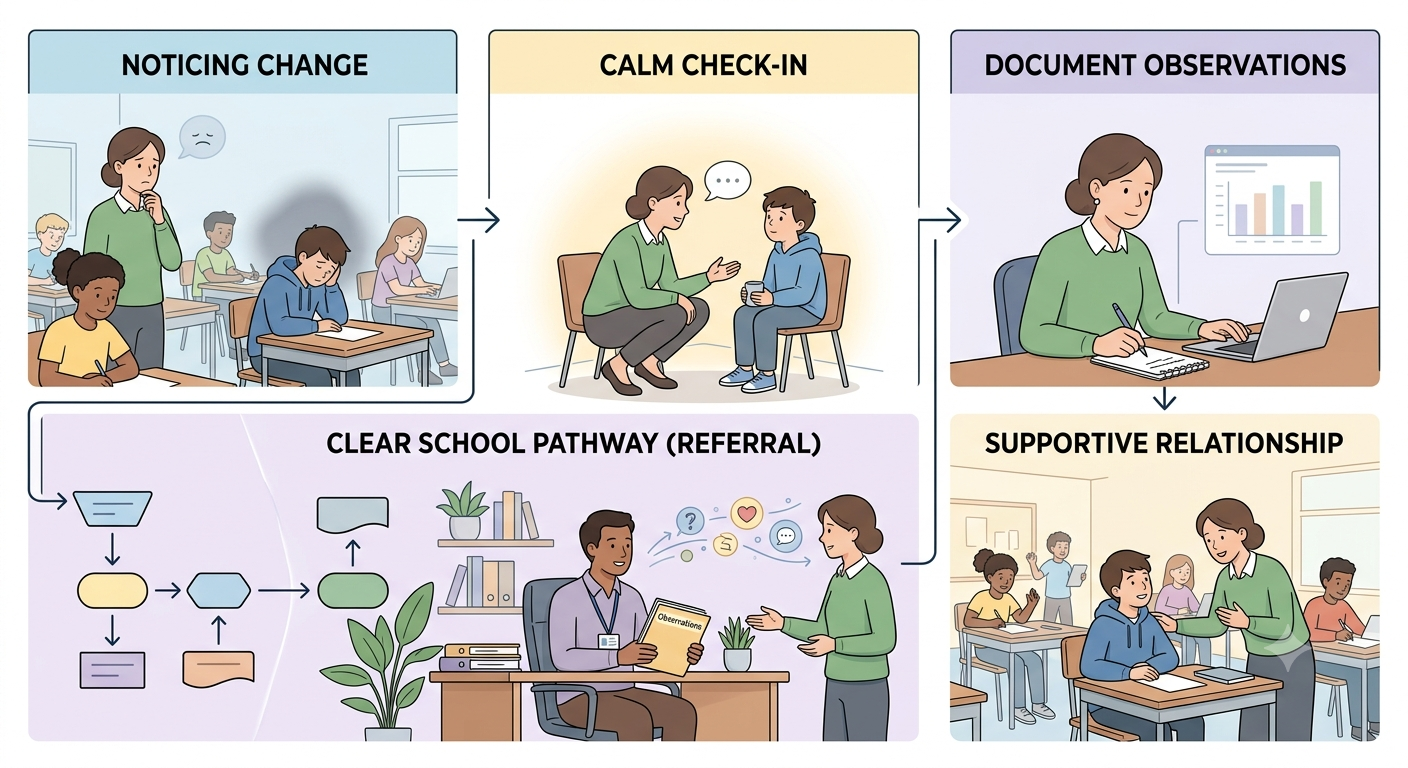
Teachers see students across time, context, and mood in a way parents and counsellors cannot. They see the Tuesday version and the Friday version, the group-work version and the alone version. This makes teachers the most reliable early warning system a school has, provided they know what they are looking at and what they are supposed to do about it.
Changes worth taking seriously:
- Withdrawal from friendship groups, or a sudden change in who a student sits with
- Falling participation from a student who used to contribute
- Irritability, tearfulness, or emotional flatness
- Perfectionism and visible distress over small errors
- Frequent physical complaints, especially headaches and stomach pain
- Declining performance that does not match known ability
- Increased absence, late arrival, or long absences from class to use the bathroom
- Sudden friendship breakdowns or social exclusion
Here is the boundary that protects everyone, including the teacher: notice and refer, do not diagnose and do not treat. A teacher's job is to observe accurately, respond warmly, document factually, and hand over quickly. The moment a teacher starts carrying a student's clinical need personally, two people are at risk instead of one.
A workable referral sequence looks like this:
- Observe and record. Write what you saw and when, in behavioural terms, not interpretation. "Has not spoken in group work for three weeks" rather than "seems depressed."
- Check in briefly and without pressure. One open question, no interrogation, no promises of secrecy you cannot keep.
- Refer the same week. Pass to the counsellor or wellbeing lead through the school's named pathway, not by informal corridor mention.
- Confirm the handover was received. A referral that disappears into an inbox is not a referral.
- Stay warm, stop carrying it. Continue the ordinary relationship. Let the clinical work sit with the clinical staff.
This is exactly the territory covered in structured manager and staff training for international teams, where the goal is confident early response rather than amateur therapy.
The Pressure on International Teachers and School Staff
Relocated teachers are asked to hold student distress while going through the same adjustment themselves, usually with less support than the students get. They teach in a second language, navigate an unfamiliar system, absorb daily emotional labour, and do it several thousand kilometres from their own support network. The result is a workforce at genuine burnout risk.
What stacks up:
- Teaching, marking, and pastoral care delivered in a second or third working language
- Relocation logistics, visas, housing, banking, and healthcare registration in the first months
- Cultural misunderstandings with parents, colleagues, or leadership, often invisible until they escalate
- Workload combined with constant emotional availability
- Supporting distressed students with no clinical training and no debrief afterwards
- Distance from family, and the guilt of missing illnesses, births, and funerals
- Accompanying partners who left careers behind and are struggling in a way that lands at home every evening
- Retention pressure, because every departure resets institutional knowledge and student relationships
The financial argument is not subtle. The World Health Organization has estimated that depression and anxiety cost the global economy around US$1 trillion each year in lost productivity. In a school, that cost shows up as sick leave, mid-contract resignations, recruitment fees, and the slow erosion of the very relationships that keep students safe.
Two pressures deserve specific naming, because schools consistently underestimate them: burnout among international employees, which builds quietly across a contract rather than arriving as a single event, and the accompanying partner's adjustment, which is one of the strongest predictors of whether a relocated teacher stays or leaves.
What a Strong International-School Mental Health System Includes
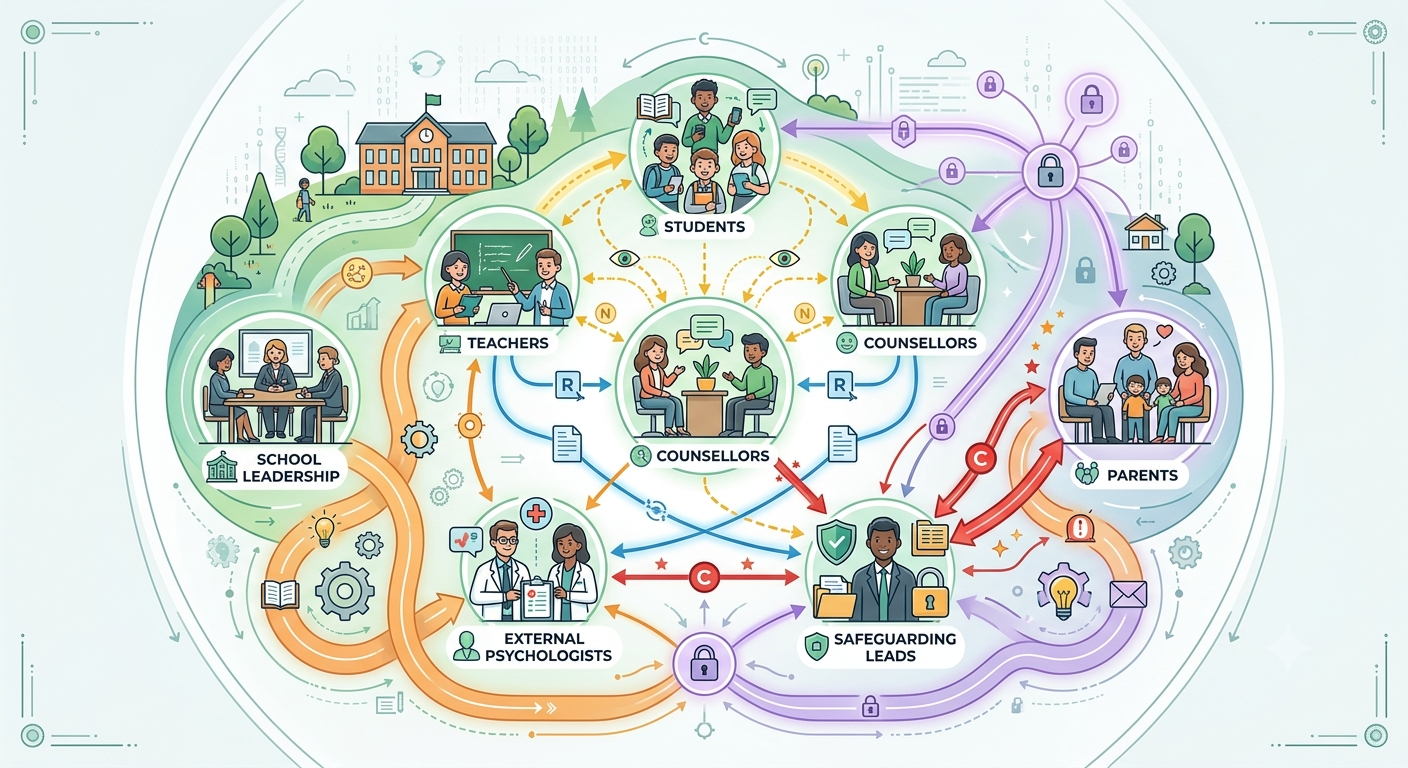
A functioning system is not a counsellor and a poster. It is a set of connected components with named owners, written pathways, and support that extends to staff as well as students. Most schools have some of these in place informally. The difference between a system and a set of good intentions is whether each piece works when the person who usually handles it is away.
| Component | What it must specify | Common failure point |
|---|---|---|
| Referral pathway | Who to tell, how, within what timeframe | Referrals passed verbally and lost |
| Staff training | Recognition, response, boundaries, escalation | One induction session, never repeated |
| Safeguarding process | Thresholds, documentation, statutory duties | Confused with general wellbeing concerns |
| School counselling | Capacity, caseload limits, languages offered | One counsellor for the whole school |
| External clinical support | Named provider, access route, waiting time | No provider identified until a crisis |
| Parent communication | Who contacts, in what language, with what framing | Parents told too late or too bluntly |
| Culturally sensitive practice | How distress presents across cultures | One cultural model applied to everyone |
| Crisis escalation | Out of hours contacts, local emergency routes | Written for the home country, not the host one |
| Staff and employee support | Confidential access, separate from line management | Assumed to be covered by the local insurer |
That last row is the one most schools leave empty. It is also the one that determines whether the other eight survive a difficult year.
How Mental Health Webinars Help International-School Teams

Webinars work in international schools because they solve the practical problem: getting an entire dispersed, timetable-locked staff body trained by a licensed psychologist without pulling teachers off timetable for a full day. Delivered live with Q&A, they give teachers usable language, clear boundaries, and a shared vocabulary that makes the referral pathway actually function.
What a well-designed session gives a school team:
- Early recognition, so staff can distinguish ordinary adjustment from a concern that needs escalation
- Response without overstepping, including what to say, what not to promise, and where the professional line sits
- A working understanding of culture shock and homesickness, including how both present differently by age and by culture
- Cross-cultural communication skills for conversations with students and with parents
- Personal wellbeing protection for staff absorbing distress all week
- Confidence about when and how to refer, which is where most well-meaning staff freeze
- Real case discussion with a psychologist, using the situations actually occurring in that school
The advantage of a provider who works with international populations specifically is that nobody has to explain the context first. The psychologist has personally lived the relocation, the language gap, and the distance from family.
Expathy delivers wellbeing webinars for international school teams, led by licensed psychologists who understand international life professionally and personally, with live Q&A, recordings, and take-away materials for staff who could not attend.
Supporting the Mental Health of International School Employees
Training changes what staff notice. It does not treat the member of staff who is themselves struggling. A teacher in month eight of a difficult posting does not need another slide deck, they need a confidential appointment with a psychologist who speaks their language and understands why the third missed family birthday hit harder than the first two.
This is the second layer, and it works differently from training on purpose:
- Access is confidential and individual, arranged through a private company access route rather than through a line manager or the head's office
- Sessions are delivered in the employee's native language, which matters because emotional precision does not survive translation
- The school receives aggregate usage data only, never names, never session content, never diagnoses
- It covers staff whose difficulty has nothing to do with work, which is most of them
Confidential therapy access for international employees is designed for exactly this: headcount-priced, native-language matched, and reported to the employer only in aggregate. Awareness training and clinical access are not alternatives. Training raises the number of people who realise they need help, and access is what those people find when they go looking.
What School Leaders Should Ask Before Choosing a Mental Health Partner
Ask questions that expose whether a provider genuinely understands international school life or has simply added the word "global" to a domestic offer. Most providers will pass the first two questions. The ones that matter are the confidentiality boundary, the language question, and what happens in the week after the session ends.
Before signing anything, ask:
- Does the provider understand international life directly? Have their clinicians relocated, taught, or worked abroad themselves, or are they reading about it?
- Are sessions delivered by licensed psychologists? Verify licensing and jurisdiction, not just job titles.
- Can content be adapted to teachers and school staff specifically? Corporate wellbeing material does not transfer to a Year 4 classroom.
- Are confidentiality boundaries written down? Ask precisely what the school will and will not receive about individual employees.
- Are employees supported in their native language? Ask how many languages, and whether matching is guaranteed or best effort.
- Are follow-up materials included? Staff who missed the live session still need the content.
- Is there a referral pathway after the webinar? A session that raises awareness with nowhere to send people creates demand it cannot meet.
Teachers are expected to notice distress, respond sensitively, support families, and keep teaching, usually without any specialist preparation for any of it. That is not a training gap. It is a design flaw in how most schools have built their wellbeing systems.
Give your staff the preparation the job actually requires. Expathy runs practical mental health webinars for international school teams, delivered by licensed psychologists who have lived international life themselves.
Frequently Asked Questions
What does international school mental health support actually include?
It includes four connected parts: student-facing counselling and referral pathways, staff training in recognition and response, confidential clinical access for employees, and clear crisis escalation procedures written for the host country. Schools frequently build the first part well and leave the third almost entirely to chance, which is what causes systems to fail under pressure.
Should teachers be trained to identify mental health problems in students?
Teachers should be trained to recognise warning signs and refer, not to diagnose or treat. Training should cover behavioural changes worth escalating, how to open a low-pressure conversation, what not to promise about confidentiality, and the exact referral route with a timeframe. Anything beyond that boundary puts both the student and the teacher at risk.
How is mental health support in an international school different from a local school?
Three factors change everything: mobility, language, and the absence of a usable local safety net. Students and staff turn over every two to three years, distress is often expressed in a second language, and public mental health services are typically organised around residents with waiting lists that outlast a posting. Support has to be internal, fast, and multilingual.
What are the signs an international student is struggling?
Common signs include withdrawal from friendship groups, falling classroom participation, irritability or emotional flatness, perfectionism, frequent headaches and stomach complaints, declining performance below known ability, and increased absence. In mobile school communities these often appear after a close friend departs mid-year, which is a predictable and preventable trigger point.
How can schools support the mental health of relocated teachers?
Start with practical relocation support in the first months, add structured training so staff are not improvising pastoral responses, and provide confidential clinical access that does not route through line management. Include accompanying partners where possible, since partner adjustment is one of the strongest predictors of whether a relocated teacher completes their contract.
Are mental health webinars enough on their own?
No. Webinars raise recognition and give staff a shared framework, which is essential but not sufficient. They increase the number of people who realise they need support, so a school running training without an access route creates demand it cannot serve. Training and confidential clinical access should be commissioned together.
How is confidentiality protected when a school pays for staff therapy?
Through separation of access and reporting. Employees book through a private company access code rather than through HR or leadership, and the school receives only aggregate usage figures such as total sessions used. No names, no session content, no diagnoses, and no attendance lists reach the employer at any point.
Who should attend a mental health webinar in an international school?
Teaching staff, form tutors, and heads of year first, since they have the most sustained contact with students. Then leadership, safeguarding leads, and counsellors, so pathways are understood consistently. Support staff, administrators, and boarding staff often see behaviour nobody else does and are frequently left out of training entirely.
How often should international schools run staff mental health training?
At least annually, timed to the start of the academic year so new arrivals are included, with a shorter refresher before the winter term when homesickness and seasonal difficulty typically peak. Schools with high staff turnover should treat it as part of induction rather than an optional professional development item.
Need support? We're here.
Book a free 15-min consultation with our expat-specialized therapists.