
Key takeaway
You can run a team, close deals and hold your own at a dinner party in your second language. Then a government letter arrives, and within thirty seconds you are a person who cannot work out what is being asked of them or what happens if they get it wrong. This article explains why official language is so much harder than ordinary conversation, how the experience differs across the Netherlands, Germany, France and the UK, what it quietly costs your confidence, and how to stop administration running your emotional life.
The envelope sits on the kitchen table for four days.
You know roughly what it is. You know it probably matters. You also know that opening it means an hour of translating, a deadline you might already have missed, and a phone number you do not want to call. So it stays there, and every time you walk past it you feel a small drop in your stomach.
Meanwhile, at work, you presented to fourteen people last Tuesday. In this same language. Nobody watching would have guessed you were operating in your second one.
Both of those things are true about you at the same time.
Why Bureaucracy Is So Much Harder Than Ordinary Conversation
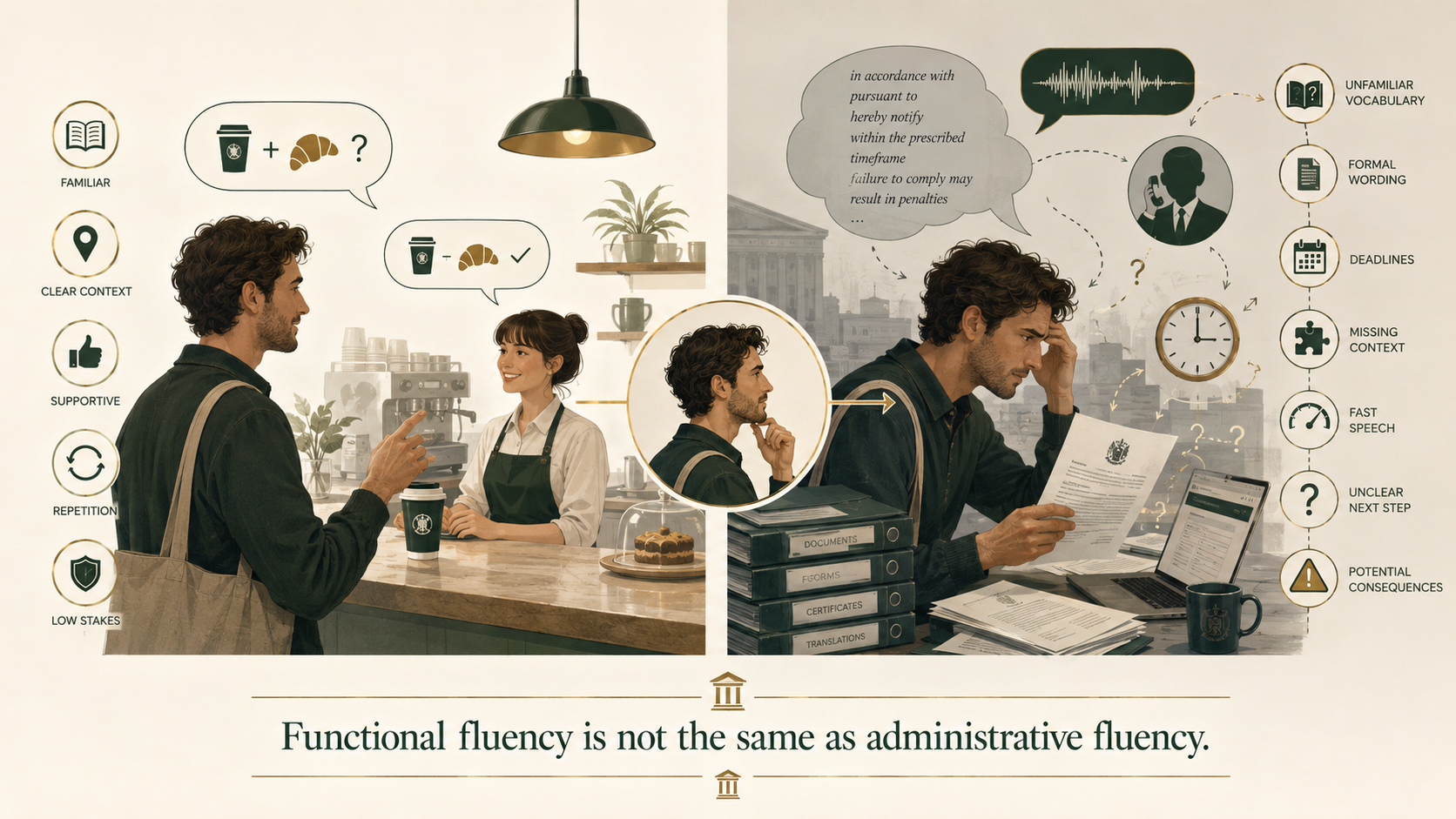
Everyday language is forgiving. Official language is not. In a cafe you have context, gestures, repetition and a person who wants to be understood. In a formal letter or an appointment you have unfamiliar vocabulary, no visual cues, one chance to get it right, and consequences attached to misunderstanding a single sentence.
Three specific things stack up.
The vocabulary is a separate language. Nobody learns the word for "objection period" or "provisional assessment" in a language course. You could be genuinely fluent and still meet twenty unfamiliar terms in one letter, most of which look important.
The stakes remove your safety net. In casual conversation, guessing is fine. If you guess wrong about your residence permit, your tax position or your child's school placement, the cost is real. So you stop guessing, which means you stop moving.
You cannot ask three times. In a shop you would. On a call with an institution, after the second repetition, most people say yes and hang up. That yes is where the trouble usually starts.
The gap is not between fluent and not fluent. It is between a conversation you can recover from and one you cannot.
There is also a second problem hiding behind the first, and it is worth separating: not understanding the language is different from not understanding the system. Locals also find official processes confusing. What you are carrying is both at once, and it is easy to blame all of it on your language.
Speaking the Language Is Not the Same as Handling Institutions in It
This is the finding that surprises people most. In the InterNations Expat Insider 2026 survey, 69% of expats in France said they spoke French at least fairly well, while only 24% said living in France without French was easy. Competent speakers are still exposed the moment official life begins.
Read those two numbers next to each other.
The same population that can hold a conversation is telling you that language stops being optional exactly where it matters most: paperwork, institutions, formal processes, the things you cannot opt out of.
That is the honest shape of the problem. Conversational ability and administrative ability are two different skills, and only one of them gets tested at a dinner party.
It also explains a specific and very common form of self criticism. You have been here three years. Your language is objectively decent. You still cannot get through a call with an institution without preparing sentences in advance, and you have quietly concluded that this means you failed at something.
It does not. You are just comparing yourself in the hardest possible setting.
The Netherlands, Germany, France and the UK Compared
The experience differs in one specific way: how much daily life you can run without the local language, versus how exposed you feel once institutions get involved. Countries where daily life is easy in English produce the sharpest gap, because nothing prepares you for the moment it stops working.
All figures below come from the InterNations Expat Insider 2026 survey, which reflects the experience of self selected expat respondents rather than the whole foreign-born population.
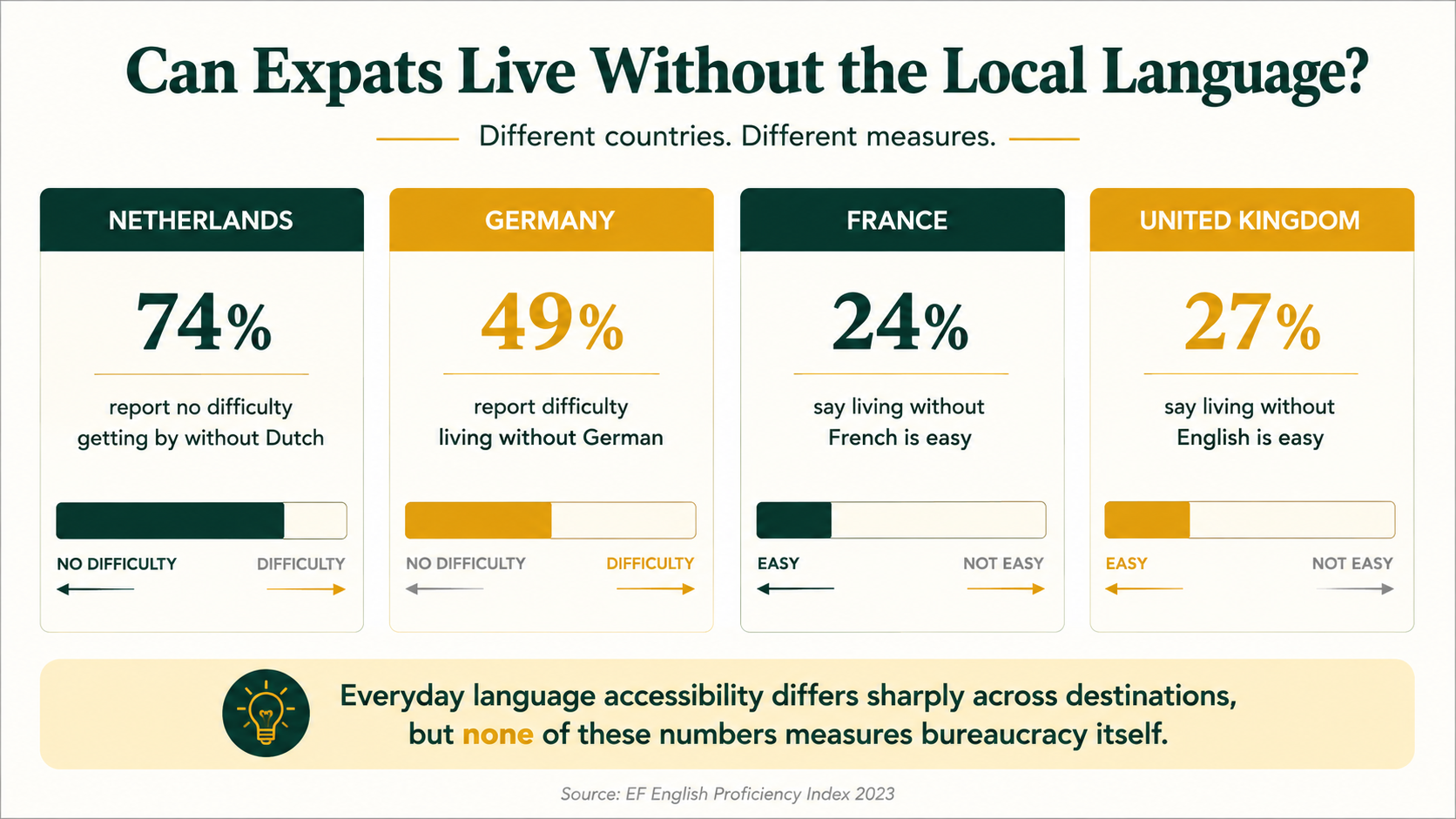
| Getting by day to day without the local language | What that means for official life | |
|---|---|---|
| Netherlands | 74% say they have no difficulty getting by without Dutch | The widest gap between daily ease and official exposure. Life runs in English until something formal does not |
| Germany | 49% say living without German is difficult, and 55% worried about the language barrier before moving | The barrier is anticipated, so expectations are more realistic, but the daily load is heavier |
| France | Only 24% say living without French is easy, though 69% speak French at least fairly well | Speaking well is not the same as feeling secure in formal situations |
| United Kingdom | 77% find learning the local language easy, but only 27% consider living without English easy | The reverse case. Institutions assume English, so weaker English is exposed everywhere at once |
The Netherlands is the most instructive case. It ranked first in the world in the EF English Proficiency Index 2025, and three quarters of expats there report no problem getting through daily life without Dutch. Which sounds like the language problem is solved.
Then a formal letter arrives, or an appointment requires a document you did not know existed, and you discover that the parts of life you cannot skip were never the parts English was covering.
That contrast catches people off guard precisely because everything else went so smoothly.
Germany and France produce a different pattern. The barrier is visible earlier, so there is less shock, but the daily effort is higher and the sense of dependence starts sooner.
The UK flips the whole thing. When the local language is also the global one, institutions assume everyone has it. For an expat whose English is not strong, there is no English-speaking parallel track to fall back on, because English is the track.
Every one of these countries produces the same underlying experience: a competent adult, temporarily unable to act on their own behalf.
The Real Cost Is Autonomy, Not Vocabulary

The damage from administrative language stress is rarely the paperwork itself. It is what repeated dependence does to your sense of being a capable adult. Asking for help once is practical. Asking for help with every letter, call and form starts to feel like something about you.
The pattern is recognisable across almost every expat who has lived through it:
- You ask your partner to make the calls, and after two years neither of you remembers deciding that.
- You screenshot forms and send them to the same local friend, and you have started apologising every time.
- You feel sharp and senior at work and strangely helpless at a counter.
- You postpone opening official mail, and the postponing becomes its own low grade stress.
- You say yes on the phone because a third repetition feels humiliating, then worry for two days about what you agreed to.
- You spend an entire evening on a form a local would finish over coffee, and you feel that difference personally.
- You notice a small resentment toward the country building up, and you do not like that it is there.
Moving abroad can turn things you never thought about, calling an office, reading a letter, filling in a form, into tasks that require preparation, translation and a bit of courage. Nobody warns you that this is the part that wears you down. It is not dramatic enough to talk about, so most people do not.
The dependence question deserves particular honesty, especially in couples. When one partner handles everything official, they gradually become the gatekeeper to your practical life: the bank, the landlord, the school, the tax office. That is not usually anyone's fault. But it can quietly shift the balance in a relationship, and it is much easier to address at year one than at year five.
If the feeling of shrinking is showing up beyond paperwork, in how you speak up and how you come across, that is a related but separate experience covered in why you feel like a different person in another language.
It Does Get Easier, and Slower Than You Think
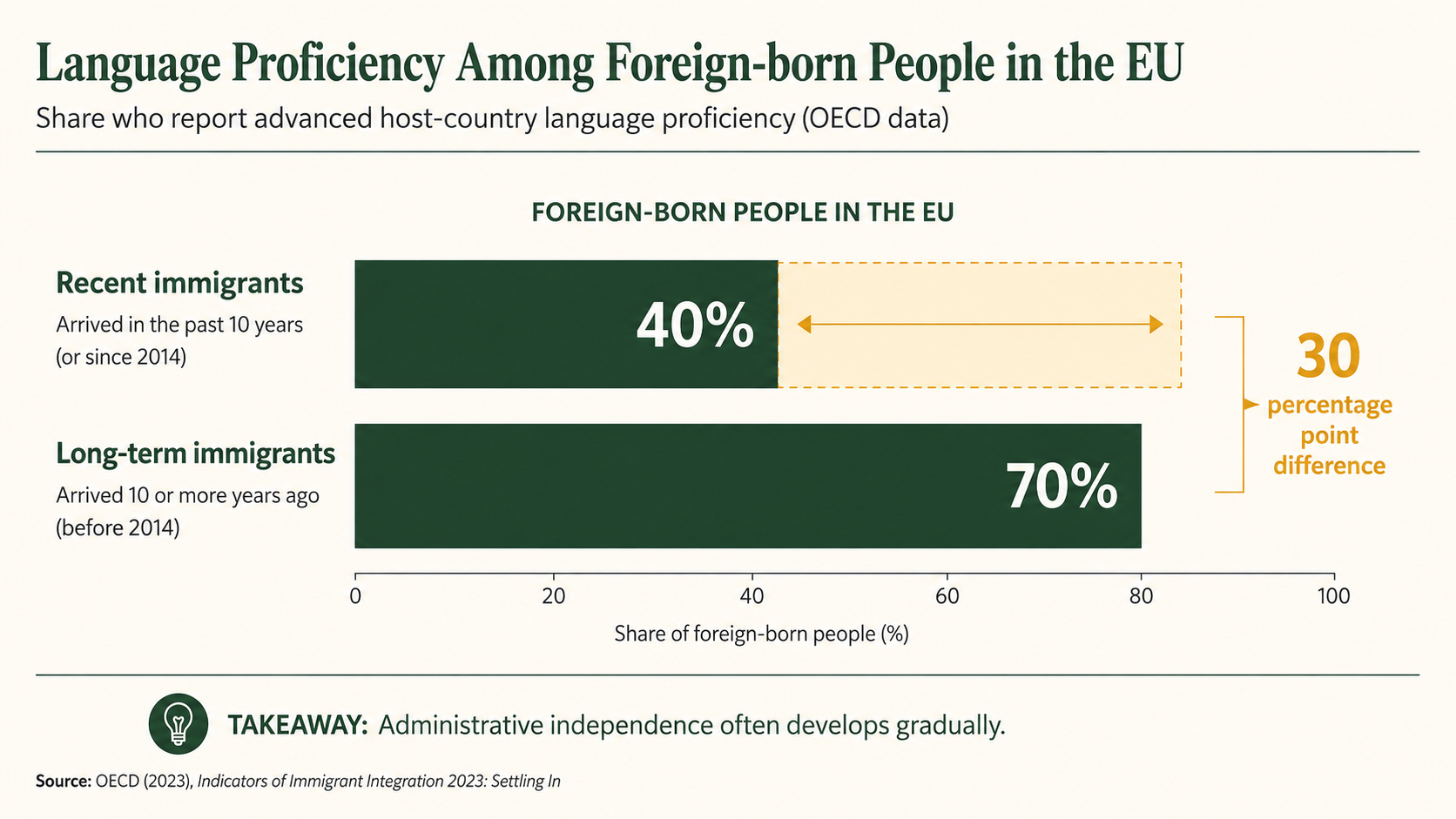
Administrative independence builds gradually, and the timeline is longer than most people expect of themselves. In OECD and European Commission data, about 40% of recent arrivals across the EU report advanced host country language proficiency, compared with roughly 70% of long term residents. The gap is duration, not ability.
That number is worth holding onto the next time you feel behind.
The people who make this look easy have usually been there ten years. You are comparing your second year to their tenth, and then drawing conclusions about yourself.
It also means the goal is not fluency before you are allowed to handle your own affairs. It is the opposite. Administrative vocabulary is small, repetitive and learnable in a way that general fluency is not. The same forty or so words come back every single time: deadline, application, extension, declaration, appointment, proof, registration, confirmation. Learn those and a disproportionate amount of official life opens up.
That is a far better use of a month than another general language course, and it is a more targeted version of the broader challenge described in our guide to language barriers for expats.
How to Make Official Life Manageable
The aim is not to understand every word of every document. It is to build enough language, structure and support that administration stops setting the emotional temperature of your week. Most of the improvement comes from changing the process, not from waiting until your language is better.
Separate translating from deciding. Do them as two tasks on two different days if the stakes are high. Trying to understand a document and decide what to do about it simultaneously is what produces the paralysis.
Translate before you are under deadline pressure. Open official mail the day it arrives, even if you do nothing else with it. Knowing the deadline is three weeks away is a completely different experience from discovering it is tomorrow.
Write the questions down before you call. Not a script of what you will say. A list of what you need to leave the call knowing. Then you can ask "so, is my deadline the fifteenth?" even if the rest of the conversation got away from you.
Ask for it in writing. After any complicated call or appointment, request written confirmation. This is normal practice, it removes the pressure to catch everything live, and it gives you something you can read slowly.
Stop pretending you understood. The polite yes is the single most expensive habit in this whole article. "Sorry, could you write that down for me?" costs eight seconds of awkwardness and prevents genuine problems.
Bring someone when it actually matters. Not for everything. For the appointment where a misunderstanding has real consequences, a trusted bilingual person is a reasonable and normal choice, not an admission of failure.
Do admin when you have energy, not at the end of the day. Understanding formal language in a second language is expensive work, and it gets more expensive as you get more tired, for the reasons covered in second language fatigue abroad. Saturday morning beats Thursday at nine at night.
Keep one place for official correspondence. One folder, physical or digital. Half the dread is not knowing what is outstanding.
The polite yes is the most expensive habit in expat life. Eight seconds of awkwardness is cheaper than a misunderstanding you find out about in six months.
Learn the recurring words, not the language. Build a personal list of the terms that keep appearing in your letters. Twenty words, added to over time. This is the highest return language study you will ever do.
When Admin Stress Becomes Something Bigger
Most bureaucratic language stress is a practical problem with practical fixes. It becomes a psychological one when the avoidance, dread or loss of confidence starts spreading beyond paperwork. The signal is not finding it hard. It is unopened letters, cancelled appointments and a growing belief that you cannot manage life here.
Worth taking seriously if you recognise several of these:
- Official mail goes unopened for weeks, and the pile now causes real anxiety.
- You feel physical dread before any appointment or call with an institution.
- You have started avoiding things that matter, including healthcare.
- The dependence has become a source of tension or resentment in your relationship.
- You feel incapable in areas of life where you were previously completely competent.
- You have started thinking about leaving the country, and the strongest reason is that ordinary functioning feels exhausting.
That last one matters, because people rarely say it out loud. The decision to leave is usually attributed to career or family. Sometimes the real driver is that daily life demanded more energy than anyone expected, and admin was where it showed up most.
If dread before appointments and calls has generalised into ongoing tension, that pattern is closer to language anxiety abroad, and anxiety therapy for expats works directly on the avoidance rather than the paperwork.
To be clear about what therapy is and is not. It will not translate your tax letter or complete your residence application. What it can address is the anxiety, helplessness, procrastination and loss of confidence that have attached themselves to these situations, and the wider adaptation strain sitting underneath, which often overlaps with culture shock.
Expathy matches expats with psychologists by native language and cultural background, and our psychologists have lived abroad themselves. You spend your week decoding a second language. Therapy should not be one more hour of it.
There is a practical logic to that beyond comfort. A psychologist who has personally dealt with a foreign municipality, a residence process and a letter they could not read does not need the situation explained. That saves you the part where you justify why something so ordinary has become so heavy. If that fits what you need, online therapy for expats is built around that match.
Final Thought
There is a particular indignity in being an accomplished adult who cannot open their own post with confidence. It reaches something deeper than inconvenience. It touches the sense that you are in charge of your own life.
So hold two facts together.
Needing help with bureaucracy in another language does not cancel out the competence you show everywhere else. It is a narrow, specialised, high stakes skill that takes years to build, and the people around you who make it look effortless have had a decade of practice, usually in their first language.
The goal was never to understand every word in the country. It was to build enough language, structure and support that official life stops deciding how capable you feel.
Start with the envelope on the table. Open it today, translate it, do nothing else. That is enough for one day.
Sources and Further Reading
- InterNations, Expat Insider 2026 survey of expat experiences across 31 destinations: https://www.internations.org/expat-insider
- EF English Proficiency Index 2025, ranking adult English skills across 123 countries and regions: https://www.ef.com/wwen/epi/
- OECD and European Commission (2023), Indicators of Immigrant Integration: Settling In, on host country language proficiency by duration of residence: https://doi.org/10.1787/1d5020a6-en
Frequently Asked Questions
Why is bureaucracy so much harder than everyday conversation in a foreign language?
Because official language removes everything that makes ordinary conversation manageable. There is no context to guess from, no gestures, no easy repetition, and the vocabulary is specialised in a way language courses rarely cover. Add real consequences for misunderstanding, and a task that would be routine at home becomes something you prepare for.
I speak the language well. Why do I still panic at official appointments?
This is extremely common. In the Expat Insider 2026 survey, most expats in France reported speaking French at least fairly well, yet only about a quarter said living there without French was easy. Conversational ability and administrative ability are different skills, and the second one is only tested in high stakes situations.
Is it normal to still need help with paperwork after years abroad?
Yes. OECD data across the EU found advanced host country language proficiency among roughly 40% of recent arrivals compared with about 70% of long term residents. Administrative independence builds over years, not months. Needing help in year two says nothing about your ability or your commitment to the country.
Which is harder for bureaucracy, the Netherlands or Germany?
They are difficult in different ways. In the Netherlands, around three-quarters of expats say daily life works without Dutch, which makes official moments feel like a sudden ambush. In Germany, about half say living without German is difficult, so the barrier is visible earlier and the daily effort is higher but less surprising.
Should I bring someone with me to important appointments?
For genuinely consequential appointments, yes. Bringing a trusted bilingual person is a reasonable decision, not an admission of failure. Reserve it for the situations where a misunderstanding would actually cost you something, and handle the routine ones alone so your independence keeps building.
How do I stop relying on my partner for every official phone call?
Start by splitting the task rather than the responsibility. Write down the two or three things you need to find out, make the call yourself, and ask your partner to review the written confirmation afterwards. Complete dependence is easier to unwind early, before it quietly becomes the permanent arrangement.
What language should I actually study to handle bureaucracy?
Not general fluency. Build a personal list of the terms that keep reappearing in your own letters: deadline, application, extension, declaration, proof, registration, confirmation. Administrative vocabulary is small and highly repetitive, so a focused list of twenty or thirty words opens up a disproportionate amount of official life.
When should I speak to a therapist about this?
When avoidance has taken over. If letters go unopened for weeks, if you feel real dread before appointments, if you are skipping things that matter including healthcare, or if the dependence is straining your relationship, the issue has moved past admin. Therapy does not complete forms, but it does treat the anxiety and helplessness attached to them.
Need support? We're here.
Book a free 15-min consultation with our expat-specialized therapists.