
Key takeaway
Relocation succeeds or fails at the level of the whole family, not the employee alone. When a partner cannot build a life or a child cannot settle, it shows up in the employee's focus, performance, and quiet decision about whether to stay. Companies that support only visas, housing, and the employee's first day at work are leaving the largest risk in the whole assignment unmanaged. This article lays out the evidence for that, and what to do about it.
Picture a company's best kind of hire. Six months into an overseas assignment, the employee is performing well. Targets met, no complaints, nothing a review would flag. But look at the home the dashboard cannot see. A partner who gave up their own career sits in a city where they are not allowed to work, with no colleagues, no network, and no clear reason to leave the apartment. A child is quietly miserable at a new school in a language they barely speak. The employee holds it together at work for as long as they can. Then one day they ask to come home, and it gets filed as "did not adapt."
That is the story this article is about, because it is the most common way a good assignment quietly falls apart. Because adaptation is a household event, some employers extend native-language therapy access to employees and their families.
Relocation doesn't fail at the desk. It fails at home.
When an assignment fails, it usually gets explained downstream: a performance problem, a talent problem, a bad fit. But upstream, the real cause is often somewhere else entirely. The employee was doing fine. The family was not.
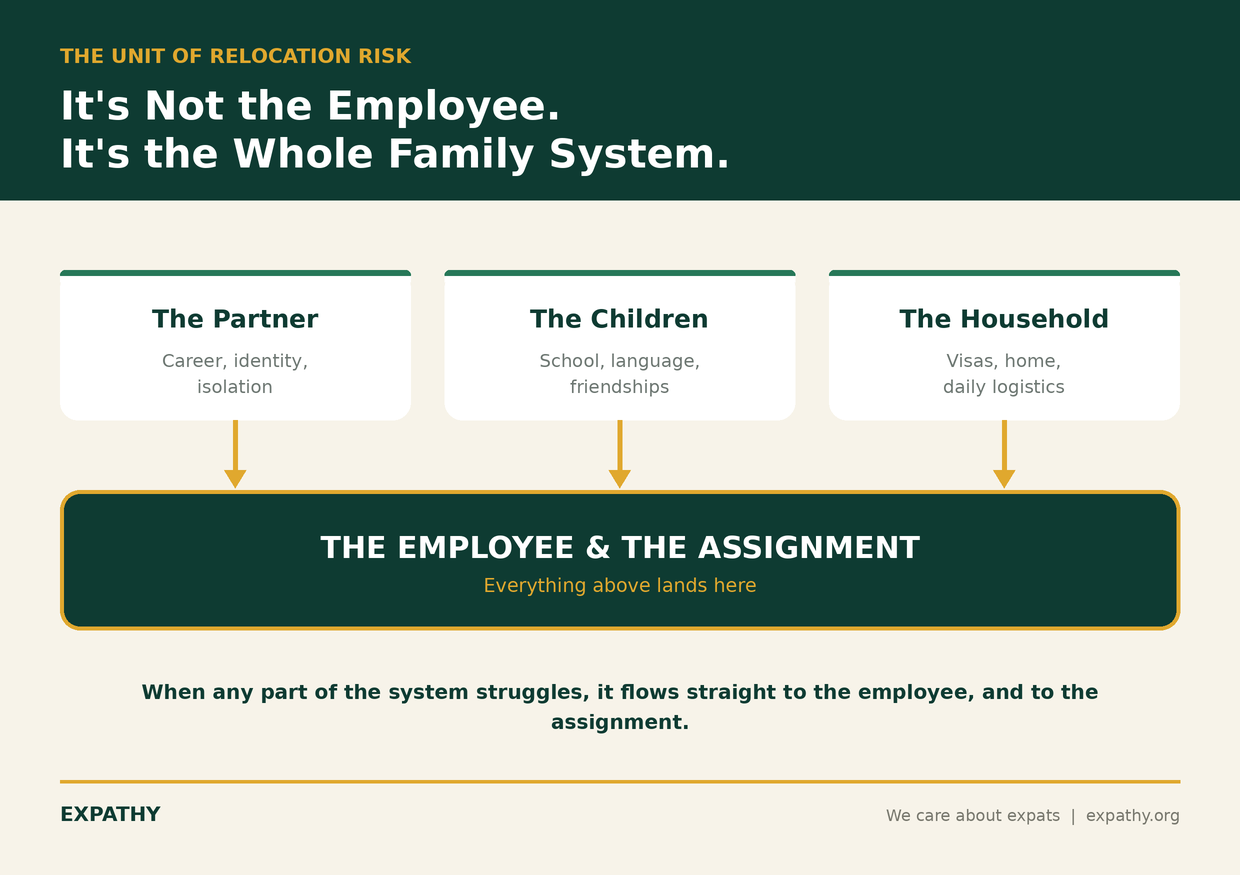
The evidence for this is unusually consistent. One of the foundational studies in the field, Black and Stephens in the Journal of Management, found that a spouse's adjustment is strongly correlated with the employee's own adjustment and their intention to stay on assignment. This is not a fringe finding. It is one of the most cited results in the entire expatriate literature, and decades of research have reinforced it rather than overturned it.
Industry data says the same thing in blunter terms.
In the 2018 EY and NetExpat Relocating Partner Survey, 71% of corporations named an unhappy or unintegrated partner as the most common reason assignments failed. Not visa problems. Not the job. The partner.
When the single most cited cause of failed assignments is how the partner is doing, the conclusion is hard to avoid: the family is not a side concern to the relocation. It is the relocation.
Why supporting the employee alone isn't enough
The reason is simple, and it has a name in the research: spillover. What happens at home does not stay at home. It crosses directly into the employee's concentration, energy, and engagement at work.
Trompetter and colleagues documented this "home to work spillover" directly, concluding that expatriates would value far more organisational support for their families, and that family adjustment has real implications for performance. An employee worrying about a lonely partner or an unhappy child does not leave that worry at the office door. They carry it into every meeting.
This is why supporting only the employee is a structural mistake, not just an incomplete kindness. You can give the employee the best onboarding, the best role, the best manager, and still lose them, because the thing pulling them home was never at work in the first place. For more on why the early weeks decide so much, see our piece on relocation mental health support and why the first 90 days matter.
What companies support vs what actually decides relocation success
Here is the gap in one look. On the left is what most relocation packages actually fund. On the right is what the assignment actually turns on.
| Companies often support | The assignment often depends on |
|---|---|
| Visa and immigration | Whether the family can settle |
| Housing | Whether the partner has identity and purpose |
| School search | Whether the child actually adjusts |
| Flights and moving | Whether the employee has emotional capacity to perform |
| Day-one readiness | Whether the household survives months 2 to 6 |
Look at the two columns together and the problem is obvious. Companies fund the left column. The assignment is decided by the right one. The support is real, but it is aimed at the logistics of arriving, not the reality of staying.
The accompanying partner is often the hidden breaking point
If there is one person who decides whether an assignment holds, it is often not the employee. It is the partner who moved for them.
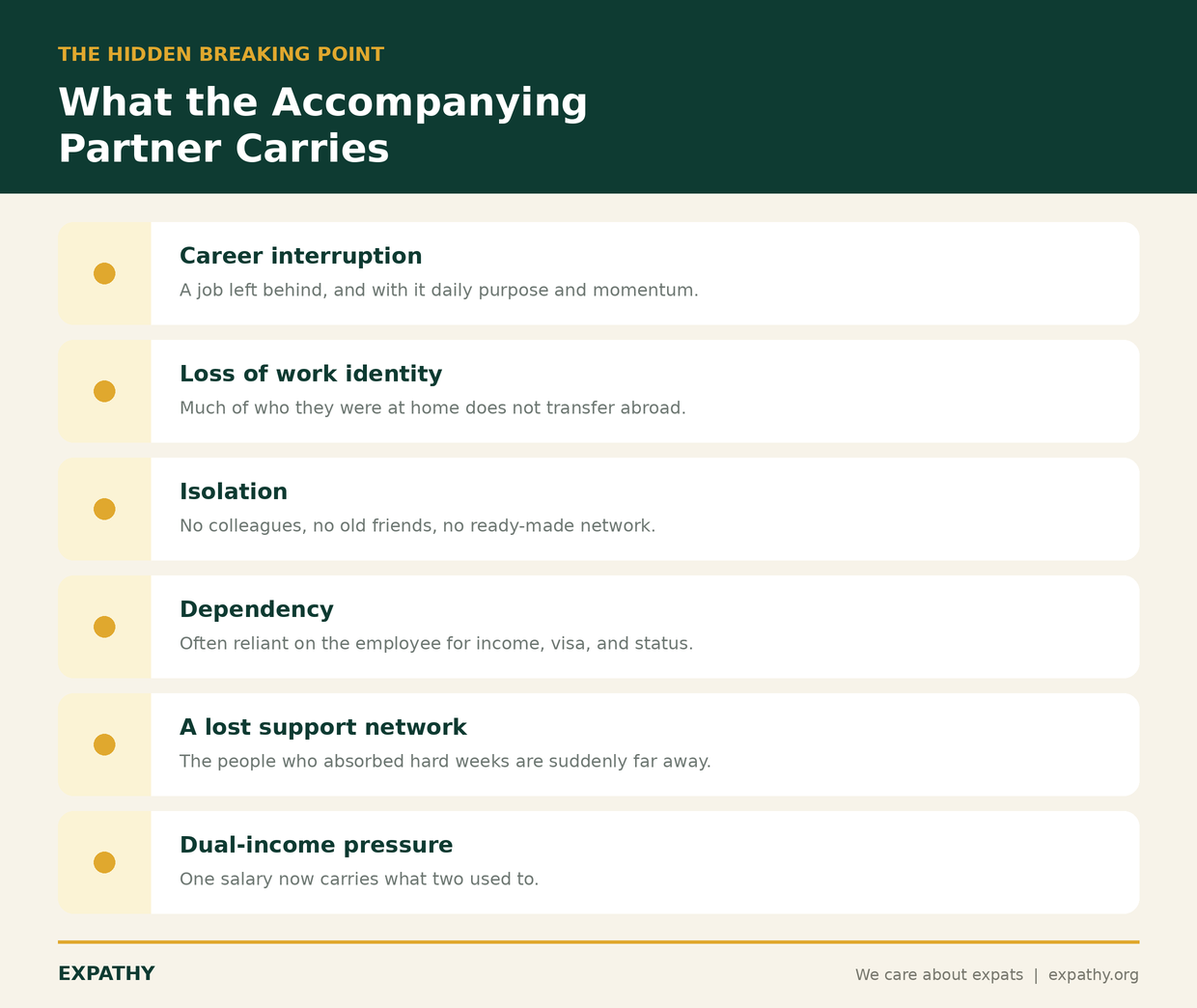
Think about what that move actually asks of someone. They leave a job, and with it a large part of their identity and daily purpose. They leave the friends, family, and colleagues who made up their support network, all at once. They arrive somewhere they may not speak the language, often unable to work because of visa rules, into a life where their main role has suddenly become managing a household's adjustment in an unfamiliar country. That is not a soft inconvenience. It is a profound disruption to a person's sense of who they are.
The research bears this out with real precision. A 2025 study in Frontiers in Psychology of 207 accompanying partners found that perceived stress was the single strongest predictor of a partner's wellbeing, and isolation was the second. These are not vague concerns. They are the two measurable forces that most determine whether the accompanying partner sinks or swims.
And the career disruption is not just an emotional issue. It is a hard mobility constraint.
Permits Foundation's dual-career research found that in 59% of organisations, an employee had turned down an international assignment because of partner career or employment concerns, and in 44%, an employee had returned home early for the same reason.
Read that again. In nearly half of companies, someone had already come home early because of the partner's career. This is not a wellbeing footnote. It is one of the clearest, most expensive risk factors in the entire relocation, and it sits almost entirely outside what most packages address.
The partner's experience follows a pattern the literature describes again and again: career interruption, loss of work identity, dependency, isolation, and the loss of an entire support network in a single move. Naming that pattern is the first step to managing it. Ignoring it is how good assignments break.
Children are a business variable, not an afterthought
It is tempting to file children's adjustment under "personal life." The evidence says that is a business mistake.
When a child struggles with a new school, a new language, or the loss of every friend they had, that strain does not stay contained to the child. It flows to the parents, and through them to the employee. A study by Shah and colleagues, following 173 accompanying spouses and 135 expatriates, found exactly this chain: children's adjustment affects the accompanying partner directly, and the employee indirectly.
In other words, a child having a bad term at a new school is not a private family matter. It is a retention risk. The parent carrying that worry is the same person the company is relying on to deliver on a demanding overseas role.
The same research points to what helps: schooling and transition support matter, and they are not an optional extra. They are part of what keeps the whole family, and therefore the assignment, on track.
Why companies keep missing this
If the evidence is this clear, why do so many programmes still get it wrong? A few reasons, and they compound.
Relocation support is built around logistics. Visas, housing, shipping, the employee's start date. These are concrete, easy to organise, and easy to tick off. Family adjustment is none of those things, so it quietly drops off the list.
Family stress gets treated as private. There is an unspoken sense that what happens at home is not the company's business, which is a reasonable instinct socially and a costly one operationally.
Family adjustment isn't tracked as a business risk. You cannot manage what you do not measure, and most programmes do not measure this. Cartus's mobility benchmarking found that many organisations still do not formally measure assignment success at all, which means family strain stays invisible until it surfaces as a declined offer, a performance drop, or a resignation.
And employees hide it. Nobody wants to tell their employer that their family is struggling and their assignment might be at risk, so the pressure stays quiet until it is too late to fix cheaply. This is also where managers matter, because they are often the first to notice, if they have been trained to. Our guide to manager training for supporting international employees covers that in depth.
What family-inclusive relocation support actually looks like
The fix is not exotic. It is a shift from supporting the employee's move to supporting the family's adjustment, phased across time rather than front-loaded at departure.
Before the move
Support that works starts before anyone gets on a plane. Pre-assignment visits, honest expectation-setting, and screening conversations that include the partner and the family, not just the employee. The goal is to surface problems while they are still cheap to solve, and to make sure the family is choosing this with open eyes.
Real partner support, not symbolic
A line in a brochure about "spousal assistance" is not support. Work-visa guidance, genuine job-search help, and dual-career support are. The dual-career evidence is clear that partner employment is one of the biggest levers on whether an assignment is accepted and whether it lasts, so this is where real budget belongs.
For families with children
Schooling is not a search-and-place task that ends when a place is found. School transition support, help with language, and attention to whether the child is actually settling are what protect the whole household, and by extension the employee.
After arrival
This is the phase most packages neglect, and it matters most. Social connection, community, language help, and culturally aligned mental health support in the family's own language. When adjustment stress becomes emotional, cultural, or language-related, support that fits the family's language and context is far more likely to be used. This is where access to therapy in a native or preferred language becomes a genuine part of the picture rather than a nice idea.
Ongoing, beyond arrival
Adjustment is not finished at week two. Real check-ins that continue through the hard middle months, not just a welcome pack on day one, are what catch trouble while it can still be turned around.
What family-inclusive relocation support should not do
Just as important as what to do is what to avoid. These are the mistakes that quietly undo good intentions.
- Do not treat the partner as a logistical add-on. The partner is often the person the assignment actually depends on, not a line item beneath the employee's package.
- Do not assume a school place means the child is settled. Finding a school is the start of the child's adjustment, not the end of it.
- Do not wait until the employee asks to return home. By the time someone raises leaving, the problem has usually been building for months. That is the moment support failed, not the moment it should start.
- Do not make family support available only before departure. The hardest stretch is months two to six, long after the pre-move support has ended.
- Do not treat partner loneliness as a private issue with no business impact. The research is explicit that isolation is one of the top predictors of partner wellbeing, and partner wellbeing drives assignment outcomes.
What HR should measure
If family adjustment is a business risk, it has to be measured like one. Track these, and track them for relocated employees specifically rather than buried in company averages:
- Assignment acceptance and early-return risk
- Partner and family adjustment feedback, gathered directly, not assumed
- Employee engagement after relocation
- Support uptake, including whether family support is actually being used
- Retention of relocated employees
- Assignment completion rates
- Performance and absenteeism shifts after the move
The bottom line is simple: if you do not measure family adjustment as part of relocation success, you are managing only part of the risk, and usually not the part that decides the outcome.
Evidence used in this article
Because this is a business case and not an opinion piece, here is the evidence base behind it at a glance.
| Evidence type | What it shows |
|---|---|
| Academic research | Spouse and child adjustment affect the employee's own adjustment |
| Dual-career surveys | Partner career issues affect assignment acceptance and early return |
| Mobility benchmarks | Many companies still under-measure family adjustment |
| Relocation surveys | Family issues appear repeatedly in declined or failed relocations |
The specific sources are named inline throughout, and include Black and Stephens (1989), Shah and colleagues (2022), the 2025 Frontiers in Psychology partner study, Trompetter and colleagues, Permits Foundation's dual-career research, the EY and NetExpat Relocating Partner Survey, and Cartus's mobility benchmarking. Academic findings, industry surveys, and mobility benchmarks are distinct kinds of evidence, and they are kept distinct here on purpose.
Support the whole system, not just the employee
The through-line of all of it is one idea: the employee is not the unit of relocation risk. The family system is. Support only the employee, and you are managing the smallest part of the problem. Support the partner, the children, and the household's adjustment, and you are managing the part that actually decides whether the assignment works.
That is where Expathy fits. We help companies add a culturally aligned support layer around the employee, the partner, and the family, especially when relocation stress becomes emotional, cultural, or language-related, delivered in the languages people actually feel in.
Supporting your relocating employees means supporting their families too. Explore Expathy's mental health support for international employees.
Frequently asked questions
Why does family adjustment affect relocation success?
Because what happens at home spills directly into the employee's focus, energy, and performance at work. Research going back to Black and Stephens shows a spouse's adjustment is strongly linked to the employee's own adjustment and their intention to stay, and later studies confirm the same crossover effect. An employee whose family is struggling is far more likely to disengage or leave the assignment early, regardless of how the job itself is going.
What is a trailing or accompanying partner, and why are they a risk point?
An accompanying partner is the spouse or partner who relocates alongside the employee, often giving up their own job and network to do so. They are a critical risk point because their adjustment strongly influences the employee's, and industry surveys repeatedly find that an unhappy or unintegrated partner is among the most common reasons assignments fail. Career interruption, isolation, and loss of identity are the recurring pressures they face.
How does a partner's career disruption affect the assignment?
Significantly. Permits Foundation's dual-career research found that a majority of organisations had seen employees turn down assignments because of partner career concerns, and a large share had seen employees return home early for the same reason. When a partner cannot work or rebuild a sense of purpose, the pressure on the household grows, and the employee is more likely to decline the move or cut the assignment short.
Do children's adjustment problems really affect the employee's work?
Yes, though the effect is indirect. Research by Shah and colleagues found that children's adjustment affects the accompanying partner directly and the employee indirectly. A child struggling with a new school or language raises stress across the whole household, and that stress reaches the employee the company is relying on to perform. Schooling and transition support are therefore business-relevant, not just a family courtesy.
Why do companies often overlook family support in relocation?
Because relocation support is usually built around logistics that are easy to organise, such as visas, housing, and start dates, while family adjustment is harder to structure and often treated as private. Many programmes also do not formally measure family adjustment or even overall assignment success, so the risk stays invisible until it appears as a declined offer, a performance drop, or a resignation.
What should family-inclusive relocation support include?
It should span the whole journey: pre-move preparation and honest expectation-setting that includes the partner, real partner-career support such as work-visa and job-search help, school and transition support for children, social connection and community after arrival, culturally aligned mental health support in the family's own language, and ongoing check-ins through the difficult middle months rather than support that ends at departure.
Need support? We're here.
Book a free 15-min consultation with our expat-specialized therapists.