
Key takeaway
A long-distance relationship plan helps couples reduce uncertainty by agreeing on communication, visits, expectations, and the future. The goal is not to control each other's schedules, but to create enough structure that both partners feel secure. A good plan covers a communication rhythm , time-zone expectations , emotional check-ins , visit planning , conflict repair , and a realistic path to closing the distance. This matters even more for international couples, because distance often comes wrapped in visas, relocation, careers, family expectations, and cultural adjustment. Without a shared plan, a long-distance relationship can start to feel emotionally unsafe even when both partners still love each other deeply. If distance is creating repeated conflict around expectations, trust, or the future, long-distance relationship therapy for expats can help you build a clearer path forward together.
A long-distance relationship can survive without perfect timing, constant texting, or daily video calls. But it usually cannot survive for long without a plan.
When two people live in different cities, countries, or time zones, love alone does not answer the practical questions that quietly shape the relationship: When will we talk? When will we visit? Who travels next? How long will we stay apart? What are we actually building toward?
Without answers, small moments become emotionally loaded. A missed call feels like rejection. A delayed reply feels like the distance growing. A cancelled visit feels like proof the relationship is not a priority.
Very often, a couple is not struggling because they lack love. They are struggling because they lack structure.
A long-distance relationship plan gives the relationship a shared rhythm. It helps both partners know what to expect, what matters, and what future they are working toward.
What Is a Long-Distance Relationship Plan?
A long-distance relationship plan is a shared agreement about how you will stay connected, manage expectations, handle visits, and move toward a future together while living apart. It is not just a schedule. It is an emotional roadmap.
A good plan answers questions like:
- How often will we communicate, and in what way?
- How do we manage time zones?
- When will we next see each other, and who travels?
- How do we handle cancelled plans?
- What boundaries do we need around social life?
- How do we talk about jealousy, loneliness, or insecurity?
- Is the distance temporary or open-ended?
- What would need to happen for us to live in the same place?
For expat couples, these questions carry even more weight. One partner may be adjusting to a new country while the other stays back home, or both may be living abroad in different countries. The relationship gets shaped by visas, career decisions, family pressure, money, cultural expectations, and the emotional load of relocation.
A plan does not remove all uncertainty. It gives both partners something stable to return to.
Why Long-Distance Relationships Need a Plan
Long-distance relationships often fail not because of distance itself, but because the distance stays undefined. When there is no clear rhythm or direction, both partners start guessing, and they rarely guess the same thing:
- One person thinks, "We are doing fine." The other thinks, "We are drifting."
- One expects daily contact. The other feels weekly calls are plenty.
- One believes the distance is temporary. The other is not ready to discuss moving.
A plan turns invisible expectations into visible agreements. Instead of silently hoping your partner understands what you need, you say it directly. This matters most when one partner feels more anxious than the other: the anxious partner needs predictability, the more independent partner needs space, and a good plan respects both instead of letting them collide.
The purpose of a long-distance plan is not to make the relationship rigid. It is to make it reliable.
1. Agree on a Communication Rhythm
The first part of any plan is communication, and the most common mistake is assuming more contact always means more closeness. Constant texting can become draining once time zones, work, and daily stress are added in. The better goal is predictable communication: both partners knowing when and how they are likely to connect.
Your rhythm might include a short morning or evening message, a few voice notes through the week, two or three planned video calls, one longer weekend call, and a quick update before nights out. The exact schedule matters less than the agreement behind it:
"Let's have proper video calls on Tuesday and Sunday, and on busy days we send voice notes instead of forcing a call."
That gives the relationship rhythm without making contact feel like a duty. For more on deepening those conversations, read our guide on how to build emotional intimacy in a long-distance relationship.
2. A Sample Weekly Long-Distance Schedule
One of the most-searched parts of long-distance planning is the schedule itself: people want to see what a realistic week actually looks like. Here is a sample weekly long-distance relationship schedule you can adapt to your own time zones, energy, and work lives. Treat it as a starting template, not a rule.
| Day | Connection | Type |
|---|---|---|
| Monday | Good morning message, goodnight voice note | Quick contact |
| Tuesday | Planned video call (45 to 60 min) | Quality time |
| Wednesday | "One thing that made me think of you" message | Light connection |
| Thursday | Short voice notes through the day | Flexible contact |
| Friday | Casual call or play an online game together | Fun and presence |
| Saturday | Virtual date: cook, watch, or coffee on video | Quality time |
| Sunday | Longer call plus weekly check-in (see Step 5) | Deep connection |
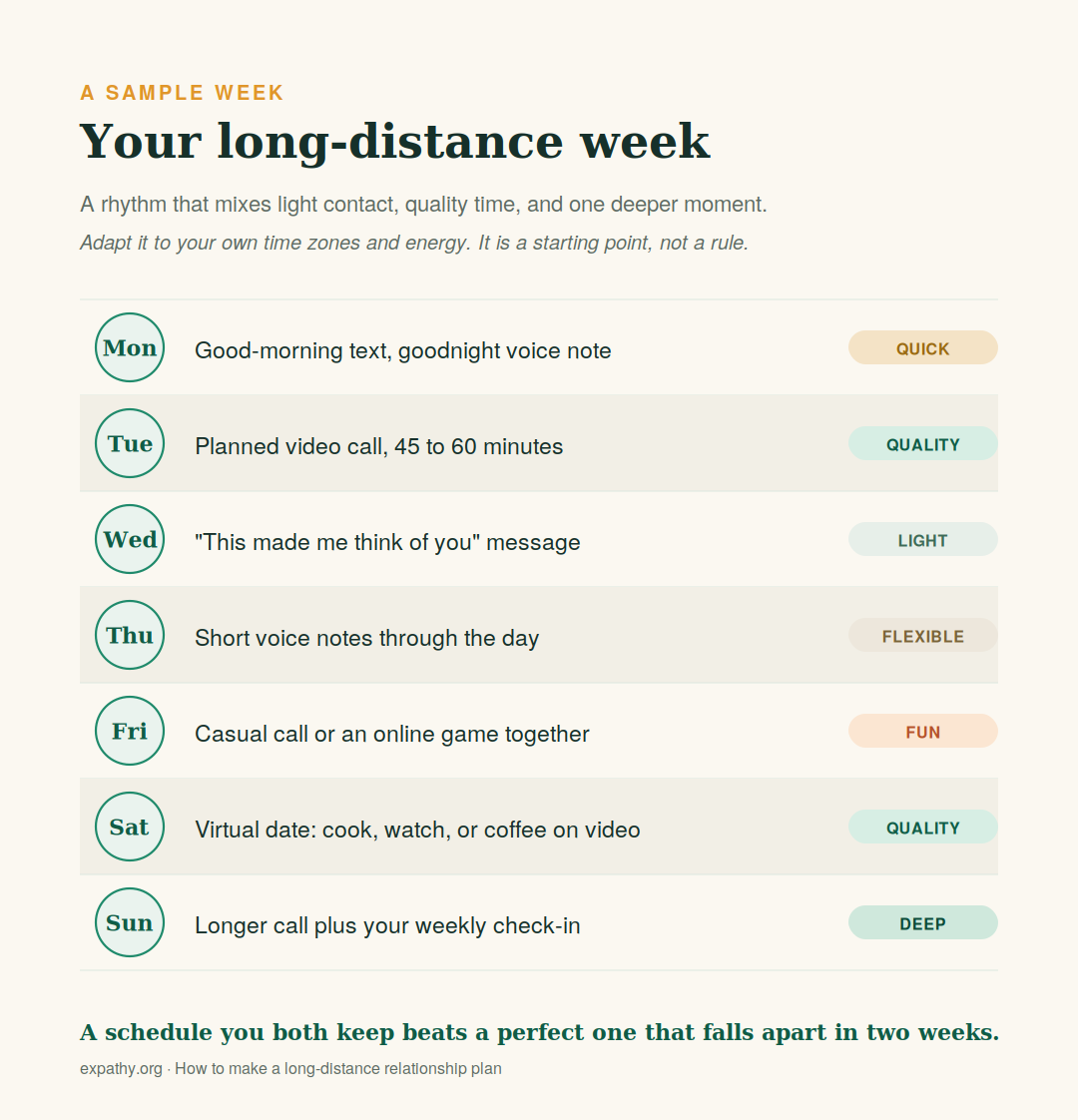
The point is not to follow this exactly. It is to show that a good schedule mixes light contact, quality time, and one deeper moment rather than expecting every interaction to carry the same emotional weight. A five-minute voice note is enough on a busy Thursday. A future-planning talk belongs on a calm Sunday morning.
A realistic schedule that both people actually keep beats a perfect one that collapses after two weeks.
3. Make a Time-Zone Plan That Feels Fair
Time zones quietly create resentment. If one partner is always staying up late, waking early, or interrupting their workday, the rhythm starts to feel unfair, and over time that person feels like they are carrying the relationship. A fair plan considers both people's energy, not only their availability. Ask each other:
- Who is usually more tired during our calls?
- Does one of us always sacrifice sleep?
- Are we scheduling serious talks at bad times?
- Do we need different call times on weekdays and weekends?
For international couples, a shared calendar showing both time zones removes a surprising amount of friction and accidental hurt. It also helps to sort contact into categories: quick connection (texts, voice notes), quality time (proper calls, virtual dates), serious conversations (planned, when both are rested), and flexible contact (spontaneous, no pressure). Not every conversation needs to carry the same weight.
4. Plan Visits Before the Distance Feels Endless
Visits are the emotional anchors of a long-distance relationship. Knowing when you will next see each other makes the distance feel manageable; without a next visit, the future blurs and the relationship can start to feel abstract even when the love is real.
You do not need every visit mapped perfectly, but you should know the next realistic opportunity. Talk about when it could happen, who travels, how costs are shared, how long it lasts, whether visits alternate, and what each of you needs from the time together.
One trap worth naming: couples often expect every visit to be perfect because time is limited, so normal tiredness or a small conflict feels enormous. A healthier plan builds in realistic expectations. Instead of chasing perfection, ask:
"What would make this visit feel meaningful and realistic for both of us?"
Usually that is one special date, some rest, a little time with friends or family, and a couple of honest practical conversations, not a flawless highlight reel.
5. Create a Weekly Relationship Check-In
A weekly check-in is one of the simplest ways to keep a long-distance relationship stable. It gives both partners a regular space to talk about how things feel before small issues turn into big conflicts. It does not need to be heavy, just a 20-minute conversation once a week. You might ask:
- What felt good between us this week?
- Did anything make you feel distant or unsure?
- Do we need to adjust our schedule?
- Is there anything you need more of from me?
- What are we looking forward to next?
Keep the tone collaborative. The question is not "Who failed this week?" It is "How can we take care of this relationship better next week?"
A check-in turns the relationship from reactive into maintained. You fix small things on purpose, instead of waiting for them to become arguments.
6. Set Expectations Around Social Life and Independence
A plan should also cover daily life apart, which is where many couples quietly struggle. One partner feels hurt when the other goes out often or makes new friends; the other feels controlled or guilty for simply living where they are. The fix is not to limit each other's independence, but to build emotional transparency.
Talk through: Do we tell each other when we are going out? What kind of situations make either of us uncomfortable? What counts as flirting? What reassurance helps without feeling controlling?
The aim is agreements, not rules, and the difference is everything:
A rule says: "You are not allowed to go out without telling me." An agreement says: "If either of us is out late, we send a short message so the other isn't left in the dark." A rule controls. An agreement protects.
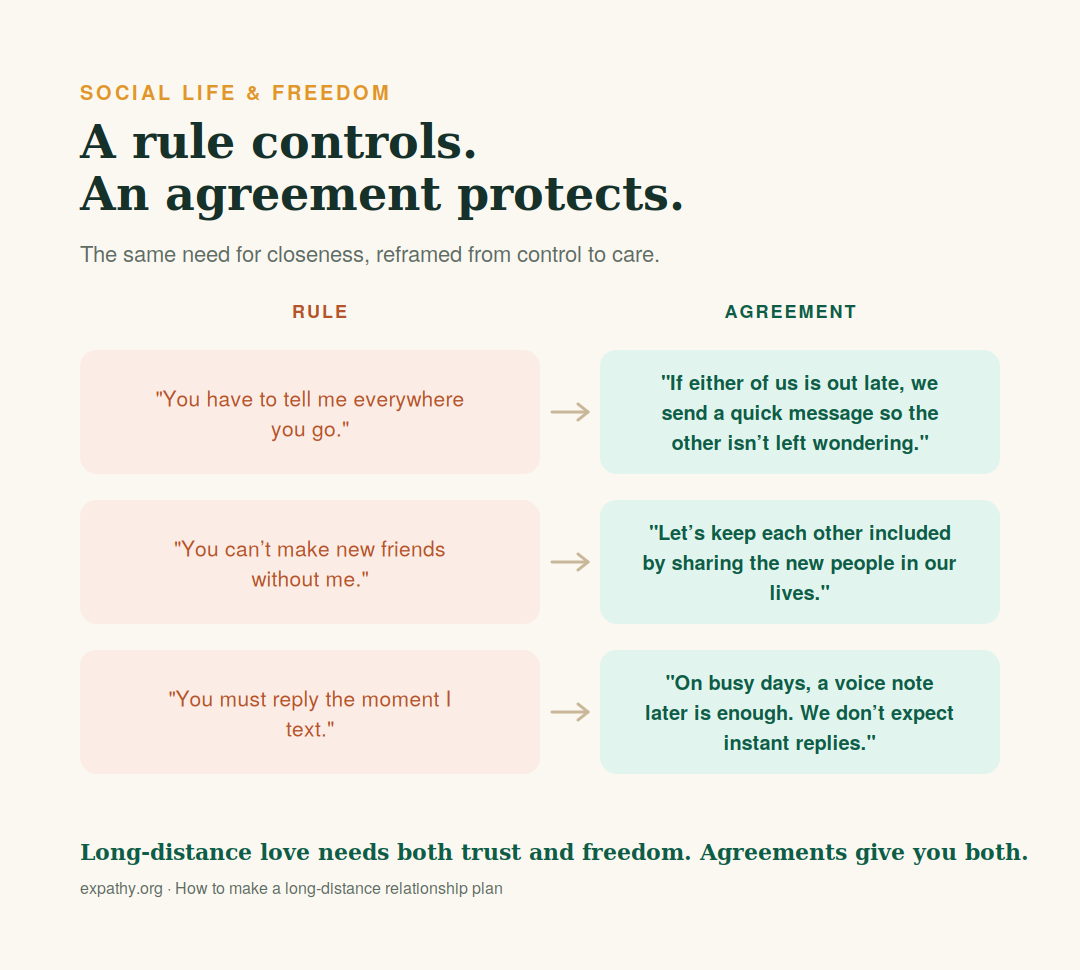
Long-distance relationships need both trust and freedom. Too controlling, and resentment grows; no plan at all, and insecurity grows. If trust itself has become difficult, read our guide on how to build trust in a long-distance relationship.
7. Decide How You Will Handle Conflict
Conflict is harder across distance because repair is limited. You cannot hug, sit together, or read body language after a hard moment. A fight over text can spiral fast, silence hurts more, and time zones can leave one person upset while the other sleeps. That is why your plan should include conflict agreements, decided while you are calm:
- We do not settle serious conflicts by text alone.
- If one of us needs space, we say when we will come back.
- We do not disappear after an argument.
- We avoid big conversations when one person is exhausted.
- We name the problem instead of attacking the person.
A useful sentence to keep ready:
"I am upset, but I am not leaving the conversation. I need time to calm down, and I will call you tomorrow."
That gives space without abandonment. Long-distance conflict becomes far safer when both partners trust that disconnection is temporary, not a threat.
8. Talk About Closing the Distance
A plan is incomplete without discussing how the distance might eventually end. This is often the hardest conversation, because it touches jobs, visas, money, family, education, language, and identity. But avoiding it usually creates more anxiety, not less. You do not need an immediate answer; you need an honest conversation. Discuss:
- Is the distance temporary or indefinite?
- Who might move, and what would make that possible?
- What would each person have to give up?
- What timeline feels realistic, and what has to happen first?
For expat couples, closing the distance can mean far more than changing cities. It may mean one person leaving their country, career, family network, or cultural comfort zone, and that decision deserves real weight, not a rushed yes. Sometimes the next step is not "move now," but something smaller and concrete: research visa options, set a decision date, save for travel, try living together temporarily, or simply agree to revisit the plan every three months.
The relationship needs direction, even when the final answer is not ready yet.
What Should a Long-Distance Relationship Plan Include?
A complete plan covers seven things:
- Communication rhythm: how often you text, call, send voice notes, and go deeper.
- Time-zone expectations: when contact is realistic and when each partner needs rest.
- Visit planning: when you will meet, who travels, and how costs are handled.
- Emotional check-ins: a regular time to talk about how the relationship feels.
- Social-life boundaries: agreements on nights out, friendships, transparency, and reassurance.
- Conflict repair: how you pause, return, and resolve without disappearing.
- Future direction: whether the distance is temporary, what closing it looks like, and when you will revisit the plan.
This plan does not need to be perfect. It needs to be honest, flexible, and shared.
Common Mistakes Couples Make When Planning
Planning only helps if the plan stays realistic. The most common mistakes:
- Creating a schedule that is too strict
- Expecting deep conversations every day
- Ignoring time-zone fatigue
- Avoiding the future because it feels scary
- Planning visits without discussing money
- Assuming your partner already knows your expectations
- Treating flexibility as a lack of commitment
- Using the plan to control your partner
- Never updating the plan as life changes
If the plan starts to feel heavy, simplify it. For more everyday strategies that keep the connection strong, see our long-distance relationship tips.
When a Long-Distance Plan Is Not Enough
Sometimes you have the schedule, the visits, and the future conversations, and the same arguments still keep coming back. That often means the issue is not practical but emotional. Professional support can help if:
- You keep arguing about communication
- One partner feels constantly insecure, or controlled
- You cannot agree on the future
- There is pressure around relocation or visas
- One partner feels left behind
- Trust has already been damaged
- You love each other but feel stuck
If distance is creating repeated conflict around expectations, trust, intimacy, or the future, long-distance relationship therapy for expats can help you and your partner build a clearer path forward, with a psychologist who understands life across countries and cultures.
Frequently Asked Questions
How do you make a long-distance relationship plan?
Start by agreeing on your communication rhythm, time-zone expectations, visit schedule, emotional check-ins, social boundaries, conflict-repair rules, and future direction. The plan should be realistic enough to follow and flexible enough to change as life changes. Write it down together so both partners share the same understanding.
What does a good long-distance relationship schedule look like?
A good schedule mixes three kinds of contact: light daily connection (messages and voice notes), a couple of planned quality calls or virtual dates, and one deeper weekly conversation or check-in. It accounts for both partners' time zones and energy, so the same person is not always sacrificing sleep. See the sample weekly schedule above as a starting template.
How often should long-distance couples talk?
There is no perfect number. Some couples talk daily; others feel secure with fewer, more meaningful calls. What matters most is predictability, responsiveness, and agreement: both partners should know what to expect rather than guessing.
How do you manage time zones in a long-distance relationship?
Use a shared calendar that shows both time zones, choose call times that are fair to both people, and separate quick contact from quality time. Avoid scheduling serious conversations when one person is exhausted. The goal is to protect both connection and wellbeing.
How do you close the distance in a long-distance relationship?
Closing the distance usually requires honest conversations about location, career, money, visas, family, and timing. Identify the realistic options, the biggest obstacles, and a decision timeline. You do not need to solve everything at once, but the relationship needs a sense of direction.
Final Thoughts
A long-distance relationship plan is not about turning love into a calendar. It is about giving love enough structure to survive real life. Distance gets harder when everything is uncertain: calls, visits, expectations, boundaries, and the future. A plan reduces that uncertainty. It tells both partners, "We are not just hoping this works. We are actively building it."
The best plan is simple, honest, flexible, and shared. You communicate predictably. You protect each other's independence. You plan visits. You talk about the future. You repair after conflict. And you update the plan when life changes.
Long-distance love does not need perfection. It needs direction.
If you and your partner are navigating distance across countries, Expathy can match you with a licensed psychologist who shares your language and cultural background and understands life abroad, often within 30 seconds. Explore long-distance relationship therapy for expats.
References
Neustaedter, C., & Greenberg, S. (2012). Intimacy in long-distance relationships over video chat. Proceedings of the 2012 ACM Annual Conference on Human Factors in Computing Systems, 753–762.
Sahlstein, E. M. (2006). Making plans: Praxis strategies for negotiating uncertainty and certainty in long-distance relationships. Western Journal of Communication, 70(2), 147–165.
Stafford, L., & Merolla, A. J. (2007). Idealization, reunions, and stability in long-distance dating relationships. Journal of Social and Personal Relationships, 24(1), 37–54.
Need support? We're here.
Book a free 15-min consultation with our expat-specialized therapists.