
Key takeaway
You ask your daughter something in your own language. She understands perfectly. She answers in Dutch. And somewhere in that half-second, you feel a small panic that has nothing to do with grammar. This article is about what is actually happening in multilingual families abroad: whether several languages confuse a child, why a child can be strong in different languages for different things, what changes after a move, why children answer in the school language, and how to keep the languages that matter alive without turning your home into a classroom.
Almost every international parent recognises the worry underneath that moment.
Your child is fine. Happy at school, funny, doing well. And yet you lie awake wondering whether the language decisions you made two years ago are quietly costing them something, or costing you something, and whether it is too late to change course.
Most of that anxiety comes from advice that was never accurate. So start with the piece that does the most damage.
Does Speaking Several Languages Confuse a Child?
No. Exposure to more than one language does not by itself cause a language disorder or a general developmental delay. This is one of the clearest findings in the field, and it is worth stating plainly because anxious parents are often given the opposite advice by well meaning people who have never worked with multilingual children.
Children have been raised with multiple languages for as long as people have moved and married across borders. It is an ordinary human arrangement, not an experiment you are running on your family. What is true is that multilingual development looks different from monolingual development, and that difference gets misread as a problem.
A multilingual child's vocabulary is distributed. School words in one language. Kitchen and bedtime words in another. The words for feelings possibly in a third. Count only one language and the total looks small. Count the whole repertoire and it usually is not.
The mistake is not multilingualism. The mistake is measuring a multilingual child with a monolingual ruler and then worrying about the result.
It is worth being equally honest in the other direction. Multilingualism is often sold to parents as a brain upgrade, and that claim does not hold. A large analysis of more than 23,000 children by Lowe and colleagues found the supposed thinking advantage essentially disappeared once publication bias was accounted for. You are not giving your child superior cognition. You are giving them more people they can talk to, which is a better reason anyway.
This does not mean language difficulties never occur in multilingual children. They occur at roughly the rate they occur in any children. The point is that if a genuine difficulty exists, the languages did not cause it, and removing one will not resolve it.
Your Child May Not Have One Strongest Language
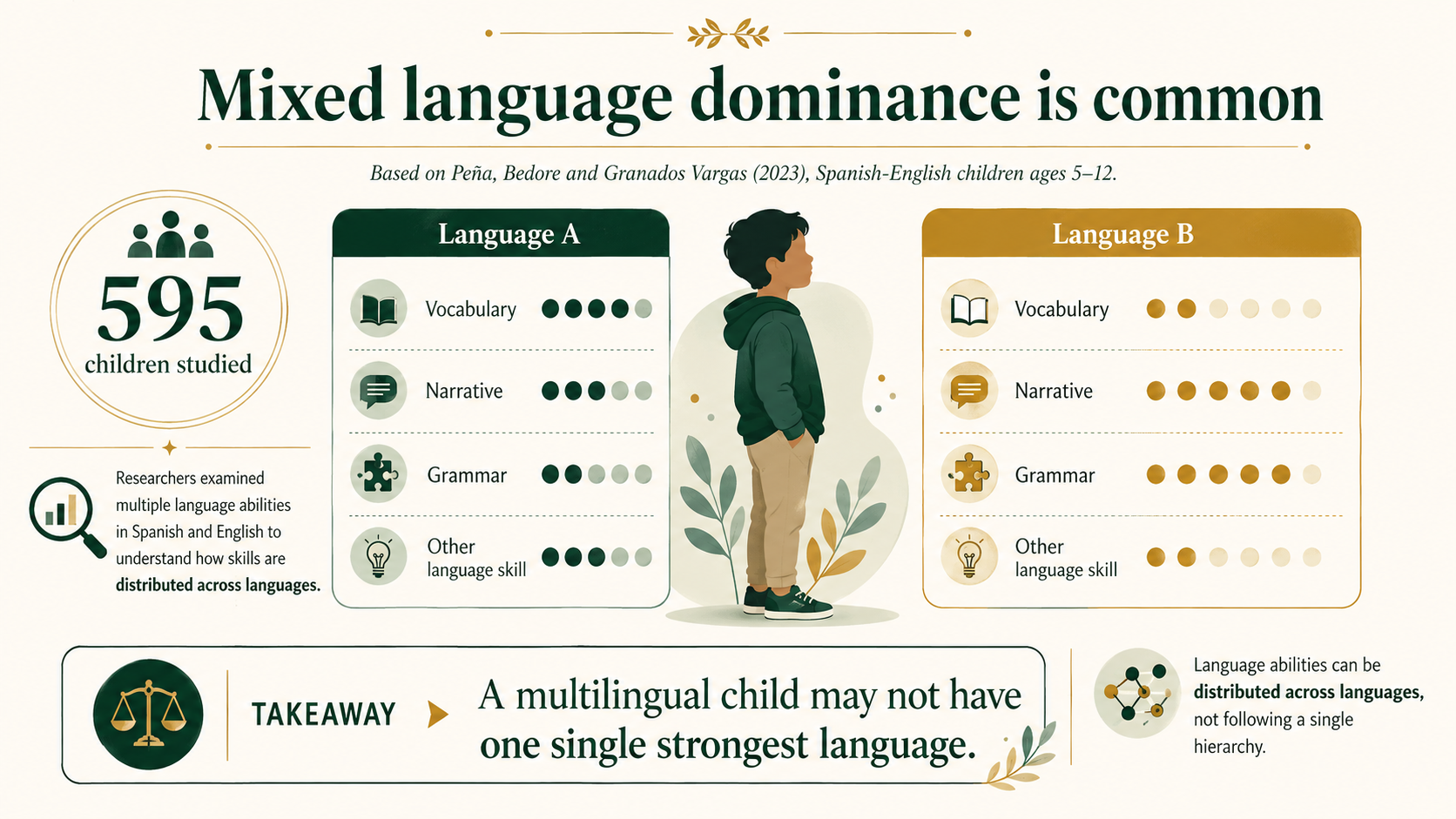
Parents ask which language their child is strongest in, expecting one answer. Often there is not one. Across 595 bilingual children aged 5 to 12, Peña, Bedore and Granados Vargas found mixed dominance was common: stronger in one language for vocabulary, stronger in the other for grammar.
Sit with that, because it dismantles a lot of unnecessary worry.
Your son might have a richer emotional vocabulary in your language and better sentence structure in the school language. Your daughter might tell better stories in one and count more comfortably in the other. Neither child is behind. They are distributed.
The same study made a second point that matters for any family who ends up in an assessment room. When the children's best performance across both languages was counted, differences linked to how much of each language they had heard largely disappeared.
In other words: a low score in one language is not evidence of low language ability. It may only be evidence that you tested the wrong half of the child.
What Happens to Family Language After You Move
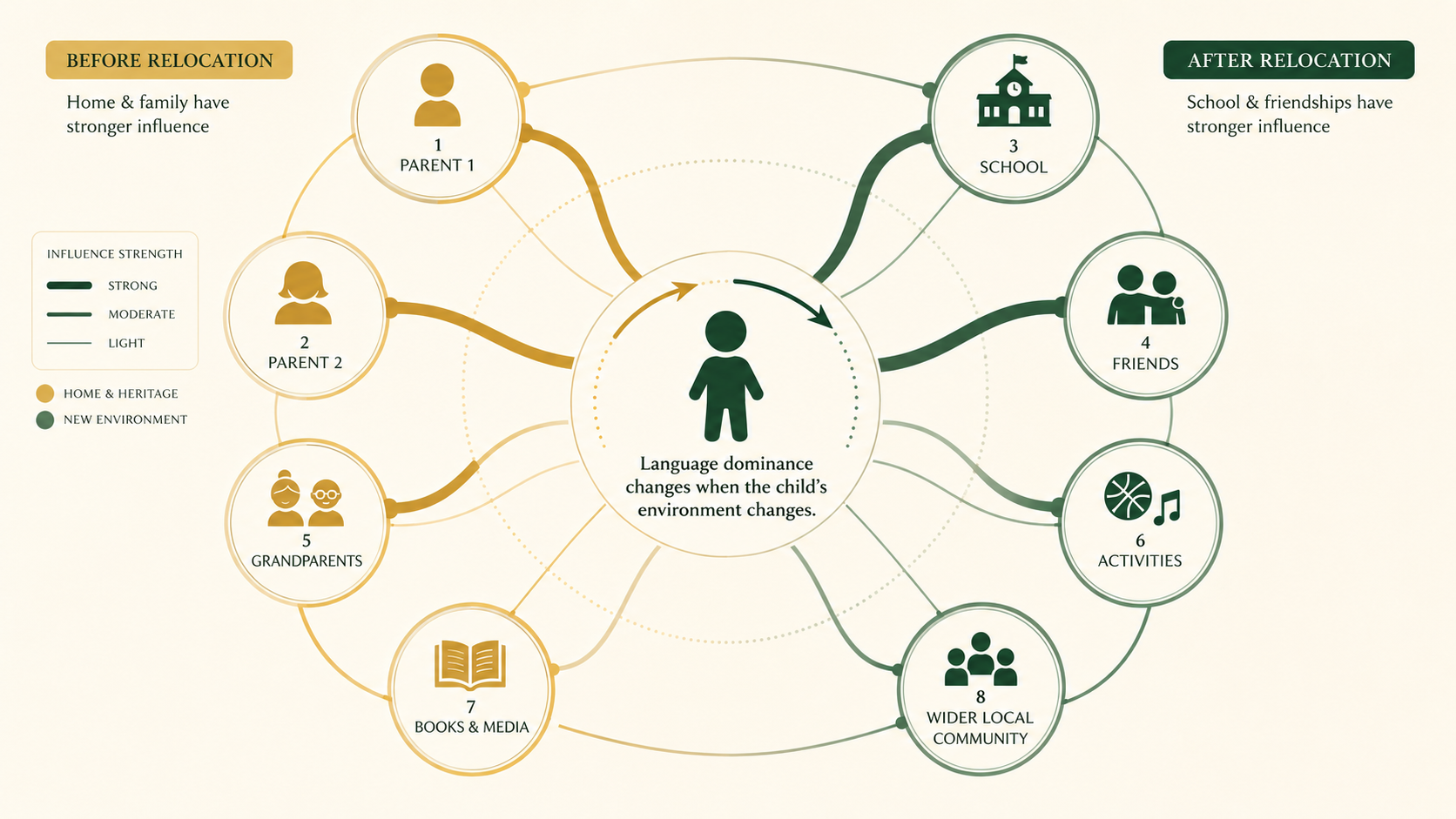
Relocation reorganises a child's entire language environment, usually faster than parents expect. Before the move, the home language covered nearly everything. Afterwards, the school language covers school, friendships, sport, jokes, screens and most waking hours. The home language does not disappear. It becomes the language of one place instead of every place.
This is the shift almost nobody warns families about, and it can be genuinely painful.
You remember a four year old who spoke only your language, constantly, all day. You now have a seven year old who speaks it with you and almost nowhere else, and who occasionally reaches for a word and cannot find it.
How did the language we once shared without thinking become the language I have to remind my child to use?
Nothing went wrong. The arithmetic changed. Your child now spends thirty hours a week in a language they did not previously live in, with the people whose opinion matters most to them at that age. Their fastest language may shift, and speed is not the same as attachment.
Separate two things that feel identical at midnight: whether your child is losing the language, and whether your child is losing you. Those are different questions, and the answer to the second is almost always no.
Should You Speak the Local Language at Home?
Usually not as a rule, and not by abandoning the language you know best. Switching the whole home to the school language is not supported by professional guidance on multilingual development, and it often costs more than it gains. Your child already gets the school language everywhere. What they cannot get elsewhere is you, at full depth.
Think about what you actually do in your strongest language.
You comfort. You explain complicated things. You are funny. You tell the story about your grandfather in a way that lands. You discipline with precision instead of blunt instruments. You say the thing that makes a crying six-year-old stop crying.
Now imagine doing all of that at seventy percent. That is the real trade you would be making, and it is a bad one.
Families are often told that home language use is slowing school integration. Usually the school language is developing on schedule and the delay exists only against an unrealistic timeline, while family conversation quality quietly drops. That is much harder to repair than vocabulary.
The exception is worth naming honestly: if you genuinely prefer the local language, or it is the language you and your partner share, use it. The goal is rich communication, not obedience to a rule about which language.
Why Your Child Understands You But Answers in Another Language
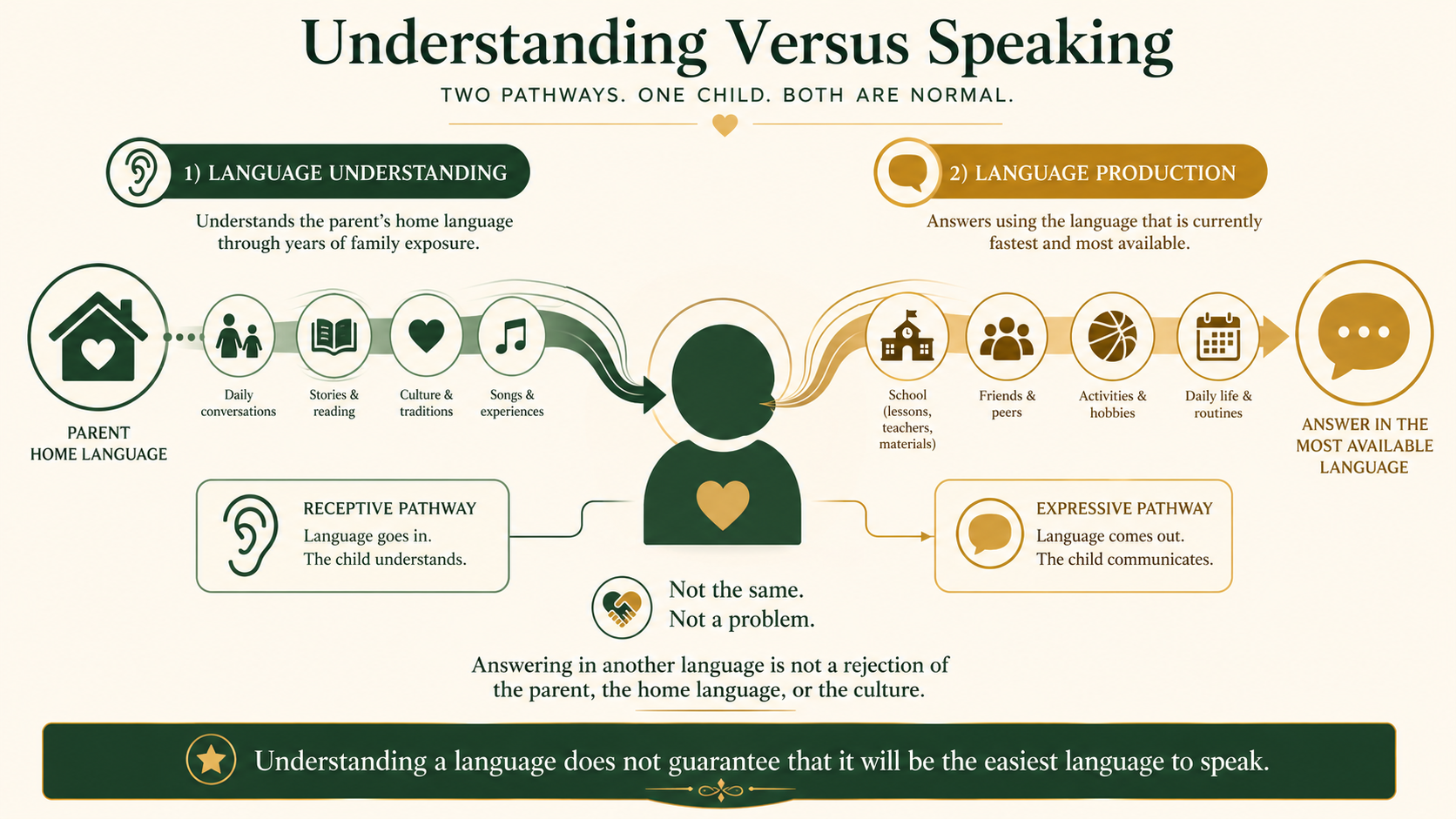
This is the most common worry in multilingual families and it usually means far less than parents fear. Understanding and speaking are separate skills, and children default to whichever language comes fastest. If school, friends and entertainment run in the local language, that language wins on speed, not on loyalty.
Your child is not rejecting you. They are being efficient, which is what all of us do.
The instinct is to make it a rule. Answer me in my language. Sometimes that works. Often it turns every conversation into an audition, and children who feel tested in a language tend to use it less, not more.
A few things that tend to work better:
Keep speaking your language regardless of what comes back. Receptive ability is real ability, and it is what allows production to return later, often around visits home or in adolescence.
Recast instead of correcting. If they answer in Dutch, reply naturally in your language using the words they needed. They hear the model without being marked.
Create moments where your language is the only option. A call with a grandparent who speaks nothing else does more than a month of instruction, because the language becomes necessary rather than requested.
Let some conversations be bilingual. A child using two languages in one exchange is not confused. It is normal multilingual behaviour.
A child who feels tested in a language uses it less. A child who feels loved in a language keeps it.
Is It a Problem When Children Mix Languages?
Generally not. Multilingual children do not experience their languages as sealed boxes. A 2025 review of 94 studies on translanguaging describes children drawing on their whole linguistic repertoire to communicate. Borrowing the easiest word mid sentence is a sign of resourcefulness, not disorder.
You will see the pattern everywhere in international families.
One language with you, another with the other parent, a third with siblings, and a running blend when they are excited. A child who tells a story with a Turkish frame, a Dutch verb and an English punchline because that was the fastest route to the point.
That child is not failing to keep languages apart. They are using everything they have.
The one distinction worth watching is context. Most multilingual children learn over time that some situations expect one language only, and they adjust. That adjustment is a social skill that develops, not something to enforce at the dinner table when they are six.
Grandparents, Belonging, and What a Language Is Actually For
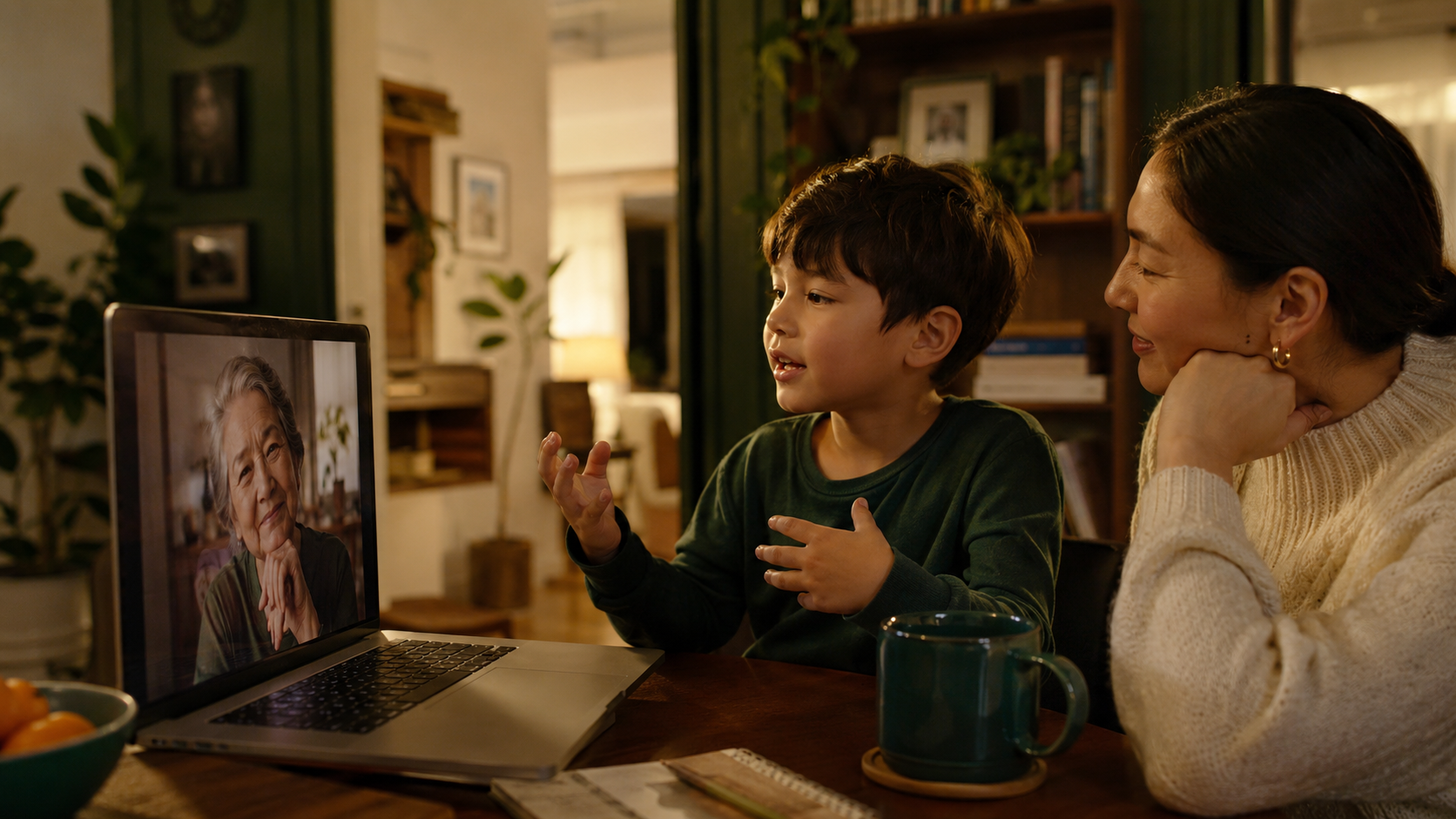
The strongest argument for the home language is not cognitive. It is relational. A weakening heritage language rarely costs a child vocabulary alone. It can cost them the ability to have a real conversation with the people who love them.
A grandmother asks about school. The child answers in four words, because four words is what they can retrieve. She hears a polite, distant child. He experiences himself as someone who cannot be interesting in front of her.
Neither is at fault. Both feel the distance.
That is what heritage language maintenance actually protects: the jokes, the stories, the ordinary teasing, the family history that lives in one language and was never translated. Not a skill. A relationship, and a route into where the family came from.
This connects to the wider question of belonging that runs through international family life, explored further in our article on identity and belonging abroad. Children raised across languages usually do fine with multiple belongings. What is harder is having a language in the family they cannot reach into.
A weaker heritage language does not doom a child to an identity crisis. Plenty of adults reconnect with a family language later. The point is simply that keeping the door open costs less than reopening it.
When Parents Disagree About Family Language
This is one of the most common sources of quiet tension in international couples, and both positions are usually reasonable. One parent wants firm home language rules. The other worries the child is already carrying enough while adapting to a new country. The disagreement is rarely about linguistics. It is about identity, fairness and fear of being edged out.
Consider the three language household, which is more common than any tidy model.
A Spanish speaking mother, a Turkish speaking father, living in the Netherlands, speaking English to each other, with a child in a Dutch school. Four languages in one family. The question is never which language to eliminate. It is which languages get real, repeated, human contact, and how each parent gets to be fully themselves with their child.
Underneath the practical debate is usually something more tender. One parent notices their language shrinking inside their own home. Their partner's language is spoken at school, on the street, on the television. Theirs exists in one hour of bedtime. That is a real loss, and it deserves to be named rather than argued around.
When Your Child Becomes the Family Translator
Children in international families often help with language, and that is not automatically harmful. Helping with a word is different from carrying responsibility for an adult system. The distinction is not whether a child translates, but what is being handed to them and how consequential it is.
Reasonable: reading a menu, helping at a shop, explaining a sign, handling a quick everyday exchange.
Heavier: a call with the tax office, a rental dispute, a medical appointment, a school conversation about their own behaviour, anything where an error has real consequences and the child knows it.
Children in that second category are frequently proud to help, which is precisely why it goes unnoticed. What they are absorbing is that the family's stability depends partly on them, at an age when it should not.
There is also a role shift worth watching for. After a few years, your child may simply be the best local language speaker in the house. Handled lightly, that is a source of pride for everyone. Handled by default, it can quietly invert the ordinary shape of the family, where you are the one who handles the world. That balance is easier to hold when your own language learning keeps moving too, which is its own separate challenge covered in language barriers for expats.
A Realistic Family Language Strategy
There is no single correct system, and the families who do best rarely follow a strict one. What predicts success is not balance but purpose: each language having real people, real activities and real reasons attached to it. Perfect equality across languages is not the goal and is not achievable for most families.
Protect relationship quality first. Whichever language lets you be warm, funny and complex with your child is doing the most important work.
Give every language a person and a place. Grandparents on video, a weekend group, cousins, a sport, a bedtime book. Languages survive through relationships, not intentions.
Stop correcting constantly. If every exchange becomes a lesson, the language becomes a test, and children avoid tests.
Choose human contact over screens. Passive watching is not the same as talking to someone who responds and expects something back.
Expect imbalance and plan for it. One language dominant, one strong, one understood and rarely spoken. That is a normal multilingual profile, not a failure.
Reassess after transitions. New country, new school, adolescence, a long summer with family. Language patterns move, and a strategy that fit at five may not fit at eleven.
Children rarely keep a language because a parent explains it will be useful in twenty years. They keep it because it belongs to someone and something they care about right now.
When to Get Professional Advice
If you have real concerns about your child's communication, get an assessment rather than an internet answer, and get it from someone who understands multilingual development. A multilingual child should never be evaluated only against monolingual expectations in a single language. That is how ordinary bilingual profiles get mistaken for disorders.
Some practical guidance.
Ask directly whether the professional assesses across all of a child's languages, or is measuring only the school language. This one question changes the quality of the answer enormously.
Bring information about the child's whole language history: which languages, from whom, since when, in which settings. That context is diagnostic information, not background.
And hold both truths at once. Multilingualism does not cause language disorders, and multilingual children can have language disorders. If something concerns you, being multilingual is not a reason to wait and see, and it is also not the explanation.
When the Language Question Is Really an Emotional One
Sometimes the argument about language is not about language. It is about guilt, identity, and the fear of raising a child who does not fully belong to where you came from. That is a heavier thing to carry than a family language plan, and it does not resolve with a better strategy.
Parents describe it in similar ways. Guilt about the language slipping. Grief about a grandparent relationship that got thinner. Resentment when one parent's language dominates the house. And a background sense of being responsible for delivering two or three cultures to a child, perfectly, alone, in a country where you are still adapting yourself.
That last one is worth challenging directly. You do not need to produce a perfectly balanced multilingual child in order to be a good international parent. You need to communicate well with your child, keep the important relationships open, and give each language enough room to live.
If those questions have become entangled with wider adaptation strain, they often sit alongside the experience of culture shock, and with the strange sense of being a slightly different person in each of your own languages, described in why you feel different speaking another language.
Expathy matches expats with psychologists by native language and cultural background, and our psychologists have lived abroad themselves. For multilingual families, that means discussing not only which language to speak, but what each language means inside your family.
If that is the conversation you actually need, online therapy for expats is built for it.
Final Thought
The question most international parents are really asking is not about vocabulary counts. It is whether their child will grow up able to talk to them properly, and to the people who came before them.
That is a good question, and the answer is mostly yes, with attention rather than perfection.
Your child is not being confused by their languages. They are building a life that needs several of them, and each one will end up carrying a different part of who they are.
Some will be strong, some uneven, one may go quiet for years and come back. None of that is failure. It is what a multilingual childhood looks like from the inside.
Sources and Further Reading
- Peña, Bedore and Granados Vargas (2023), study of 595 Spanish and English speaking children on mixed language dominance and assessment: https://doi.org/10.1044/2023_JSLHR-23-00117
- Moraru and colleagues (2025), systematic review of 94 publications on translanguaging among multilingual children: https://doi.org/10.1002/rev3.70069
- Lowe and colleagues (2021), large meta-analysis examining claimed cognitive advantages in bilingual children: https://doi.org/10.1177/0956797621993108
Frequently Asked Questions
Does bilingualism delay speech in children?
No. Exposure to more than one language does not by itself cause a delay or a language disorder. Multilingual children may reach some milestones on a different pattern, and their vocabulary is often spread across languages, so counting only one language can make their abilities look smaller than they are.
Will three languages confuse my child?
Three languages is common in international families and is not inherently confusing. Children can manage several languages when each one has consistent, meaningful human contact. Practical difficulty usually comes from a language having no real speakers or purpose in the child's life, not from the number of languages itself.
Should expat parents speak the local language at home?
Usually not as a rule, and not at the cost of the language you speak best. Your child receives the school language in large quantities elsewhere. What only you can provide is warmth, humour, nuance and complex explanation, and that depends on speaking the language in which you are most fully yourself.
Why does my bilingual child understand me but answer in another language?
Because understanding and speaking are separate skills, and children reply in whichever language comes fastest. When school, friendships and entertainment all run in the local language, it wins on speed. This is usually a preference driven by daily exposure, not rejection of you or of your language.
Is it normal for a bilingual child to mix languages in one sentence?
Yes. A review of 94 studies on translanguaging describes multilingual children drawing on their whole linguistic repertoire to communicate. Borrowing the easiest available word is efficient, not disordered. Most children also learn over time which settings expect one language only, and adjust accordingly.
Can a child have more than one strongest language?
Yes, and it is common. In a study of 595 bilingual children, mixed dominance appeared frequently: a child could be stronger in one language for vocabulary and in the other for grammar. Asking which language is strongest may simply be the wrong question for many multilingual children.
Should I force my child to speak my native language?
Firm rules work in some families and backfire in others, because a child who feels tested tends to use the language less. Usually more effective: keep speaking it yourself, respond naturally rather than correcting, and create situations where your language is genuinely needed, such as time with relatives who speak only that language.
Should my child translate for me?
Small, everyday help is fine and often builds confidence. Handing a child responsibility for consequential adult matters, such as medical appointments, official calls or disputes, is different. The distinction is not whether a child helps with a word, but whether they are carrying responsibility for an adult system.
Need support? We're here.
Book a free 15-min consultation with our expat-specialized therapists.