
Key takeaway
You expected the first six months to be hard. Nobody warned you that year three could feel worse. You have colleagues, a gym, three WhatsApp groups and a decent life on paper, and still no one you would text on a Friday evening without overthinking it. This article is about what happens when loneliness abroad stops being a phase and starts becoming the shape of your life: why it persists, how it quietly changes what you expect from people, and what actually interrupts the pattern.
Here is the moment that usually tells someone the truth.
Something goes wrong. A bad scan result, a job loss, news from home at two in the morning. You open your phone and scroll through a contact list with three hundred names in it.
And there is nobody nearby you would actually call.
Not because you know no one. You know plenty of people. It is that knowing people and being known by people turned out to be different things, and somewhere in the last two years the gap between them stopped closing.
What Chronic Loneliness Abroad Actually Means
Chronic loneliness is not a diagnosis and not simply loneliness that lasted longer. It is loneliness that has stopped being a response to transition and started becoming the default setting of your life abroad, persisting long enough to change your expectations, your confidence and how much you are willing to reach out.
The word chronic here describes a pattern, not a severity level.
Early relocation loneliness has a story attached: I just arrived, I do not know anyone yet, this takes time. That story is accurate, and it makes the feeling bearable because it is temporary by definition.
Chronic loneliness has a different story: I have done the things, and it did not work, and I am starting to think it might not.
The broad picture, why loneliness happens abroad in the first place and what helps in general, is covered in our main guide to loneliness abroad. This article picks up at the point where the usual answers have already been tried.
The useful question is not how many months it has been. Six months of acute loneliness during a hard first year is normal. Two years of a quiet, stable, low grade disconnection that you have organised your life around is something else, even if it feels less dramatic.
Ask yourself this instead of counting months: has loneliness become a temporary reaction to change, or the ordinary background condition of my week?
The Shift From "I Have Not Found My People Yet" to "Maybe I Will Not"
The turning point is rarely an event. It is a sentence that changes. When someone stops explaining their loneliness by circumstance and starts explaining it by something about themselves or the country, the experience becomes considerably harder to move. That shift usually happens quietly, without anyone noticing the day it occurred.
Compare the two internal narrations.
I have not found my people yet. This assumes people exist and the search continues. It keeps effort worthwhile.
Maybe I am never going to find my people here. This is a conclusion. And conclusions change behaviour, because there is no point investing in something you have decided will not work.
Neither sentence is a character flaw. The second one is usually earned, built from a genuine accumulation of disappointing evenings, unreturned suggestions and friendships that dissolved when someone's contract ended.
The problem is that once the conclusion forms, it starts producing the evidence that supports it. Fewer invitations offered means fewer accepted. Less openness means less closeness. The prediction quietly arranges its own confirmation.
Loneliness and Social Isolation Are Not the Same Thing
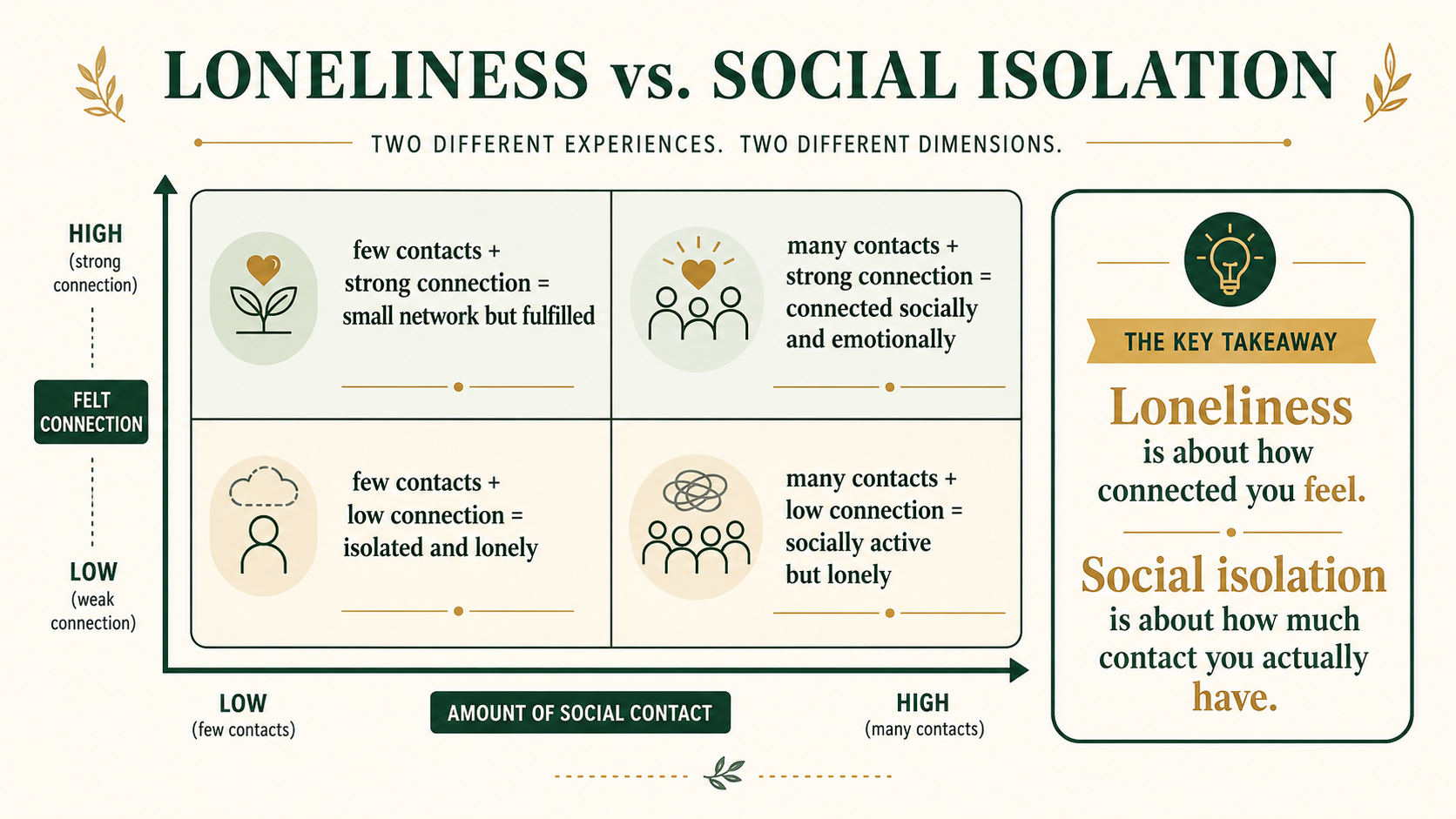
This distinction matters more than almost anything else here. The World Health Organization defines loneliness as the painful feeling from a gap between the connection you want and the connection you have, while social isolation is the objective lack of contact. The WHO Commission on Social Connection notes the two are only weakly related.
Read that again, because it explains something people abroad find baffling about themselves.
| Your social life | Actual contact | How it feels |
|---|---|---|
| Full calendar, no close relationships | High | Deeply lonely |
| Two real friendships, quiet weeks | Low | Largely content |
| Few contacts, no close relationships | Low | Lonely |
| Several close, reciprocal relationships | High | Connected |
Social isolation describes the structure of your social life. Loneliness describes how it feels from inside. You can sit in row one and row four of that table without your diary looking meaningfully different.
The WHO Commission also found that roughly one in six people worldwide reported loneliness between 2014 and 2023, which is worth knowing for one reason only: whatever else is happening, this is not a rare defect in you.
The rest of this article is about the felt gap. The structural side, when someone genuinely has too few contacts and too few routes into social life, is a separate problem with separate answers.
Why You Can Have Friends and Still Feel Lonely
Because company and intimacy are different products, and international social life is unusually good at supplying the first while failing at the second. You can have a busy calendar full of people who do not know anything true about you, and that combination produces a particularly confusing loneliness, because on paper nothing is wrong.
What is often missing is not contact. It is:
Reciprocity. You initiate every time. They always say yes and never suggest. Pleasant, and quietly exhausting.
Continuity. People who remember what you told them last month, who follow up on the thing you were worried about.
Permission to be a burden. Someone you could call at an inconvenient hour without calculating whether you have earned it.
Being individually known. Belonging to a group is not the same as being someone in particular within it. Plenty of people are included everywhere and known nowhere.
This is why the standard advice fails at this stage. Someone in this position does not need ten more acquaintances. They already have acquaintances. Adding more will change nothing, which is why doing exactly what everyone recommended left them feeling worse and privately concluding the fault must be theirs.
If you are earlier in the process and genuinely still building a circle, the practical groundwork is covered separately in our guide on making friends abroad. This article is about what happens after that stops being the bottleneck.
What Repeated Goodbyes Do to Your Willingness to Invest
International communities make friendship easy to start and hard to keep. Contracts end, visas change, relationships relocate people, companies restructure, and after the third or fourth close friend leaves, most people quietly adjust how much of themselves they are willing to put into someone new.
That adjustment is the mechanism worth watching.
You meet someone promising. You enjoy them. And a small internal calculation runs in the background: how long are they here for? You are not being cynical. You are protecting yourself from a loss you have already survived several times.
But the protection has a cost. Depth requires exposure over time, and a friendship held slightly at arm's length rarely becomes the kind you would call in a crisis. You end up with a wide circle of pleasant, provisional relationships, which is precisely the configuration that produces loneliness while looking like a social life.
The InterNations Expat Insider 2026 survey captures the shape of this in the Netherlands, a country where daily life in English is famously easy: only about 29% of expats felt positive about making local friends, and roughly half said their friends were mostly other expats. Comfortable, and still circling within a population that turns over.
The exhaustion is not from losing one friend. It is from the prospect of building the whole thing again from zero, for the fifth time, at thirty eight.
How Loneliness Starts Changing What You Expect From People
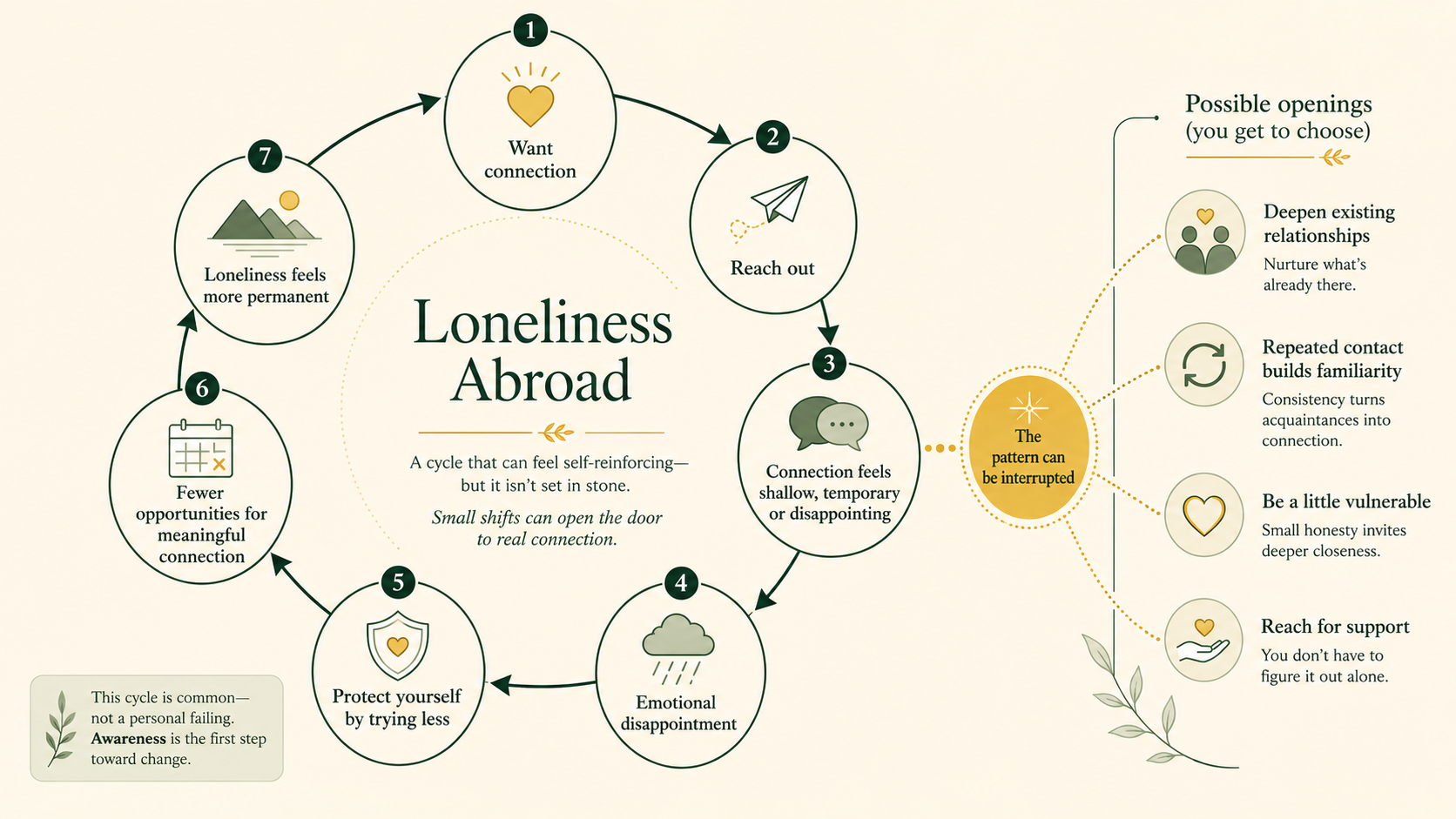
Persistent loneliness does not only make you sad. It gradually recalibrates how you read other people, making ambiguous social signals look like rejection and making the effort of reaching out feel less and less worth it. This is the compounding part, and it is the reason chronic loneliness behaves differently from the ordinary kind.
The loop is simple and almost invisible from inside it:
You want connection → you make an effort → the result is thin or temporary → you are disappointed → you protect yourself by trying less → there are fewer chances for anything deep → loneliness confirms itself.
In practice it sounds like this. An unanswered message is now evidence rather than an unanswered message. A cancelled plan means they were never that interested. Being the one who always organises stops feeling generous and starts feeling humiliating, so you stop.
None of these interpretations are irrational. They are what a mind does after enough repetition. The difficulty is that they are also self sealing: the more protective you become, the less disconfirming evidence you generate.
Cultural and language friction adds a layer that people abroad rarely name. Interacting outside your strongest language can make socialising less rewarding even when it technically succeeds, because humour, timing and emotional nuance are the first things to go, an experience covered in why you feel different speaking another language. Slightly less rewarding, several hundred times, adds up.
Why "Meet More People" Stops Working, and What Does
At this stage the problem is depth, not volume, so the answer is not a bigger funnel. The most reliable route out is to stop searching for a new social circle and start investing disproportionately in the two or three relationships that already show some reciprocity. That is a much smaller task than it sounds.
Step 1. Map what you actually have. Not to rank people. To see what is missing. Sort your contacts honestly: acquaintances, activity friends, work friends, people who would help in a crisis, people from home, actual local relationships. Most people discover they have plenty of one category and nothing in another. That tells you what to build.
Step 2. Pick one or two, not ten. Look for anyone who has ever initiated, followed up, remembered something, or made room for you. That is the raw material. It is far easier to deepen a warm acquaintance than to manufacture a new friend.
Step 3. Build repetition, not events. Adult closeness comes from recurrence, not intensity. A standing Tuesday coffee beats four excellent one off evenings, because familiarity is a function of frequency. Convert we should do this again sometime into an actual repeating slot, which is the single highest leverage move in this whole article.
Step 4. Take small, deliberate risks. Say you enjoyed the evening. Ask for a favour. Mention something real that is going on. Vulnerability is not a confession, it is a signal that this is allowed to be more than pleasant.
Step 5. Check who you are spending your effort on. Some people are structurally unavailable: always travelling, leaving in four months, at capacity. Nothing is wrong with them. But if your entire social energy goes to people who cannot offer continuity, the outcome is predictable and it is not your fault.
Step 6. Spread the load. One partner, one best friend or one colleague cannot be your entire support system. When that person is busy or leaves, the whole structure goes with them.
You do not need a social circle. You need two people and a repeating slot in the week. Almost everything else grows from that.
When Loneliness Starts Becoming a Question About Staying
Eventually the loneliness stops being about your social life and becomes a question about your entire life abroad. Should I stay? Is it this country? Would I feel this way anywhere? These questions are legitimate, and they are also extremely hard to answer while lonely, because loneliness colours everything it touches.
Here is the trap.
Loneliness attaches itself to whatever is nearby. It becomes the weather, the bureaucracy, the local culture, the way people here make friends, the job. Some of that may be genuinely true. But a country you experience alone is not the same country you would experience connected, and it is nearly impossible to evaluate one while living the other.
This is worth naming honestly rather than resolving. Some people do need to move home, and that is a legitimate answer, not a defeat. Others move home and discover that the friends they missed have children now, and the closeness they remembered belonged to a version of life that ended.
What usually helps is separating the questions before deciding. Is this country wrong for me, or have I been lonely in it? Am I staying for reasons I still believe in? These sit close to the wider work of identity and belonging abroad, and they deserve better than being decided in a bad week.
When Professional Support Helps
Therapy is worth considering when loneliness has stopped being about opportunity and started being about what you now believe. If reaching out feels pointless, if rejection feels certain before it happens, or if the loneliness has begun pulling down your mood, sleep and sense of worth, that is a psychological pattern rather than a scheduling problem.
Be clear about what this does and does not do. Therapy will not find you friends. What it can do is work on the things standing between you and connection: rejection sensitivity, withdrawal that has become automatic, the belief that you are somehow harder to like here, the fear of investing again, and the grief of a social life you left behind and have not replaced.
It also helps to have somewhere to sort out whether this is loneliness alone or whether something heavier has settled underneath it. Persistent loneliness and low mood often travel together, and the overlap is worth taking seriously rather than waiting out, as we discuss in relation to homesickness and depression abroad.
There is a specific reason this is worth doing with someone who understands the context.
If you have ever tried to explain to a therapist why friendships abroad feel temporary, or why being surrounded by internationals does not produce belonging, or why going home is not the simple solution everyone assumes, you know how much of the session that consumes.
Expathy matches expats with psychologists by native language and cultural background, and our psychologists have lived abroad themselves. The context is already understood, so the hour goes to the actual problem.
That is not a claim that support in your own language is universally better. It is a claim about starting from the right place. If that is what you need, online therapy for expats is built for exactly this.
Final Thought
The cruellest thing chronic loneliness does is convince you it is a verdict on you. That other people manage this easily. That there is something about you specifically that does not translate here.
Look at the evidence instead. The largest analysis of migrant adaptation to date, covering 1,114 studies and 571,260 people including business expatriates, found that feeling connected and not feeling lonely were among the strongest positive correlates of adapting well to a new country. Not personality. Not effort. Connection itself.
Which means this is not a side issue you should be handling privately while getting on with the real business of living abroad. It is close to the centre of whether life abroad works.
You are not bad at this. You have been trying to build in years what most people around you inherited over decades.
Start smaller than you think. One person, one repeating slot in the week, one thing you say honestly. That is how this actually turns.
Sources and Further Reading
- World Health Organization, Commission on Social Connection (2025), on definitions of loneliness and social isolation and global prevalence: https://who.int/news/item/30-06-2025-social-connection-linked-to-improved-heath-and-reduced-risk-of-early-death
- Bierwiaczonek and colleagues (2025), meta-analysis of 1,114 studies and 571,260 migrants, students, expatriates and refugees on social correlates of adaptation, Nature Communications: https://doi.org/10.1038/s41467-025-67468-z
- InterNations, Expat Insider 2026 survey on expat friendship and social experience by destination: https://www.internations.org/expat-insider
- Bayraktar and colleagues (2026), study of 281 expatriates on local social networks, support and adjustment: https://doi.org/10.1007/s11575-025-00605-4
Frequently Asked Questions
How do I know if my loneliness abroad has become chronic?
Look at pattern rather than duration. If loneliness has shifted from a reaction to being new into the ordinary background of your week, if you have stopped initiating because you expect little from it, and if your routines have quietly organised themselves around being alone, it has become persistent rather than transitional.
Why am I lonely even though I have friends abroad?
Because company and closeness are different things. Loneliness is the gap between the connection you want and what you experience, so a full calendar changes nothing if the relationships lack reciprocity, continuity or the sense of being individually known. This is extremely common in international communities and says nothing about your likeability.
Is chronic loneliness the same as social isolation?
No. The World Health Organization defines social isolation as objectively having few relationships and loneliness as the painful feeling of a gap between desired and actual connection, and notes the two are only weakly related. Isolation describes the structure of your social life. Loneliness describes how it feels.
Can moving countries repeatedly make loneliness worse?
It can, though not inevitably. Each rebuild costs energy, and after several rounds of losing close friends to relocation many people begin investing more cautiously in new relationships. That caution is understandable self protection, but because depth needs sustained exposure, it can make the next friendship shallower than the last.
Why do I stop wanting to socialise when I am the most lonely?
Because withdrawal works in the short term. It removes the risk of another disappointing evening and provides immediate relief. The cost arrives later: fewer opportunities for anything meaningful, which reinforces the expectation that reaching out is pointless. The relief is real. So is the compounding.
Should I move home if I cannot build close friendships abroad?
That is a legitimate option, but it is difficult to evaluate while lonely, because loneliness attaches itself to the country, the culture and the job. Try separating the questions first: is this place genuinely wrong for me, or have I been experiencing it without connection? Those produce very different answers.
When should I talk to a therapist about loneliness?
When the loneliness has changed what you believe rather than only how you feel. If rejection feels certain before it happens, if reaching out feels pointless, if you are withdrawing automatically, or if your mood, sleep or self worth have started slipping, professional support is appropriate and often faster than waiting it out.
Can therapy help if the real problem is that I have no close friends?
Therapy does not supply friends, but it addresses what makes friendship hard to build or trust: rejection sensitivity, automatic withdrawal, fear of investing again, and the belief that you are harder to like here. For many people the obstacle is not opportunity but the protective patterns that formed after repeated disappointment.
Need support? We're here.
Book a free 15-min consultation with our expat-specialized therapists.