
Key takeaway
Employee mental health benefits are the therapy, counseling, and wellbeing support a company funds so staff can get help before stress becomes crisis. The benefit only creates value when people actually use it, and usage is where most programs quietly fail. A company can pay for support, believe the benefit exists, and still have international employees who experience it as unusable . That gap between what HR provides and what a relocated, multilingual employee can actually reach is the real problem this guide addresses.
What are employee mental health benefits?
Employee mental health benefits are employer-funded services that give staff access to psychological support. In practice they cover a few distinct things: an Employee Assistance Program (EAP) for short-term counseling and referrals, therapy or counseling coverage through insurance or a dedicated platform, wellbeing programs such as workshops and resilience training, and manager training to spot and support struggling employees.
Most large employers now offer at least one of these, and demand keeps climbing. The World Health Organization estimates that 15% of working-age adults were living with a mental disorder in 2019, so the need inside any large workforce is substantial. The gap is rarely whether a company offers something. The gap is whether the offer reaches the people who need it, in a form they can use.
Why usage matters more than access
Access is easy to buy. Usage is what pays off, and the business case rests entirely on the second one. The World Health Organization estimates that 12 billion working days are lost every year to depression and anxiety, at a cost of around US$1 trillion in lost productivity. That cost lands on the employer whether or not a benefit sits unused in the background.
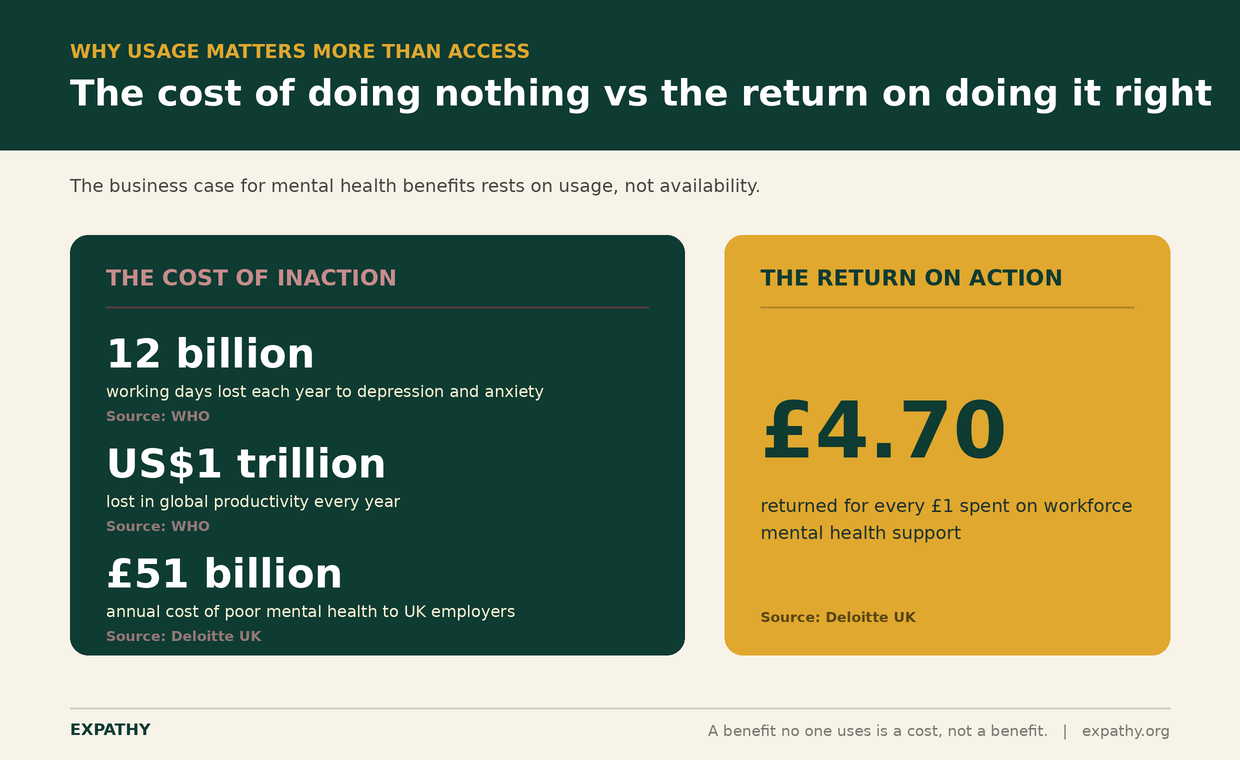
The return, by contrast, follows usage. Deloitte UK estimates that poor mental health costs UK employers around £51 billion a year, and that employers see an average return of about £4.70 for every £1 spent on workforce mental health support. Those returns depend on employees actually engaging with what is offered. A benefit no one uses is a cost, not a benefit. This is exactly where international teams are underserved: the need is high, but the barriers to use are higher.
Why generic benefits often miss international teams
Standard mental health benefits are designed for a general, mostly local workforce. They assume the employee shares the provider's language, understands the local care system, and feels safe disclosing personal struggles to someone from the dominant culture. For an international workforce, each of those assumptions can break.
Several barriers reduce usage among relocated and multilingual staff:
- Language. Therapy depends on nuance. An employee processing grief, identity, or burnout in a second language often cannot reach the vocabulary that makes therapy work, so they disengage.
- Cultural fit. A counselor unfamiliar with the employee's background may misread what is normal, what is distress, and what help should look like.
- Relocation stress. Moving countries stacks visa pressure, isolation, and loss of support networks on top of the job itself. Generic benefits rarely name this experience, so employees assume the benefit is not for them.
- Family pressure. A relocating employee often brings a partner or children who are also struggling to adapt, which feeds back into the employee's own wellbeing.
- Trust and confidentiality. Staff far from home are often more worried about privacy, and about how disclosure might affect their standing, which lowers uptake further.
The result is a program that looks complete on paper while helping almost no one in the international segment.
The four things a mental health benefit needs to work
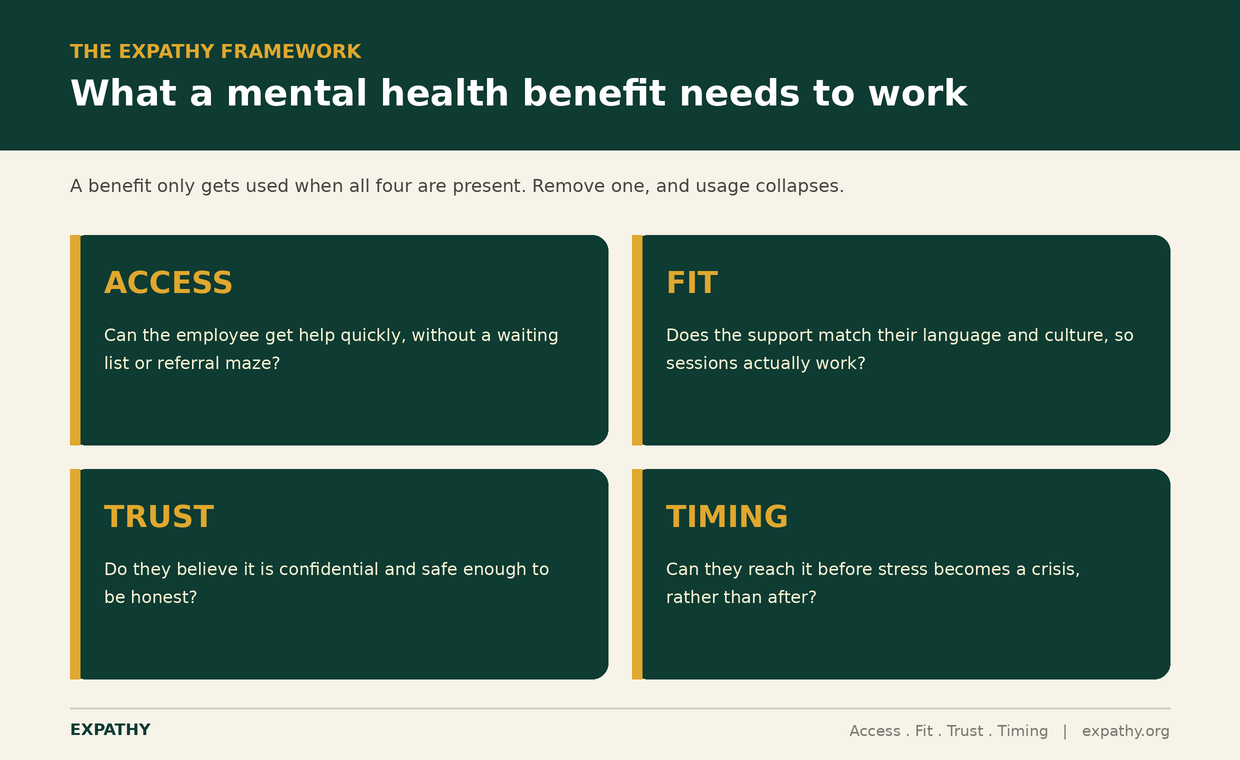
A useful way to evaluate any benefit is against four conditions. A mental health benefit only works when access, fit, trust, and timing are all present. Remove any one and usage collapses.
- Access. Can the employee get help quickly, without a long waiting list or a referral maze?
- Fit. Does the support match their language and culture, so the sessions are actually productive?
- Trust. Do they believe it is confidential and safe enough to be honest?
- Timing. Can they reach it before stress becomes crisis, rather than after?
Generic benefits often deliver access alone. For international teams, fit and trust are usually the missing conditions, and they are the reason a well-funded benefit still goes unused. For a closer look at why language and cultural matching drive engagement, see our piece on native-language therapy as an employee benefit.
What strong employee mental health benefits should include
A mental health benefit that international teams actually use tends to share a set of features. Use this as a working standard when reviewing what you offer:
- Licensed therapy access with short waiting times, not just a referral line.
- Native or preferred-language support, so employees can be matched with a professional who speaks their language.
- Culturally aligned care, where the professional understands the employee's background and the expat experience.
- Wellbeing workshops for teams, covering stress, adjustment, and resilience.
- Manager training so team leads can recognize early signs and respond well.
- Family-sensitive support that acknowledges partners and children affected by relocation.
- Clear confidentiality, communicated in a way that reassures employees who are far from home.
Manager capability is easy to overlook here, because leaders set the tone for whether support feels safe to use. Our guide on manager training for supporting international employees covers how to build that skill across a multicultural team.
Generic EAP vs international-team mental health benefit
EAPs are useful. They provide broad, low-cost, first-line support and work well for a general workforce dealing with common stressors. They are simply not always enough for multilingual and relocated staff. The table below is a fair comparison, not an argument against EAPs.
| Dimension | Generic EAP | International-team benefit |
|---|---|---|
| Best for | Broad workforce, common stressors | Multilingual, relocated, culturally diverse staff |
| Language | Usually local or English only | Native or preferred language matching |
| Cultural fit | General | Professional understands expat and cultural context |
| Access model | Referral line, short sessions | Direct matching with licensed psychologists |
| Family context | Rarely addressed | Partner and family adaptation considered |
| Usage barriers | Language, cultural fit, and relocation context may reduce uptake | Designed to remove language, cultural, and relocation barriers |
The honest read: many companies do not need to replace their EAP. They need to add a specialist layer for the part of the workforce a generic EAP was never built to serve. If you are weighing that trade-off directly, our guide on EAP alternatives for international employees walks through when a supplement makes more sense than a replacement.
The question HR should ask is not "Do we offer support?"
The better question is: "Would an employee actually use this support at the moment they need it?"
That single shift changes how you evaluate a program. Coverage on a benefits sheet tells you nothing about whether a Turkish engineer in Amsterdam, three months into a relocation and struggling to sleep, will book a session with a counselor who does not speak her language or understand her situation. She probably will not. The benefit exists, and she remains effectively unsupported. The most expensive mental health benefit is not the one with the highest price. It is the one your employees do not trust enough to use. Designing for the moment of use, not the fact of provision, is what separates a benefit that works from one that just looks good in an offer letter.
How HR should choose the right benefit
When evaluating a provider or reviewing your current program, work through a short checklist:
- Coverage of languages. Can employees be matched with a professional in their own language?
- Cultural competence. Do the professionals understand the expat and relocation experience?
- Speed to first session. How long from sign-up to a real appointment?
- Licensing and credentials. Are all professionals licensed and verifiable?
- Family support. Is there provision for affected partners and children?
- Confidentiality clarity. Is privacy explained in a way that reassures international staff?
- Measurable usage. Will you be able to see whether people actually engage?
The last point matters most. A benefit's value is proven by utilization, so treat expected usage as a selection criterion, not an afterthought.
When this matters most
An international-focused mental health benefit earns its place in specific situations: during relocation and international assignments, when hiring across borders, when running distributed or remote teams across time zones, when a workforce is multilingual or multicultural, and during high-stress assignments where burnout risk is elevated. Companies with a high share of expatriate or relocated staff feel the gap most sharply, because that is exactly the population generic benefits underserve.
How Expathy fits the gap
Expathy is the culturally aligned mental health support layer for international and expat employees. Staff are matched with licensed psychologists who share their native language and cultural background, in around 30 seconds rather than the weeks a waiting list can take. It is built for the part of the workforce that generic benefits tend to miss, and it works alongside existing programs rather than replacing what already serves your general staff. Companies can also add wellbeing workshops for teams with a high international population.
Want to see how this could work for your team? Talk to us about employee mental health support for your international staff.
Frequently asked questions
What should employee mental health benefits include?
Strong benefits combine licensed therapy access, wellbeing workshops, manager training, and clear confidentiality. For international teams, native-language and culturally aligned support are essential, because they determine whether employees actually engage rather than letting the benefit sit unused.
Should we replace our EAP?
Usually not. Most companies keep their EAP for the general workforce and add a specialist layer for international, multilingual, and relocated staff. The two work together: the EAP covers broad first-line needs, while the specialist layer removes the language and cultural barriers an EAP was not built for.
How do we measure whether employees actually use the benefit?
Track utilization rate, time from sign-up to first session, repeat engagement, and usage broken down by employee segment. Low uptake among international staff is a common blind spot, so segmenting the data by language or location often reveals a gap that overall averages hide.
Are mental health benefits confidential from HR?
With reputable providers, individual session content is confidential and not shared with the employer. HR typically sees only aggregate, anonymized usage data. Communicating this clearly matters, because employees far from home are often more anxious about privacy and will not use a benefit they do not trust.
Why do international employees need different support?
Relocation adds language barriers, cultural adjustment, isolation, and visa or family pressures that general benefits rarely address. Support matched to an employee's language and cultural background removes the friction that otherwise keeps international staff from using what is offered.
How much do employee mental health benefits cost?
Cost varies by model, from per-employee EAP fees to per-session or subscription pricing on dedicated platforms. Rather than comparing headline price alone, weigh cost against expected usage, because a cheaper benefit that no one uses delivers less value than a well-matched one that people engage with.
What is the difference between an EAP and a mental health platform?
An EAP typically offers short-term counseling and referrals across a broad workforce. A dedicated mental health platform usually provides ongoing, directly matched therapy. For international teams, the key difference is matching: platforms that match on language and culture tend to see higher engagement from relocated staff.
Need support? We're here.
Book a free 15-min consultation with our expat-specialized therapists.