
Key takeaway
You gave a good presentation this morning. Your manager said so in front of the team. You answered forty messages, stopped at the supermarket on the way home, and told a friend that work is going really well. Then you sat down on the sofa at seven and did not move for three hours, cancelled dinner, and lost the weekend to your apartment. On Monday you will be fine again. This article is about whether that still counts as depression, and why the answer is usually yes.
The question almost everyone in this position asks first is a version of the same thing.
If I can still do all this, can I really be depressed?
It feels like a reasonable objection. You are not in bed. You have not missed a deadline. Nobody has noticed anything. Whatever depression looks like in your head, it presumably looks worse than this.
But the logic has a flaw in it, and the flaw is the whole subject of this article.
Functioning is something other people can see. Wellbeing is not. They are not the same measurement, and they do not fail at the same speed.
What "High-Functioning Depression" Actually Means
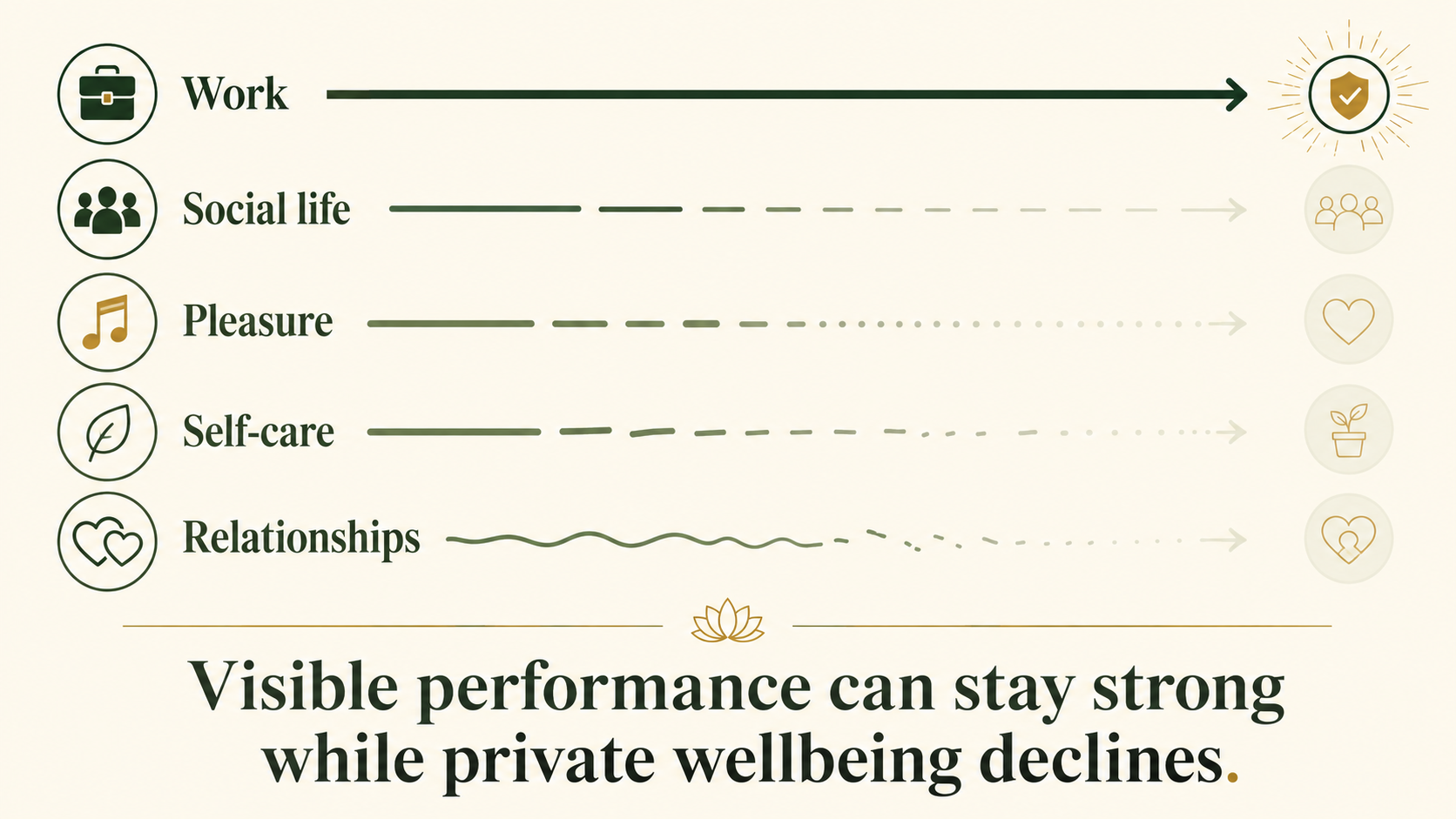
It is a description, not a diagnosis. No clinician diagnoses high-functioning depression, and it appears in neither the DSM nor the ICD. It is the phrase people reach for when they are experiencing significant depressive symptoms while still meeting their visible responsibilities, and it describes a real pattern even though it is not a clinical category.
Two things worth clearing up immediately.
It is not a milder type of depression. Someone maintaining full-time work can be experiencing symptoms as severe as someone who cannot.
It is also not the same as persistent depressive disorder, which is a formal diagnosis for longer-lasting, often lower-grade depression. The two get conflated constantly. Persistent depressive disorder is about duration. High-functioning is about which parts of your life are still visibly working.
So the phrase is useful because it describes how people actually experience this, and it is worth knowing that the thing underneath it is just depression. The broad picture, symptoms, causes and treatment, is covered in our main guide to depression abroad.
Can You Be Depressed If You Still Function?
Yes. Depression does not damage every area of life at the same rate, and the areas most people use to judge whether someone is coping, work and visible responsibilities, are frequently the last to go. Preserved functioning is not evidence of wellbeing. It is evidence that some things are still being held up.
The clinical criteria for depression have never required that you stop working.
They require a persistent cluster of symptoms, most centrally low mood or loss of interest and pleasure, affecting how you feel and operate. Whether your employer has noticed is not part of the assessment.
This matters because a lot of people abroad are quietly waiting for permission. They have decided that if they are still delivering, they are not entitled to call this anything. So they wait, sometimes for years, for a collapse that may never arrive and would be a terrible thing to use as a threshold anyway.
You are not waiting to become properly depressed. You are waiting for evidence that would be visible to other people, and depression does not always produce that.
Why Work Survives While Everything Else Does Not

Because work supplies the motivation from outside, and the rest of your life does not. Deadlines, meetings, colleagues, expectations and a salary create a structure that pulls behaviour along even when internal drive has gone. Evenings and weekends require you to generate that drive yourself, and that is precisely the thing depression takes.
This produces the pattern that confuses people most about themselves.
I can concentrate for eight hours in a job with real consequences, and I cannot make myself cook a meal, answer a friend, or do the hobby I moved here for.
That is not laziness, and it is not inconsistency. The eight hours had scaffolding. The evening did not.
There is a second mechanism underneath it. Depression does not delete competence. You have not forgotten how to run a meeting, write a report or manage a client. What can disappear is anticipation, interest and the sense of reward that used to come with doing those things.
A 2024 systematic review of 20 studies by Wong and colleagues found that anhedonia in major depressive disorder was associated with worse physical, psychological and social functioning and lower quality of life. The domains that deteriorate are not always the ones your job measures. How that loss of pleasure actually works, and why anticipation and enjoyment come apart, is covered separately in our article on anhedonia abroad.
And there is a third reason, less comfortable than the others. Some people keep going because stopping is not available. Rent, a visa tied to employment, a family depending on the income, a professional identity that has become most of who they are.
Sometimes you are not functioning because you are well. You are functioning because stopping does not feel like an option.
What Keeping It Going Actually Costs
The cost is usually paid in the parts of life nobody audits. When almost all available energy goes to preserving visible performance, what gets sacrificed is everything discretionary: friendships, hobbies, intimacy, self-care, curiosity and rest. Those are exactly the things that do not appear in a performance review.
One person, one month. Work functioning: largely intact. Social life: three cancellations, no initiations. Pleasure: absent. Self-care: laundry done only when nothing clean remains. Intimacy: avoided. Hope: quietly declining.
Ask them whether they are still working and the answer is yes. Ask almost anything else and the picture changes completely.
This is why "are you still able to work" is such a poor screening question, and it is the question most people, including the person themselves, use.
To be clear about what this does not mean: it is not true that everyone maintaining functioning eventually collapses. That is a dramatic claim the evidence does not support, and it is not a threat anyone needs. The real risk is more mundane. Preserved functioning delays recognition, both from other people and from yourself, because nothing ever looks urgent enough to act on.
Why This Is Harder to Recognise Abroad
Because nobody around you has a comparison. The people who would once have said "you have not seemed like yourself lately" are in another country, and the colleagues you see daily only ever met this version of you. They have no baseline to notice a change against.
That is the single most expat-specific thing about this experience.
If you have been slightly withdrawn since you arrived, your friends here think that is who you are. They do not know you were the person who organised everything, told the stories, made everyone laugh. The evidence of the change exists only in your own head, and in people who see you on a screen for forty minutes a fortnight, at your most composed.
Two other things compound it.
Independence works against you. International life rewards handling things alone: bureaucracy, a second language, rebuilding routines from nothing, tolerating uncertainty. You got good at it. So when this arrives, the instinct is I moved countries by myself, I can manage this too. That resilience is real, and it can quietly delay getting help by a year.
Success creates guilt. You have the job, the city, the apartment, the trips people comment on. So the thought arrives: what right do I have to feel this way? Visible privilege and genuine depression coexist constantly, and the guilt does not protect you from the second one. It just stops you mentioning it.
At home, someone would have noticed by now. Abroad, the only person holding the before-and-after is you.
The Weekend Test
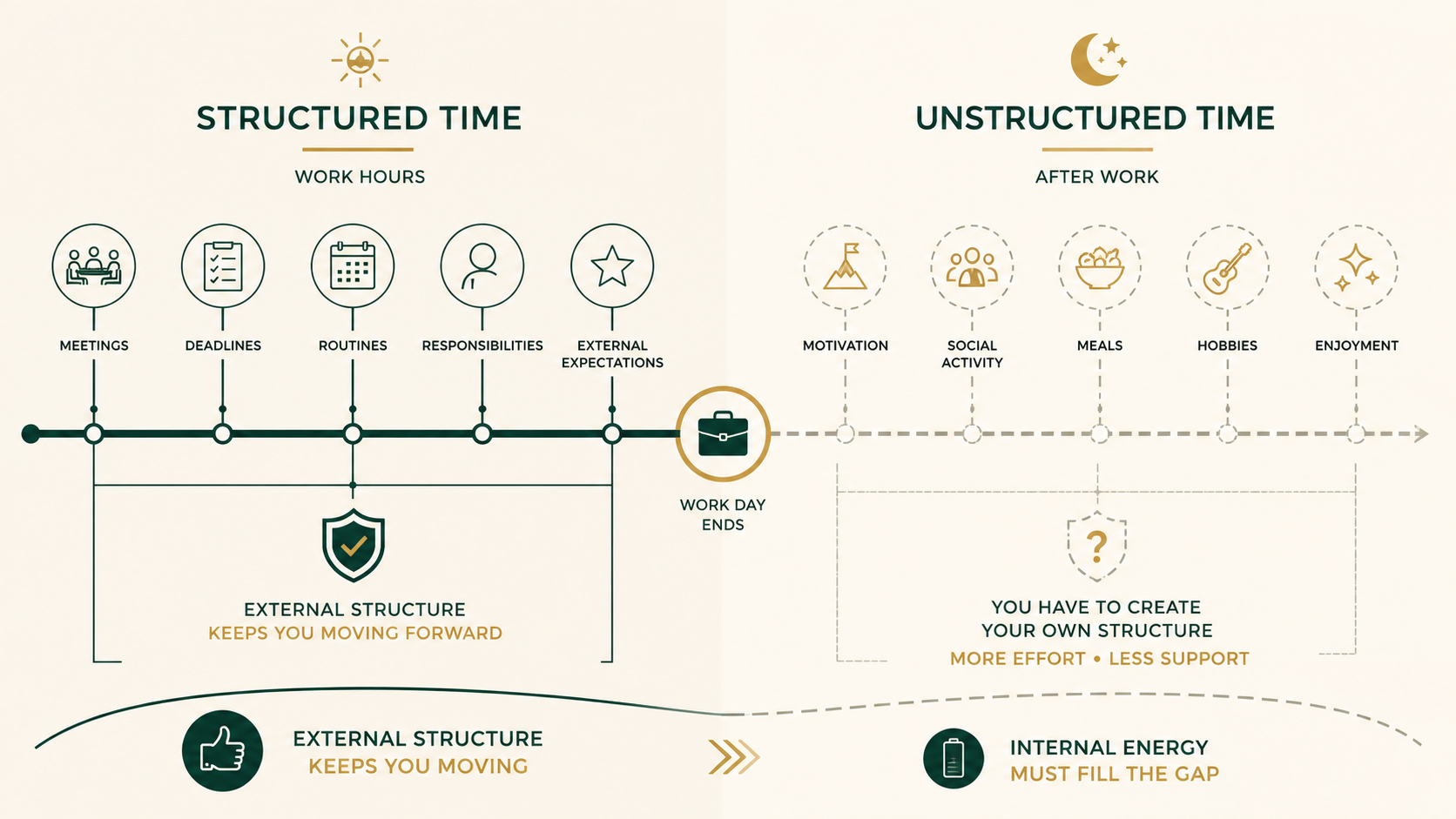
If you want a more honest gauge than your work performance, look at your unstructured time. Workdays hide symptoms because the structure carries you. Free time reveals them, because nothing external is deciding what happens next. The question is not whether you rest at weekends. It is what your free time feels like.
Two versions of the same Saturday. One person wakes without plans, feels some curiosity, decides on something and ends the day restored.
The other wakes without plans, cannot choose anything, scrolls for two hours, cancels the one arrangement, and feels relief when Monday returns because Monday at least tells you what to do.
Waiting for the working week because it gives your day a shape is worth paying attention to.
One caveat, because this is easy to over-read. Spending a weekend in bed after a brutal week is not a symptom. Being tired is not depression. What matters is the pattern holding across weeks: whether pleasure, anticipation and motivation have gone missing generally, not whether one Saturday was quiet.
Is This Burnout, Exhaustion or Depression?
These get confused constantly and the distinction changes what helps. Burnout is tied to work. Ordinary exhaustion responds to rest. Depression tends to spread into areas of life that have nothing to do with your job. The most useful test is what happens when work stops.
| Where it centres | What happens when work is removed | |
|---|---|---|
| Ordinary tiredness | Recent workload or sleep debt | Rest restores capacity fairly reliably |
| Burnout | Chronic unmanaged workplace stress | Often improves meaningfully with genuine distance from work |
| Depression | Mood, pleasure, motivation and functioning broadly | Symptoms tend to persist, and free time can feel worse |
The World Health Organization classifies burnout as an occupational phenomenon rather than a medical condition, which is a genuinely useful boundary.
The practical version: if you take two weeks off and something comes back, that points one way. If you take two weeks off and nothing comes back, that points another.
Plenty of people have both at once, and work stress abroad is a common route in, which we cover in our article on expat burnout. The signal that this has become broader is when the flatness follows you into things that were never about work.
Why Achievements Stopped Feeling Like Anything
This is the symptom people find most disturbing about themselves. You get the promotion, the praise, the offer, and you feel almost nothing. Not disappointment, which would at least be a reaction. Just a small flat pause where the reward used to be.
It is worth knowing that this is a recognised feature of depression rather than a sign that you have become cold or ungrateful.
The mechanism is that reward processing is affected, so competence stays and the payoff disappears. You can still do the thing. You just do not get anything back for having done it.
For someone abroad this lands especially hard, because a lot of international moves were justified by exactly these moments. You went for the career, the opportunity, the milestone. Reaching it and feeling nothing raises a frightening question about whether the whole thing was worth it, and depression is the worst possible condition under which to answer that question.
Why Success Makes It Harder to Admit
Because admitting it can feel like a verdict on the move. If the relocation represented ambition, independence, sacrifice or a relationship decision, then saying "I am depressed" can feel like saying "this was a mistake." So people hold the line, sometimes for years, to avoid conceding something that was never actually being asked.
Untangle those two things, because they are not connected.
Depression tells you nothing reliable about whether the country, the job or the decision was right. It is a condition, not an assessment. You can be genuinely depressed in a place you genuinely chose well.
There is also a social layer. Everyone at home thinks you are doing brilliantly, partly because you told them so and partly because you believed it. Correcting that story now feels enormous. It is not, but it feels that way from inside.
What Actually Helps
Not a holiday, and not less work, though both may be reasonable. Depression responds to treatment, and preserved functioning does not change what that treatment is: structured psychotherapy, medication in appropriate cases, and often both in more severe presentations. The starting point is an assessment, not a lifestyle adjustment.
Get assessed while you are still functioning. This is the most important line in this article. Nothing needs to have collapsed. You do not need a story that sounds bad enough.
Psychotherapy. Approaches with strong evidence include cognitive behavioural therapy, behavioural activation and interpersonal therapy, among others, with NICE guidance treating several as appropriate depending on severity and preference.
Behavioural activation is unusually well suited to this pattern. The specific problem here is that obligatory activities continue while voluntary, rewarding ones have quietly stopped. Behavioural activation works directly on that gap, rebuilding the connection between action, values and reward in a structured way rather than waiting for motivation to return first. It is not "force yourself to have fun." It is planned, gradual and done with a therapist.
Medication is an evidence-based option where clinically appropriate, and whether it fits depends on severity, history and preference. That is a conversation with a doctor.
Exercise, sleep and routine have real supporting evidence, including a large 2024 review of over two hundred randomised trials, but treat them as things that make treatment work better rather than as replacements for it.
When to Get Help If You Are Still Working
The threshold is not your job performance. It is whether pleasure, motivation, connection and hope have been declining for weeks, regardless of what your output looks like. Work impairment is one possible sign among many, and for this group it is usually the last to arrive.
Worth speaking to someone if several of these hold:
- Things you used to enjoy have stopped delivering anything
- You do what is required and almost nothing that is optional
- Weekends are spent recovering rather than living
- Sleep, appetite or concentration have changed
- You have been withdrawing from people for weeks
- Emotional numbness has become the normal setting
- Hopelessness is increasingly present
- Maintaining the appearance of being fine takes real effort
- Nothing has shifted despite reasonable attempts to fix it yourself
- You have had thoughts of self-harm or of not wanting to be alive
There is something specific this reader tends to need from therapy, beyond the treatment itself. A place where you do not have to keep performing competence. If you have spent eight months telling everyone you are fine, having one hour where that is not required is not a small thing.
Expathy matches expats with psychologists by native language and cultural background, and our psychologists have lived abroad themselves. You will not have to explain how a life that looks successful and a person who is struggling can be the same thing.
That saves real energy when you have very little to spare. If you want to start there, depression therapy for expats is the direct route, and online therapy for expats covers the wider picture if several things are happening at once.
If You Are in Crisis Right Now
If you are having thoughts of harming yourself, if you feel life is not worth living, or if you are frightened you might act on those thoughts, please get help today rather than waiting.
Contact your local emergency number, your country's crisis line, or go to the nearest emergency department. If you have a doctor or therapist, contact them urgently. Tell someone you trust and ask them to stay with you.
Being far from home makes this harder and it does not make it impossible. Emergency services exist everywhere, and you do not need perfect language to ask for urgent help.
Depression is treatable, including when it does not feel that way from inside it.
Final Thought
Nobody is going to intervene here. That is the honest part of this. You have built something that looks, from every external angle, like a person doing well abroad, and the people around you have no reason to think otherwise.
Which means the recognition has to come from you, on the basis of evidence only you can see.
The version of you that shows up to work is real. So is the one that cannot get off the sofa afterwards. The first one being functional does not make the second one less true.
You do not need to fall apart first to be allowed to ask for help. You just need to notice that most of your life has quietly gone quiet, and decide that is reason enough.
Sources and Further Reading
- Wong and colleagues (2024), systematic review and meta-analysis of 20 studies on anhedonia and functioning in major depressive disorder: https://doi.org/10.1016/j.jad.2024.04.086
- World Health Organization on burnout as an occupational phenomenon in the International Classification of Diseases: https://www.who.int/news/item/28-05-2019-burn-out-an-occupational-phenomenon-international-classification-of-diseases
- NICE guideline NG222, Depression in adults: treatment and management: https://www.nice.org.uk/guidance/ng222
- Noetel and colleagues (2024), BMJ network meta-analysis of 218 randomised trials on exercise for depression: https://doi.org/10.1136/bmj-2023-075847
Frequently Asked Questions
What is high-functioning depression?
It is a descriptive phrase, not a diagnosis, for experiencing significant depressive symptoms while continuing to meet visible responsibilities such as work. The underlying condition is simply depression. The phrase captures a real and common pattern in which professional performance stays intact while pleasure, motivation, relationships and self-care decline.
Is high-functioning depression medically recognised?
Not as a formal category. It appears in neither the DSM nor the ICD, and clinicians do not diagnose it. That does not make the experience less real or less serious. It means the assessment and treatment are the same as for depression generally, and severity is not determined by whether someone is still working.
Can you be depressed if you go to work every day?
Yes. The criteria for depression have never required stopping work. Employment supplies deadlines, expectations and financial necessity, which can keep behaviour moving long after internal motivation has gone. Whether your employer has noticed anything is not part of any clinical assessment.
Why can I function at work but do nothing afterwards?
Because work provides external structure and your evening does not. Obligations pull behaviour along without needing motivation. Free time requires you to generate it yourself, and that is precisely what depression depletes. Competence usually stays intact, while anticipation, interest and reward disappear first.
Is high-functioning depression the same as burnout?
No. The World Health Organization classifies burnout as an occupational phenomenon arising from chronic workplace stress rather than as a medical condition, and it typically improves with genuine distance from work. Depression tends to persist through time off and spreads into areas of life unrelated to your job. Both can be present together.
Is it the same as persistent depressive disorder?
No, and the two are often confused. Persistent depressive disorder is a formal diagnosis defined largely by duration, typically longer-lasting depression. High-functioning is an informal description of which parts of life are still visibly working. Someone can meet criteria for various depressive presentations while functioning at work.
Why do achievements stop feeling rewarding?
Because depression affects reward processing rather than ability. You can still perform well, but the internal payoff for having done so goes missing. This is a recognised feature of depression, not a sign of being ungrateful, and it can be especially disorienting when the achievement was part of why you moved abroad.
When should I get help if my work performance is still good?
Do not use work as the threshold, since for this pattern it is the last thing to slip. Consider professional support when pleasure, motivation, connection or hope have been declining for weeks, when free time is spent recovering rather than living, or when keeping up appearances has started taking real effort.
Can therapy help if nobody else realises I am struggling?
Yes, and it is often particularly valuable for exactly that reason. Beyond the treatment itself, therapy provides one place where you do not have to keep performing competence. Evidence-based approaches including behavioural activation are well suited to a pattern where obligatory activity continues but rewarding activity has quietly stopped.
Need support? We're here.
Book a free 15-min consultation with our expat-specialized therapists.