
Key takeaway
You have the international life you worked toward. You still go to work, still answer messages, still say "good, really good" when someone asks how it is going. But the restaurant you loved feels like nothing, the weekend is something to get through, and you cannot remember the last time you looked forward to anything. This article is about what depression looks like when you live abroad, why relocation can quietly change the conditions around it, how to tell it apart from ordinary adjustment, and what genuinely helps.
There is a specific kind of confusion that comes with being depressed in a life you chose.
You booked the flights. You wanted this. On paper the apartment, the job, the city and the person beside you are all things you would have envied five years ago.
And yet you stopped calling home because talking takes energy you do not have. You booked a trip and felt nothing about it. You have started avoiding the weekend rather than looking forward to it.
The question underneath is usually the same one: if my life is objectively good, why do I feel nothing?
Depression is not a verdict on the quality of the life you built. It is a condition that changes your capacity to experience that life, which is a different thing entirely.
What "Expat Depression" Actually Means
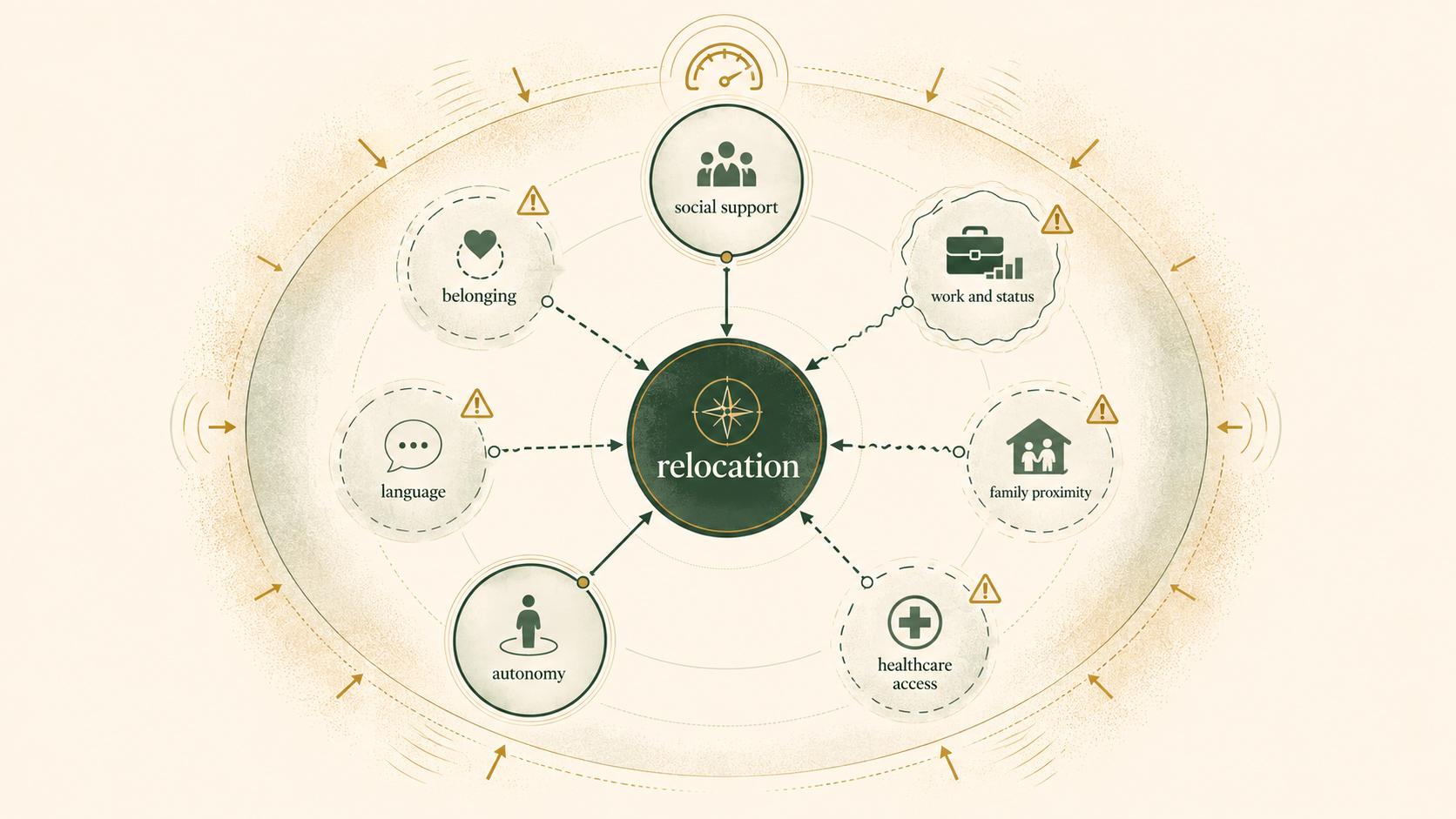
There is no separate illness called expat depression. Depression is depression, and the clinical picture does not change when you cross a border. What can change abroad is the context around it: your social network, language, professional status, family proximity, legal certainty and sense of belonging can all shift at once.
That distinction matters more than it sounds.
It means you are not dealing with something exotic that ordinary treatment does not reach. The same evidence-based treatments apply. It also means nobody should tell you this is simply what moving abroad feels like.
The most defensible way to describe what happens is this: international relocation can change your social, linguistic, professional, legal and family ecosystem simultaneously, and those changes interact with the established risk and protective mechanisms for depression.
Living abroad does not cause depression. It can change several of the conditions that depression responds to, all at the same time, and faster than most people expect.
Is Depression More Common After Moving Abroad?
Honestly, nobody can give you a reliable figure for expats specifically, and anyone quoting one is inventing it. What the research does show is that depression among people who migrate is common enough to take seriously, and that risk varies enormously depending on circumstances rather than on the fact of moving itself.
A meta-analysis of 25 studies by Foo and colleagues found a pooled depression prevalence of 15.6% among international migrants, with education, employment status and length of residence all changing the picture significantly.
Read that carefully. Those studies combined highly different groups of people, so it is not an expat depression rate and should not be treated as one. What it does establish is that this is not rare.
The more useful finding is how much circumstances matter. In a 2024 review of migrants living with prolonged unresolved legal status, pooled depression prevalence reached 49.5%. That population, people stuck in indefinite legal limbo, is entirely different from a professional on a work permit, and the number must never be transferred across.
But it makes the point sharply: legal insecurity, discrimination and precariousness are not administrative annoyances. They are serious mental health contexts.
Which is why the honest answer to "does moving abroad make depression more likely" is: it depends almost entirely on what moving abroad did to your circumstances.
What Depression Looks Like When You Live Abroad
The symptoms are the standard ones, but abroad they often get misread as adjustment, tiredness or a personality change. Persistent low mood, loss of interest and pleasure, fatigue, sleep and appetite changes, difficulty concentrating, withdrawal, hopelessness, guilt and irritability are the core picture, whatever country you are in.
What that looks like on an ordinary Tuesday:
Reading the same work email five times and retaining none of it. Functioning competently all week, then spending Saturday in bed. Booking a weekend away and feeling absolutely nothing about it. Letting your mother's calls ring out because a conversation feels like a task. Stopping the hobby you moved here to have more time for, without ever deciding to. Getting disproportionately angry at a delivery that did not arrive.
And the one that catches almost everyone: thinking "I should be happy" and then feeling guilty for not being.
Two presentations deserve specific mention because abroad they get missed most often.
You may not feel sad at all. Plenty of people experience depression as flatness rather than sadness, as irritability, exhaustion or a sense that everything has been turned down. Not feeling sad does not rule anything out.
You may lose interest before you lose function. This is anhedonia, and it is a core feature of depression rather than a side issue. If the dominant experience is that nothing is enjoyable anymore, our article on anhedonia abroad goes into how reward, motivation and anticipation come apart.
Why You Can Still Function and Still Be Depressed
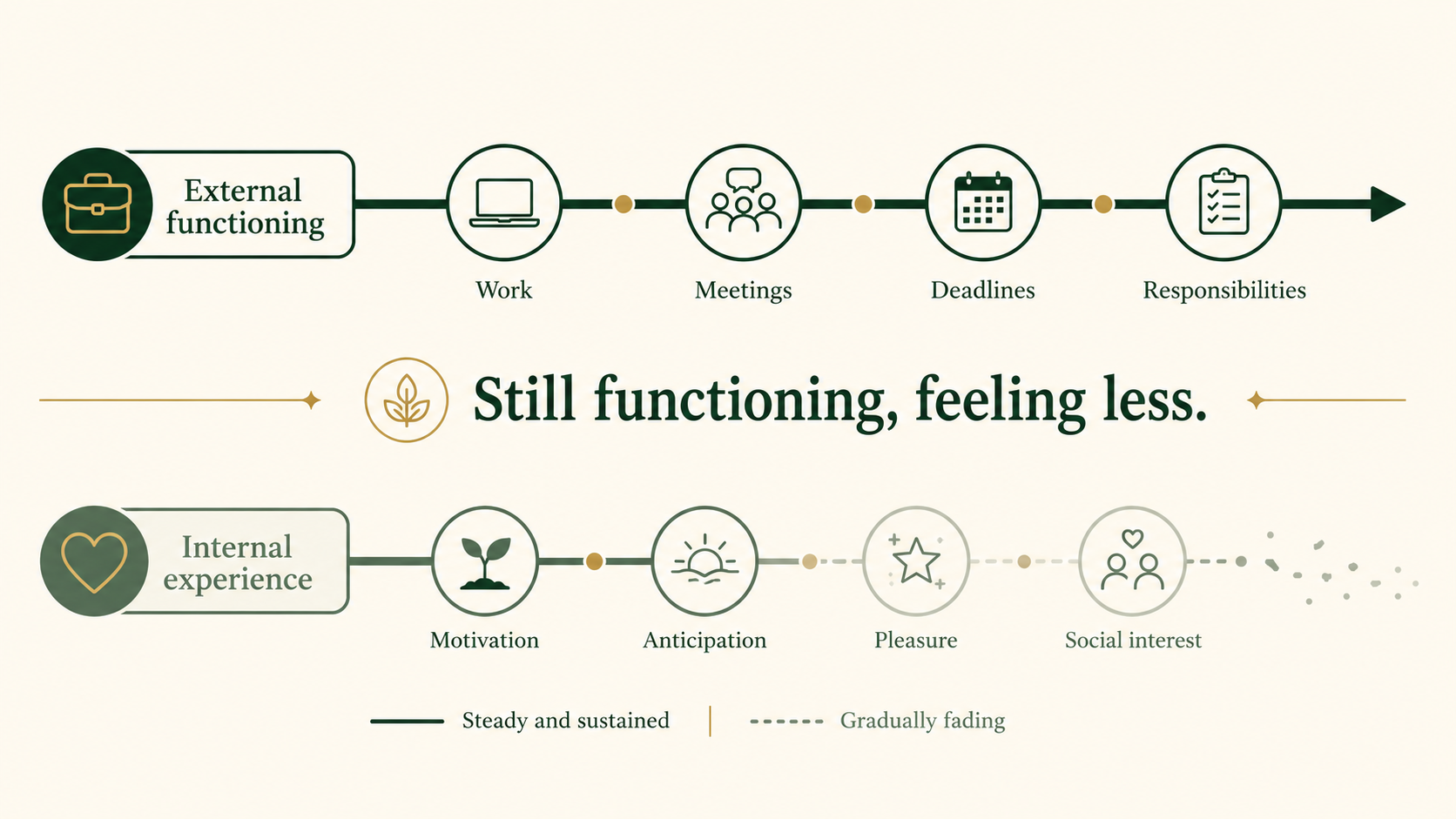
Because functioning is not all or nothing. Work supplies structure, deadlines, other people's expectations and financial necessity, and those can hold performance up long after pleasure, motivation and social life have collapsed. From the outside, the visible part looks fine.
There is evidence for this split. A 2024 systematic review of 20 studies by Wong and colleagues found that anhedonia in major depressive disorder was associated with worse physical, psychological and social functioning and lower quality of life. The parts that deteriorate first are frequently the ones nobody at work can see.
It explains the sentence so many people abroad recognise: I can deliver a presentation to forty people, and then I cannot make myself text a friend afterwards.
The job requires competence, which you still have. The friendship requires wanting something, which is precisely what has gone.
People sometimes call this high-functioning depression. That is a descriptive phrase, not a diagnosis, and it is worth knowing that the "high-functioning" part usually refers only to work. Everything else may already be falling away.
There is one more layer specific to life abroad. A good salary, an enviable city and a life other people describe as a dream can make you feel you have no right to be struggling. Visible privilege and genuine depression coexist constantly. The guilt does not protect you from the condition; it just stops you mentioning it.
Depression, Homesickness, Loneliness and Burnout
These four get confused constantly, partly because they can all be present at once. The rough distinction is what each one centres on, and how far it spreads. None of this is diagnostic, but it helps you ask a better question.
| Experience | Usually centred on | What tends to distinguish it |
|---|---|---|
| Homesickness | Missing home, people, familiar routines | Focused on separation and what is elsewhere |
| Loneliness | The gap between wanted and actual connection | Relational, improves when connection improves |
| Burnout | Chronic unmanaged workplace stress | Occupational, classified by the WHO as a work phenomenon rather than a medical condition |
| Depression | Mood, pleasure, motivation and functioning | Pervasive, spreads across most areas of life at once |
The word doing the work in that last row is pervasive. Homesickness attaches to home. Burnout attaches to work. Depression tends not to stay in one place.
Someone homesick can still enjoy dinner with a friend. Someone burnt out often revives on holiday. When the flatness follows you into the things that have nothing to do with the cause, that is a different picture.
Homesickness and depression do overlap, and one can sit inside the other, but homesickness is not a stage that automatically becomes depression. If that is your specific question, we cover it directly in when homesickness becomes depression, and the ordinary experience itself in our guide to homesickness abroad.
Why Relocation Can Set the Conditions
Moving does not cause depression, but it can strip out several protective factors at once while adding new risks on top. Most people badly underestimate how many separate systems in their life change during a single week of relocation. These are the mechanisms that show up most consistently in the research.
Your social network disappears. Not just friends, but practical help, spontaneous contact, and the people who would have noticed you had gone quiet. That loss is closely tied to how well people adjust, which is why we treat loneliness abroad as its own subject.
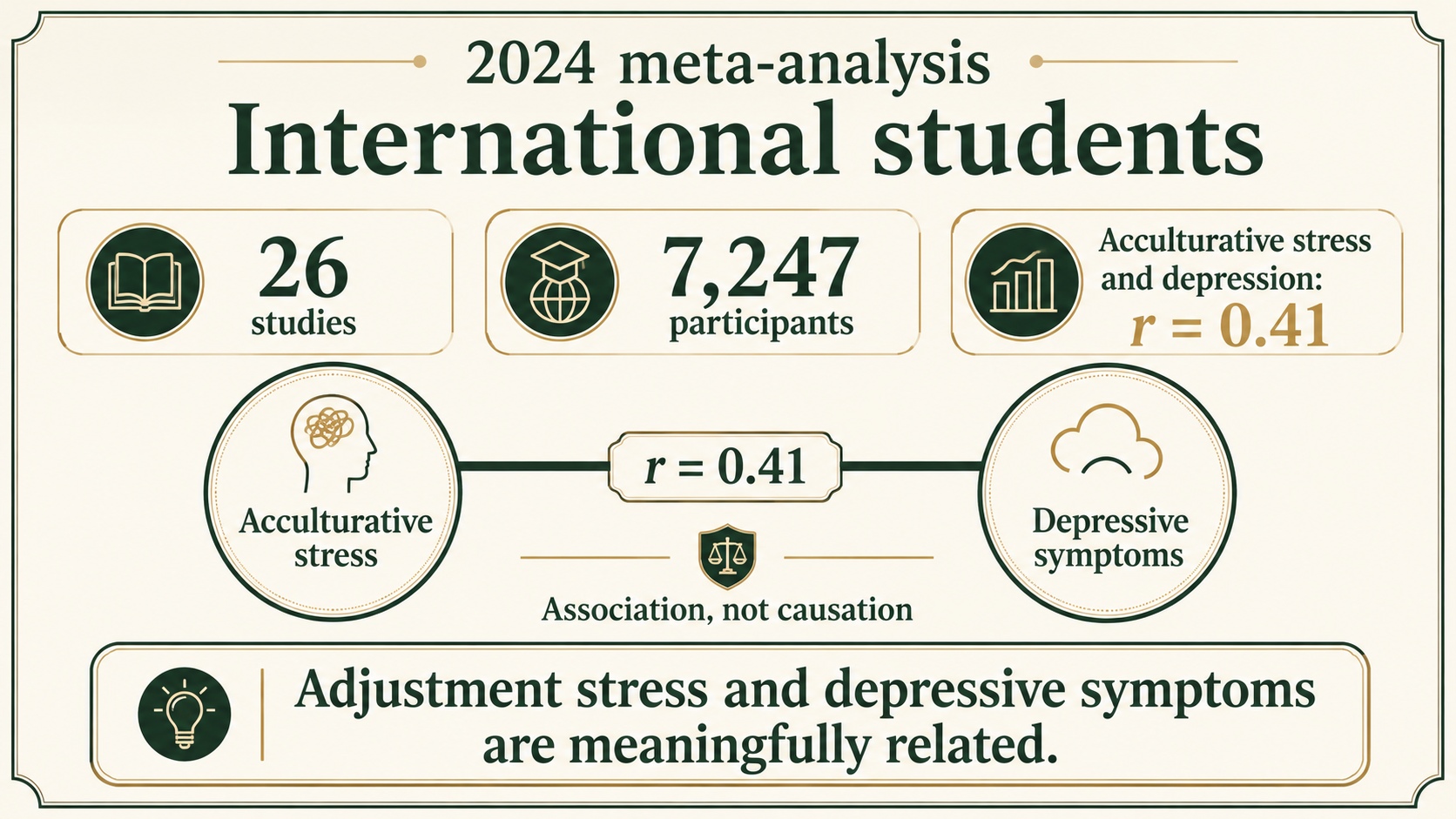
Acculturative stress accumulates. This is not about unfamiliar food. It is decoding social norms, being unable to express yourself fully, learning a new work system, fearing evaluation, and managing daily tasks that used to be automatic. A 2024 meta-analysis of 26 studies covering 7,247 international students found acculturative stress moderately and consistently associated with depression. That population is students rather than expats generally, and the studies could not establish causation, but the association is one of the clearest in this field.
Language limits more than conversation. It affects autonomy, friendship depth, bureaucracy, work, healthcare access and, critically, your ability to describe what is wrong to anyone who could help.
Status and career can change abruptly. Qualifications that do not transfer, a career paused, a period of unemployment, or dependence on a partner's income. This hits accompanying partners particularly hard, and losing a professional identity is a real loss rather than a logistical one.
Discrimination and exclusion are risks, not irritations. The research on this is strongest in refugee populations and cannot be transferred wholesale, but the direction is unambiguous and the effect sizes are large.
Family separation removes your early warning system. The people who would have said "you do not seem like yourself" are now on a screen, seeing the version of you that shows up for a call.
One thing worth stating plainly, because it circulates as fact: there is no strong evidence that moving to a darker or colder country causes depression. Seasonality can affect mood, but the simplistic version of this claim is not supported for migration specifically.
Why It Often Starts Months After the Move
This is one of the most common questions, and the honest answer is that there is no universal timeline. The old honeymoon-to-crisis-to-adjustment curve is not supported by the evidence, and expecting to follow it can make people think their experience is wrong.
What can explain later onset is more prosaic.
The first months are structured and busy. There is an apartment to find, paperwork to submit, a job to start, a city to learn. Novelty and logistics occupy attention. Then it settles, the tasks run out, and what is left is the actual shape of your life here.
Social losses also take time to become visible. You do not miss having someone to call at week three. You miss it at month fourteen, when something goes wrong and you scroll through your contacts and find nobody nearby.
There is evidence that post-migration mental health does not automatically improve with time. A meta-analysis of 20 longitudinal studies covering 8,156 refugees and asylum seekers at baseline found pooled depression prevalence of 23% at baseline, dropping to around 18% at one year, then rising to 23% at two years and 34% at three years.
Those are refugees and asylum seekers, not voluntary migrants, and the composition of studies differed at each follow-up point, so this is not a trajectory to expect for yourself. What it does dismantle is the assumption that time alone reliably fixes post-migration distress.
Sometimes the hardest part of moving abroad begins after you have become good at the practical part of living there.
"Do I Dislike This Country, or Am I Depressed?"
This question deserves a better answer than "it is just depression." It is frequently both, and they feed each other. Real problems genuinely exist: bad housing, a difficult job, bureaucracy, discrimination, a strained relationship, a social life that has not materialised.
Those conditions can contribute to depression. But once depression develops, it changes how you evaluate everything.
Anhedonia and negative evaluation make many areas of life feel unrewarding at the same time, and the mind reasonably concludes that the common factor must be the country.
Some questions that help separate the two:
Is your dissatisfaction concentrated around one or two specific problems, or has almost everything started feeling pointless? Do things you used to enjoy still deliver something when you do them? If one genuine problem were solved tomorrow, would the whole picture likely change, or only that corner of it? Has your capacity for pleasure changed, or only your circumstances?
If enjoyable things still feel enjoyable, you are probably dealing with circumstances. If the enjoyment itself has gone flat, something broader is happening. Some of what you are feeling may also be ordinary adjustment, which we cover in our guide to culture shock.
"Will Going Home Fix It?"
Sometimes it helps, and it is still not a treatment. Repatriation can remove genuine stressors, and if isolation, work conditions or legal insecurity are actively maintaining the distress, changing them can matter considerably. But depression does not reset when you cross the border. That distinction is worth holding onto.
If the syndrome is established, it usually travels with you.
The harder version of this that people rarely anticipate: going home can bring its own losses. The friends you missed have different lives now. The version of home you have been picturing was partly a memory. And you have changed too.
None of that means staying is right either. It means the decision deserves to be made when you can think clearly, which is not usually the middle of a depressive episode.
What Actually Helps
Depression is treatable, and the evidence base behind that statement is genuinely strong. The main established options are structured psychotherapy, antidepressant medication, and in more severe presentations the two combined, with lifestyle factors acting as real but supporting elements rather than as replacements for treatment.
Psychotherapy. Approaches with solid evidence include cognitive behavioural therapy, behavioural activation and interpersonal psychotherapy, among others. NICE guidance treats several as appropriate depending on severity and preference. No single therapy is best for everyone.
Behavioural activation deserves particular attention if you live abroad. Depression produces a loop: less motivation leads to less activity, which leads to fewer rewarding experiences, which further reduces motivation. Behavioural activation works on that loop directly by systematically rebuilding activity and reward rather than waiting for the desire to return first. It is not "force yourself to go out." It is structured, gradual and planned with a therapist. When life abroad has narrowed to work, home, sleep, repeat, this is often the most directly relevant approach available.
Medication. Antidepressants are an evidence-based option for appropriate cases. Whether they suit you depends on severity, history, other conditions and your own preference, and that is a conversation with a doctor rather than an article.
Combined treatment is often used in more severe presentations, though it is not automatically better for everyone.
Exercise has better evidence than most people assume. A 2024 BMJ network meta-analysis of 218 randomised trials with roughly 14,170 participants found walking or jogging, yoga and strength training were among the approaches associated with meaningful reductions in depressive symptoms. That is a serious finding, and it comes with a serious caveat: it is not evidence that someone with significant depression should exercise instead of getting treatment.
Sleep, routine and social contact matter too. Treat them as supports that make everything else work better, not as the cure.
When to Get Professional Support
You do not need to be in crisis to justify getting help. The reasonable threshold is symptoms that have persisted for weeks, are getting worse, or are affecting your work, relationships, functioning or capacity for pleasure. That is enough. It does not need to be worse than that first.
Worth speaking to a professional if:
- Low mood or loss of interest has lasted more than two weeks and is not shifting
- Ordinary tasks have become disproportionately difficult
- You have withdrawn from people and stopped things you used to do
- Sleep, appetite or concentration have changed noticeably
- Hopelessness has become a background presence
- Reasonable self-help has not moved anything
- You are having thoughts of harming yourself
You do not have to prove that your life is falling apart before depression deserves attention. Earlier is easier to treat than later.
Therapy, Language and Culture
This is worth being precise about, because there is a lot of marketing in this area. Shared language and cultural background can genuinely reduce how much context you have to explain, but demographic matching alone does not guarantee better clinical outcomes.
The landmark evidence here is a meta-analysis by Cabral and Smith covering 52 studies of client preferences, 81 of perceptions and 53 of actual treatment outcomes. People showed a moderately strong preference for a therapist from their own background and rated them somewhat more positively. The difference in actual treatment outcomes was close to negligible.
That finding is a useful corrective, and it does not mean culture is irrelevant.
It means cultural responsiveness is not the same thing as demographic matching. A therapist who listens well, understands migration and status, and questions their own assumptions may serve you better than one who simply shares your nationality.
Language works similarly. Some people access emotion more easily in their first language. Others find useful distance in a second. The same person may prefer different languages for different topics. The universal claim that native-language therapy is always better is not supported.
What is defensible is more modest and still valuable: if you are already depleted, spending the first three sessions explaining why a voluntary move can still hurt, why going home is not simple, and why an enviable life abroad can feel empty, is an expensive use of limited energy.
Expathy matches expats with psychologists by native language and cultural background, and our psychologists have lived abroad themselves. Less of the hour goes to context, and more of it goes to you.
If you want support specifically for this, depression therapy for expats is the direct route, and online therapy for expats covers the wider picture if several things are happening at once.
If You Are in Crisis Right Now
If you are having thoughts of harming yourself, thinking life is not worth living, or you are frightened you might act on those thoughts, please get help today rather than waiting.
Contact your local emergency number, your country's crisis line, or go to the nearest emergency department. If you have a doctor or therapist, contact them urgently. If you can, tell someone you trust and ask them to stay with you.
Being in an unfamiliar country makes this harder, and it does not make it impossible. Emergency services exist everywhere, most countries have a crisis line, and you do not need perfect language to ask for urgent help.
Depression is treatable, including the severe kind, and including when it does not feel that way from inside it.
Final Thought
The cruellest thing about depression abroad is how easily it disguises itself as a verdict. On the move, on the country, on the decision, on you.
It is worth holding onto this: the flatness you are describing is a symptom, not an assessment. It is not evidence that you chose wrong, that you are not resilient enough for international life, or that you are ungrateful for something other people would want.
You did not fail at living abroad. Something treatable happened while you were living abroad, and those are different sentences.
If most of this article described your last few months, the next step is small and specific. Tell one person, or book one appointment. That is enough for now.
Sources and Further Reading
- Foo and colleagues (2018), meta-analysis of 25 studies on depression prevalence among international migrants: https://doi.org/10.3390/ijerph15091986
- Côté-Olijnyk and colleagues (2024), systematic review and meta-analysis on depression among migrants living with prolonged insecure legal status: https://doi.org/10.1016/j.psychres.2024.115931
- Soufi Amlashi and colleagues (2024), meta-analysis of 26 studies and 7,247 international students on acculturative stress and depression: https://doi.org/10.3389/fpsyg.2024.1403807
- Handiso and colleagues (2024), meta-analysis of 20 longitudinal studies with 8,156 refugees and asylum seekers at baseline: https://doi.org/10.1007/s11469-024-01406-w
- Wong and colleagues (2024), systematic review of 20 studies on anhedonia and functioning in major depressive disorder: https://doi.org/10.1016/j.jad.2024.04.086
- Noetel and colleagues (2024), BMJ network meta-analysis of 218 randomised trials on exercise for depression: https://doi.org/10.1136/bmj-2023-075847
- Cabral and Smith (2011), meta-analysis on client and therapist ethnic matching, preferences, perceptions and outcomes: https://doi.org/10.1037/a0025266
- NICE guideline NG222, Depression in adults: treatment and management: https://www.nice.org.uk/guidance/ng222
- World Health Organization on burnout as an occupational phenomenon: https://www.who.int/news/item/28-05-2019-burn-out-an-occupational-phenomenon-international-classification-of-diseases
Frequently Asked Questions
What is expat depression?
It is not a separate diagnosis. Depression is the same condition wherever you live, with the same symptoms and the same evidence-based treatments. What can differ abroad is the context: relocation can change your social network, language, professional status, family proximity and legal certainty at the same time, and those changes interact with known risk factors.
Can moving abroad cause depression?
Not directly, and the evidence does not support that simple claim. Relocation can remove protective factors such as social support and familiarity while adding stressors such as acculturative strain, career disruption, discrimination or legal insecurity. Whether that leads to depression depends heavily on circumstances rather than on the act of moving itself.
Why am I depressed when my life abroad is objectively good?
Because depression affects your capacity to experience life, not the quality of the life itself. Work often keeps functioning intact through structure and deadlines while pleasure, motivation and social connection quietly deteriorate. A good salary, an enviable city and a supportive partner do not provide immunity, and the guilt that follows usually just delays getting help.
Can you be depressed without feeling sad?
Yes, and this is commonly missed. Depression can present as emotional flatness, irritability, exhaustion or a sense that everything has been turned down, without obvious sadness. Loss of interest and pleasure is a core feature in its own right, so the absence of visible sadness does not rule depression out.
Can depression start months after moving abroad?
It can, and there is no universal timeline despite the popular stage models. The first months are structured and busy, which occupies attention, while social losses become clearer later. Evidence from longitudinal migration research also indicates that post-migration mental health does not automatically improve with time.
How do I know if I am depressed or just homesick?
Homesickness centres on separation from home, people and familiar routines, and usually eases when contact or familiarity improves. Depression tends to be pervasive, spreading into areas of life unrelated to home, and affects pleasure, motivation and functioning generally. They can overlap, and homesickness is not a stage that automatically becomes depression.
Is depression the same as burnout?
No. The World Health Organization classifies burnout as an occupational phenomenon arising from chronic unmanaged workplace stress, not as a medical condition. Burnout is centred on work and often eases with genuine recovery time. When hopelessness, loss of pleasure and withdrawal spread beyond work, that suggests a broader depressive picture.
Should I move home if I am depressed abroad?
Going home can remove genuine stressors, but repatriation is not an established treatment for depression, and the condition usually travels with you. Returning also brings its own losses, since home has changed and so have you. It is generally better to get assessment and treatment first, then make the decision with a clearer head.
What treatment works for depression?
Structured psychotherapy such as cognitive behavioural therapy, behavioural activation or interpersonal therapy, antidepressant medication, and in more severe cases the two combined. Exercise has meaningful supporting evidence from large trials. Which combination fits depends on severity, history, preference and professional assessment rather than on a single universal answer.
Can therapy work in a language that is not my first?
Often yes. Some people access emotion more easily in their first language, while others find useful distance in a second, and preferences can vary by topic. Research on demographic matching found strong client preferences but only a very small difference in actual outcomes, so therapist quality and cultural responsiveness matter more than matching alone.
Need support? We're here.
Book a free 15-min consultation with our expat-specialized therapists.