
Key takeaway
A mental health workshop for international teams is a small-group, interactive session that builds real skills for handling the pressures of working across cultures and borders. It is not a talk and it is not a webinar. People do something in the room, practise something, and leave with an action they can actually use. This guide covers what a good one looks like, a sample 90-minute agenda, the formats to choose from, and the mistakes that quietly ruin most of them.
What is a mental health workshop for international teams?
A mental health workshop for international teams is a facilitated, participatory session focused on skills rather than information. Where a lecture tells people what stress is, a workshop has them practise noticing it, naming it, and doing something about it, together, in a room built to feel safe. For something more hands-on, a mental health workshop for international teams gives a small group the space to actually talk rather than just listen.
The international part changes the material. A mixed team carries pressures a domestic one does not: relocation and adjustment, working in a second language, cultural differences in how people show distress or ask for help, and colleagues who are physically far from any support network they trust. A workshop that ignores all of that and runs a generic resilience script will feel, to the people who need it most, like it was written for someone else.
Workshop vs webinar: which does your team need?
Both have a place. They are not the same tool, and picking the wrong one is why so much wellbeing spend gets no engagement.
| Webinar | Workshop | |
|---|---|---|
| Format | Broadcast, one-to-many | Interactive, small group |
| Group size | Unlimited | Roughly 8 to 20 |
| Goal | Awareness, reducing stigma | Building a specific skill |
| Best for | Reaching a whole workforce quickly | Going deep with a team or cohort |
| Follow-up | Optional resources | An action step people leave with |
If your aim is to reach everyone and open a topic, run a webinar. If your aim is to change how a specific team handles a specific pressure, run a workshop. For the awareness end of this, our guide to wellbeing webinar topics for international employees covers the broadcast side in detail.
What a good mental health workshop includes
Strip away the branding and every workshop worth running has the same bones:
- A clear objective. One thing the room can do at the end that they could not do at the start. Not "raise awareness," something specific.
- A facilitator who has lived it. Someone who understands the expat experience first-hand, not a generic trainer reading cross-cultural slides. People can feel the difference within minutes.
- Psychological safety, set explicitly. Ground rules on confidentiality and no-pressure participation, stated out loud at the start, not assumed.
- Real interactive exercises. Practice, discussion, scenarios, not forty slides and a Q&A tacked on the end.
- Culturally aware framing. Room for the fact that people in the session express distress, and seek help, in very different ways.
- An action step. Everyone leaves with one concrete thing to try, and a clear path to support if they need more.
A sample 90-minute workshop agenda
Here is a realistic structure for a single 90-minute session. It is deliberately front-loaded on safety and back-loaded on next steps, because that is what makes people actually engage in the middle.
- 10 min — Opening and psychological safety. Facilitator sets the tone, agrees confidentiality, and makes clear no one has to share anything they do not want to.
- 15 min — International-team stressors. A short, honest look at what makes working abroad harder: adjustment, isolation, language load, distance from support.
- 25 min — Interactive exercise. The core of the session. Small-group work or paired scenarios where people practise a skill, spotting early strain, or opening a hard conversation.
- 20 min — Group reflection. Bringing it back together. What came up, what surprised people, what patterns the room recognises in itself.
- 10 min — Personal action step. Each person commits privately to one small, doable thing before the next session or the next month.
- 10 min — Support pathway. Where to go if any of this raised something bigger, made explicit and easy, so no one leaves holding something alone.
Adjust the middle to the team, but keep the safety opening and the support close. Those two blocks are what separate a workshop from a well-meaning conversation that leaves people worse off.
Workshop formats HR can choose from
The right format depends on your team and your goal, not on what a provider happens to sell:
- Single 90-minute session. Best for a one-off skill or a specific pressure point.
- A multi-session series. Best when you want change that sticks, spaced over weeks.
- Team-level workshop. Best for an intact team that works together daily.
- Manager-level workshop. Best for building the people who spot distress first.
- Online for distributed teams. Best when your people span time zones, run it live, not as a recording.
- Language-specific or mixed-language. Best decided by who is in the room and how safe they will feel speaking.
What a mental health workshop should not do
This is the part providers rarely put in writing, and the part that decides whether people trust the session or quietly shut down in it.
- It should not force employees to share personal stories. Pressure to disclose in front of colleagues is not safety, it is the opposite. Good facilitation makes sharing possible, never required.
- It should not become a generic stress-management lecture. If the international reality never gets named, the people carrying the most weight will correctly conclude it was not built for them.
- It should not promise therapy outcomes. A workshop builds skills and awareness. It is not treatment, and any session that blurs that line is setting people up to expect something it cannot give.
- It should not expose personal struggles to managers. What happens in the room, and who spoke, stays there. The moment employees suspect otherwise, honest participation ends and the session becomes theatre.
How to run a workshop that works, step by step
- Define the outcome first. Decide the one thing the room should be able to do afterwards, then build backwards from it.
- Pick the format that fits the team and the goal, not the one that is easiest to book.
- Choose a facilitator who has lived the expat experience, because credibility in this room is earned in the first five minutes.
- Set safety and confidentiality out loud before any content, and mean it.
- Keep it interactive. If people are only listening, you booked a webinar by accident.
- Close with an action step and a support pathway, so the session leads somewhere. If a workshop surfaces a need it cannot meet, people should know exactly where ongoing support for international employees picks up.
How to measure workshop outcomes
Because workshops build skills, measure them differently from a broadcast session. The most useful signals are a pre and post shift in confidence on the specific skill, whether people actually apply it in the weeks after, and honest feedback on how relevant the session felt to their real situation. Over a longer horizon, watch team cohesion and uptake of support services.
Keep the business case honest, though. Mental health is not a soft cost.
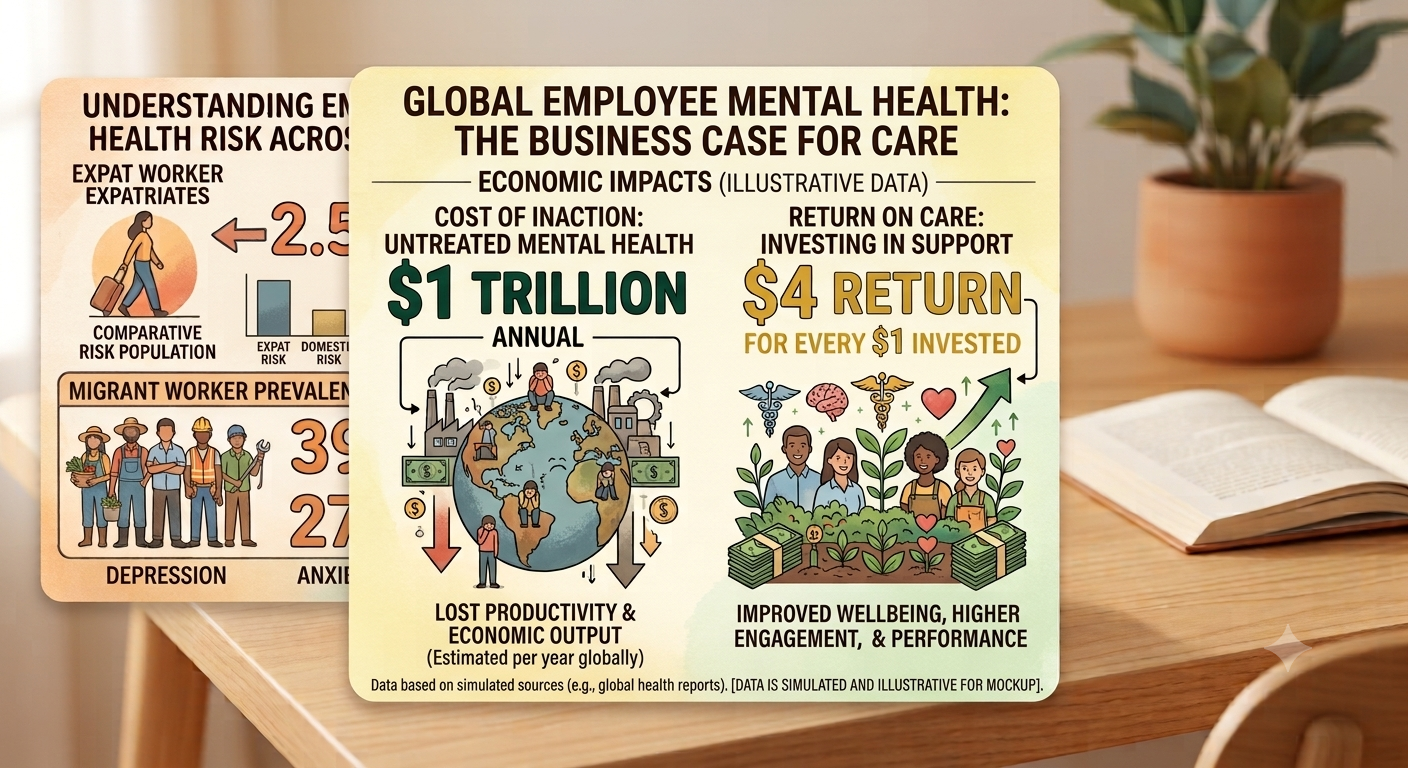
The World Health Organization estimates that depression and anxiety cost the global economy US$1 trillion a year in lost productivity, and that every US$1 invested in scaled-up treatment returns about US$4 in improved health and productivity.
That return, in the WHO's own framing, comes from sustained treatment, not a single session. So read a workshop's numbers as evidence that people engaged and built something, not as proof of financial return on its own. One workshop is a start. It is not a fix, and any provider who tells you otherwise is selling you something.
Workshops build skills. Ongoing care catches people.
A workshop can teach your team to notice strain earlier and talk about it more openly. That is real, and worth doing. But it cannot sit with the employee who is genuinely struggling at 9pm, in a country where they cannot explain what they are feeling to anyone nearby who speaks their language. Skills help the room. They do not catch the individual who has already fallen through.
That is the difference between a workshop and ongoing care. Expathy was built for the second one: matching expat employees with licensed psychologists who share their native language and have lived the expat life themselves. A workshop is a good way to build capability across a team. Real support is what happens when one person needs more than capability.
Looking for company-wide support that goes beyond a one-off session? Explore Expathy's mental health support for international employees.
Frequently asked questions
What is a mental health workshop for international teams?
It is a small-group, facilitated session that builds practical skills for handling the specific pressures of working across cultures and borders: adjustment, isolation, working in a second language, and cultural differences in how people show distress. Unlike a lecture, it is interactive, and people leave with an action step rather than just information.
How long should a workshop be?
A single session of around 90 minutes works well: long enough for a proper interactive exercise and reflection, short enough to hold attention and protect calendars. For deeper change, a series of shorter sessions spaced over weeks tends to outperform one long block, because skills need time and repetition to stick.
What's the difference between a workshop and a webinar?
A webinar is a broadcast, one-to-many session aimed at awareness and reducing stigma across a whole workforce. A workshop is interactive, small-group, and aimed at building a specific skill with a specific team. Webinars reach many people shallowly. Workshops reach fewer people deeply. Most organisations need both, for different jobs.
How many people should attend?
Roughly 8 to 20 is the sweet spot. Small enough that people can speak and be heard, large enough for varied perspectives and group exercises. Beyond about 20, genuine participation drops and the session drifts back toward being a lecture, which defeats the point of choosing a workshop.
Can workshops be run in multiple languages?
Yes, and for genuinely international teams it often matters. Running a session in a shared second language, a single native language, or with a facilitator who shares the group's cultural background changes how safe people feel speaking. The right choice depends entirely on who is in the room, which is a decision worth making deliberately rather than by default.
How do we measure whether a workshop worked?
Look at the shift in participants' confidence on the target skill before and after, whether they apply it in the following weeks, and their feedback on how relevant it felt. Longer term, watch team cohesion and uptake of support services. Treat these as signals of engagement and capability, not as a direct financial return, which comes from sustained support rather than a single workshop.
Need support? We're here.
Book a free 15-min consultation with our expat-specialized therapists.