
Key takeaway
Wellbeing webinars help international employees when they stop being generic. The pressures of working abroad, relocation stress, cultural adjustment, isolation, and doing all of it in a second language, are not what a standard resilience session was built for. The topics below give HR teams a practical menu to offer this quarter, with sources, plus how to run each session and how to tell whether it worked.
The World Health Organization estimates that depression and anxiety cost the global economy US$1 trillion every year in lost productivity, and your international staff carry more of that load than your local staff do.
What is a wellbeing webinar for international employees?
A wellbeing webinar for international employees is a live, online session built around the specific pressures of working abroad rather than general workplace stress. Culture shock, homesickness, isolation, family adjustment, and the strain of processing emotion in a non-native language are the material. That focus is the whole point.
Here is the difference in practice. A generic webinar tells a room of people to set boundaries and take breaks. That advice does not touch the employee who moved to Amsterdam four months ago, has no friends yet, cannot read their own health insurance letters, and lies awake at 2am doing the math on whether this assignment was a mistake.
Same session. Completely different reality. If the content does not name that reality, international employees quietly conclude the programme is not for them, and they stop showing up.
If you want to introduce this across a whole team at once, a wellbeing webinar for international employees is often the simplest place to start.
The research is blunt about how exposed this group is:
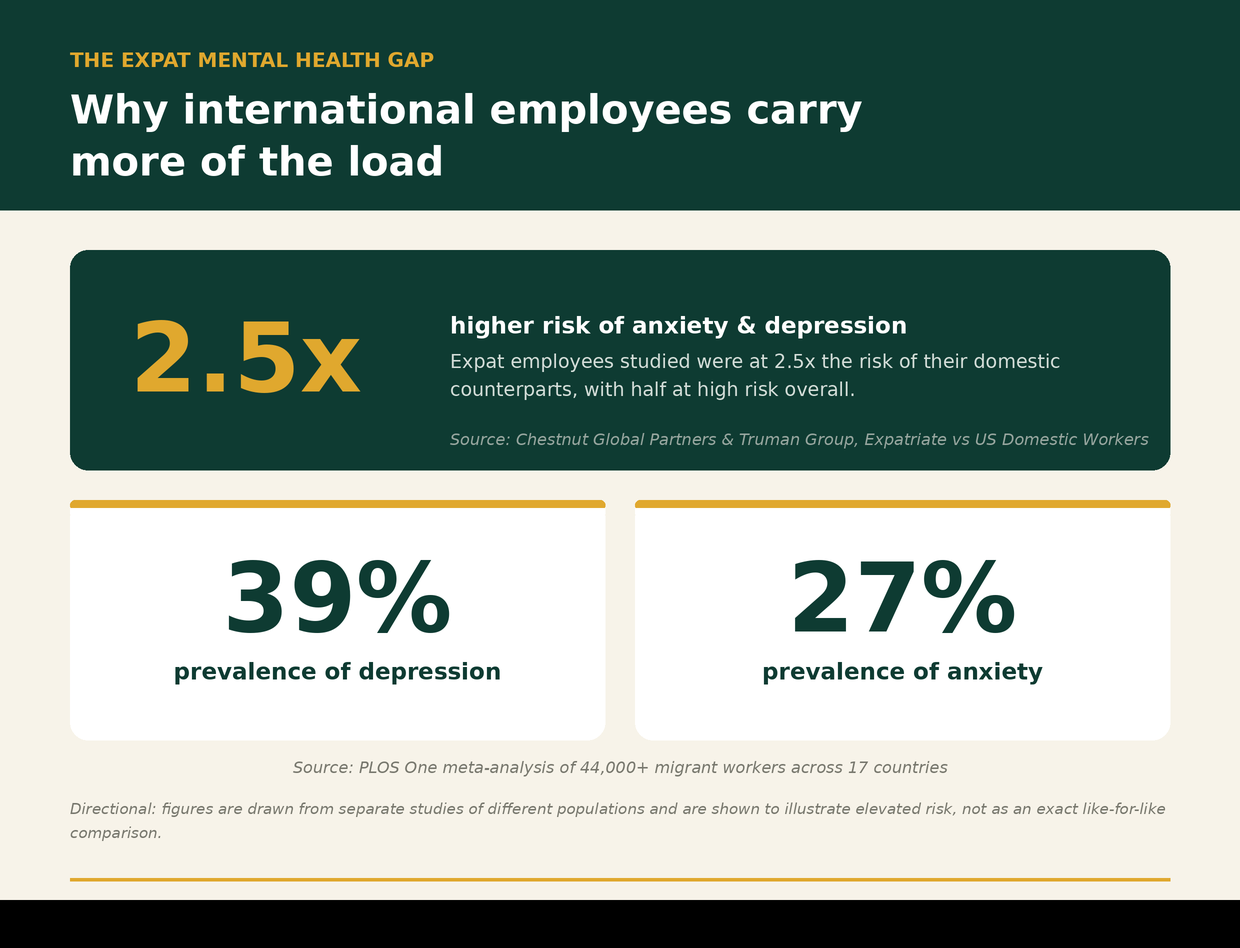
A joint study by Chestnut Global Partners and the Truman Group found that half of the expats studied were at high risk of anxiety and depression, around 2.5 times the rate of their US-based counterparts.
A meta-analysis in PLOS One, pooling more than 44,000 migrant workers across 17 countries, put the prevalence of depression at roughly 39% and anxiety at 27%.
Whatever the exact figure for your workforce, the direction is not in dispute: people working outside their home country are more exposed, not less.
12 wellbeing webinar topics HR teams can offer
You do not need all twelve. Pick the three or four that match where your international staff actually are right now, then rotate the rest through the year. The mistake I see most often is running the topic that is easiest to book rather than the one your people need, and attendance tells on you every time.
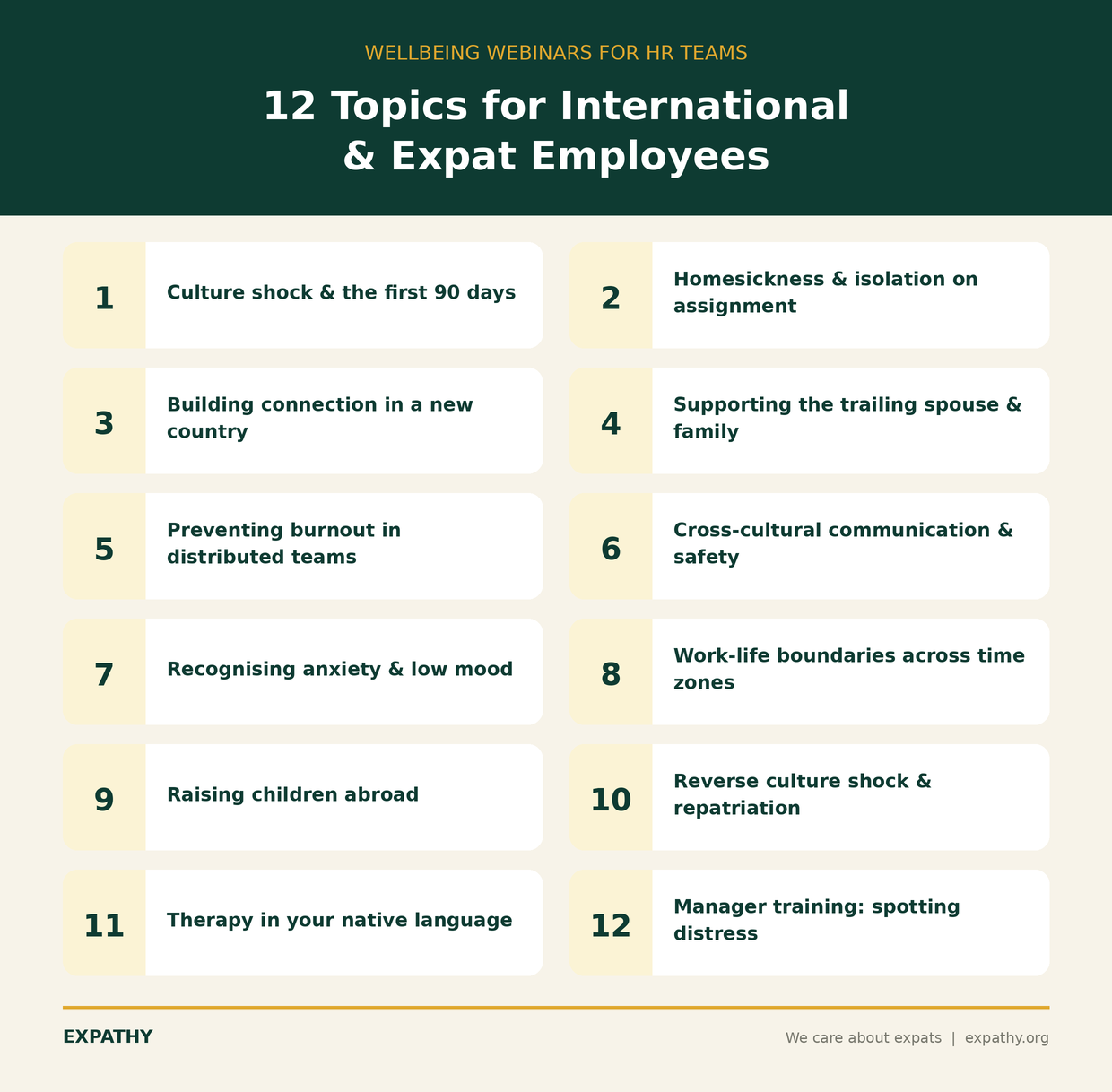
Navigating culture shock and the first 90 days
The first three months carry the steepest adjustment curve, and most employees have no map for it. This session normalises the honeymoon-then-crash pattern most movers hit, so people stop treating a predictable stage as a personal failure.
Managing homesickness and isolation on assignment
Homesickness sounds soft until it is quietly hollowing out one of your best hires. This topic helps employees name it and build the small routines that make distance survivable. (For the employee-facing side of this, our guide to expat homesickness goes deeper.)
Building connection and community in a new country
Loneliness is the single most common complaint we hear from expats, and the one managers notice last. This session gives people concrete ways to build a social base abroad, which protects wellbeing and, bluntly, protects your relocation investment.
Supporting the trailing spouse and relocating family
The accompanying partner usually carries the heaviest adjustment load with the least support. When the partner is drowning, the assignment is already at risk, and covering this openly tells employees the whole household counts.
Preventing burnout in globally distributed teams
International roles smear the working day across time zones until there is no edge to it. This session helps employees catch their early burnout signals and gives managers language to step in before it turns into sick leave or a resignation.
Cross-cultural communication and psychological safety
A German direct-feedback style and a Japanese indirect one can read each other as rude and evasive, and neither person knows why the meeting felt off. This topic unpacks how culture shapes feedback, conflict, and silence, so teams stop misreading each other.
Recognising anxiety and low mood after relocation
Adjustment can tip into something clinical, and the line is genuinely hard to see from the inside. This session teaches employees to tell ordinary settling-in stress apart from anxiety or depression, and shows them where to get help before it deepens.
Work-life boundaries across time zones
When your team spans London, Dubai, and Singapore, someone is always awake and someone always wants a reply. This topic covers boundary-setting that survives contact with a real distributed calendar, not the idealised version.
Raising children abroad and expat parenting stress
Foreign schools, a new language, and a child who has lost every friend they had, on top of a full-time job. This session supports working parents through one of the biggest and least-discussed sources of assignment stress.
Reverse culture shock and repatriation
Coming home is often harder than leaving, and almost nobody prepares people for it. This topic readies returning employees, and their managers, for the stage most mobility programmes forget entirely.
Accessing therapy in your native language
Emotion lives in the language you grew up in, not the one you negotiate contracts in. This session explains why language and cultural fit change what therapy can reach, and what native-language access looks like as an actual benefit.
Spotting distress in international reports, for managers
Managers are the first people to notice when someone is struggling, and the least trained to act across cultures. This manager-only session covers how to spot the signs and open the conversation without making it worse.
How to run a wellbeing webinar international employees actually attend
- Choose the topic your staff need now, not the one that is easiest to slot in.
- Schedule across time zones, or run two sittings, so distributed teams attend live instead of ignoring a recording.
- Use a facilitator who has lived the expat experience. People can tell within two minutes whether the person on screen actually gets it.
- Keep it interactive. A lecture on connection that allows no connection is self-defeating.
- Make confidentiality explicit. International employees on visas are acutely aware of who might be listening, and silence is often caution, not disinterest.
- End with a real support pathway. A session that raises hard feelings and offers nowhere to take them does more harm than good.
How to measure whether it worked
Do not judge a webinar by attendance alone, because a full room tells you the topic was appealing, not that it helped. In the short term, look at reach, live engagement, and a short post-session pulse on whether people found it relevant and know where to go next. Over the longer term, watch uptake of follow-on support, absenteeism, and retention among international staff specifically.
Hold these numbers honestly. One webinar will not move your retention rate, and any provider who promises it will is selling you something.
The WHO puts the return on mental health investment at about US$4 for every US$1 spent on scaled-up treatment for depression and anxiety, but that return comes from sustained support, not a single session.
Read your webinar metrics as evidence of engagement, an early signal that people are willing to show up, not as proof of financial return.
Webinars are a starting point, not a strategy
A wellbeing webinar opens a door. It does not walk anyone through it. It will not sit with your employee at 9pm in a country where they cannot explain what they are feeling to anyone within a thousand miles who speaks their language. That is the gap, and no webinar closes it.
This is exactly where Expathy was built to work. Our whole model is matching expat employees with licensed psychologists who share their native language and have lived the expat life themselves, which is the difference between a session an employee tolerates and one that actually reaches them.
Looking for company-wide support? Explore Expathy's mental health support for international employees.
Frequently asked questions
What topics should a wellbeing webinar for international employees cover?
The most useful topics address pressures specific to working abroad: culture shock and the first 90 days, homesickness and isolation, burnout in distributed teams, family and partner adjustment, and accessing therapy in a native language. Start with the three or four that match where your international staff are right now rather than trying to cover everything in one session.
How long should an employee wellbeing webinar be?
Most run 45 to 60 minutes including questions. Long enough to treat a topic with real depth, short enough to protect attendance across busy, time-zone-spread teams. For heavier topics such as burnout or anxiety, leave more room at the end, because that is when people actually speak.
How is a wellbeing webinar different from an EAP?
A webinar is a one-to-many awareness session. An EAP is an ongoing, confidential support service employees use one to one. Webinars educate and reduce stigma at scale, but they do not replace individual care. Many international employees also under-use generic EAPs precisely because the support is not in their language or culture. If that gap is your real problem, our support for international employees is built around it.
Can wellbeing webinars be delivered in multiple languages?
Yes, and for genuinely international workforces it matters more than most HR teams expect. Offering sessions in more than one language, or with facilitators who share the audience's cultural background, lifts both attendance and trust. Mental health providers widely note that therapy tends to be more effective in a client's native language, and the same instinct applies to group sessions: people engage more when they are not translating their own feelings in real time.
How often should we run wellbeing webinars?
A quarterly rhythm works for most organisations, rotating topics so the programme stays relevant without flooding calendars. Time sessions around known pressure points: the start of new assignments, the dark winter months when isolation peaks, and the return-to-work period.
How do we measure ROI on a wellbeing webinar?
Combine immediate signals, attendance, engagement, and post-session survey scores, with longer-term indicators like uptake of support services and retention of international staff. The WHO's often-cited US$4 return for every US$1 invested comes from sustained care, not one-off sessions, so treat webinar metrics as directional evidence of engagement rather than a hard financial figure.
Need support? We're here.
Book a free 15-min consultation with our expat-specialized therapists.