
Key takeaway
An expat identity crisis is the disorienting sense that you no longer fully belong to your home country and do not yet belong to your host one. It is one of the most common and least discussed experiences of living abroad, and it is not a sign that something is wrong with you. It is a normal response to being pulled between two cultures, and with the right support you can build a genuine sense of belonging abroad without giving up who you were.
You have lived in your new country for three years now. Your accent has settled. You know which supermarket aisle has the good coffee, you can argue with a landlord in the local language, you have a favorite bench in a park you once could not pronounce. And then a colleague asks, half-joking, "So where's home for you?" and you feel your stomach drop, because you have no honest answer. Home is a place you visit and feel like a tourist in. Here is a place you live and still feel like a guest. You belong, technically, to both. You feel, in your body, like you belong to neither.
That gap has a name, and understanding it is the first step out of it.
What Is an Expat Identity Crisis?
An expat identity crisis is a period of psychological uncertainty about who you are and where you belong, triggered by long-term life in a culture different from the one that shaped you. Unlike a passing bad day, it involves a felt loss of the stable self you brought from home, alongside the exhausting work of building a new one. It is disorienting, but it is also the doorway to a bicultural identity.
Psychologists describe identity as partly constructed by our surroundings: the language we think in, the people who mirror us back, the unspoken rules we no longer notice. When you move abroad, almost all of those mirrors change at once. According to the World Health Organization, migration and displacement are recognized as significant social determinants of mental health, and the loss of familiar social and cultural anchors is a core part of why. You are not imagining the weight of it.
An identity crisis abroad usually shows up as a cluster of quiet, recurring experiences rather than one dramatic event: a fading sense of who you are, a feeling of being an outsider in both countries, and a low-grade cognitive dissonance between the person you were at home and the person you are becoming here.
You did not lose yourself when you moved. You are being asked to build a bigger self, one that can hold two homes at once.
Why Can Living Abroad Change Your Identity?
Living abroad changes your identity because identity is not fixed inside you. It is continuously shaped by language, relationships, and cultural context, and moving abroad disrupts all three simultaneously. When the environment that used to confirm who you are disappears, the self it supported starts to feel unfamiliar, and rebuilding it in a new cultural adjustment takes real psychological work.
Three forces drive this shift. The first is language. Even fluent speakers report feeling slightly different in a second language, less witty, less warm, less themselves. When you cannot express nuance, part of your personality goes quiet, and a persistent language barrier can leave you feeling emotionally muted for years.
The second is social mirroring. At home, decades of relationships reflected a consistent version of you. Abroad, new people meet only the version who arrived last year, with no memory of who you were before. The third is cultural fatigue, the low but constant exhaustion of decoding unspoken rules, which slowly wears down your sense of ease and self-continuity.
This is distinct from culture shock, which is the initial disorientation of a new environment and usually fades. An identity crisis tends to arrive later, sometimes years in, once the practical adjustment is done and the deeper question, who am I now, finally surfaces. If the earlier disorientation still lingers for you, our guide to culture shock in expats covers that stage in depth.
Why Do Some Expats Feel They Belong Nowhere?
Many expats feel they belong nowhere because they have partially detached from their home culture while never fully integrating into the host one, leaving them suspended between two worlds. This "in-between" position is a known feature of long-term migration, not a personal failure. It reflects the genuine difficulty of holding two cultural identities at once before they resolve into a stable bicultural identity.
The feeling of belonging nowhere often intensifies with time abroad rather than fading. In the first year, you are a visitor and expect to feel foreign. By year five, you expect to feel at home, and the gap between that expectation and reality becomes its own source of grief. You have changed too much to slot back into your old life, and you carry too much history to feel fully native in the new one.
Research on international populations consistently links this rootlessness to loneliness. The World Health Organization has identified loneliness as a pressing global health concern, estimating it is associated with hundreds of thousands of deaths a year, and expats face a specific version of it: being surrounded by people while feeling that none of them truly know your full context. If that isolation is what weighs on you most, loneliness while living abroad addresses it directly.
How Transience Weakens Belonging
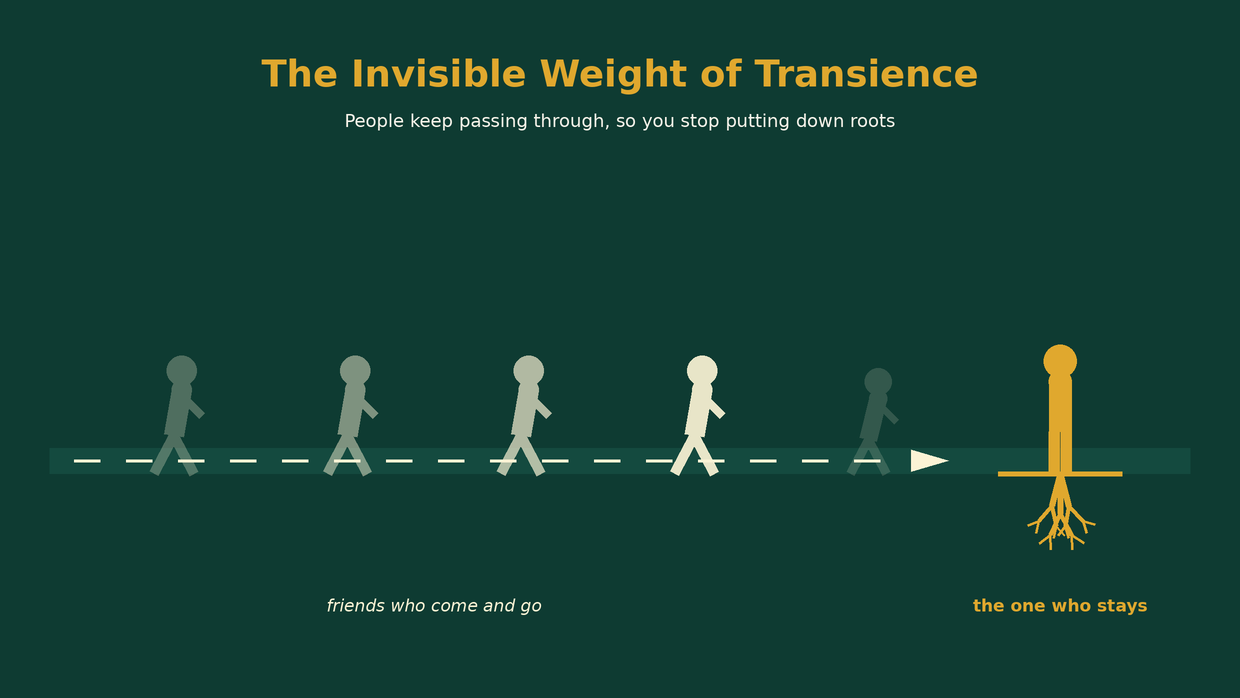
Transience, the constant coming and going of people in expat life, quietly undermines belonging by teaching you not to invest in relationships that feel temporary. When friends leave every year or two, the rational response is to hold back, and that self-protection, repeated over time, produces exactly the disconnection you were trying to avoid. Belonging requires roots, and transience keeps pulling them up.
This is one of the most underestimated causes of expat loneliness. In highly mobile communities, an unspoken math takes hold: why open up fully to someone whose contract ends in eighteen months? So people default to friendly but shallow connections, and everyone privately wonders why they feel unknown despite a full social calendar.
The way out is counterintuitive. You have to invest as if people are staying, knowing some will not.
- Name the pattern out loud. Tell a new friend, "I know expat friendships can feel temporary, but I'd like to actually build something here." Naming it disarms it.
- Anchor to at least one non-expat local. A local friend, neighbor, or community group is far less likely to leave, and gives your belonging somewhere stable to attach.
Can You Build a Bicultural Identity?
Yes. A bicultural identity is the psychologically healthiest resolution to an expat identity crisis, and research suggests it is associated with better wellbeing than clinging to one culture or rejecting both. Rather than choosing between "home me" and "abroad me," you integrate them into a single, larger self that can move fluently between two worlds and belong to both.
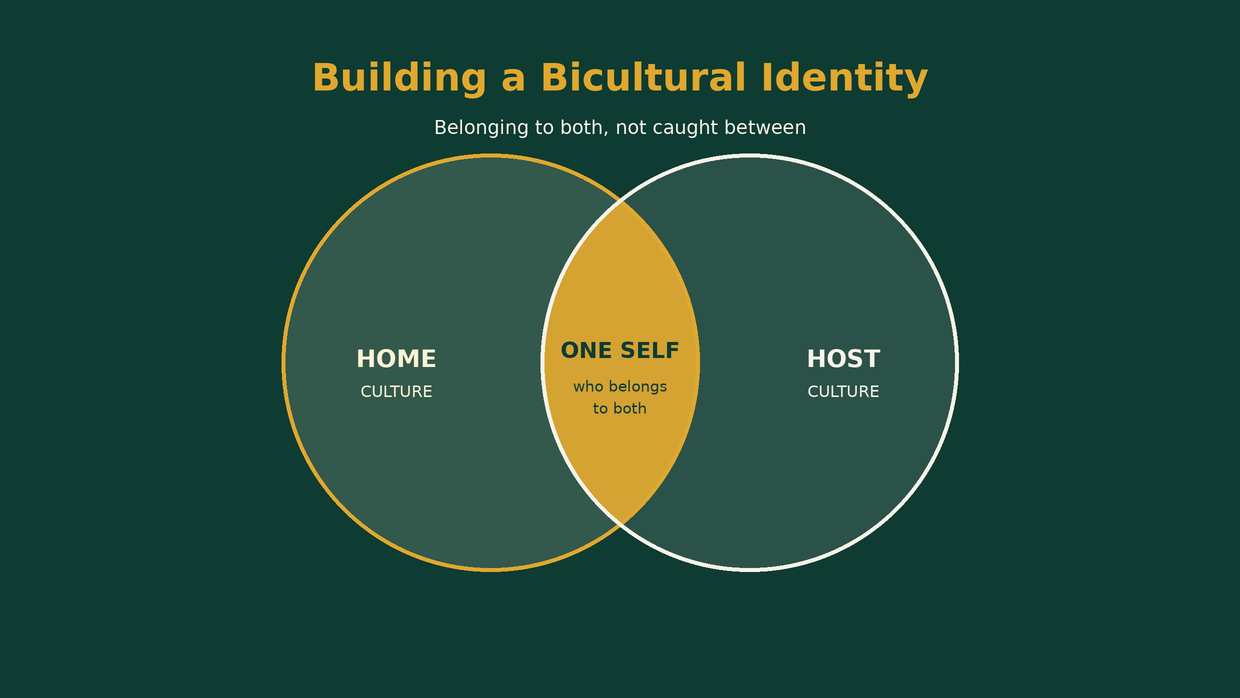
Studies in cross-cultural psychology, including work associated with researchers such as John Berry on acculturation, describe integration, keeping your heritage culture while genuinely engaging the new one, as the strategy most consistently linked to positive adjustment. The alternatives, assimilating completely or withdrawing into an expat bubble, tend to correlate with worse outcomes.
Building a bicultural identity is not a single decision but a slow reframe. It means letting go of the idea that you must pick a side, and starting to see your doubled perspective as a form of range rather than rootlessness.
A bicultural identity is not being half of two things. It is being fully both, and belonging to a category most people never get to join.
Social Integration Without Losing Yourself
Social integration is the process of building real relationships and a functional place within your host community without erasing your original cultural identity. Done well, it is not assimilation. It is adding a new layer of belonging on top of the one you already have, so that you gain a second home instead of trading in your first.
The fear underneath slow integration is often if I fit in here, I'll lose who I was. But integration and heritage are not a zero-sum trade. You can cook your grandmother's food and learn the local holidays. You can keep your first language for your inner life and build your public life in another.
Two concrete moves make integration real rather than theoretical:
- Convert weak ties into one strong tie. Pick one acquaintance you like and deliberately deepen it: suggest a specific plan, follow up, be the one who initiates twice in a row.
- Join something that repeats. A weekly class, a recurring volunteer shift, a sports team. Belonging is built by showing up to the same room enough times that you stop being the new person.
Sometimes the barrier to integration is not effort but a quiet expat impostor syndrome, the sense that you will never be "local enough" to truly belong. That feeling is common, and it is worth naming: you do not need permission or a passport to belong to a place you contribute to.
When Going Home No Longer Feels Like Home
Reverse culture shock is the disorienting experience of returning to your home country and finding that it, and you, have changed enough that it no longer feels like home. For many expats this is the moment the identity crisis becomes undeniable, because the one place that was supposed to feel safe now also feels foreign, confirming the fear of belonging nowhere.
Going home after years abroad rarely delivers the relief people expect. Friends have moved on, references have shifted, and the version of you that fit there no longer exists. Psychologists studying repatriation consistently find that coming home is often harder than leaving, precisely because it is unexpected. You brace for culture shock going out; nobody warns you about it coming back.
This is not a sign that you have lost your home. It is a sign that you now have two, and neither fits perfectly, which is the ordinary condition of a bicultural life. The grief is real, and it eases as you stop measuring both places against an old idea of "home" that no longer applies to who you have become.
How to Build Belonging Abroad
You build a sense of belonging abroad by combining consistent local roots, one or two deep relationships, and a reframe of your bicultural life as an asset rather than a loss. Belonging is not something you wait to feel; it is something you construct through repeated action, and most expats underestimate how much of it is within their control.
Here is a practical sequence that works:
- Root yourself in one physical place. Become a regular somewhere, a cafe, a market stall, a gym. Being recognized, even by a barista, is a small but real form of belonging that compounds.
- Build one deep friendship on purpose. Depth beats breadth. One person who knows your full story is worth twenty pleasant acquaintances.
- Mix expat and local circles. Expats understand your situation; locals root you in the place. You need both, and relying only on the expat bubble keeps belonging permanently temporary.
- Keep a living link to your heritage. Cook the food, speak the language, mark the holidays. A secure first identity makes it easier, not harder, to add a second.
- Reframe the doubled self as range. Start noticing the moments your two cultures make you more perceptive, more adaptable, more useful. That is not homelessness. That is a wider map.
For a fuller playbook on the relationship side of this, our guide to making friends abroad as an expat breaks down how to turn acquaintances into the deep ties that belonging depends on.
When Therapy Can Help
Therapy can help with an expat identity crisis when the feeling of belonging nowhere becomes persistent, interferes with daily life, or tips into ongoing loneliness, low mood, or anxiety. A psychologist who understands the expat experience can help you process the loss, rebuild a coherent sense of self, and move toward a bicultural identity, rather than treating your situation as a generic problem.
The difficulty many expats face is that a therapist from the host culture may not grasp what it means to be culturally homeless, and one back home may not understand the pull of the new life. This is precisely why cultural matching matters: being understood without translating your whole context first is, itself, a form of belonging.
Struggling with belonging and identity abroad? Expathy matches you with a licensed psychologist who is an expat too, in your native language and cultural background, in about 30 seconds. Find your therapist.
Frequently Asked Questions
What is an expat identity crisis?
An expat identity crisis is a period of uncertainty about who you are and where you belong, caused by living long-term in a culture different from the one that shaped you. It typically involves feeling disconnected from your home country while not yet feeling fully at home in your host country, and it is a normal, treatable response to life abroad.
Can living abroad cause an identity crisis?
Yes, living abroad can cause an identity crisis because identity is shaped by language, relationships, and cultural context, all of which change at once when you relocate. The loss of the familiar mirrors that confirmed who you were can leave you feeling unmoored. This is a recognized psychological experience, not a personal weakness.
Why do I no longer feel at home anywhere?
You may feel at home nowhere because you have partly detached from your home culture while not fully integrating into the host one, leaving you suspended between two worlds. This "in-between" state is a common and well-documented feature of long-term expat life, and it usually eases as you build a bicultural identity that lets you belong to both places at once.
Why do expats feel like outsiders even after several years?
Expats often feel like outsiders after years abroad because integration is slower than practical adjustment. You can master the language and logistics while still lacking the deep relationships and shared history that create belonging. The gap between how settled you look and how connected you feel is what produces the persistent outsider feeling.
How can expats build a sense of belonging abroad?
Expats build belonging by rooting themselves in a consistent local place, forming one or two deep friendships on purpose, mixing expat and local circles, and keeping a living link to their heritage. Belonging is constructed through repeated action rather than waited for, and most of it is within your control once you stop expecting it to arrive on its own.
Can you belong to two cultures at the same time?
Yes, you can belong to two cultures at once, and psychologists consider this bicultural identity the healthiest resolution to an expat identity crisis. Integration, keeping your heritage culture while genuinely engaging the new one, is consistently linked in acculturation research to better wellbeing than either assimilating completely or withdrawing into an expat bubble.
What is the difference between culture shock and an expat identity crisis?
Culture shock is the initial disorientation of adapting to a new environment and usually fades within months. An expat identity crisis tends to arrive later, once practical adjustment is done, and centers on the deeper question of who you are and where you belong. Culture shock is about the place; an identity crisis is about the self.
Can returning home make an identity crisis worse?
Yes, returning home can intensify an identity crisis through reverse culture shock. Many expats expect home to feel safe and instead find that it, and they, have changed enough that it feels foreign too. Discovering that neither country feels fully like home can confirm the fear of belonging nowhere, though this grief eases with time and support.
Is "expat dysphoria" a real condition?
"Expat dysphoria" is not a recognized clinical diagnosis. Some people informally use the phrase to describe the feeling of being culturally homeless or disconnected while living abroad. The underlying experience is real and worth taking seriously, but it is better understood as an identity and belonging difficulty than as a formal medical condition.
When should an expat seek help for identity and belonging problems?
An expat should seek professional help when the sense of not belonging becomes persistent, disrupts daily life, or develops into ongoing loneliness, low mood, or anxiety. A psychologist who understands the expat experience can help you process the loss and rebuild a coherent, bicultural sense of self. Seeking support early tends to make the adjustment shorter and less painful.
Need support? We're here.
Book a free 15-min consultation with our expat-specialized therapists.